Five Things: Wednesday 5th June

Daft. Not Punk.
So I ask Mark what he thinks of the new Daft Punk album and he says “Rubbish,” and I think 50 million people and all the broadsheet critics can’t be wrong. So I listen. I put it on Spotify when Summer arrives for a day and we have a barbecue. I play it when I’m walking around the house, or making tea. And guess what. Mark is right. Everyone else is wrong. And I love disco, and I love session musicians, but this is just… for instance, one track sounds like wonky, rubbish version of a Police song. The nadir is reached with  the Paul Williams tune, which sounds like a lame copy of something from Joss Whedon’s genius Buffy musical. It’s a cute idea to work with Williams (who wrote some of the Carpenters hits) but it just sounds… rubbish. So why is everyone so invested in saying it’s great. Is it because half of them seem to be creative partners in some promotional campaign (stand up, Pitchfork), or have got special access and an interview? The sell is clever, and it’s smart to get their collaborators to act as shills for them, but I’ll leave you with three words: Emperor’s New Clothes (or in this case, Motorbike Helmets).

Pink

The Blues, a film.
Sam Charters showed us this, his brilliant, little seen, 1962 film, as he was on his way to Scotland to spend time with Document Records remastering it. Shot as he and Ann Charters travelled through the South recording bluesmen who had had their moment in the sun in the 20s and 30s, it is 22 minutes of poetry and poverty. From a host of riveting performances, a favourite moment: Pink Anderson and his sweet-faced boy, Little Pink, playing Leadbelly’s Cottonfields. Hopefully the DVD will see the light of day later in the year.

Go Away You Bomb?
Bob Bomb
Hand-typed [as opposed to…?] lyrics to a Bob Dylan song which he never recorded are expected to sell for £35,000 when they go up for auction at Christies in London next month. Dylan’s lyric sheet for “Go Away You Bomb” will go under the hammer at Christie’s in London on June 26. Israel ‘Izzy’ Young: “I was compiling a book of songs against the atom bomb and asked Dylan to contribute; he gave me this song the very next day. I have never sold anything important to me until now and the funds raised will help to keep the Folklore Center in Stockholm going. I have always had a passion for folk music and I have collected books and music since I was a kid. I produced my first catalogue of folk books in 1955, comprised of books that nobody had ever heard of – this was the beginning of the interest in American folk music. Bob Dylan used to hang around the store and would look through every single book and listen to every single record I had. Since opening the Folklore center I have organised over 700 concerts with some of the biggest names in this music world. I’m a fun-loving Jewish boy who loves folk music and never gave up – that’s why I’m still alive.”

Cerys Matthews on Bob.
From The Guardian: “By 2008, her marriage was over and she was back in the UK. By now, she had a low-key solo career up and running, made an unexpected appearance on I’m a Celebrity… Get Me Out Of Here! and was starting to present shows on BBC 6 Music. A year later, she married her manager, Steve Abbott. The couple met when she recorded a duet with one of Abbott’s other clients, Aled Jones. “We just clicked. We had very similar taste in music, right down to the line between liking Bob Dylan and not really liking Tom Petty.” She smiles. “That kind of thing is important to me. I’m very opinionated about music. So is he.” Exactly right, Cerys! People always assume that you’ll like Tom Petty because you like Bob. And it’s just not true.

You Really Couldn’t Make This Up…
Cabin
The sisters Mamet [daughters of David, band name The Cabin Sisters] introduce their [in their own words] unique brand of folk via body percussion, banjo and harmonies. This will be their first music video. “This music video for Bleak Love is our chance to realize through the visual artistry of some very talented people the universal feeling of un-requited love. Your support for this project will be the backbone to a body of excited filmmakers, producers and musicians all making something from nothing. we have a wonderful concept from a bright young director that includes, beautiful gowns, statues, a large opulent loft space, extensive make-up, saturated tones needing anamorphic lens (for those technically inclined). We also have those folks who are good enough to work for free that we are trying to travel and feed. It is an expensive proposition when all is said and done, but we have a realistic budget that we know we can make work. So, please please join us in the fight against heartbreak!” Apart from the hazy punctuation and capitalisation, wtf? Listen to Zosia’s stumbling and half-assed reasons why you should back her in the begging video. Well-paid, well-connected actresses using Kickstarter for vanity projects? I’m betting that, for your $8,000, the director styled chair is not cutting it.

Five Things: Wednesday 29th May

Wayne Miller died last week
Wayne Miller was one of the less famous names at the legendary photo agency Magnum. When we were looking for a cover for our album in 1986, to be called South, we were determined not to have ourselves in the frame. Our first single had used a Weegee photo of a burning building, and we liked the anti-80s feel of black and white photography. In the mid-80s every cover seemed to have sharp pinks and hard yellows and glossy, overlit faces shining out.
Wayne
We were looking for a photo that summed up the feel of a record recorded partly in the Alabama heat of Muscle Shoals, and found it in the book that accompanied Ed Steichen’s famous Family of Man exhibition at the Museum of Modern Art in 1955. The photo we fell in love with was of a couple in a clinch. It was part of a series taken in 1949 of migrant workers – cotton pickers – in California. We thought that the intensity and intimacy was something to behold. There’s another wonderful image in this series of the same couple, the man sitting disconsolately on the bed, with the woman lazily fiddling with her nails. I’m still not sure how we convinced anyone to go with this approach, but we did. Of course, the record company could probably point to the cover having something to do with the paltry sales of the album… The type is cut out of some posters that we had printed by Tribune Showprint, of Earl Park, Indiana. You can read about the rather great Mr. Miller here. If you’re curious, more on our failed career here.

The Clash interviewed, The Guardian
Paul Simenon on musicianship: I’d become musically more capable. I could take off the notes that were painted on the neck of my guitar. But then I did make a mistake in being really confident: I went for one of those jazz basses that didn’t have frets… and when it goes really dark, and you can’t quite hear what you’re playing, it suddenly sounds like you’re drunk. So I said: “You know what? I think I’ll have the frets put back on.” I got a bit carried away. I thought I was getting quite good, but I got a big slap in the face.

…and on presentation: A lot of the looks were down to financial problems. Everyone in those days wore flares and had long hair. So if you went into secondhand stores, there’d be so many straight-legged trousers because everyone wanted flares. That instantly set you apart from everybody else. And also there was another place called Laurence Corner… Mick Jones: Selling army surplus…

I work along the road from where Laurence Corner was, and still fondly remember the green Army Jacket I bought there. Now there’s a chemist in its place, but they’ve put a nice plaque in the window…

Laurence

That Difficult Second Album
Sexual Healing, Pamela Stephenson Connolly’s sex therapy column in The Guardian: “My boyfriend talks too much during sex. We’ve been together for a year and recently he’s started talking to me while we’re intimate. At first it was everyday stuff like what he wants for dinner but then essentially he began ranting. Do you know how hard it is to climax while listening to someone talk about how many bands have produced “disappointing second albums”? I don’t know if I can go on like this.”

Rolling Stone’s Bob Dylan Special
No professional manicures for Bob…

bobmanicure

Stephen Collins’ strip, Guardian Weekend
Still, his wonderful anti-Mumfords bandwagon rolls on…

Scollins

Not room this week for Sam Amidon at Bush Hall, intriguing, strange and moving in equal measure. More next week…

Five Things: Wednesday 22nd May

RIP George Jones: A memory of the Wembley Country Festival, 1981
Simon and I loved the Killer, Jerry Lee Lewis, and were prepared to endure any amount of maudlin production-line Nashville filler to see him. However, the bill at the 1981 International Festival Of Country Music (© Mervyn Conn) at the Empire Pool was pretty good, and Carl Perkins’ set led into Jerry’s, the highlight of which was a staggeringly over-the-top rendition of “Somewhere Over The Rainbow”. The icing on the cake, however, was the towering (but pretty short, if memory serves me well) performance by the legendary George. I had inveigled a press pass and snuck into the VIP section, and found myself next to Elvis Costello, who was there to pay homage, I’m guessing. Two frames, a rather evil-eyed look from one of Elvis’s companions, and I concentrated on the stage. My favourite shot, though, is of Simon, resplendent in bootlace tie and Jim Reeves badge…

George

Michael Hann v Ginger Baker, Guardian video
I’m with Ginger on this. It’s not nearly as awkward as The Guardian claims, and Hann should have realized from question one that he needed to be a bit less rock writerly. The business of being a working musician is often about money, and survival, not art, so asking him questions like “Your time in Africa – it seems from the film to be very, very important to you, was that the time when you felt most musically fulfilled?” may not be the best starting point, especially as it implies that anything post that period was a let down…

Bowie Fan album, £650
Weirdest item in the Selfridges pop-up Bowie shop.

BowieFan

A Week of Gifts…
Lloyd gives me Imelda May’s plectrum: “Hubbard, my oldest friend from Hull, is mad about Imelda. He went to see her and after the gig got chatting and she gave it to him – it’s the one she used.”

Imelda

And Weston kindly gives me these cigarette cards of guitarists, part of a set issued by Polydor in the seventies. It reminds me that I need to download the Shuggie Otis outtakes that Richard Williams writes so well about here.

Cards

Ladies & Gentlemen, Henry Diltz
I’m introduced to Henry, legendary lensman of Laurel Canyon, whose iconic pictures of The Doors, Buffalo Springfield, The Eagles, Joni Mitchell and CSN&Y were the visual soundtrack to my adolescence. I ask him when he switched his focus from musician (he was a member of the Modern Folk Quartet, playing banjo) to photographer. He tells me that Steve Stills mentioned that the Springfield were going to do a gig at Redondo Beach, so he tagged along to take pictures for the slide show that he would do for his friends every weekend, showing pictures of L.A. itself and sometimes its musicians, who were often among those gathered in Henry’s house. The Springfield came outside from their sound check and he asked if they’d pose in front of a large mural. A magazine heard that he had some shots and paid him $100. Realising he could make this photography thing work he started taking more and more and, often with designer Gary Burden, photographed his friends album covers. I loved hearing about his time playing banjo for Phil Spector: Spector was interested in the nascent folk-rock scene and took The Modern Folk Quartet into the studio, where they recorded a Harry Nilsson song, “This Could be the Night”. Brian Wilson dropped by whilst they were recording it, in his pajamas and dressing gown, and sat there with the song on repeat, mesmerized. Spector, very paranoid about any song he released, afraid that it wouldn’t scale the heights of his previous successes, and would therefore damage his reputation, never put it out. But Henry did get to play banjo sitting next to Barney Kessel in the guitar section of the Wall Of Sound, on the Righteous Brothers “Ebb Tide” among others…

Henry introduces the film Legends Of The Canyon at the Mayfair Hotel, tiny Canon camera always at hand

Henry introduces the film Legends Of The Canyon at the Mayfair Hotel, tiny Canon camera always at hand

There’s a very good interview with Henry here, from rockcellarmagazine, that tells the stories in more detail.

Five Things: Wednesday 15th May

Bowie Walk

Bowie
Having helped the V&A with a photo of Dobell’s, they’re kind enough to send me this Jonathan Barnbrook-designed pamphlet, David Bowie Is Walking In Soho. The tour starts here.

Riders Of The Stars
FRANK SINATRA: One bottle each: Absolute, Jack Daniel’s, Chivas Regal, Courvoisier, Beefeater Gin, white wine, red wine. Twenty-four chilled jumbo shrimp, Life Savers, cough drops. No mixers?
BRITNEY SPEARS: Fish and chips, McDonald’s cheeseburgers without the buns, 100 prunes and figs, a framed photo of Princess Diana. Britney, as always, touched by genius!
AL GREEN: Twenty-four long-stem (dethorned) red roses. Having seen Rev. Green present these in the flesh to his adoring audience, I’m touched by the thoughtfulness.

Cat Power, Bathrooms & Bullies
On Woman’s Hour I catch Chan Marshall talking about the best places she found to sing as a teenager and she talks of school bathrooms when no-one was in them, singing to the walls and the echo – and when she’s on Later that night you can see how her voice now has those reflections and deflections built into it. With a haircut borrowed from Nick Lowe and her hands jerking in and out of her jean shirt, her performance of “Bully” was twitchy and vulnerable, but beautifully her – she doesn’t sound much like anybody else (the same is true of Laura Mvula, also on the show, who – making a nod to Nina Simone – is refreshingly different from her peer group).

Found on the website bestofneworleans.com while googling “who wrote Walkin’ to New Orleans.”
Well Composed: Bobby Charles tells how he wrote three of his classic songs.

Walking to New Orleans
“I had sent Fats a copy of ‘Before I Grow Too Old,’ and he had recorded it, but I didn’t know. The next night he was playing in Lafayette, and I went to see him play. He told me, ‘I cut your song last night – I wish I’d brought a copy of it for you to listen to.’ And he said, ‘You gotta come to New Orleans to see me and hang out with me.’ I said, ‘I’d love to, but right now I’m really on my butt and got no money and no way to get over there.’ He said, ‘Take a bus or something.’ I told him, ‘The only way I’d be able to get there would be to walk to New Orleans.’ As soon as I said that, I said, ‘I gotta go.’ I jumped in the car and wrote the song on the way back home from Lafayette to Abbeville.”
See You Later Alligator
“I used to say to the band or friends, ‘See you later, alligator.’ One night after a dance, I was walking out the door, and my piano player was sitting down in a back booth, and there were two drunk couples in the booths in front of him. I said, ‘See you later alligator’ to him as I was walking out, and it was one of those doors that closed real slow. I heard a girl say something about ‘crocodile.’ I walked back in and said, ‘I don’t mean to bother you, but I just told him, “See you later, alligator.” What did you say?’ She said, ‘After a while, crocodile.’ I said, ‘Thank you,’ and went home and wrote the song in 20 minutes. My daddy was screaming at me to turn out the lights, because he had to get up and go to work at 5 o’clock in the morning. I said, ‘Give me five more minutes.’ I had to sing it to myself over and over so I wouldn’t forget it.”
The Jealous Kind
“I was married at the time, and I was in the bathtub. My wife was fussing and hollering at me while I was taking a bath. I said, ‘Why don’t you bring me paper and a pencil and just leave me alone for 30 minutes.’ She said, ‘You and your damn paper and pencil.’ I wrote it right there in the bathtub. Same thing with ‘Before I Grow Too Old.’ She said, ‘You gonna be like this for the rest of your life?’ I said, ‘I’m gonna try and hurry up and do as much as I can before I get too old.’ Bam! Bring me a paper and pencil!”

I’m appalled that I’d never known that Bobby Charles wrote one of my all-time favourite songs.

And more from The Big Easy…
…in the shape of another Hugh Laurie documentary. He’s dry and funny, and has great taste in producers and musicians, and plays pretty good piano. I just never want to hear him sing again, if that can be arranged. Best bit: the amazing Jon Cleary, an Englishman in New Orleans, doing a staggering take on James Booker and Professor Longhair. He rips through a sonic wonderworld of rhumba rhythms and tumbling blues, then turns to Laurie and says, “New Orleans comes into fashion, goes out of fashion. They don’t stop playing here just because no-one’s looking.”

Professor Longhair’s House, 2010

Professor Longhair’s House, 2010

Longhair had my favourite band name ever: Professor Longhair and The Shuffling Hungarians [called that, as Wikepedia says, for reasons lost to time. As far as I can ascertain, there were no Hungarians in the band]. I do remember going with Mark to see James Booker at the 100 Club. As we came down the stairs to the basement room we heard the sound of a New Orleans band pounding out “Junco Partner”, the bass shaking the walls, what sounded like a horn section high-stepping the accents. We stepped through the door to find Booker alone at the piano, committing his mischief, conjuring up an orchestra’s worth of accompaniment with just two hands…

Five Things: Wednesday 8th May

Tony, Tony, Tony
Following on from the despair of a couple of weeks ago at depressing rock reads, this rebalanced everything: Eamonn Forde’s brilliant compression of Tony Blackburn’s hysterical and self-regarding autobiography, Poptastic. Here are two examples, the first about Gary Glitter. Read it and weep. With laughter.

TonyB

Elton John Documentary, BBC
elton_john_backbendI caught the last quarter of the Elton doc, which seemed to compress the past thirty years of his career into ten minutes and was struck by this: Why, if you’ve got an interview with Terry O’Neill, and he says, “Elton rang me up and said we’re doing a show at Dodger Stadium, it’s gonna be great, get over here and take some pictures,” do you not show any of Terry’s now-iconic shots, just some fairly run of the mill video?

Little Bulb’s Orpheus, Battersea Arts Centre
Amidst the wonderfully mad recreation of Hades and the beautifully evoked Parisian nightclub of this Django-ised retelling of the Orpheus myth, a truly stunning moment. Tom Penn, who plays The Drummer/Stage Hand/Dancing Bear/Too Many Parts To Mention, sits down and, as Persephone [the Queen of the Underworld] plucks the opening notes on a harp of a beautiful ballad, “La Chanson de Persephone,” written by the company. From his mouth issues a falsetto that is extraordinary – part Bon Iver, part Antony – and in a production filled to the brim with indelible music – “Minor Swing”, Saint-Saens, Debussy, Piaf’s “Hymne à l’amour” – brings the house down. A song you wanted to hear again the second it finished.

Littlebulb

“I analyse leaders for a living, and none are as great as Alex Ferguson”
Nick Robinson, the BBC’s political editor: As someone paid to observe and analyse leaders and potential leaders for a living, I never saw one to match Sir Alex. Like the impresario of a great opera company or the chief executive of a mighty corporation he succeeded so much and survived for so long because he understood people – how to motivate them, how to discipline them and how to inspire them. When this year Harvard Business School asked Fergie to share some of his secrets, he explained how as a young manager he studied and learned from leaders in other walks of life: “I had never been to a classical concert in my life. But I am watching this and thinking about the co-ordination and the teamwork – one starts and one stops, just fantastic. So I spoke to my players about the orchestra – how they are a perfect team.” He didn’t manage teams – he created them.

Tribeca Films Logo Screen
TriI’m not even sure what those pre-credit sequences that show the production company of the film are even called. Splashes? You know – the Lion of MGM, the Searchlight of Fox, the Calder Mobile thing for Pathe? Whatever, check out this little beauty from Tribeca Films at the head of this two minute preview for Greetings From Tim Buckley [you’ll need to search for Tim Buckley]. Using a lighthouse sweep, it’s just gorgeous.

Five Things: Wednesday 1st May

A Rainy Night In Bourges: Le Printemps De Bourges, Loire, France
The annual festival brings a platter of bands to almost every bar in town. Trying to decide where to go and who to see brings the following descriptions from the programme: Superhero Big Beat Surf/Pop Art Punk/Reggae Occitan/Black Death/House Celt Rock Experimental, and my favourite: Rock Noise Folk Blues. This poster in a nearby town would have had me putting money down for tickets, but it was in the past…

B1

Best music we saw was a cracking band called Minou, consisting of Pierre Simon & Sabine Quinet, plus a bald percussionist on electric pads. They play guitars and keyboards, both well, and their oeuvre is some unholy mixture of Kraftwerk, Nirvana and Talking Heads, put over with personality and pizazz and great timing. They were playing in a plastic garden tent, set up in the street, with a pop-up bar serving beer and lethal rum punch, and gave it their all – a welcome relief from the sub-Punk Rock being played in most bars, that the French seem, unaccountably, to be in love with.

Minou

Bob Gumpert Appalled By Ricin Suspect
Josh Marshall, TPM: “We had the first court appearance this morning for James Everett Dutschke. Unlike his predecessor, a flat claim of true innocence does not seem to be in the cards. More shocking, it’s now alleged Dutschke is a Wayne Newton impersonator.”

Bob says: “Perhaps only in Mississippi – the first guy arrested for poison letters was an Elvis impersonator. He was turned loose. The new person arrested is a Wayne Newton impersonator and that is just plain offensive.” To make it even worse for Bob, The Daily Mail reports that “the FBI searched his home, vehicles and former studio last week, after dropping charges against an Elvis impersonator who says he had feuded with Dutschke in the past.” Couldn’t make that up – feudin’ impersonators: Elvis vs Wayne…

The Thick Of It Writer Ian Martin’s 60 thoughts about turning 60, The Guardian
My favourites:
4. It was 1968. Early summer evening, a Saturday. My mate and I were hitching home in the Essex countryside. We got a lift from a happy couple in a boaty car that smelled of leather and engine oil. We were 15, they were proper old, 20-ish. Relaxed and so very much in love. They treated us as equals, laughed at our jokes, we smoked their cigarettes. “Walk Away Renee” by the Four Tops came on the radio. We all sang along to the chorus. I felt a blissful certainty that life as an adult might genuinely be a laugh. The entire encounter lasted no more than 10 minutes. I have thought about that couple every day since. Every day, for 45 years. Imagine that. A Belisha Beacon of kindness pulsing through the murk of a whole life.

58. “Nice snare sound.” Always say this to someone you like when they are playing you terrible music, especially if it’s their demo. This insincere but specific observation allows both parties to sidestep more general, and potentially cruel, discussion. If the person insists, they deserve everything they get, starting with “shit snare sound.”

Portrait Of The Artist, The Guardian: Madeleine Peyroux, Singer
What work of art would you most like to own? “I hate the idea of owning a work of art. But I do own a guitar that I consider a work of art. It’s a 1943 Martin 0-17. I took it on tour with me for 16 years, but I’ve just had to put it back in the closet. It was made in the United States during the second world war, when metal was rationed – there’s no metal in the neck, which means it’s constantly going out of tune.”

Edith Bowman’s 10 Best Songs Ever Written, Stylist Magazine
Marvin Gaye, What’s Going On: “To be honest, I don’t feel there’s a lot I can say about the song itself. Just listening to it says it all. It’s the perfect tonic. It brings out the sunshine. The horn section at the start of the song, coupled with the melodies, makes you want to groove from the first few bars. Instant smiles from the get-go.” Marvin would be pleased that his agonised plea for peace and understanding (opening lines Mother, mother, there’s too many of you crying/Brother, brother, brother, there’s far too many of you dying…) soundtracks Edith’s braindead summer picnics. And she actually says, about Joni Mitchell’s “The River,” “she sings it in a way that makes her feel totally accessible, the fragility in her voice encouraging you to sing along. This is probably quite a ‘girl’s choice’ to be honest…” In what world is choosing a song by one of the greatest songwriters ever to have graced pop music girly? There’s not a lot of fragility in Joni. Bare, naked honesty, yes. Fragility? I don’t think so. This is a woman who got totally pissed off when she played acetates of Court & Spark at a party after Dylan had played the acetates of Planet Waves, and having no-one listen. And knowing that it was a better record. The woman who Dylan whispered to, after they shared a bill together in the early 2000s, “Joni, you make me sound like a hillbilly in comparison.” Oh, Edith. Behave.

Five Things: Wednesday 22nd April

One Thing I’ll Miss Later This Week: The “Muscle Shoals” Film
PickI’m really looking forward to this documentary, but am not around to see it at the Sundance Festival in London this week. I wrote a reminiscence of the time that our band, Hot!House went there to record (find it here). Incidentally, the Rock’s Back Pages logo is the legendary Jimmy Johnson’s guitar pick (he lent us his car as well…)

I liked this review on imdb titled, The only puzzling thing about “Muscle Shoals” is how this story went so long without being told.
prettycleverfilmgal writes: “Have you ever heard of Muscle Shoals, Alabama? Let me rephrase the question – have you heard an Aretha Franklin song? Have you ever grooved to Wicked Wilson Pickett’s “Land Of 1000 Dances?” Have you ever thought, “Yes, Percy Sledge, that is exactly what happens when a man loves a woman!” Have you ever driven way too fast while the Rolling Stones’ “Brown Sugar” blasted through your speakers? If you answered yes to any of those questions, then you have heard of Muscle Shoals, Alabama, or at least you’ve heard the Muscle Shoals sound, the subject of the documentary Muscle Shoals from director Greg ‘Freddy’ Camalier. In the interest of full disclosure, these are my people ya’ll! I grew up just east of Muscle Shoals, also on the banks of the Tennessee River – “The Singing River” to the Native Americans who made their home there for millenia before Rick Hall founded FAME studios. Driven by a need to escape the crushing poverty and overwhelming tragedy that befalls him, Hall is the central figure in the story of the famed “Muscle Shoals Sound” – well, him and a group of homegrown, white-as-cotton studio musicians known as the “Swampers.” These men shaped what ultimately proved to be some of the finest rock, soul, and R&B America would ever produce.”

Thinking About Richie Havens
Introduced to him by Don Sollash, manager of Dobell’s Record shop (“I listened to jazz all day – the last thing I wanted to listen to at home was more jazz…”), I bought all of the late 60s-early 70s Havens’ LPs and loved them. I re-bought some of them last year on iTunes and gloried again to “I Started A Joke,” “This May Be The First Day,” “Handsome Johnny” and their like. Marcel called me up when they showed a Beatles At The BBC programme of cover versions, saying how great Richie’s awesomely strummed version of “Here Comes The Sun” was. His second guitarist and conga player have the damnedest time trying to keep up with him…  And this is lovely, from Richard Williams’ thebluemoment: “I interviewed Havens once, for the Melody Maker, and it gave me a good story to tell. It was at a hotel on Park Lane, in 1970 or 71. I went up to his room at the appointed time, knocked on the door, and was shown in. He greeted me with great warmth, and looked me straight in the eye. “Aquarius,” he declared. Er, sorry, I said, but no. Still that piercing look. “Sagittarius!” No, wrong again. “Capricorn!” Look, sorry about this, but… “Taurus!” You can guess the rest: he ran through the whole card before a process of elimination gave him the right answer. He didn’t appear at all embarrassed, and it certainly amused me. Then we got to talk. He seemed like one of the good guys.” I also like Havens’ story of walking on Hampstead Heath in 1974 and spotting Ray Charles from a distance, sitting on a park bench. “Suddenly I heard, “Hey, Richie. Get over here!” And it was Ray. He had extraordinary senses…”

Jackie DeShannon,“Put A Little Love In Your Heart” As Seen On TV (In A Cholesterol Spread Advert)
I heard this (probably DeShannon’s biggest hit, from 1969) on tv the night before her cover of Neil Young’s “Only Love Can Break Your Heart” pops up on my iPhone. Now most versions of this, even by good people, are dull and lugubrious. This one, in the hands of the estimable Jackie, is different. It starts straight, then an accordion enters and gets a Bacharach/Butch Cassidy feel going. It takes a left turn with the entrance of a pedal steel into a 5th Dimension/Bones Howe groove, and DeShannon pushes the vocal line away from the original, but in a good way. Oh, and it has an accordion. Did I mention that?

“I Bet Your Mama Was A Tent Show Queen”
Bob Gumpert sends a link to a fascinating piece by Carl Wilson (not the Beach Boy) on the Random House, Canada blog. It’s the strange story of, to quote the intro “a gay, cross-dressing, black singer named Jackie Shane, who scored a surprise radio hit in what was then staid and uptight Toronto.” His only surviving tv clip can be seen here, a compellingly diffident performance of Rufus Thomas’ “Walking The Dog”

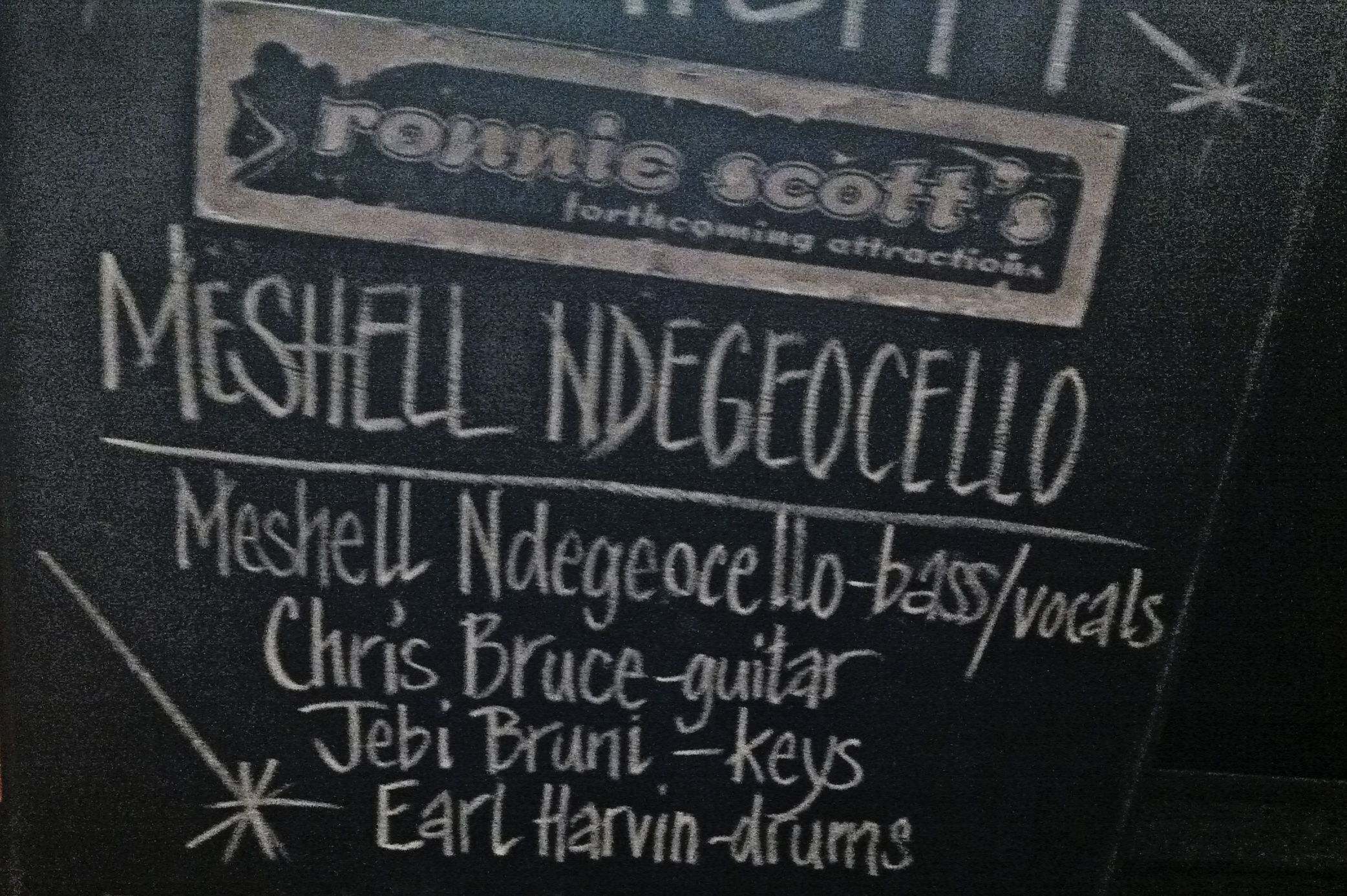
Meshell Ndegeocello: Ronnie Scott’s, Tuesday Night
The drummer, Earl Harvin, sits on the left, his kit pointing across the stage. His mallets are at the ready. Chris Bruce, the guitarist, playing a modded Tele Custom from the 70s, crouches at his pedalboard. Meshell Ndegeocello, her angular bass worn high, counts the song down. And, like setting out a manifesto, they start playing “Tomorrow Never Knows”…
Turn off your mind relax and float down stream
It is not dying, it is not dying
Lay down all thoughts, surrender to the void,
It is shining, it is shining.
Yet you may see the meaning of within
It is being, it is being
Love is all and love is everyone
It is knowing, it is knowing
and underneath it all creep the contorted keys of Jebin Bruni, wrenching decayed and tweaked noises from his banks of vintage organs and synths and laptop screens.

Meshell

There is, in her music, enough of the familiar to feel comforted. Often the songs are known – tonight derives mostly from her album in tribute to Nina Simone – but the constituent parts are roughly handled. They keep you on the edge of your seat: how far will they push before it all collapses? Great holes appear, to be suddenly filled by the rolling thunder of the drums or a shard of guitar or a sliver of keyboard or the clanging slap of Ndegeocello’s bass. It’s as if all the comforting sureties of the songs have been stripped away — but it’s music of beauty. It’s just that it’s not afraid to be ugly, too, like it wants to encompass the whole experience of life. It’s really hard to do it justice: my hastily scribbled notes in the darkness have phrases like ghostly martial doo-wop liberally sprinkled. But I’m making it sound doomy and it wasn’t at all. There’s such joy in hearing these musicians play. The metal freak-out that ends “Feeling Good,” the girls at the bar providing the backing vocals for “See Line Woman,” the stunning bass solo that brings a double-time “Suzanne” to an end – this is all wonderful, wonderful stuff. A version of “Pink Moon” in honour of London, and the stark and short “Oysters” are the icing on the cake. If she plays your town, go.

Five Things: Wednesday 17th April

Words Fail, pt. 73
From the Evening Standard: The soundtrack to David and Samantha Cameron’s marriage is an album of Depression-era US folk music, the PM’s wife has disclosed. Time (The Revelator) is a 2001 collection of austere narratives by Nashville singer Gillian Welch. Peter Mensch, manager of rock stars such as Metallica and husband of ex-Tory MP Louise, discussed the Camerons’ tastes at a Tory function. “I asked Samantha Cameron, ‘Why Gillian Welch?’,” said Mensch, who manages the singer and invited the couple to her Hammersmith concert in 2011. “She said, ‘There was a record store  in Notting Hill where David and I used to live. I would say to the guy with the purple mohawk: “What should I be listening to?” He sold me Time (The Revelator). For the past 10 years David and I listened to it all the time’ .”

Lana Del Rey, Chelsea Hotel No 2
Nicely simple and atmospheric version of a song its author has often felt uneasy about. I’m not even sure anyone but Leonard Cohen should sing this, but the solemn and melancholy tune is a draw to a certain type of singer. I think my favourite version is actually Meshell Ndegeocello’s, where she creates such a slowed-down, sultry arrangement that it seems that she’s only singing the song for one person to hear, not an audience. I don’t think it’ll be on the setlist next week at Ronnie Scott’s.

From Our Woodstock Correspondent
The road from RT 28 to W’stock, formerly rt. 375, will be officially re-named Levon Helm Highway. Meanwhile, all Robbie has named after him is the house next door, and that’s not even official. (But a couple has moved in and are done a nice job renovating…) as ever, john c

What I Say
Yeah Yeah Yeah’s notice, posted on the doors of Webster Hall, New YorkYeah

Killing Them Softly
The soundscape of this beautifully shot film based on George V Higgins’ fine book, Cogan’s Trade, and recently released on DVD, is fantastic. It’s worth watching just for that, from the opening credits of crunching footsteps underneath a voiceover of Obama on the election trail. The election is a presence throughout the film, playing on TVs in bar and on car radios. From the creak of car seats, the roar of throaty engines and the rain on the windshield, to the clangs of echoing hallways, real care is taken. Music supervisor is Rachel Fox, piano pieces and musical ambiences by Marc Streitenfeld. Take a bow.

5 Things Extra: Dobell’s Exhibition

Unknown man outside shop, possibly Pete Martin’s wife Joyce behind him.

Unknown man outside shop, possibly Pete Martin’s wife Joyce behind him.

DobellsThe Dobell’s exhibition at my old alma mater, Chelsea School of Art (now relocated in the shadow of Tate Britain and renamed university of the arts london chelsea) was a Proustian rush – who knew that the Museum Of London had collected parts of the original shop when the Tower Street branch finally closed in 1992? The ‘drum’ sign, the record bags, the cover artworks, most of all an original record rack built by my dad – filled in a picture of what it was like to be there, at a time when record shops were part-business, part-clubhouse, and part-preacher’s pulpit. I met two of my old bosses, Les and Gerry, caught up with Leon Parker – whose hard work had made the exhibition happen – and ended up between Donald Smith (the curator) and Jona (“You’ll Always Find Me In The Kitchen At Parties”) Lewie as they both reminisced about Anthony Newley and sang snatches of his songs back and forth, which seemed a strangely appropriate end to the evening.

Richard Williams was there too, and writes here about the story of Dobell’s in a typically astute post on his blog, thebluemoment.com.

Here are some photos – mostly taken by my dad, Bill – of life in the shop in Brighton, with a picture of the more famous London shops at the end.

“Has ‘Trad’ Jazz Had It? Special Investigation.” Those were the days… Don Sollash, my mum Betty and me, and my cousin Ray, Brighton Shop, 1957

“Has ‘Trad’ Jazz Had It? Special Investigation.” Those were the days…
Don Sollash, my mum Betty and me, and my cousin Ray, Brighton Shop, 1957

Early window display. Poor opinion of Elvis Presley expressed.

Early window display. Poor opinion of Elvis Presley expressed.

Early record browsing seals habit of lifetime.

Early record browsing seals habit of lifetime.

Ron & Mina Bowden and Bill look on as Brownie McGhee and Sonny Terry (cut off) play in the shop.

Ron & Mina Bowden and Bill look on as Brownie McGhee and Sonny Terry (cut off) play in the shop.

Charing Cross Road, Jan 1966, Kodachrome Slide

Charing Cross Road, Jan 1966, Kodachrome Slide

Five Things: Wednesday 10th April

Willy Moon, I Wanna Be Your Man
Short. Stylish. Funky. Great guitar. His new album is 28 minutes long. That’s the way to do it.

Buying Cords from Eric Clapton
Well, not actually from Eric. Going to the wonderful Cordings on Piccadilly to peruse the trousers only to discover that EC liked the shop so much, he bought it. Shops that you feel will be forbidding and aloof usually turn out to be the opposite. Davidoffs’ cigar store on Jermyn Street and uber liquor-emporium Hedonism in Mayfair spring to mind—great, knowledgeable staff and no pressure…

The Art of Listening to Records
I listened to two great stereo systems this week, Alex’s and George’s. The same day we’d been in Cordings Alex put, by total coincidence, Eric Clapton’s “The Core” from Slowhand on his Technics deck… After listening to George’s – driven by a Garrard deck set in concrete – it seemed like Taj Mahal and the Pointer Sisters were actually in the room as we listened to “Sweet Home Chicago,” a great performance which I had forgotten all about. I always appreciate amazing stereos when I hear them, and am in awe of the lengths people go to – steam cleaning records, adding AC/DC converters, setting decks in concrete and the like. (see below for George’s response!)

George

Part of George’s extraordinary stereo

Then I saw this on London Jazz Collector’s blog: “I read something recently on the subject of record and hi-fi reviews which struck a chord. It was this. No-one really knows what anyone else hears. Thinking about it, it’s true. I only really know what I hear, and sometimes I’m not even sure of that. Sometimes I am only remembering what I thought about what I heard, which is not the same thing. I am remembering an opinion, not a sound. Every now and then I put on a record I haven’t played for a while, but remember thinking at the time was one of the best pressings I had ever heard, only to find it rather ordinary. It hasn’t changed, I have. Or the system has. Or something I am not aware of has. Worse, I recently upgraded a copy of a record I can remember really liking. Only to find, on playing, I no longer like it at all…”

Actually, worse is my admission that my favourite place of all to listen to music is one that any self-respecting audiophile absolutely scorns: the car.

Spring arrives, time for Calypso
As if to prove my point, no sooner has the sun come out (after what seems like an eternity) when “Lorraine” by Explainer bursts into life on the iPhone as I’m driving around town. Truly, one of the great intros: a bouncing bass, a chattering guitar, tss-tss hi-hat and The Explainer shouting: “Taxi! Taxi! Airport Kennedy!” And it sounds fantastic in the car…

Rock ’n’ Roll. Phew!
My friend Pal Hansen had this to say about photographing people whose work you know: “Sometimes you get that commission to photograph someone whose work you admire and whom you think is genuinely interesting. Many times, you walk away disappointed and with a distaste for whatever you did admire them for in the first place.”* It’s a little like that with most rock biographies, I find. And, my God, books written by musicians are seriously depressing, no? I’ve barely recovered from the ghastly sleazefest that was Warren Zevon’s I’ll Sleep When I’m Dead when I pick up Dallas Taylor’s Prisoner of Woodstock. Taylor, Crosby Stills, Nash & Young’s drummer in the late sixties, is a favourite of mine, but this terrible tale of abuse, insecurity, drugs, surgery and ego was almost too awful to read.

* Pal then went on to say: “However, once in a while, someone who comes across as truly talented and nice is actually just that.  One of my favourite actors, Forest Whitaker, is as nice as they come.”

From George
Just to set the record straight, so to speak, my turntable is a 50-year-old Garrard 301 from the days of British precision engineering. It is set into a plinth made of layers of lead sheet and MDF bolted together. The whole is supported on a slate slab which in turn is floated on 2 layers of air-filled BMX inner tubes for complete isolation from vibration. (The turntable in the Dobell’s exhibition was also a Garrard but made 25 years later when the company had been sold to new owners who took it downmarket).

The converter you refer to is a DAC (Digital to Analogue Converter) which is usually incorporated into CD players. Digital players only produce a series of  signals which are either “on” or “off”, expressed as 1 or 0. They produce these at very high speeds, and the DAC decodes them and turns them into waveforms which amplifiers understand. At these ultra high speeds accuracy can be a problem. The more accurate the decoding, the better the music will sound. Mine is built for much higher levels of accurate conversion than are usually available from mass-market CD players.

AC/DC conversion is converting the current from the mains (in the UK 230V AC) to the voltages and type of electricity that will power audio circuits (typically DC, like from a battery, and in valve equipment circuits ranging from 3V DC to 500V DC).