Five Things: Wednesday 14th August

Nice Promo For The Blind Boys Of Alabama
Their new album, produced by Justin Vernon (Bon Iver) sounds pretty good from the clips. Listen out for Shara Worden singing “I’ll Find A Way”, written by Motown guitarist Ted Lucas (no, me neither) that in the short clip sounds just great. Vernon has taste in female singers – his cover of Bonnie Raitt’s “I Can’t Make You Love Me” testifies to that – and I’ll give him the benefit on his hyperbole about Worden. There’s a touching moment where Shara plays the finished item for Ted’s widow and rushes for the tissue box.

True Say, Will!
“Sometimes a band arrives and becomes extremely popular without good reason. Who are the million people who bought the debut album by White Lies, the trio from Ealing in West London? And who are the ever-growing hordes piling into arenas to hear their polished but unremarkable pop-rock? What do they hear in White Lies that can’t be heard from any number of Eighties-influenced bands, or indeed on albums by actual bands from the Eighties? Perhaps the answer is in White Lies’ ability to make euphoric, reverb-drenched, large-scale music that hints at dark edges but doesn’t actually have any, thereby making the listener feel they might be exploring hidden depths without running the risk of being exposed to anything challenging or depressing… and lyrics that suggest something meaningful without containing too many specifics that might alienate potential listeners.” Will Hodginson, The Times.

Urban Proms, BBC/Coolio’s Cash
The Urban Proms was pretty good musically, although most of what I saw cleaved to the Coolio template of “Gansta’s Paradise”, namely hip hop/rap/grime/whatevs with, er, a string section. But the between-songs links were crucifyingly embarrassing. I Name and Shame: Sarah-Jane Crawford (BBC Radio 3) and Charlie Sloth (BBC Radio 1Xtra). Unbelievably bad, with Sloth a kind of lightweight, unfunny James Corden. I know. Imagine that. By the way, if you want to profit from “Gansta’s Paradise” go to the Royalty Exchange where $140,000 will get you a cut of Coolio’s copyrights. I seem to remember this idea not panning out so well for David Bowie’s investors a while back.

Karen Black, RIP
I’ll always treasure her Rayette in Five Easy Pieces, loving Tammy Wynette with all her heart. First seen as a late teen in a Stockholm Cinema in the afternoon, told by friends that it couldn’t be missed, and they were dead-on. Even now ”Stand By Your Man” gets me, with its strangely off-beat army of acoustic guitars punching home the chorus. Ryan Gilbey, in his Guardian obit, wrote well:

“These parts were strikingly different from one another, but they had in common Black’s knack for conveying her characters’ rich and troubled inner lives, their cramped or thwarted dreams. The consummate example could be found in her Oscar-nominated performance as Rayette, the Tammy Wynette-loving girlfriend to Nicholson’s discontented antihero Bobby Dupea, in Five Easy Pieces. There was a comical but achingly sad intellectual gap between the two. Bobby resented her. Crucially, the audience never did. “I dig Rayette, she’s not dumb, she’s just not into thinking,” said Black in 1970. “I didn’t have to know anybody like her to play her. I mean, I’m like her, in ways. Rayette enjoys things as she sees them, she doesn’t have to add significances. She can just love the dog, love the cat. See? There are many things she does not know, but that’s cool; she doesn’t intrude on anybody else’s trip. And she’s going to survive.”

Southcliffe
Wonderfully nuanced use of sound in this slightly pointless mass-murderer tale. The amped up folk band in the nightime town square are all bass and a tiny bit of vocals, Otis and James Carr on the car stereo sound exactly right, the metal band in a bar is as muffled and chaotic as it would be in life. Bass thrash, guitar blur, gruff vox. The Pretenders’ “Brass In Pocket” in the pub makes you remember what a great and unusual song that is.

“Got brass in pocket
Got bottle, I’m gonna use it
Intention, I feel inventive
Gonna make you, make you, make you notice

Got motion, restrained emotion
Been driving, Detroit leaning
No reason, just seems so pleasing,
Gonna make you, make you, make you notice”

Extra: Deke’s Car. Sunday. Definition of Rock (abilly) ’n’ Roll

Belair

Five Things: Wednesday 7th August

Selfridges Shoe Department
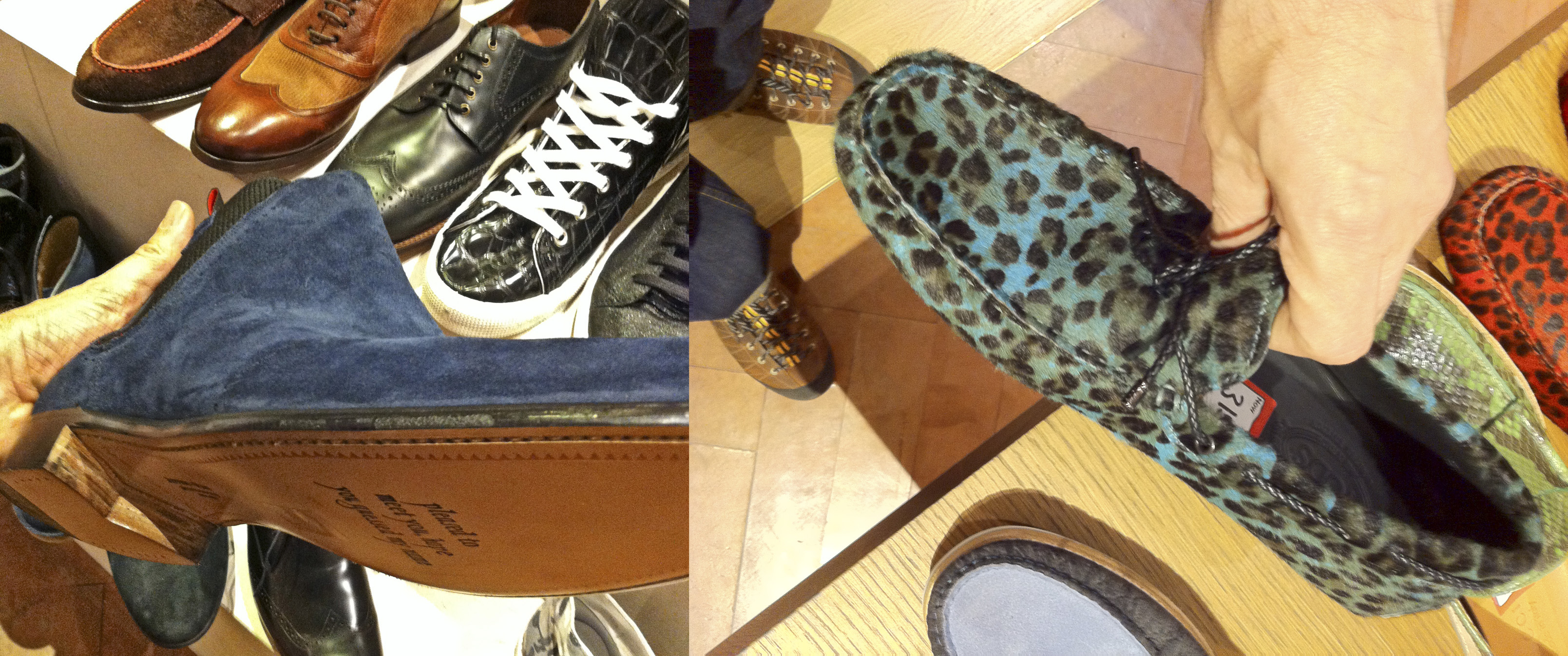
Blue suede shoes by Jeffery West, with the deathly “Please allow me to introduce myself…” line that we can’t seem to avoid, engraved on the sole. And don’t you step on my blue leopardskin shoes, either. {fyi: Both remained unbought.}

Blue SuedeFavourite Song Of The Summer (so far)
Lana Del Rey has covered Nancy Sinatra and Lee Hazlewood’s 1967 track ‘Summer Wine’, (“Strawberries, cherries and an angel’s kiss in spring/My summer wine is really made from all these things”) with, appropriately, her boyfriend – Barrie-James O’Neill of Scottish rockers Kassidy – stepping into Lee Hazlewood’s cowboy boots. It’s bass-heavy and groovy, with gloriously woozy backing vox. It ends with a distant peal of thunder, a snatch of Billie Holiday, some chattering and some beachside noises. In a great piece of iPhone synchronicity it merges into the start of Kevin Ayers “Song From The Bottom Of A Well” with its treated guitars and booming noises (sounding exactly like the song’s title) static-ing between the speakers like some early version of Scott Walker’s Drift.

Underneath Putney Bridge, Sunday

FormbyUkelele practising/busking.
We do a quick duet on
”I’ll See You In My Dreams,”
the Isham Jones/Gus Kahn
tune from 1924 that
Joe Brown played to close
the George Harrison tribute
concert in 2002.


Missive from Tim, RE: The Alleycat
”Just to let you know the Iko’s New Orleans Music Shop at the Alleycat is fab. The excellent house band played tunes by Champion Jack Dupree, Professor Longhair,  Jelly Roll Morton, the Band (”Ophelia“) and more. The jam session that followed was of an amazingly high standard and the vibe was all-inclusive, everyone from twentysomethings to pensioners, dreads to suits. I had to drag myself away at midnight to catch the tube, though apparently they carry on to 2am…“ From the venue website: The Alleycat sits just beneath the fabled Regent Sound Studios which was set up at 4 Denmark Street in 1963. With the Rolling Stones recording their first album here, The Kinks recording ”You Really Got Me”, Black Sabbath recording “Paranoid” as well as many other seminal moments of music history, the studio took off as the place to be seen to be making music.

Late Afternoon, Tottenham Court Road
Have Mercy

Taxi advertising my friend MJ Paranzino’s choir, quite possibly a first in choral advertising, swiftly followed by a roller-derby flash mob gyrating to “Disco Inferno”, blasting from a tricycle with giant speakers. We once worked with the co-writer of DI, Ron “Have Mercy” Kersey, cutting a version of Willie Nelson’s “Crazy” in LA. Ron was fabulously louche, feet on the control board as he lazily played the bassline on a synthesiser, gassing and joking with his engineer, the wonderfully named Hill Swimmer. My memories of the session are of Mark playing the most beautiful Reggie Young-like parallel fourths to the general amazement of the studio gatherees, and Ron asking where the hell he’d learned to play like that, and if he was available for sessions. And of sitting against the wall of the recording room as Alex Brown (Ron’s partner and genius vocal arranger/songwriter for the likes of Anita Baker and Whitney) and her girls sang the backing vocals. What on the record sounds sweet and swooping was delivered to the microphones at an ear-bending volume and hair-raising power. Heather and I stepped back into the control room, emotional and speechless. Ron then had an acetate cut and took us to his local bar, where he would play stuff he was working on to the patrons, for feedback! I can see him there, sipping a gin and tonic through a thin black straw, laughing, enjoying their bemused reaction.

Five Things: Wednesday 31st July

Everyday I Have The Blues…
Or everyday that Richard posts, anyway. And in a good way. Not to be bossy or anything, but you really should all be following thebluemoment, for the way Richard Williams illuminates popular (and some other kinds of) music with a lucidity that shines out of the computer screen. This week, one of the things that propelled him to the keys was Frances Ha. “It’s not often I want to get up and dance in the aisles of a cinema, but that’s how I felt halfway through Noah Baumbach’s Frances Ha the other night, when David Bowie’s “Modern Love” erupted out of the speakers. I’ve never been keen on Bowie (although I admire the stuff from his Berlin period), but “Modern Love” is one of those tracks — like Boffalongo’s “Dancing in the Moonlight”, Danny Wilson’s “Mary’s Prayer” or the New Radicals’ “You Get What You Give” — that automatically quicken the heartbeat and turn the world’s colours up a shade. It doesn’t matter who it’s by. Listen without prejudice, as someone once suggested.”

Last Night I Had A Dream…
…in which Bill Nighy suggests I listen to the music of GT Moore and the Reggae Guitars. Strange.

Neil, hung
NeilHanging Henry Diltz’s beautiful photo of NY at Balboa Stadium in 1969 (bought at a strikingly strange auction after a showing of Legends Of The Canyon), I put iTunes on a random Neil Young playlist and it threw up something I had never heard (let alone knowingly owned). It’s from the Citizen Kane Junior Blues bootleg recorded at the Bottom Line in New York in May, 1974. Young was there to see Ry Cooder – and was so inspired that, when Ry had finished, he got up on the stage and played for an hour. Most of the material was unknown to the audience, being from the as-yet unreleased On The Beach. “Greensleeves was my heart of gold” sings Neil, before talking amusingly about depressing folksingers… Hear it in the music player to your right.

Now That’s a Record Cover
H HawesFrom London Jazz Collector’s blog, the moody Hampton Hawes, caught in a great sepia mood. And look at its recording venue: Live at the Police Academy, Chavez Ravine, June 28, 1955, Los Angeles, CA. In related news; if you can, look up a copy of Ry Cooder’s Chavez Ravine, a concept album which tells the story of the Mexican-American community demolished in the 1950s in order to build public housing, which, this being LA, was never built. Eventually the Brooklyn Dodgers built a stadium on the site as part of their move to Los Angeles. Fantastic music, especially good on hot summer days, with fine guest vocalists and astonishing percussion.

Best. Busker. Ever.
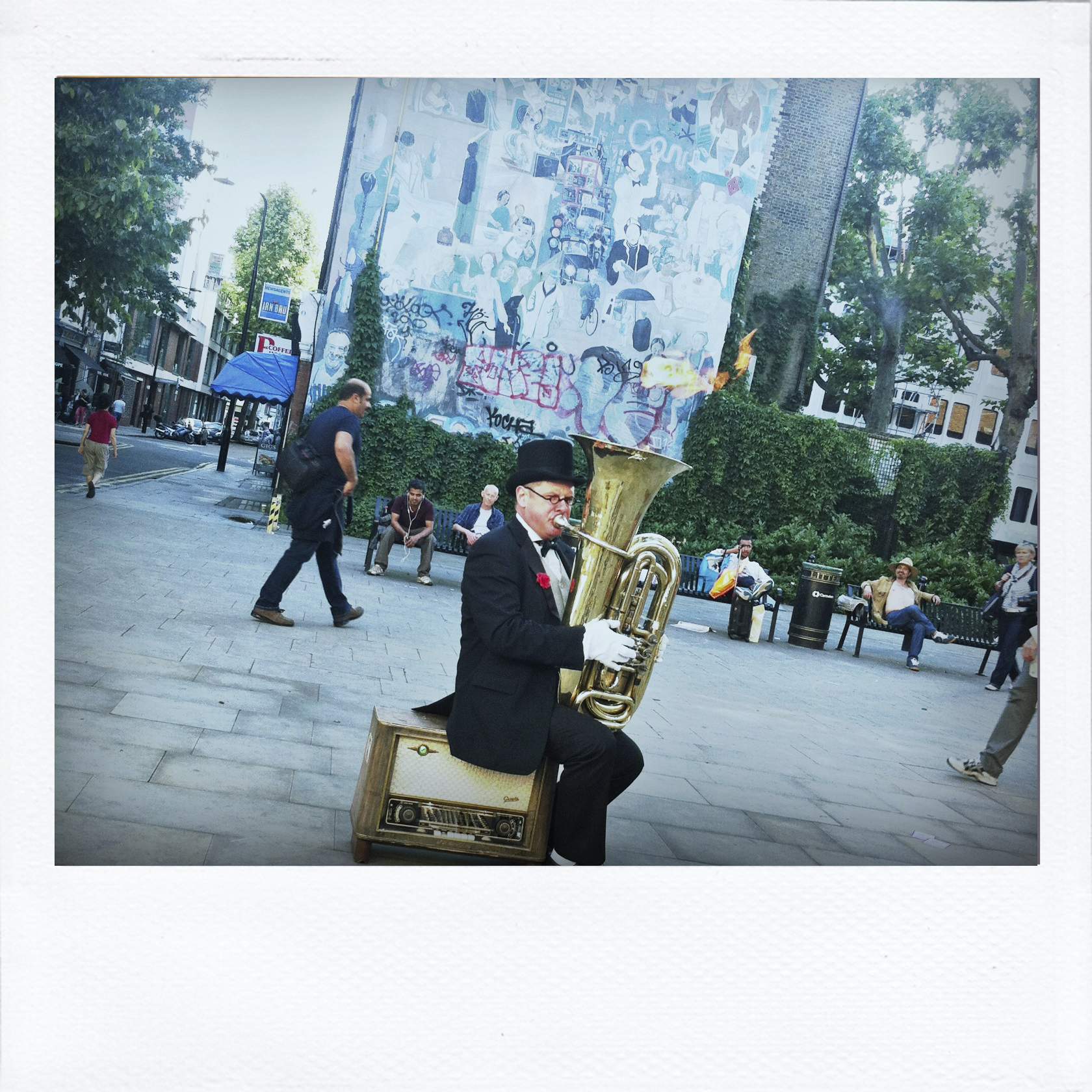
Donovan (“Sunny Goodge Street”) meets Arthur Brown (“Fire”)  at twilight by the American Church.

Tubafire

One Thing: Wednesday 24th July

Consumed by moving house, saying goodbye to the loft, some nostalgia…
so only this pic this week, of the loft wall, if you’ll indulge me. Normal service resumed next week.

Loft

Out Of Left Field
Ken at the 51; Skiffle Group – Ken, Alexis, Lonnie, Chris, Bill; a ticket for the Rock Island Line; Bill’s old mucker, stride great Ralph Sutton; Ken with Sister Rosetta, photographed by Terry Cryer; on the beach at Malibu and on Jimmy Johnson’s car, Muscle Shoals; Bob Mitchum and Jane Greer still from Out Of The Past.

Stuck In The Middle
MLK glasses , watch and radio; Bob in studio, 1965, by Daniel Kramer; Sonny Terry & Brownie McGhee, signed to Bill; Buddy Guy & Junior Wells, 1970; Wayne Miller photo of couple, as used on Hot House cover; George Lewis applauds, by Terry Cryer; my photo of Joni Mitchell watching Neil Young at Mariposa Folk Fest, Toronto, 1972, 100 Club matches, Armstrong and Django memorabilia.

Right In Time
Mr Cohen by Mr Antonio Olmos; Muscle Shoals sign; Mark at the Wurli in the studio in the Shoals; Bill in Hamburg, 1955; Motor racing at Crystal Palace, early 60s; reprint of Monterey Pop poster.

Five Things: Wednesday 17th July

Oh, Yeezus…
​You know when pop stars ​used to re-record their latest hits in the language of another market – say, Germany or France – before the world was totally consumed by the language of Amerenglish pop? Bowie did it, Dusty did it. I wish we could bring it back, and Kanye West would re-record Yeezus in a language I don’t understand. Then I’d be happier when I listened to it. Because the words on Yeezus are f***ing unlistenable. As if written by a seriously misogynistic asshole with self-aggrandisement issues. You wouldn’t want to be his wife. And it’s a drag, because the music, the beats, the soundscape, the whatever… is utterly, utterly, utterly great. Just out-of-the-park brilliant. Here’s Laughing Lou Reed on the talkhouse: “The guy really, really, really is talented. He’s… trying to raise the bar. No one’s near doing what he’s doing, it’s not even on the same planet. If you like sound, listen to what he’s giving you. Majestic and inspiring”. Lou also had an issue with the words and talks interestingly about that – it’s worth checking the full review out).

Oh, and $120 will buy you this Kanye West white T-Shirt. Dazzling.

Kanye

And The Hits Just Keep On Comin’
Bob Dylan, The Bootleg Series, Vol. 10 – Another Self Portrait (1969-1971) is set to cover some interesting, if maligned, years. The complete IOW performance from August 31, 1969, a personal favourite (even in really bad audience-taped quality) with Dylan and the Band alternating a sweet, woody country sound with ragged roadhouse rip ’em ups. Also some great New Morning alternate versions (a piano-based “Went To See The Gypsy” and “Sign On The Window” with a string section should be particularly good if real bootlegs from the past are anything to go by). And finally, some cleaned up/stripped down Self Portrait tracks accompanied (amusingly) by liner notes courtesy of Greil Marcus, writer of the famous SP review in Rolling Stone with the deathly opening line, “What is this shit?”.

May need to start a Ken Colyer Corner in Five Things
Two more letters about The Stones, The Guardian:
• Messrs Gilbert and Blundell, prepare to eat dirt (Letters, 6 July). I saw the Stones at the Ken Colyer Jazz Club (It was actually called Studio 51, but was generally known as Ken’s Club) in Leicester Square in June 1963. “Come On” was slowly climbing the charts. It was the first date I ever went on. I was 16. The cellar venue was stifling with condensation and we drew CND signs in it on the low ceiling. The Stones looked like cavemen and sang every great rock number, including “Poison Ivy”, “Johnny B Goode” and “Route 66”. My date and I caught the last train back – the 12:42 from Victoria to Bromley South. When we arrived at Shortlands Station, my father was on the platform to meet us. “Just checking,” he said and walked off. My boyfriend lasted less than 50 days, but the Stones – well, you all know the rest. Susan Castles, Wem, Shropshire
• How about 1962 in the small cellar Studio 51, Great Newport Street, W1? Chatting with all of them every Sunday at the bar during the break. Two sessions, 4pm and 6pm. Signed pre-first record release photo to prove it, with a note from Bill on the back apologising for no news of first “disc”. Anybody else who was there? Gerry Montague, Berkhamsted, Hertfordshire

FYI: The Beatles visited the Rolling Stones on September 10th, 1963 as they rehearsed at the 51. They presented them with a new, unfinished song, “I Wanna Be Your Man”. On  hearing that the Stones liked the song, John and Paul went into Ken’s office and completed it, thus giving the Stones their first hit with a new song rather than a cover.

The Americans awakens a long-buried love for post-Peter Green Mac
The 80s-tastic Russian/US spy series features a cracking soundtrack from my least-liked decade. “Tusk” by Fleetwood Mac in episode 1 sends me to the remastered album – as recommended, months ago, by Tom at work. It’s amazingly odd for a mainstream Californian rock record (and amazingly good, though I didn’t listen in 1979) and nothing’s stranger than “Tusk” itself, with the tribal percussion, the mumbling/chanting and the most eccentric drum rolls in pop’s history.

Bob Gumpert sends me this, An Alan Lomax Gallery…with this sensational contact sheet. This is Stavin Chain playing guitar, Lafayette, Louisiana, 1934. The movement in that top triptych is just stunning. More here.

Lomax

Five Things: Wednesday 10th July

Robert Christgau on the Louis Armstrong House Museum, msn.com
“Armstrong never made the money he should have – Glaser kept most of it. But he could have afforded a far grander place, and that he chose not to says something telling about a genius who never aspired to rise above a common station except in the notes he played. Within the limits he laid out for himself, however, Armstrong didn’t stint. Reading about the mirrored bathroom, gold-plated toilet fixtures, cheetah-print stair carpet, and aquamarine everything, you may fear the house is pretentious or embarrassing, but it’s not at all, at least not to someone who grew up in Queens when Armstrong lived there. On the contrary, it’s an object lesson in limited luxury. With its careful period authenticity – even the air conditioners are very 1970, although their guts have been replaced – the museum is a vivid reminder of how much more acquisitive, pretentious, and would-be hip wealth has become since the days of the affluent society.”

This reminded me of something that Rupert Everett, the actor, said in an interview to coincide with the release of his second book, the brittle and fascinating vanished years. “If you look at books of Hollywood homes in the 70s, it’s just amazing how humble they are; they’re like little beach shanty houses with bric-a-brac furniture. Now the smallest fucking brainless Hollywood producer lives in an Earth Wind & Fire Egyptian Palace. It’s just… become so tasteless, I suppose.”

Starry-eyed an’ laughing
I swear I don’t try to shoehorn Bob into every post, but visiting Mayfair’s (and, quite possibly, the World’s) greatest wine store, Hedonism, the record on the deck (they have a ridiculously high-end system, somewhat matching the drink selection) is Another Side Of… and track four, side one plays as I wander around, window shopping. Later, around the corner, I pass this plaque on the wall of the building that used to be home to The Robert Stigwood Organisation…

BeeGees

Two letters about The Stones, The Guardian
• In 1963 or 1964* I went to Ken Colyer’s jazz club with other members of High Wycombe YCND. A note on the door said that the usual Dixieland wouldn’t be playing: instead, “a young rhythm and blues band, the Rolling Stones”. Not impressed, we spent the evening in the pub.
Jo Russell, Stoke-on-Trent
• I remember seeing the Stones about 1964 at the Empress Ballroom in Wigan (Later to become the Wigan Casino, home of Northern Soul). During their performance, Jagger threw his sweaty shirt into the audience. I and another girl caught it. She ended up with one sleeve and I won the rest of it. I stored it carefully in one of my drawers at home, where my mother found it and, seeing it was damaged, tore it up and used it for dusters.
Marie Blundell, Wigan

* I think it may have been ’62, but certainly not ’64…

Busker, Euston Station
The summer heat brings an unusual sight and sound: a black guy, possibly blind, Bizet’s Carmen blasted through an amp hanging from his neck, playing the top line (tone courtesy of Paul Butterfield) on a crunchily amplified harmonica. Orchestral Harp vs Blues Harp. No contest.

Rickie Lee Jones, On My Playlist, Metro. Eloquent.
• “On The Road Again” Canned Heat
Alan “Blind Owl” Wilson, the harmonica player, plays so lyrically, I often quip and hoot to myself as I listen.
• “Linden Arden Stole The Highlights” Van Morrison
The lyric on this is so wild. Van is a master. This is timeless, uplifting and healing, and is a transporter to some other realm.*
• “John Barleycorn Must Die” Traffic
This song was very influential: the sound of the recording, the sweet voices and the English accents were all very interesting to me when I was 16.
• “Into White” Cat Stevens
Like Van, Cat seemed to be familiar to me, as if his musical language emanated from a home I shared.
• “Voodoo Chile” Jimi Hendrix
This is live and crazy good. Avoid the new remastering – it’s like a graffiti artist smudging the Mona Lisa. The original mixes were perfect. Delicate, loud, sexy and otherworldly. And Jimi’s rather silly-sounding voice is not silly at all. as told to Zena Alkayat

* Helped along by a stunning piece of fretless bass playing by David Hayes.

EXTRA: Yasiin Bay (Mos Def as was) undergoing Guantánamo Bay force-feeding procedure.
Watch it and weep.

Five Things: Wednesday 3rd July

River Island go for the Newport ’64 look

Dylan Jeans

Kenny Rogers, questioned by Alexis Petridis in The Guardian
I found an old newspaper story online about you beginning a parallel career in professional tennis in the late 70s.  What was that all about? I’m kind of an impulsive obsessive, I don’t know if there’s a category like that. I get impulsively involved in something and I get obsessed with it. I did that with tennis. I didn’t start playing until I was 35 years old, and then I got obsessed with it and I played eight hours a day. I played in professional matches. I had a national ranking. I was one spot above Björn Borg in doubles.
You’re joking!* No! That’s just my nature. Then I couldn’t physically play tennis any more, so I took up photography. I studied for four years under a guy who’d been Ansel Adams’ assistant … [describes photographer Adams’ “zone system” codification of the principles of sensitometry in mind-boggling depth].
*He’s not.

Busker, Northern line to Old Street
As he tried to pick up a Polish girl (“Sorry, love, thought you said Portuguese…”) he starts playing “Three Little Birds”, all Glasto peace & love, but failing to feel any enthusiasm from a listless tube carriage, takes a weird right turn into “Blue Suede Shoes” – One for the money/Two for the show…

The Stones & The Times
The Evening Standard writes: The biggest fan of Mick Jagger still seems to be The Times newspaper. In 1967, its then editor William Rees-Mogg wrote in defence of Jagger after he was given three months in jail for possession of amphetamines, under the headline Who Breaks a Butterfly on a Wheel? This weekend, prior to the Stones’ Glastonbury set, The Times returned to Jagger who had confessed that he might have liked being a teacher rather than a rocker. “The newly qualified teacher Mr Jagger was quickly taken off religious studies after he expressed sympathy for the devil,” began its leader. “His biology lessons were not much better, strangely dominated as they were by wild horses, little red roosters and the spider and the fly. Chemistry lessons were a disaster after Mr Jagger baffled the pupils with his insistence that jumping jack flash was a gas, gas, gas. He also showed a dangerous tendency to play with fire, which contravened the school’s health and safety regulations.” What have the Times leader writers been taking?

“A man of wealth and taste.” First part correct, not sure about second.

Ronnie Wood painting of Mick Jagger and hand-lettered guitar (words from “Sympathy For The Devil”)

Ronnie Wood painting of Mick Jagger and hand-lettered guitar (words from “Sympathy For The Devil”)

Favourite Letter Of The Week
“Marie Paterson bemoans the coverage of classical as opposed to pop music (Letters, 1 July) but at least “pop” music is performed by the composers, whereas classical music, with some exceptions, is usually performed by a tribute band, often known as an orchestra.”
Derek Middlemiss, Newark, Nottinghamshire, in The Guardian

Five Things: Wednesday 26th June

L. Ron Mellotron
On a walking tour of Fitzrovia, a whole host of music references, from the squat where Boy George and Jon Moss wrote “Do You Really Want To Hurt Me?” to the mansion flat that Robert Nesta Marley lived in for a year in 1972. Bob’s flat was in the rectangular block of streets between Tottenham Court Road and Gower Street, which is technically Fitzrovia, but in a no-man’s-land between it and Bloomsbury, known as the Gower Peninsular. We proceed to the original location of Cranks, first organic cafe in London, where Johnny Rotten and Sid Vicious worked – washing up – for a short time. My favourite moment comes as we pass a large grand house on Fitzroy Street, and someone says, That’s where L Ron Hubbard lived. And I overhear a man talking to his partner, saying I was down in East Grinstead for work and we passed Saint Hill Manor [Scientology’s national headquarters, a huge brick temple with visitor’s centre] and we were given a tour by a slightly scary woman, and I got to play L Ron Hubbard’s mellotron. I ask him what he played, as the mellotron songbook is not huge. Strawberry Fields Forever, he says.

I loved this photo…

Smith
…of jazz guitarist Johnny Smith, playing in a Tucson music store in the late 1970s. It ran with the New York Times obit. It’s partly for the faded Kodachrome, partly for the light, partly for the clothes, partly for the wonderful selection of guitars. A lovely quote stood out: “He accomplished everything he ever wanted,” his daughter, Kim Smith Stewart, said. “He played with the best musicians in the world, he went deep sea fishing in the Gulf of Mexico, he was a great father.”

Jazz 625 from the early 60s, George Lewis with Acker Bilk’s band, The Marquee
At the end of the song, Humphrey Lyttleton says “Every great jazz musician has one number that is his one-way ticket to immortality, and that surely is George Lewis’s – Burgundy Street Blues. Simon emails: “It may have been the extra-widescreen TV I was watching on, but George Lewis, in the 625 film, had the longest ET-like fingers, specially designed for the clarinet – I’m still reeling…” George’s performance is lovely, swooping and poised, and as he and the band finish, Acker says Yeah… softly and clasps him on the arm.

More Jazz
Reviewing Jazz. New York in the Roaring Twenties by Robert Nippoldt, Hans-Jürgen Schaal, for Eye magazine, my favourite brace of spreads are these, featuring the waveforms of the 20 songs from the enclosed CD, along with a timing graph. Only “Rhapsody In Blue”, commissioned by Paul Whiteman from George Gershwin, is over 3 minutes 20 seconds, and continues by itself onto the second spread.

Jazz

Illustrator Greg Clarke put this lovely illustration on his blog

facial hair drop shadow

Five Things: Wednesday 19th June

I hear about Mavis Staples’ new album…
Due June 25 on Anti, One True Vine is described as “stark, acoustic arrangements and the most honest, unvarnished vocal performances of her career”. Featuring 10 tracks, including new songs written by producer Jeff Tweedy and Nick Lowe along with covers ranging from Funkadelic to Low. Recorded at The Loft, Wilco’s studio in Chicago, the album features Jeff Tweedy on nearly every instrument except drums, which were played by his 17-year-old son Spencer.

I rescue Son and Seb from Download…
… having had the car key stolen. They are at the edge of a massive event that stretches for miles, but considering that it only finished the night before, the clean-up and dismantling that’s taken place is majorly impressive.

Donington

I love the soundtrack …
by Mogwai for eerie French drama, The Returned. Its crepuscular, Lynchian feel is given extra heft by the almost constant musical backdrop, sometimes a spindly xx-y kind of guitar track, sometimes a curdled piano and spooky xylophone. I came across this interview with Fabrice Gobert, who wrote and directed the series, and Dominic Aitchison, from Mogwai.

FABRICE GOBERT  Six months before filming, we were casting the actors and I thought it was very important to cast the music for the series, as it would be a main character in the drama. I love what Mogwai do in general, but especially the film about Zinedine Zidane [Mogwai wrote the soundtrack for Zidane: A 21st Century Portrait]. It was a strange movie and the music was spectacular. When I was writing the scripts I was listening to that music a lot. I thought it would be strange to imagine that a band like Mogwai would agree to work on a French drama, but we tried it. We sent them three or four pages, where I tried to explain why I’d like to work with them. And they were interested. I don’t know why.

I talked to them about a Swedish film, Let the Right One In, a film with vampires rather than zombies, but it was very realistic, and a good influence for what we wanted to do. We don’t want to make The Walking Dead; we wanted to make a French fantasy drama where dead people come back. I gave them some photographs from Gregory Crewdson, an American who photographs the American suburbs and makes the spectator feel very uncomfortable with something very familiar and very strange. And I gave them music from films that I like. The sort of thing musicians make with movies when they are free, such as Neil Young for Dead Man, and Miles Davis for Louis Malle’s Elevator to the Gallows.

DOMINIC AITCHISON  We received the basic synopsis, plus a list of films and books that might influence the tone of the programme. We’ve always wanted to do more soundtracks. The Zidane film was the only chance we’d really had to do something like that. It was great fun and quite different from writing a normal record – you have to try not to have obvious effects that would really ramp up the tension. You have to keep it really simple, and try to keep the dynamics quite flat; not having it jump up, and not having the big scares.

I send a video…
Land
To the This Land Is Your Land Project, an interactive PBS documentary that plans to record us all (or as many who upload their version) singing Woody Guthrie’s “This Land Is Your Land.” I dug out a version [the first song we recorded in Garageband six years ago, as a test] and made a stills-based short to go with it. The title still is a photo taken of Coit Tower in San Francisco, on one of Bob Gumpert’s excellent tours.

I finally take the plunge…
This week, after four years prevarication, I finally take the plunge and order one of these…

Bruce

Yes, it’s an Ampeg Scroll bass, as played by one of my heroes, Rick Danko. First seen on the Rock Of Ages sleeve in 1972, I have wanted one ever since. I met a jazz bassist once with one, and I saw a picture of Brian Eno playing one Enothat I clipped out of the Guardian years ago (see left), but four years ago I found that Bruce Johnson – a retired Disney Thrill Ride engineer – had set up shop and was loving recreating (while considerably improving) Ampeg basses. Every piece of the body and neck, virtually every part of the hardware, made by hand, on turn of the century lathes that Bruce has overhauled. On holiday in LA we made a midnight visit to Bruce’s workshop in Burbank, and spent a fascinating hour with him and his dog. More anon on how the bass takes shape. Here’s Rick (a man who, in Ralph J Gleason’s wonderful line, “looked as if he could swing Coit Tower”, so muscular was his playing, so lurching his stage movements) with his fretless at Brooklyn’s Academy Of Music, New Year’s Eve, 1971 with “Don’t Do It”. And again, in an soon-to-be-released extended version of the great Festival Express, playing “Jemima Surrender”. Dig Levon’s rhythm guitar work on an Gibson SG, which makes a mockery of the “bring over my Fender” line.

Five Things: Wednesday 12th June

Otis Black
Talking about the Otis Redding documentary last week, Hugh told us: “I was in the art class at Dunfermline High when I heard that Otis had died. My fellow Mods and I gathered together at lunchtime to discuss the sad news and it was agreed that we would all wear black ties the next day. So I borrowed (or nicked) my dad’s funeral tie and duly turned up at school – to find that I was the only one who had remembered or, to be more accurate, bothered – Mods could be a fickle bunch, with a bit more style than substance.”

Four-Hour Flight Of The Eagle
Possibly too long, not enough peyote, or grumpiness with CS&N, too much “how we got back together after sacking everyone…” But an awesome level of ability and professionalism, some great singing and guitar slinging, the right amount of indebtedness to Jackson, JD Souther and – most especially – Linda Ronstadt,  and a fair sampling of the treasurable Joe Walsh, a true one-off. My favourite moment is when Glenn Frey is talking about how being on the road so much makes you go a little crazy and the camera pans across to Joe, wearing (of course) a fly’s head made of aluminium foil, and he nods. But the silver foil head is lovingly crafted. It has antennae and a proboscis, and the longer he nods the funnier it becomes. Richard Williams recently told me to listen to “Tell The World About You” from Walsh’s Barnstorm. You are advised to track it down post-haste. It’s a truly gorgeous meld of Southern Soul and Southern California.

Marnie Stern, Here’s Imelda’s Plectrum
Talking of one-offs, after Marnie’s blistering screamfest of an opening number, Marcel turns to me and says, “Well, at least she’s not copying anyone”. Cartoon-voiced, foul-mouthed, with two burly men on bass and drums, she thrashes out one short sharp song after another, filled with firecracker guitar and lots of shouting. It’s exhilarating. The melodies are jagged and the riffs punchy – like a slightly more benign thrash metal. Marnie looks like Cameron Diaz playing the role of AC/DC’s Angus Young. The person I’ve seen recently with the same quality of intensity and humour is Este Haim, the bassist with Haim, whose gurning and whirling are a sight to see. At one point Marnie’s bassist shoots a film of the audience clapping and cheering to prove, Marnie says, “that people love me,” as her mother is convinced they don’t…

Just before the last song she drops her plectrum and can’t find it. I’m kind of stunned she doesn’t have a gaggle of picks taped to her mike – this must be a regular occurrence. I remember I have Imelda May’s pick in my jeans [why? see here] and proffer it to Marnie, getting a warm clap on the back from a fellow audience member. The show goes on to climax in a number where the drummer gets ever louder and faster, the bassist is all over the frets and Marnie is spinning and playing a raucous off-kilter riff. It combines John Bonham with Philip Glass, and, oh I don’t know… Yngwie Malmsteen? Whatever, its pummeling intensity for six minutes gives the next minute a blissful sense of headiness, as if you’d been holding your breath and suddenly let go. Marcel gets a CD signed. Thanks for the pick!!! It was great heartxo.

MarnieRocks

Calling Bill Hicks
I’m always at a loss why already rich people are shills for the likes of watch and perfume companies, but I guess jazz musicians don’t take home the money that film stars do. So the appearance, only a few pages apart, of two advertisements featuring Wynton Marsalis in the new edition of American Esquire, shouldn’t surprise me. Mind you, it pales in comparison to this: Jermaine Jackson says, “Being involved in the hospitality business is a dream I shared with my brother Michael, and Jermajesty Hotels and Resorts is named after my son [that’s right. His son is called Jermajesty]. I am absolutely delighted to have GoConnect joining us in this emotional journey. Rarely is there an opportunity for an upscale hospitality business to be able to capitalize on the success of a global entertainment brand. With the establishment of Jermajesty Holdings, that opportunity has now finally arrived.”

fullmontage images

Sophie Heawood On The Digitising Of Music, The Guardian
Over the past few years I have got rid of all my CDs, all my records, all my tapes. I even wiped my hard drive, leaving nothing on my iTunes. I used to live for music, and spend most nights of the week at gigs or in nightclubs. As a music journalist, I used to have so much sent to me that you could barely get into the spare room… The digital age was starting to offer freedom from all this clutter, so when my career changed, and I moved house a couple of times in rapid succession, I decided it had to go. I would be free! I would stream music from the internet as the mood took me! Just like William Blake said, I wouldn’t bind myself to a joy, I would kiss the joy as it flew.

(It is possible that the musicians who slog for two years to write the songs for an album, book studios to record them, sound engineers to mix them, people to design the album sleeve and print them, weren’t madly keen on my streaming it online while they were remunerated with a 25p cut of the streaming company’s advertising revenue, along with a couple of woodpigeons and a soap-on-a-rope as a goodwill gesture. I have a sneaking feeling they would have preferred to pay their landlord and sound engineer in cold hard cash.)

Still, they needn’t have worried, as I have ended up only listening to Rihanna. On Spotify. They haven’t even got all the albums. I don’t even think they’ve got the ones I like. But I can’t remember which ones I like any more. As Kelly Oxford writes in her new memoir, Everything Is Perfect When You’re a Liar: “I don’t think I’m going to die soon, but I finally feel like I’m growing old. Like, I know there’s a Lil Wayne and a T-Pain, but somehow I thought they were the same person. You can be sure you’re getting older when your finger isn’t on the pulse of pop culture but you’re sure it is.”

It prompted this nice letter the next day: “I was pleased to read that Sophie Heawood (G2, 5 June) has rediscovered the pleasure of listening to good music on a decent stereo. As Alex said in A Clockwork Orange: “What you got back home little sister, to play your fuzzy warbles on? I bet you got little save pitiful, portable picnic players. Come with uncle and hear all proper! Hear angel trumpets and devil trombones. You are invited.” Ralph Jones