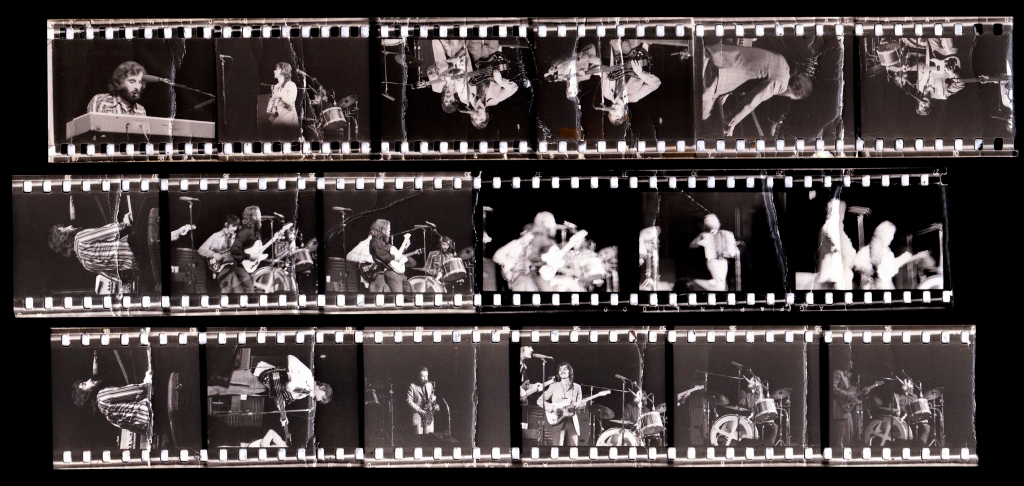
{ONE} RONNIE HAWKINS, THE LAST WALTZ | “COME ON ROBBIE, LET’S TAKE A LITTLE WALK…”
Robbie still has to count Ronnie in … but the sound of his newly-bronzed Stratocaster summons up the rowdy rockabilly that Ronnie Hawkins traded in. “I didn’t know whether it would be a bad idea, but I decided to have the Stratocaster bronzed. It was a bit tricky, you know, finding somebody to do that. One of the road manager guys said, There’s a place where they bronze baby shoes. He did some research, took it, brought it back, and it was bronze. I thought, Wow — it does look beautiful. They put it all back together again. I played it, and it sounded unlike any guitar I had ever played. Then, when I stood up and put on the strap, I realised it weighed more.
I tried it out in the rehearsals for the Last Waltz and it started to feel right to me, and I was quite drawn to the tonality of it. There was a little bit more… it was just a sharper tone, with more metal involved. It grabbed right onto the notes, making them sting, in a way, and have a nice sustain to it as well…” Well, there’s a whole life on the rockabilly road in Ronnie’s performance, topped with his glorious scream, and Robbie becomes eighteen again, the six-days-on-the road, “blowing down the backroads headin’ south” boy, taking lessons from Fred Carter Jr. and Roy Buchanan and trying to be the loudest, flashiest guitar player on the circuit.
{TWO} BOB DYLAN’S HOTEL ROOM, GLASGOW | “I CAN’T LEAVE HER BEHIND…”
Robbie Robertson jamming with Bob Dylan at the Station Hotel, Glasgow, on a day off between concerts, 18th May 1966. One of Dylan’s song sketches from a time when he’d try out melodies, often having an almost medieval feel, with dummy or half-formed words (most famously on “I’m Not There” on the Basement recordings the next year). How good would this have sounded on Blonde On Blonde?
“I’m not getting the bridge,” says Robbie, as he tries to read Bob’s mind… “That’s it, that’s it”, says Bob. Towards the end, as the song coalesces, hear how Robertson became one of the great structural guitarists of the pop age, learning how to play behind singers, how to structure the textures, the hills and valleys of songs, and when to drop in sweet grace notes, or play a fill that knits two parts together.
{THREE} OLD, OLD WOODSTOCK | “KING HARVEST (HAS SURELY COME)”
Everyone’s seen this performance, shot in what is now John and Jan Cuneo’s house, but was Robbie’s studio back then. Maybe no songwriter outside of Fleetwood Mac has written so many songs directed at their bandmates as Robbie Robertson has — “Stage Fright”, “Where Do We Go From Here?” Forbidden Fruit,” but here, as the second album is finished and all is well in the Band world, this film shows their characters and connection beautifully.
Barney Hoskyns, in his excellent book on The Band, Across The Great Divide, wrote: “Corn in the fields / Listen to the rice when the wind blows ‘cross the water / King Harvest has surely come…” It was the first of three marvellous images that Levon intoned as prefaces to Richard’s verses — just part of the song’s intricate structure, which involved several time changes and suspensions. “The chord progression was a little bit complex”, says Robbie. ‘There’s a sifty feeling we were trying to get, which was subtle and bold at the same time.’ Just as ‘sifty’ were the sounds the band attained for each instrument. With John Simon playing an electric piano through the same black box Robbie had used on “Tears Of Rage,” Garth’s Lowrey shimmered away in the background, and Robbie made tiny Telecaster incisions off to one side. “This was the new way of dealing with the guitar,” Robbie says. “Leaving out a lot of stuff and just waiting till the last second and then playing the thing in just the nick of time. It was an approach to playing where it’s so delicate, the opposite of the “in your face” playing that I used to do.” After the final verse, Robbie played a solo so intense it was frightening. “It’s like you have to hold your breath while playing these kinds of solos,” he says. “You can’t breathe, or you’ll throw yourself off.”
“Tempo sounds slow, John”, Levon drawls to their producer, John Simon, at the end. Sounds perfect to me.
{FOUR} I SAW IT AT THE MOVIES | “WONDERFUL REMARK”
A Van Morrison song and performance from the soundtrack of Scorsese’s The King of Comedy, produced by Robertson.
Robbie’s tremolo’d guitar comes in halfway through the song, playing along with Richard Tee’s glorious piano and then re-appears shuddering, swooping and stinging, taking out the song as Van moans, “I sighed a million sighs / I told a million lies / to myself / To myself / Baby, to myself…” It’s some of the most “Robbie” playing on record.
{FIVE} DOWN SOUTH IN NEW ORLEANS | “SECRETS OF STORYVILLE”
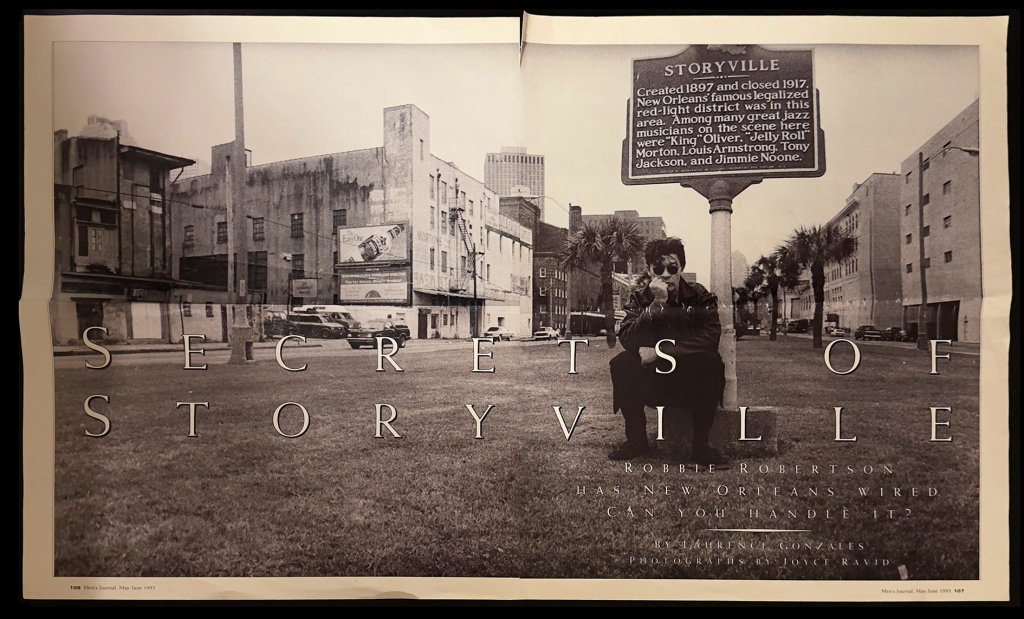
“Tipitina’s at 1:00 a.m. A sound so loud it seemed to suck the air out of your lungs. George Porter Jr., formerly of the Meters, also a sideman on Robbie Robertson’s album Storyville, was playing up there beneath a giant picture of Professor Longhair, playing funky stuff with four horns under smoke that swirled in cones of colored light. Nervous people, wall to wall, danced to the nervous licks from a bottleneck guitar. A man in a donkey mask danced for a moment in an orange light and then was swallowed by the primordial, protoplasmic crowd. A miasma of smoke and sweat rose to the faint lights. A soprano saxophone wailed old Coltrane, set to rhythm & blues.
We were trying to hide in the shadows beside the stage “to avoid any foolish thing that might happen,” as Robbie had put it. But the band began what Robbie called “this ferocious funk thing,” and then Porter went up to the microphone and looked over in our direction, saying with a sly smile: “Robbie? You wanna get some of this?” It was such a cool way of putting it. It was practically irresistible on its own. But then it was Nick Wechsler, Robbie’s manager, who did it. He had gotten up behind Robbie, and he was pushing him like a tugboat, pushing, pushing through the crowd, and there was nowhere else to go. Robbie later told me: “The appeal of it was that it was just this unknown ferocious funk that evolved. When I went up there, I didn’t know what they were playing.”
When Robbie pushed past Paula and me to get to the stage, we didn’t know what he was doing. Robbie rarely sat in, but there he was, climbing the stage, and the guitar player handed him the instrument as the crowd erupted with sustained Indian cries. It was as if a dam had burst, and sound flowed out, transforming itself into “Iko Iko,” the national anthem of New Orleans funk. Paula and I were absorbed into the crowd, and then we were dancing, Dominique was dancing, and the notes from Robbie’s guitar were unfurling like bolts of coloured fabric tossed into the wind.” — From a great Laurence Gonzales article, “Secrets of Storyville”, Men’s Journal, 1993
Here’s “Go Back To Your Woods”, a song from the album co-written with Bruce Hornsby — hear Robbie backed by the Meters, with George Porter on bass and some incantations from a couple of Parade Chiefs. There are some brilliant things on Storyville — “Soap Box Preacher”, ”Night Parade”, and ”Breakin’ the Rules” (with its great opening line, “I tried to reach you, on Valentines Day” and Blue Nile’s Paul Buchanan on vocals).
{SIX} RECITING LOU REED | “SOMEWHERE (DIRTY BLVD.)”
Lang Lang’s extraordinary merging of Bernstein and Sondheim’s “Somewhere” and Lou Reed’s “Dirty Blvd.” If you remember “Somewhere Down the Crazy River,” then it makes perfect sense. It’s amazing, ten and a half minutes of pianistics, bombastic percussion, “Somewhere” sung by Lisa Fischer, and “Dirty Blvd” spoken by Robertson. One of America’s iconic songs of hope balanced by one of Lou’s greatest songs about lives lived in poverty and trauma.


![This photo of Bob Dylan holding a Fender Bass (which he never played) for a Fender promotional campaign is used so often it’s ridiculous, especially as there are so many great mid-60s shots by so many great photographers (Barry Feinstein, Daniel Kramer and Elliot Landy for starters). However, the Guardian news story that it led to today was fascinating, finally allowing Bobcats the chance to gather some meaning from one of Bob’s most translucent songs, “I’m Not There, I’m Gone”, aka “I’m Not There [1956]. Instagram don’t seem to have Bob’s version, recorded in the Basement of Big Pink with The Band, so here’s a cover* by Howard Fishman (*Greil Marcus Approved).](https://scontent-iad3-1.cdninstagram.com/v/t51.82787-15/656201217_18094947014012756_5753647827031573893_n.jpg?stp=dst-jpg_e35_tt6&_nc_cat=110&ccb=7-5&_nc_sid=18de74&efg=eyJlZmdfdGFnIjoiQ0FST1VTRUxfSVRFTS5iZXN0X2ltYWdlX3VybGdlbi5DMyJ9&_nc_ohc=lSbgQj4uFO8Q7kNvwE-ybV6&_nc_oc=Adrm7qXaNCQE7_-KyPox9F8x1W9dOaJGHQ3fL1naASl4w1K2dbqpsCk4IdlU-6azXD8&_nc_zt=23&_nc_ht=scontent-iad3-1.cdninstagram.com&edm=ANo9K5cEAAAA&_nc_gid=LPLlzS7LLj7jb3XeyRRKvQ&_nc_tpa=Q5bMBQFvDorCId1U23ZYZYE_jQV6JGv0yawReh0HLX-QvYYQrea2bKfU7lovgolIqmp9f9X644zVzEy0Jw&oh=00_Af2LjxfPwBSUvUxDdfDPNrxlRjRUcLuZ5bBW957fc7TFSg&oe=69D25982)


 Five Things I Saw & Heard This Week