Five Things I Saw & Heard This Week: Wednesday 28th November

The Return Of Scott Walker
Exciting news for us Scott fans! In a relatively revealing Guardian interview as his new album, Bish Bosch, is launched, Scott talks about his fear of performing, as well as saying that no promoter would put him on anyway, as they’re only interested in money. But Scott could tour cultural festivals, not rock arenas, if he chose. In 2008, for instance, The Barbican put on Drifting and Tilting—The Songs of Scott Walker. It was more opera than rock. Scott, eyes hidden beneath baseball cap, stood at the mixing desk conducting his collaborator Peter Walsh. It was all I could do to drag my eyes away and back to the stage, which teemed with extraordinary visions. The most arresting image? Possibly a boxer using a pig’s carcass as a percussion instrument. Or maybe Gavin Friday as Elvis (“It casts its ruins in shadows/Under Memphis moonlight”), perched on a stool, singing to his stillborn twin Jesse, while a bequiffed and backlit figure strode  from the back of the stage until he assumed gigantic proportions, looming over the whole theatre. Whichever, it was an evening that lives on in the memory. Long may Scott run.

Amy’s Blues
The National Portrait Gallery in London buys a portrait by Marlene Dumas of the late Amy Winehouse, and  the curator says: “Dumas said that she had been very moved by the news of Winehouse’s death.” Which sort of begs the question: why not be moved by something useful like her talent or her voice—while she was alive. What’s “moving” about her death? “Dumas, who is based in Amsterdam, sought out images of Winehouse online for the work which draws the viewer in to the singer’s distinctive eyes and eye liner.” Yes, you read that right. In Art Speak, she sought out images of Amy online. And then copied some of the photos she found, quite badly. So, basically, this mediocre fan painting was co-created by Google Image Search (79,600,000 results).

Kermit The Frog, Meet Miles Davis & Louis Malle & Jeanne Moreau
Genius overlay of Davis’ session (filmed by Malle) recording the soundtrack to Lift To The Scaffold, the great French noir from ’58, with LCD Soundsystem’s New York I Love You, But You’re Bringing Me Down. The film of Davis playing to a huge projection of Moreau walking the streets of Paris at night is just stunning. That’s cut with Kermit on a rock across the river from midtown, and in Times Square. Hats off to Alessandro Grespan for his inspired and crazy jamming together of these two videos. The despairing mood of both pieces is eloquently summed up in James Murphy’s brilliant couplet “There’s a ton of the twist, but we’re fresh out of shout…”

Is It Rolling, Keith?
My favourite moment so far in Crossfire Hurricane, the Stones doc, is the extraordinary stage invasion footage. Keith: “It started, man, on the first tour. Half way through things started to get crazy [here the on-stage cameras filming the concert record a group of young besuited guys pushing the Stones over, singing into Jagger’s mic, attempting to pull Brian Jones’ guitar off, as the soundtrack becomes phased and fragmented]… we didn’t play a show after that, that was ever completed, for three years… we’d take bets on how long a show would last—you’re on, 10 minutes…”

Christies Pop Culture Auction Preview, South Kensington
A random sampling of the 20th Century, from chairs that were part of the set of Rick’s Cafe in Casablanca, via Harrison Ford’s bullwhip from Raiders to the ‘Iron Maiden’ from Ken Russell’s Tommy (a snip if it goes for its estimate of £1000). I was there to gaze upon Mitch Mitchell’s snare drum (as featured on Purple Haze, The Wind Cries Mary, Hey Joe etc) and Andy Warhol’s mock-up of an unpublished book of the Stones ’75 tour. Favourite item? Hibbing High School Yearbook, 1958, signed, “Dear Jerry, Well the year’s almost all over now, huh. Remember the “sessions” down at Colliers. Keep practicing the guitar and maybe someday you’ll be great! A friend, Bob Zimmerman”
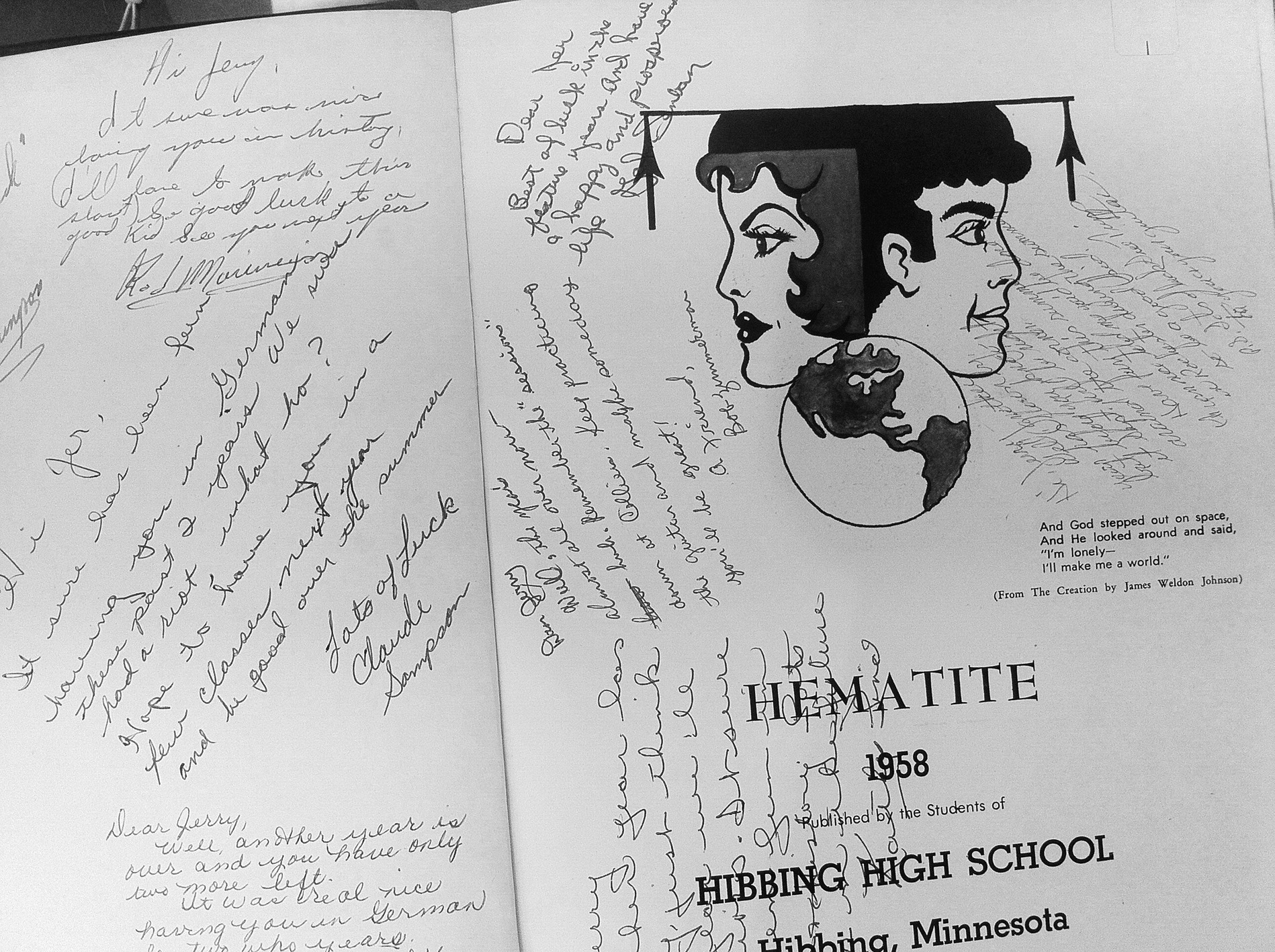
Jerry’s Yearbook, Hibbing High School, 1958

Five Things I Saw & Heard This Week: Wednesday 31st October

Danny Baker, Shortlist Questionnaire
Who’s the most overrated band of your lifetime? “Queen. A dreadful group. They were neither Led Zeppelin nor Bowie and they played that middle ground in between. Punk rock didn’t come around because of prog rock or anything like that, it came around because of Queen. Abba, Queen and ELO—that was what people were trying to move away from. You can find everything Queen did better elsewhere.”

Bob Dylan & The Poetry Of The Blues
Michael Gray, my favourite writer on Bob Dylan, gives a talk in Canterbury, close enough to drive to. Mick Gold comes with me, supplying an excellent compilation CD and fascinating conversation for our tiny road trip. Michael’s presentation is terrific—funny and revelatory. Over a meal afterwards we talk about the fact that Freddy Koella is both Michael and my favourite Dylan guitarslinger. Mick reveals that the night before, Freddy had guested for two songs at Bob’s Santa Barbara gig—the first time since he was a member of the Never-Ending Tour Band in 2004.
Michael on Freddy: “Freddy was Dylan’s best-ever lead electric guitarist (and just might be the best electric guitarist altogether since the heyday of Hubert Sumlin). Robbie Robertson was near sublime—the next best, a very close second—but Freddy was better. And in The Band all the other musicians were crucial too, whereas in Dylan’s band Freddy had to carry the whole front line. Of course you could say Mike Bloomfield was right up there, but he was, though a virtuoso, essentially more limited (Dylan had to tell him, for Like A Rolling Stone, to play ‘none of that B.B. King shit’); and G.E. Smith was terrific, but safe. You never wondered excitedly what he might do next. Whereas Freddy played by living on the edge, like Bob, fusing Django Reinhardt and Carl Perkins and playing as if it were 1957 now. He was the electric lead guitarist Dylan himself would have been, had Dylan ever bothered to master the instrument.” That line is fantastic, and spot on—“Playing as if it were 1957 now…”

Papa Nez’s Blues
To the Queen Elizabeth Hall with my mum to see her old fave, Mike Nesmith (The First & Second National Band stuff, not The Monkees, just so’s you know). I seem to be making it a point lately to see only Senior Citizens Of Rock™ but it’s just coincidental. It’s instructive to compare and contrast the approaches, however.
Leonard “Ladies’ Man” Cohen, 78, 4 years into his latest group of tours, is in fantastic voice, playing three-and-a half-hour shows with some of the finest musicians on God’s earth and playing versions of his songs that make the original tracks seem pale shadows. It is, in all senses, not just another show. It’s a summation of a life’s work.
Ian “Mott To Trot” Hunter, 73, belts out his impressive and rockin’ back catalogue with ferocious intent, fronting a hell-for-leather combo, The Rant Band. On lead guitar, Mark Bosch is a passionate and note/feel-perfect Seventies/Eighties Noo Yawk (think Leslie West or Mike Rathke) player, matching Hunter every step of the way. His tribute to Mick Ronson, Michael Picasso, is really moving, and the sense of community between him and his fans something to feel.
Mike “Papa Nez” Nesmith, 70, hasn’t played London since 1975, and makes a rather terrible decision. Sold to the audience as cutting edge technology by Nesmith, the three musicians on stage play along with pre-recorded tracks (mostly triggered by the keyboardist), which a) makes the sound terrible, all clunky Casio drums and booming sound effects, and b) forces everyone into a rather tight and metronomic way of playing—an already fairly predictable bass player becomes almost immobile, and the music has no sway or grace. This seems a real shame, as Nesmith’s use of soundscapes on tracks like Nevada Fighter, Bonaparte’s Retreat or Beyond The Blue Horizon were really innovative, especially in a country rock context. There are some beautiful songs here, from Joanne to The Grand Ennui to Rio, and Nesmith has the fine idea of setting up each song with a short piece of fiction contextualising the events that have (supposedly) led up to the song. But the bad sound, the gloopy and excessive synth string playing, the hopeless beats and Nesmith’s out of practice and strained voice leaves us feeling underwhelmed.

www.bullettmedia.com/article/music-journalism-cliches-that-need-to-be-retired-today/
Well, this brilliant broadside by Luke O’Neil makes rock journalism just that bit more difficult (but—hey—upside… potentially better!)

Not So Lucky, Lucky, Lucky
“I love all the PWL stuff slowed down, it sounds great.” says Kylie talking about The Abbey Road Sessions, where she re-records her pop hits of the eighties. I remember when the band I was part of (who NME saw as the antithesis of Stock, Aitken and Waterman’s PWL stuff—Rick Astley, Kylie, Jason Donovan etc.) decided to record a slow version of Kylie’s I Should Be So Lucky for a radio session. Sounded great when Mark roughed it out on piano with Heather, but someone somewhere hit the Irony Alert! button and thought better of it…

Five Things I Saw & Heard This Week: Wednesday 17th October

Rock Me, Davy!
1972, Fulham. Tony Cane Honeysett calls me over to his record player. Listen to this! he says. The 45 starts with a snarly riff, before going into a moody, groovy blues, with snappy drums and hooky fuzz guitars. The singer sounds both pop and familiar. After a few minutes I tumble. It’s David Cassidy, essaying a new, more grown-up direction, trying to move on from teen fandom to a kind of rock/blues. In May of ’72 he’ll pose nearly naked for Annie Leibovitz in Rolling Stone. This week in 2012, four of Cassidy’s albums from this period are re-released. Not sure I’ll check them out, but for old times sake (Hey, Tone!) I re-listen to Rock Me Baby, and it’s great. The Wrecking Crew rhythm section—Hal Blaine on drums and Joe Osbourne on bass—get down while Mike Melvoin (father of Wendy) prowls around the edges on piano. In the centre of the soundstage Larry Carlton and Dean Parks strut and fret, combining to brew up a nasty Southern Rock snarl. It’s just great, and I’m back in Anselm Road with Tony…

Seamus Ryan Sings ‘Liverpool Lou’
We had 12 minutes to photograph Billy Connolly in a room in a painfully Boutique Hotel™ this week. Photographer [to the stars] Seamus breaks the ice and makes a connection by revealing that he’s Dominic Behan’s godson, and Billy, famously, once decked Dominic in a bar, a fight broken up by Ronnie Drew of the Dubliners. Billy remembers the incident in detail, including the fact that he apologized the next morning to Dominic (sober throughout the whole fracas). At one point in the twelve minutes Seamus sings a few bars of Liverpool Lou, one of his godfather’s most famous songs [he also wrote The Patriot Game], very prettily. On a recent Desert Island Discs, Yoko Ono selected Liverpool Lou as one of her choices, remembering that her husband had sung it to their son as a lullaby. Oh, and Seamus delivered, as always.

Now This Sounds Intriguing…
The Coen brothers’ next film is Inside Llewyn Davis, about a struggling folk musician in the Village at the height of the 1960s folk scene. Apparently, the film’s title character is based on Dave Van Ronk. Bob Sheldon called him The Mayor of MacDougal Street [the name of Van Ronk’s autobiography, written with Elijah Wald] and everyone who went through Greenwich Village at that time seems to owe him a debt, most famously Dylan. John Goodman was interviewed in US Esquire this month by Scott Raab, and talked about it:
Raab: What are you shooting in New York?
Goodman: Inside Llewyn Davis. I’m playing a junkie jazz musician for Joel and Ethan Coen. I haven’t worked with them since O Brother, Where Art Thou?—15 years. Boy, it’s great to be back with them again. We have a real good comfort zone. I just adore being with those guys. It’s like hanging around with high school guys or something.
Raab: I’ve heard the film is based on folk singer Dave Van Ronk’s life. So it’s set in Greenwich Village in the ’60s?
Goodman: Right on the cusp of Dylan’s big explosion.
Raab: I’m probably one of the few people who’s seen Masked and Anonymous, the movie you were in with Dylan, half a dozen times. It’s such a strange movie, and it has so many moving parts. It’s a fascinating film. How was Dylan on set?
Goodman: Being around Bob was a trip. I just hung back and watched him. When the cats had downtime, they’d go somewhere and play together. And I’d listen to that. The film got a god-awful reception at Sundance. There were a lot of walkouts, but who cares? It was kind of an absurdist, futurist piece. It was fun. And I got to work with Jeff Bridges again. I got to stand next to the fabulous Penélope Cruz for a little while. That was worth the price of admission. Senorita Cruz.”

Mortification Corner
1>
“Diana Krall has collaborated with Academy Award winning costume designer Colleen Atwood and acclaimed photographer Mark Seliger to create a series of beautiful and striking images for Krall’s new album, Glad Rag Doll. They are inspired by Alfred Cheney Johnston’s pictures of the girls of the Ziegfeld Follies taken during the 1920s.” Well, if you say so…
2> Pity poor Art Garfunkel as he sits on the sofa being interviewed by the One Show dolts whilst they implore the Mrs Robinson’s in their audience to text photos of themselves, preferably with toyboys. Art tried to modify the disdain in his expression, but didn’t quite succeed…

King Harvest (Has Surely Come): Hyde Park, Saturday

“Corn in the field, listen to the cars when they cross Hyde Park Corner…”

Five Things I Saw & Heard This Week: Wednesday 10th October

Genius Idea Of The Week
Nick Paumgarten writes about record producer Scott Litt, New Yorker, October 1st.
When Scott Litt built a recording studio in the back of his house, in Venice, California, seven years ago, he did it with Bob Dylan in mind. He pictured Dylan sitting there at the Hammond organ, accompanied by nothing but drums and a standup bass. Or maybe in an arrangement featuring a banjo and a trumpet. “I always imagined him having a Louis Armstrong Hello, Dolly sound,” Litt said the other day. “Musically, that’s as American as it gets.” [Sadly, when Litt was hired to engineer Bob’s latest, Tempest, and] …got up the nerve to mention his idea, it didn’t go over very well. [Bob] just went, “Heh heh heh—Hello Dolly.”

This, From The Very Wonderful “Letters Of Note”
In 1919 [at which point he was just 9 years old] Samuel Barber wrote the following letter to his mother and left it on his desk for her to find. She did, and a year later Barber began to compose his first opera, The Rose Tree. He was still only 26 years of age when, in 1936, he finished his most famous work, Adagio for Strings.
“NOTICE to Mother and nobody else
Dear Mother: I have written this to tell you my worrying secret. Now don’t cry when you read it because it is neither yours nor my fault. I suppose I will have to tell it now without any nonsense. To begin with I was not meant to be an athlet [sic]. I was meant to be a composer, and will be I’m sure. I’ll ask you one more thing.—Don’t ask me to try to forget this unpleasant thing and go play football.—Please—Sometimes I’ve been worrying about this so much that it makes me mad (not very),
Love,
Sam Barber II

Roll On, John
Stanley Reynolds’ piece for The Guardian, 3 June 1963, reprinted this week: “Inside the club, down CND symbol smeared walls to a dark and bronchial cave, the dancers have originated the Cavern Stomp, because they did not have room enough to twist. In the dressing room off stage a steady flow of rock artistes come to talk with Mr Bob Wooler, the Cavern’s full-time disc jockey whose visiting card tells you, with Dickensian charm, that he is “a rhythm and blues consultant.” That is The Cavern, duffel coats and feigned boredom. On tour it is like a Hollywood success story. At the Odeon, Manchester, in the Beatles’ dressing room, the four boys were asking a reporter from a disc magazine to please see if she could do something to stop girls from sending them jelly babies. She had once said they liked them. “We’ve got two ton of them now,” John Lennon said. “Tell them to send us E-type Jaguars or button-down shirts.” Someone came in and said two girls had won them in a contest. “Just who are these girls who won us?” John Lennon asked. “I mean, how long have they won us for.”

“Hear What I’m Saying, I’m Not Saying It Right”
Random Acts [a series of short films chosen for their bold and original expressions of creativity] Channel 4.
Comedian and poet Sean Mahoney, directed by Jeremy Cole. An age-old subject, a harrington jacket, a little bit of Mike Skinner in the delivery. Vulnerable and sharp at the same time. A talent. Lovely.

Record Cover Of The Week

Paris flea market purchase. Just listened to. As you’d expect, The Surfaris via St Malo.

Five Things I Saw & Heard This Week: Wednesday 12th September

When Harry Met Sammy
I don’t normally like to these posts to be long, but as a piece of writing this is too good to edit down. This reminded me again that things are rarely as they seem, rarely as simple as outsiders perceive—those at the centre of events always have a much more complex perspective. And also it reminded me of the importance of primary recollections…

It started when Barney let me know a couple of months ago about an upcoming Harry Smith Conference, America Changed Through Music: Harry Smith’s Anthology of American Folk Music at 60, a one-day conference this Saturday September 15th. It’s hosted by the University of East Anglia’s School of American Studies at UEA London, and will explore the impact and ongoing legacy of an extraordinary cultural artefact—whew! I emailed one of the co-directors, Thomas Ruys Smith, as I’d been talking to Sam & Ann Charters about their time with Moe Asch at Folkways Records, and offered to put him in touch. He said he’d be delighted in Sam’s view. And then Sam emailed me with his view, which is brilliant (if off-message…)

“I’ve had a long, complicated relationship with Harry’s set. I first heard it in New Orleans in 1952 just after it first came out—a folk singer named Billy Faier in the French Quarter had it—then when Annie and I first began living together in 1957 the first thing we bought together was the Harry Smith set. $35 dollars—a lot of money for us. I liked some of it—some of it I already knew—and it all seemed to be to be just part of what had been going on with the reissues of old jazz and blues recordings since the 1930s. Fred Ramsey was doing a twelve volume LP reissue for Moe Asch of the history of jazz at the same time and his volume 1 had a lot of the same kinds of material. When I began working with Moe he said that he had been helping support Harry and they both were junking old 78s on 6th Avenue, just around the corner from the Folkways office. All the records in the collection were up in the office and half of the records that went into the set were his. He said that he and Harry had talked a lot about what they wanted from the set and of course it followed the outlines that the Lomaxes had set up in their folk song anthologies. The LPs were fine and fun—but no big deal.

But—for all those sixties teenagers the world began with Bob Dylan, and if he listened to the set it had to be the roots of everything that ever happened in America. Harry was living in the Chelsea Hotel all this time and in all my experiences with him he was a genuine horse’s ass. I had to shut him up sometimes when I was trying to record people in the Village and he kept drifting into Moe’s office begging for money. All his films were there as well, but I had seen a lot of experimental film and I didn’t think these were very exciting. His great things seemed to be the collection of painted Russian Easter Eggs in his hotel room, and his unending repertoire of string games. I edited an album of Allen Ginsberg’s readings and singing from tapes that Harry made in the hotel room, and at least he got a decent sound.

He made some scrawled notes for a Volume 4 and I was given the luckless task of trying to figure out what he wanted to include from his list—which drew down upon my head the wrath of everyone whose lives had begun with the original three volumes. Harry finally couldn’t pay his hotel bill, so Allen moved him in and supported him, which meant that Harry now became an iconic figure, since Allen always made it known that he only hung out with important figures. Before he died Allen set up in his will a legacy to pay for promotion of the Harry Smith legend. The woman who had the job was a fire-eater who often expressed her dislike for me, but I always felt that she was just doing what she was paid to do. There was eventually a Harry Smith celebration at the St. Marks Church on the Lower East Side where Harry was presented as the only person anyone knew who was probably at least as important as Jesus.

So that’s me and Harry—I wish some of these people could somehow see that what happened in the 1950s was just a continuation of the gathering and collecting of vernacular music in the South that had been going on for nearly a century. Everything I learned was from what people like Fred Ramsey and Bill Russell had done in New Orleans and the South in the 1930s—their recordings of musicians like Leadbelly and Bunk Johnson and Jelly Roll Morton—the books and articles and eventually LPs and films. Why does Harry get the credit for something that was much larger than his set? I dunnow.

I did a radio interview yesterday with someone in America who had just read The Country Blues and he wasn’t really aware that these things could have happened so long ago. At least the people obsessed with the blues don’t go on about Harry—they want to talk about the Stones and the other Brits. I try always to talk about other things, but there is always a silence. At least he didn’t ask me about Dylan.

You can certainly pass this on to Tom—a small muted protest.”

Thankfully, Tom felt that it was “a priceless perspective to get on things—a rich account from a significant individual.” As it is. My dad used to include a couple of the tracks when he did record recitals around the country in the late fifties. I found these notes he made about Richard “Rabbit” Brown’s James Alley Blues.

Bill Colyer Record Recital rough notes

Art Garfunkel: Walking/Singing interface
Reports MSN Music: We did not know that Art Garfunkel has been walking as part of his therapy. He’s currently walking across Greece, en route to Istanbul, a journey that began in Ireland and has continued in 100-mile installments over the past 10 years. He tells us: “I am singing while I walk! I sing because I need to find my voice—I’ve had trouble with it over the last two years—and I can’t live without singing.”

Duquesne by Bob Gumpert
Following last week’s mention of Duquesne, Bob sends these fantastic photos.

1986: Duquesne, PA. The abandoned Duquesne Steel Works, and a view of the dying steel town. Photographs by Robert Gumpert

On My iPod, Danny O’Donoghue, Metro
Fire and Rain by James Taylor. “This is such an emotional song and without doubt one of his best. It’s about the time he spent with junkies, in particular a girl called Suzanne.” Ah, Danny, with his simple, inaccurate view of the world…
The song actually chronicled Taylor’s experiences in mental institutions, such as McLean Hospital in Massachusetts as a senior in high school and his battle with drug addiction (The fire in the title refers to his shock therapy). “Suzanne the plans they made put an end to you,” refers to Suzanne Schnerr, a childhood friend of his who committed suicide while he was away in London recording his first album for Apple Records. Friends at home, concerned that it might distract Taylor from his big break, kept the news from him, and he only found out six months later.

Where’s My Harmonica, Albert? Why, In Beak Street, Bob, At Your Pop-Up Shop…
…just around the corner from Carnaby Street. Underwhelming. I bump into Mark Ellen, whose two-time-listen opinion of Tempest is “Five good songs.” Dead on. Or as my friend Lloyd said, “It’s like one of his theme time radio shows—but just him…”

Bobstore; Cinema downstairs, desultory Don’t Look Back showing; Shop floor and harp.


Five Things I Saw & Heard This Week: Wednesday 5th September

Black Tie White Noise
Evening Standard, last week. Bowie disputes claims made in the Observer by the V&A that he is co-curating the [Bowie Costumes] show. “Contrary to recently published reports: I did not participate in any decisions relating to the exhibition. A close friend of mine tells me that I am neither ‘devastated,’ ‘heartbroken,’ nor made ‘uncontrollably furious,’ by this news item.”

Really?
Interview with Kevin McDonald, Director of Touching The Void and Marley: “Q: Why do you think Marley’s music has proved so enduring? A: He wrote incredibly good tunes. Bob wrote more standards than almost anybody else, apart from Lennon and McCartney.” Did he? Standards? I Shot The Sheriff, Redemption Song, One Love, Three Little Birds, No Woman, No Cry, sure, but are his songs covered regularly, in the way that standards are? Marley’s number 211 on the SecondHandSongs database, a pretty comprehensive list of the most-covered songwriters, some way below Ozzy Osbourne and Marvin Gaye.

I Can Hear That Whistle Blowin’
My friend Steve Way on Duquesne Whistle: “Dylan vid weird. Like Bob is doing a phone ad song, and the director is doing a Sundance lo-fi Korean remake.” True say, Steve, but the world may be a better place for having this song in it—the chorus and thick, dirty riff are just joyous. Duquesne is a city along the Monongahela River in Allegheny County, Pennsylvania. Earl Hines, legendary jazz pianist, was born there. He signed my autograph book once.

I love that—”To, Martin, keep with it” written by Sinclair Traill, editor of Jazz Journal, who then joked around with Earl and they ended up signing their names as Sinclair Hines and Earl Traill…

“Even Cathy Berberian Knows/There’s One Roulade She Can’t Sing.”
The wonderfully titled Berberian Sound Studio featuring Toby Jones opens this week, named for Cathy Berberian, American soprano of the avant-garde. With Umberto Eco she translated works by Jules Feiffer and Woody Allen into Italian. You couldn’t make that sort of detail up. Eco nicknamed her magnificathy. Steely Dan paid their own tribute in the lyric above, from Your Gold Teeth on the Countdown To Ecstacy album.

Musical Marylebone
A few streets separate Joe’s monstrous urban flyover and John’s rather luxe pad. Of course, John’s background was rather more flyover than Joe’s…

Five Things I Saw & Heard This Week: Wednesday 22nd August

Garner-A-Go-Go! “This is Jim Rockford; at the tone leave your name and message…”
Talking to Aimee Mann about her new album, she mentioned being drawn to analogue synthesizers and gnarly guitars after revisiting some classics from the early eighties pop-synth era. Among the more obvious markers like the Cars and Blondie, it was great to hear her namecheck the terrific theme to The Rockford Files by Mike Post… and to hear her quote it at the end of the title track of Charmers.

Bits Of Bob
As excerpts of Tempest (not The Tempest—that’s Mr Shakespeare’s, according to Bob himself) filter out, we hear Early Roman Kings (fabulous title, no?) soundtracking some dreary looking US tv series, Strike Back… The song itself is a default Dylan accordion-led 12-bar that gives the band little room to move. Now that Charlie Sexton is back this is disappointing: at Hammersmith last year he showboated so much it could have been called The Charlie Sexton Show, featuring Bob Dylan, as he fired riff after riff into every available space, absolutely thrillingly…

Lyle Lovett, What I’ve Learned, US Esquire, February 2012 (yes, I’ve only just got round to reading it…)
“The inspiration and excitement that you get from being amazed when you give a vague direction to a guitar player like Dean Parks—“Make it sound a little more purple”—and then hear him play exactly the right thing.”

And Talking Of Purple: Fashion Forward Drummer, South Bank, Last Friday Evening

Never seen a drum kit this particular colour. Apparently it’s very… this season.


Photographers on Music: Brilliant!
The advent of blogging has revealed that photographers are a) really thoughtful and smart about their work, the world, the price of coffee, etc, and b) can really write. Here’s two I came across by chance this week. Firstly, Chris Floyd, on his blog Clean Living Under Difficult Circumstances, writing about a complex quick-turnaround portrait of Olympic Cycling Gold Medallist Laura Trott:

“I close my eyes and I think of the canon. The canon are the photographers I draw on in times of doubt. They give me comfort, solace and inspiration. They include Richard Avedon, Helmut Newton, Bruce Weber, Lee Friedlander, Sally Mann, Corrine Day, Glen Luchford, Erwin Blumenfeld, Harry Callahan and, in this case, Irving Penn… I go through the rolodex in my head thinking of them all until I find the one that instinctively feels like the inspirational match for the task at hand. That’s not to say I set about slavishly ripping them off. I use them as my starting point… They are my photographic moral compass. They show me the light, guide the way and keep me company. Once I push off and get underway I’m then going forward under my own steam. By the time I get to the other side I will have, hopefully, added enough of my own ingredients to the dish for it to taste new and different. To understand what I mean then check this out:

Bad Penny Blues by Humphrey Lyttleton (1956).

then this:

Lady Madonna by The Beatles (1968).

Each of them are great but one was a jumping off point for the other. I love it. You can hear the lineage right there.”

I also stumbled (is there a better way, internet-wise, to say this?) via the Black Eyewear blog, across the Secret Diary of Perou (photographer to the stars) and amongst factory-and-dog-related-posts read this fantastic account of his experience of seeing Elizabeth (Cocteau Twins) Fraser at Meltdown. If only more music writing was this good, or this well laid out:

“i am sitting on my own due to a late ticket purchase.
but i’m three rows from the stage.

we all make the mistake of sitting through 30 minutes of support act: four people doing acapella, harmonised, medieval chanting.
all songs sound exactly the same.
unexpectedly, it makes me want to punch someone: almost certainly not what this music was designed for.

elizabeth arrives on stage: a demure, grey haired lady with the voice of an angel.
during the second song: a reworking of a cocteau twins track, i feel tears on my face and i’m glad i’m sitting on my own.
i have crazy tingles over my spine.

but then…

behind elizabeth i notice the bald keyboard player who looks like richard o’brien in the crystal maze, wearing a sparkly, tinsel, double-width, pointed shoulder-padded outfit, postulating between two stacks of keyboards like a prog-rock nightmare.
he is more than a little distracting.
and begins the downfall of my evening’s entertainment.

the audience are annoying.
in between songs, old men shout out ‘we love you liz’. ‘marry me’ and ‘where have you been?’

there is a lesbian couple in front of me who try to dance though seated through all the cocteau twins songs.
one of these women also keeps trying to take photos of elizabeth on an iphone and keeps getting told by the ushers ‘NO PHOTOS’

i am no longer able to enjoy the performance when a girl arrives four songs before the end of the show to take her empty seat next to mine.

she is wearing an overpowering fragrance that smells like a combination of mountain pine fresh toilet duck and lemon fresh toilet duck.
i don’t know if she bathed in it pre-show or if she’s been drinking it, but i am unable think about anything else now.

i am concerned my nasal passages will be permanently damaged by sitting next to this person.

there are two standing ovations.
i sit through the first one
i stand through the second so that i am able to leave swiftly.

for the second encore elizabeth does a version of one of my favourite songs: ‘song to the siren’ which she did with ‘this mortal coil’ (a tim buckley cover)
and it is not so good.
i leave the royal festival hall a little disappointed.

sarah texts from the train station.
she’d left with steve before the first encore “…the memories were better.”

Genius.

Five Things I Saw & Heard This Week: Wednesday 25th July

Big Man On The Bass
Sad news that Bob Babbitt (Midnight Train to Georgia, Rubberband Man, Signed, Sealed, Delivered I’m Yours, Inner City Blues, Band Of Gold, Tears Of A Clown, Copacabana, Never Can Say Goodbye—wow!) has passed away. Watch Standing In The Shadows Of Motown and thrill to his pulse, precision and groove. He’s totally on it, whether negotiating James Jamerson’s iconic lines or his own. Watch him—in a moment caught on low-res videocam—reflected in Meshell Ndegeocello’s sunglasses, as he tearfully talks about the assassination of Martin Luther King, saying of the other musicians who made up the Funk Brothers, “I felt as sad as they did. I was one of them.”

“She Came With Her Spindly Little Legs And Her Mental Hair And Sang Her Heart Out…”
Amy Winehouse: The Day She Came to Dingle. Philip King, producer: “There’s something about singers, they’re sort of odd, you know. They carry songs with them… how many songs is any singer singing at one time? If you talk to a great jazz singer they’ll say I know five hundred songs but I’m singing thirty of them at the minute… Certainly the way that she sang that night, Amy… sang the blues away, She used her gift to still her trembling soul. She used her gift as a way to explain herself to herself. To entertain people, sure, but to sing the blues and to give herself some relief.” On bass, Dale Davis. On guitar, Robin Banerjee. Singing stunningly, Amy Winehouse. There are too many great moments to list, but the Ray Charles interview, an exquisite Me & Mr Jones, the way Amy’s eyes light up when she talks about the Shangri-La’s, the way she sings ‘Door’ in You Know That I’m No Good. If you love music, watch this film.

Surely Previous?

On the shelf above, a sticker read: “When It’s Gone, It’s Gone!”


Euro 2012: A Thriller. Imogen Heap’s Version: Not So Much

I forgot to write about this, but just found a note. Now—I love a re-visioned MJ classic as much as the next person {EVIDENCE FOR THE PROSECUTION: Robbie Fulks’ Billie Jean} but it has to make sense. The usual end-of-tournament slo-mo roundup-with-music was typically well edited and included all the moments of high tension and goals to die for that are prerequisite. It was soundtracked by Imogen Heap (who I usually like and admire) doing an acoustic cover of Thriller—nice piano playing, and lyrically some strike/hand/paralyzed-type links for relevant footage. But, Billie Jean with an impassioned, paranoid delivery atop a slinky bolero beat=goal. Thriller with all the thrills drained out, replaced with slightly hammy over-emoting=horrific penalty shoot-out miss.

Tonight The Blackbird Dies
Despite really liking Low and seeing them live last year, I was ashamed to discover I’d never heard Monkey, which blasts out over the opening of a cracking (but modest) B-picture, Killshot, based on Elmore Leonard’s book of the same name, one of the great modern-day crime novels. The song is fantastic—“Tonight you will be mine, tonight the monkey dies…” Nice to finally see a Hollywood film about hitmen that’s not excessive and stupid, but tight and realistic instead. Mickey Rourke is in finest Wrestler mode as Armand “Blackbird” Degas, Diane Lane is excellent and Joseph Gordon-Levitt as Richie Nix is really fine. The behind camera lineup is impressive: Produced by Laurence Bender and the Weinsteins, directed by John Madden, shot by Caleb Deschanel, thanks to Anthony Minghella and Sydney Pollack in the credits. Of course, it never got a cinema release in Britain.

Five Things I Saw & Heard This Week: Wednesday 18th July

Woodrow Wilson “Woody” Guthrie, born 14th July, 1912
My favourite photograph of a musician is this, a picture of Woody Guthrie, kindly given to me by the peerless Bob Gumpert. It’s my favourite because it has all the essential ingredients for a great music photo: An Icon. A Cigarette. A great location. A wide-angle that puts you right there. An acolyte, absolutely in the moment of playing with an trailblazer. A fascinated, curious crowd, all looking about fifteen. Their expressions are priceless.

Jack ’n’ Woody

I asked Bob how he came to have the picture: “It was taken by a photographer named Art Dubinsky—I am guessing the late 50’s-early 60’s in Washington Square Park in Greenwich Village, NYC. The other guitar player is Ramblin’ Jack Elliot. Art was a friend, a generous man who was a far better photographer than he got credit for. He lived in NYC at the time—at least I think so. I met him when he lived in LA and I was working in a rental darkroom, time behind the counter for time at the enlarger. He came in one day to use the darkroom as his home had burned down. We got to talking and became friends. He put me in contact with the National Lawyers’ Guild which led first to my photographing farmworker housing at Gallo wine, housing they said they didn’t have, and then to Harlan County, Kentucky for three months of photographing a coal miner’s strike. That in turn led to everything else. Sorry—I guess that is really more about Art and I and not the photo. He gave me the image, probably for no other reason than I liked it and had said so.” An appropriate story to celebrate Woody’s hundredth birthday—a story of friendship, inspiration and workers’ rights.

Poor Old Donovan, Destined To Be Dissed By Dylan Comparison Forever*
The always-amusing Barney Ronay on André Villas-Boas, new Spurs Manager, Guardian. “…there was something oddly heartening about the return in full-page panoramic close-up of André Villas-Boas, now formally in place as the new head coach of Tottenham Hotspur, and appearing, austerely suited in the middle of all this wretchedness, like an unexpected knock at the door from the local curate, who against all expectation you find yourself delightedly ushering inside. Welcome back, André. It has become fashionable to see Villas-Boas as a rather tarnished figure, to recall the frictions of his time at Chelsea, to balk at that familiar air of manicured expectancy. And to portray him instead as a kind of weak-chinned, own brand José Mourinho, Donovan to Mourinho’s Dylan, a provincial Wimpy bar to Mourinho’s gleaming McDonald’s, a managerial Sindy doll of prodigious inauthenticity. This is more than a little unfair. If nothing else there is much to admire in the way Villas-Boas is still out there… displaying the unshakable backseat extroversion that all the best managers have, as he winces and struts centre stage in skinny-trousered splendour, looking each time a little more like a tiny little dancing soldier on top of a wedding cake, or, increasingly, like a particularly convincing waxwork of himself.”

* However, Donovan doesn’t see it this way himself—there’s not much humility going on in his autobiography, The Hurdy Gurdy Man. The evidence of Don’t Look Back doesn’t lie, however—It’s All Over Now, Baby Blue vs To Sing For You?

Roll Away The Stone
The Stones played their first gig at the Marquee club 50 years ago this week. Bill Wyman, in his book, Stone Alone: “On 3 March 1963 we played… an afternoon session at the Ken Colyer Club, Studio 51, in Soho. It was ironic that we were given a great welcome by the ladies, Vi and Pat, who ran this stronghold of New Orleans-style jazz, whereas the jazz snobs at the Marquee and elsewhere saw us as upstarts who should not be encouraged.” The Stones went on to play Ken’s club most Sundays for a year. On September 10th, 1963, The Beatles visited them as they rehearsed at the 51. They presented them with a new, unfinished song, I Wanna Be Your Man. On hearing that the Stones liked the song, John and Paul went into the office and completed it.

The Sound Of Gatz
Ben Williams is on stage through the whole of Gatz (so that’s about six-and-a-half-hours in all), sitting at a desk off to one side, controlling the sound effects and cues, as well as playing various characters. He does a stunning job—sometimes intensifying the drama, sometimes broadening it out with humour—running the gamut from car crashes and gunshots to air conditioner hums and vaudeville turns. One of the most (unexpectedly) moving moments comes when Mike Iveson, playing Gatsby’s houseguest Klipspringer, turns the office sofa into a piano and mimes the gestures of a pianist, paying along to Williams’ tape. He abruptly stops and sings, acapella, the only words in Gatz which don’t come from Fitzgerald’s book, the song The Love Nest.
Building houses still goes on
Now as well as then
Ancient Jack and Jill are gone,
Yet return again.
Ever comes the question old,
“Shall we build for pride? Or,
Shall brick and mortar hold
worth and love inside?”
Just a love nest, cozy and warm,
Like a dove rest, down on the farm,
A veranda with some sort of clinging vine,
Then a kitchen where some rambler roses twine…

In an exquisite rendition, Iveson turns the theme from the George Burns and Gracie Allen Show, a pretty standard Twenties musical number, into a complex, achingly poignant commentary on the emptiness at the heart of Jay Gatsby’s mansion.

M.I.A.’s ‘Bad Girls’ Video, As Recommended This Week In Metro By Shirley Manson
Words are extraneous. Just go to 2:03. Go on.

Five Things I Saw & Heard This Week: Wednesday 11th July

Poliça/Dark Star
Reasons to Hate: Huge amounts of reverb. Achingly trendy/Hipster friendly. Arty Double tracked female vocal. Iconic Grateful Dead title. [Dangerous to pilfer Iconic Grateful Dead titles]. Reasons To Love: Wonderful live drumming with a huge open-room sound. Sometimes there’s nothing better than a pummeling four-on-the-floor (hey, even Take That’s Shine has a fabulous drum track, all Rak Studios, circa Mickie Most). Cracking tune. And the arty double-tracked vocal really works, weaving in and out of unison. It reminds me of Al Green singing around and off himself in How Can You Mend A Broken Heart? Add all this to some great twanging bass and slightly out-of-focus horns and it’s a winner. Granted, this could end up wearing thin over more than a few tracks, but Dark Star and Lay Your Cards Out (for another great melody and truly insane drumming) are absolutely terrific.

Seven Is The Magic Number
A review of a new version of Sophocles’ Antigone by Anne Carson (Antigonick) in the New Yorker printed this fine single-verse version of the siege of Thebes: “Seven gates/and in each gate a man/and in each man a death/at the seventh gate.” Seven is a very lyrical number— especially in country blues. There’s Muddy Waters, singing Willie Dixon’s Hoochie Coochie Man: “On the seventh hour/On the seventh day/On the seventh month/The seven doctors say/He was born for good luck/And that you’ll see/I got seven hundred dollars/Don’t you mess with me.” Or Dylan’s Ballad Of Hollis Brown: “There’s seven breezes a-blowin’/All around the cabin door/Seven shots sound out/Like the ocean’s pounding roar/There’s seven people dead/On a south Dakota farm/Somewhere in the distance/There’s seven new people born.”

Nora Ephron (and Susan Edmiston) interview Bob Dylan, Albert Grossman’s office, late summer, 1965
But negro rhythm and blues has been around underground for at least twelve years. What brought it out now?
The English did that. They brought it out. They hipped everybody. You read an interview asking who the Beatles’ favourite singer was and they say Chuck Berry. You never used to hear Chuck Berry records on the radio—hard blues. The English did that. England is great and beautiful, though in other ways kinda messy. Though not outside London…”
In what way messy?
There’s a snobbishness. What you see people doing to other people. It’s not only class. It’s not that simple. It’s a kind of Queen kind of thing. Some people are royalty and some are not.” Plus ça change…

Best Thing I Read About The Gracelands Controversy
Following Stuart Jeffries’ Guardian review of the 25th anniversary documentary, where he concluded that Paul Simon should have left the music alone:—“it gave the chance to hear unsullied the South African music that thrilled Simon 25 years ago. How lovely to hear, for instance, accordionist Forere Motloheloa laying down a groove without Paul Simon singing over it. If only it had remained the music Simon loved, rather than the music he, having loved, used.”*

Widlow, on the Guardian’s blog, answered with this: “Paul Simon clearly was a politically naive, contrary, slightly obsessive, perfectionist artist, who may have thought himself above such things as needing permission from the ANC. But what he produced was akin to Jesse Owens at the 1936 Olympics: a body of work that incarnated the exact opposite of the Apartheid philosophy, that sang out “Mixing cultures is good”, that proclaimed “These musicians are virtuosos and their culture is vibrant”, that put Black and White people into the same studio and had them eating and drinking together and using the same toilets and calling each other Brother…”

*This footage of the original 1985 sessions was extraordinary. There were children and babies sitting on the studio floor as the guitarists danced around the backing singers, vaulting their legs over their guitars (!) with the monumental bass and accordian lines of what became Boy In The Bubble booming out…

Leaving On A Jet Plane
Photo found in PA Photos: Britain in the 60s. British pop groups, bound for the USA on a tour which will yield half a million dollars. They are the Jimi Hendrix Experience, Eric Burdon and the Animals, The Alan Price Set and Eire Apparent. Eire Apparent?