Five Things I Saw & Heard This Week: Wednesday 23rd January

Daughter Reviews Les Mis
Running time: 2.5 hours
Spoken word count: 17
Number of times Hugh J cries: 6
Most used facial expression: anguish mixed with constipation
Most enhanced facial feature: lines around the mouth
Number of times stolen bread is mentioned: 12
Laugh-out-loud moments: Sasha B-C and Helena B-C as pick-pocketing inn keepers
Time it takes Cosette and Marius to fall head over heels in love: 4 seconds
Most moving songs: Anne H/I Dreamed a Dream and Samantha Barks/On My Own
Supporting Show Stealers: Daniel Huttlestone as Gavroche and Samantha Barks as Eponine

Reasons That Awards Are Stupid
Chose between these acts for Best International Male at the Brits:
a) Bruce Springsteen b) Frank Ocean c) Goyte d) Jack White e) Michael Bublé

Amazing Facts From Patrick Humphries’ Biography Of Lonnie Donegan, King Of Skiffle
“The first record Art Garfunkel remembers buying for himself was Lonnie’s Rock Island Line; and in Fairfax, California, that same Lonnie song was the very first tune that a shy 17-year-old Harvey Phillip Spector learned to play on the guitar. In New Orleans, the young Dr John—Malcolm “Mac” Rebennack was another who remembers being inspired by the Donegan hit. And way, way down in Texas, Jerry Allison and his buddy, Buddy Holly, were so captivated by Donegan’s Rock Island Line that they began incorporating it into shows they played around Lubbock.”

“Can You Dance To It?”
Listening to a CD lovingly compiled by my friend Tim, of African singles [African Serenades 44: Kenyan Singles] and finding this quote from him on the back: “I taught near Eldoret for two years in the early 1980s, fell in love with the music and then found that my Zigzag-reading, album-sleeve-obsessive completist’s mindset was completely turned upside down because, of course, none of the friends I made cared about who was responsible for that amazing guitar solo or impassioned vocal on individual songs. All they were concerned about was, “Can you dance to it?” Which isn’t a bad take on things when it comes down to it…”

Priceless
Teaser on rocksbackpages.com: “No one can define creativity. If you don’t have it, you can’t expect to understand it…”
Wham!’s Andrew Ridgeley to Smash Hits (1984)

Snow-based Pop Criticism, Marylebone High Street
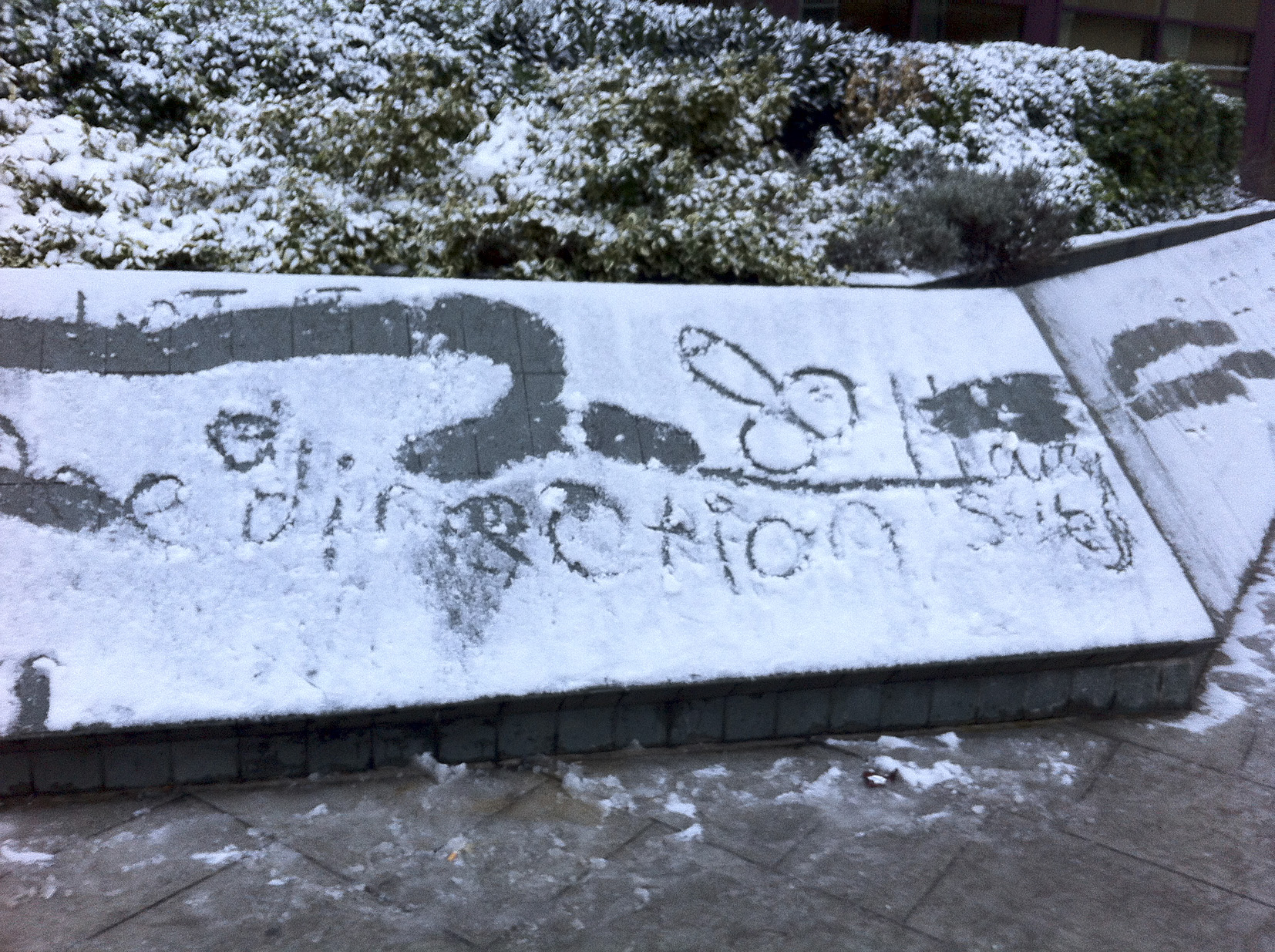
One direction


Five Things I Saw & Heard This Week: Wednesday 16th January

Marianne Faithfull interview, The Guardian
The Guardian: There’s a fantastic YouTube clip of you in 1973, wearing a nun’s outfit, singing with David Bowie at the Marquee club. It’s like watching an early Lady Gaga.
Marianne Faithfull: “I’ve known that ever since Lady Gaga came along­—I did it much better and long before you! Working with David Bowie was very interesting, but I couldn’t surrender to it. I should have let him produce a record for me, but I’m very perverse in some ways. He’s brilliant, but the entourage were rather daunting.”

It’s amazing how large the Marquee looks in this clip. It was a tiny place, but the US tv crew filming this special in ’73 have made it seem much more expansive. I remember the band looming over the audience. And the costumes. I remember the costumes. But very little else, so it was great to see the space-rock Sonny & Cher again, and to hear the lovely guitar obbligato from Mick Ronson.

I Should Have Known…
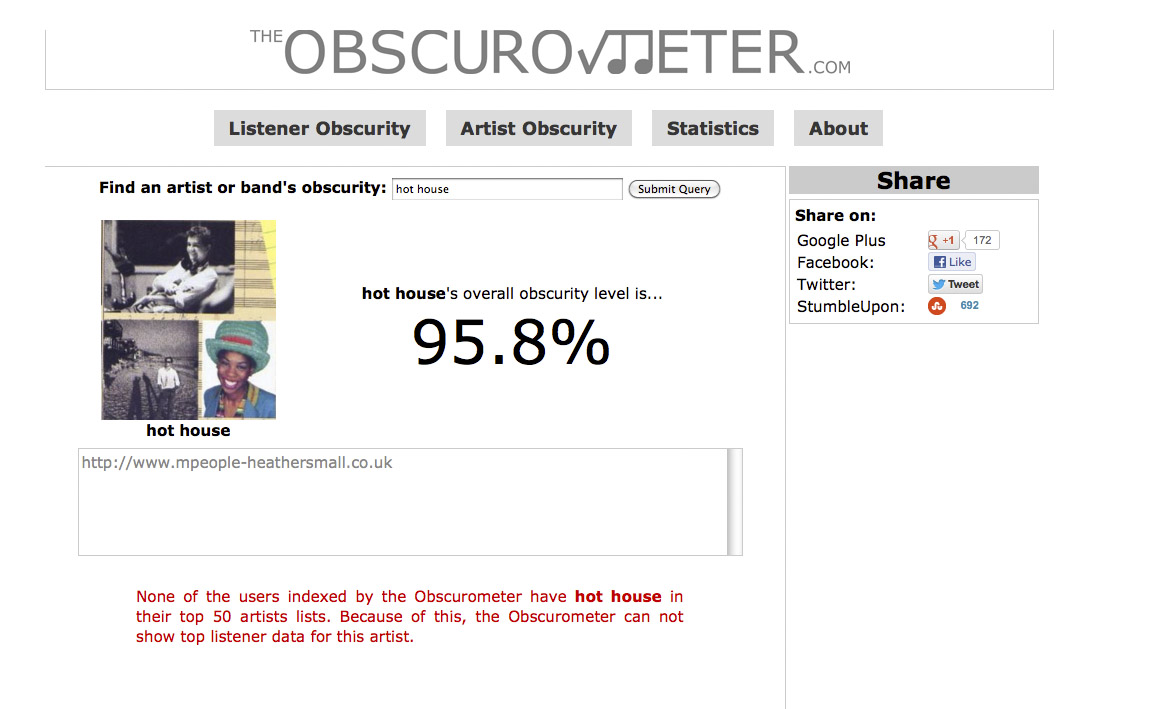
“What is the Obscurometer? Simply put, it’s a tool to measure just how obscure the music you listen to is.” And with that, people who are—or were—in bands, typed their bandnames into the dialogue box and hit return. And, I’m guessing, got a similar result percentage-wise…

Obscureometer

Excellent David Bailey quote
I once saw the world’s grumpiest photographer give a lecture at the Marble Arch Odeon in London. Everyone before him had done lavish slide shows with overviews of their ouevre. Bailey handed a polaroid to a person in the first row and asked them to pass it along. So it was passed along, row by row, as he talked brilliantly about his career, cameras, lenses, models… In the Guardian Weekend Questionnaire he was asked Which living person do you most admire?, and answered: Bob Dylan, because he is like a singing Picasso.

Motörhead: “Down. Down. Stop! Up, Up, A Little Bit, A Bit More—Great, That’s It!”
Lemmy has launched a line of Motörhead branded headphones in the United States. Specifically made for listening to rock music, the all-metal headphones are called Motörheadphönes. “People say we’ve never sold out. No one ever approached us,” said Lemmy, at the US launch earlier this week. I didn’t realise until recently that I saw a very early Motörhead gig (their eleventh), supporting Blue Oyster Cult at the Hammersmith [remember No Sleep ’til Hammersmith?] Odeon. We had gone because BOC had a kind of rock-crit cachet as being “intellegent” hard rock. My lasting memory was of Larry Wallis trying to tune his guitar between songs without turning off his fuzz box (ah, loved those pre-electric tuner days) and getting helped by the audience, as illustrated by the headline…

This Guitar, British Heart Foundation Charity Shop, £25
Made in Valencia by the firm of Vicente Tatay Tomás—not top of the line— with a huge crack along back held down by sellotape (but hey, hasn’t Wille Nelson proved that extra holes in guitars have no effect on the tone…)

Guitar

Five Things I Saw & Heard This Week: Wednesday 9th January

Weird iPod Synchronicity Pt4: Hyde Park Corner, London
As Lana Del Ray sparks into life in my headphones, hitting the chorus of Day At The Races [And I’m off to the races/Cases of Bacardi chasers/Chasing me all over town…] a trap and four outriders, all jodhpurs, riding hats & crops, trots in front of the bus, past Apsley House, and makes their way into Hyde Park.

On The Road Again
Fact Of The Week: At number 17 in the Highest Earning World Tours last year, Leonard Cohen is ahead (at £28.4 million) of Justin Bieber… and at Number 27, The Black Keys are ahead of Celine Dion, having grossed $23.5 million. The Black Keys. $23.5 million. Wow…

emusic Find Of The Month: Menahan Street Band, The Crossing
Recorded in a studio paid for by a Jay Z sample, by some of the musicians behind Sharon Jones and Charles Bradley’s sound, mostly during the night, this instrumental album is wonderful. Some of it is Spaghetti Western, some a kind of handicraft Portishead—try Ivory & Blue: jazz horns, soulful wah-wah guitar, funky Seventies pop drumming. Just the right amount of loose, just the right amount of tight, just the right amount of great.

Jeff Buckey: Three Films In Pipeline…
But the one I’m looking forward to (Brendan Fletcher’s A Pure Drop) is written by the fabulously named Train Houston. You’d have to gravitate towards music in some form with a name like Train Houston.

Bowie Back, Nile Rogers Bio, Letters Of Note
One the evening before David Bowie’s return to PopWorld™ I was reading Nile Rodgers’ very entertaining biography Le Freak, and had reached the part where he talks about recording Let’s Dance with the label-less Bowie.

“As I say to vocalists who are singing a little flat, sharp, or out-of-the-pocket, We’re in the neighbourhood, but we haven’t found the house yet.” David Bowie helped me find the house.

Not long after I arrived in Switzerland, Bowie strolled into my bedroom with a guitar.“Hey, Nile, listen to this, I think it could be a hit.” What followed was was a folksy sketch of a composition with a solid melody: the only problem was it sounded to me like Donovan meets Anthony Newley. And I don’t mean that as a compliment. I’d been mandated to make hits, and could only hear what was missing… I started reworking the song. I soon discovered the diamond in the rough.

[We] asked Claude Nobs, creator of the Montreux Jazz Festival, to round up a handful of local musicians… gone were the strummy chords… I’d replaced them with staccato stabs and a strict harmonic interpretation. I used silence and big open spaces to keep the groove and kept rearranging it on the spot, like I always did with Chic. David quickly got down with the reshaping of his song. We had a lot of fun and laughter in that Swiss studio with those terrific musicians… Laughter is the key to my sessions—the unconditionally loving parent in the room.”

And from Letters Of Note: In November of 1970, a month after signing a five-year publishing deal with Chrys­alis Music, 24-year-old David Bowie wrote the following letter to Bob Grace, the man who signed him, and briefly filled him in on his life so far:

November 17th, 1970
Haddon Hall

Mr. Bob Grace
Chrysalis Music Ltd
388/398 Oxford Street
London W1

Dear Bob
I was born in Brixton and went to some Schools thereabout and studied Art. Then I went into an Advertising Agency which I didn’t like very much. Then I left and joined some Rock ’n’ Roll Bands playing Saxophone and I sang some which nobody liked very much.

As I was already a Beatnik, I had to be a Hippie and I was very heavy and wrote a lot of songs on some beaches and some people liked them. Then I recorded Space Oddity and made some money and spent it which everybody liked.

Now I am 24 and I am married and I am not at all heavy and I’m still writing and my wife is pregnant which I like very much.

LOVE DAVID

Five Things I Saw & Heard This Week: Wednesday 2nd January

Pop Music Lives!
The Graham Norton Show. Girls Aloud. New Single. Love Machine. I roll my eyes at the title. But it’s great, a cracking pop single, with hints of Sweet’s Ballroom Blitz. And, as the chorus powers into view, at the back of my mind, a nagging What Else Does This Sound Like? It only takes a few demented minutes of humming. Step forward The Butterfield Blues Band…

Ok! Hep, Two, Three, Four…
Woodstock Soundtrack, original vinyl, Side Six. The Butterfield Blues Band. Featuring saxophonist “Brother” Gene Dinwiddie. “I got a little somethin’ I’d like to lay on y’all, if you’ll bear with me a minute… please. We’re gonna do a little March right along thru now… It’s a Love March. We don’t carry no guns and things in this army we got. Don’t nobody have to be worried about keepin’ in step, and we ain’t got no uniforms—we’re a poor army. In order to keep our heads above the water and whatnot, we sing to one another, and play to one another and we trying to make each other feel good. Ok! Hep, two, three, four…” On the back of a great Rod Hicks bassline and Phillip Wilson’s martial drumming, Dinwiddie gives his all to the uber-hippie lyrics. As feedback crackles around Buzzy Feiten’s guitar, the horn section (featuring David Sanborn) riff like the most soulful Marching Band ever. And it certainly could be the inspiration for the Girls’ songwriting team, although I doubt it.

John Barry: Licence To Thrill (BBC Four Doc With A Rotten Title…)
I’d totally forgotten his great score for The Ipcress File. It uses one of my favourite instruments, a cimbalom (a kind of hammered dulcimer). One night I was in Budapest at a conference and we were all taken to a Hungarian Folk Dance dinner. It was, hands down, the loudest thing I’ve ever witnessed. The stage floorboards were percussively assaulted by the dancers’ boots and our insides were assaulted by the unholy bass vibrations that this set off. There were two cymbalom players at either side of the stage, hitting seven shades out of their instruments. The pitch of the treble strings as they were struck by the hammers was enough to take the top of your head off. Instant Migraine. Brilliant. I bought the CD.

“Tis The Song, The Sigh Of The Weary, Hard Times, Hard Times, Come Again No More…”
Laura Barton’s wonderful Guardian column, Hail, Hail, Rock & Roll, was one of the inspirations for me to do this blog, so I was sad to read of her hard year in the round-up of favourite moments by Guardian music writers. Here, she talked honestly about the past twelve months, and a rare bright moment. “This was not the happiest of years for me; all through January, on into spring and the summer, I took a slow lesson in falling apart. I could no longer see the beauty in anything—days stood grey and flat, food was flavourless, even music seemed muffled and blunt. By the first Tuesday in March I was experiencing daily panic attacks, and often felt too fearful to leave the house. But that evening Future Islands were playing the Scala in London… They played my favourites of course, and it was one of the finest gigs of my life, but what really made it was the stage invasion—a sudden surge of excitement at the beginning of, I think, Heart Grows Old, and suddenly we were all up there, dancing among the cables and the synths. And I remember in that moment looking down from the edge of the stage, out at all the bright faces and euphoria and glee, and feeling my chest swell with a brief, sweet gulp of long-lost joy.”

R.I.P Fontella Bass
Rescue Me. The best Motown song that was never on Motown, the best Motown bassline that wasn’t a Motown bassline (played by Louis Satterfield). Fontella Bass was a powerful singer, who made some wonderful gospel albums. The one I could find this morning was From The Root To The Source. It has Phillip Wilson, co-writer  of Love March (see above) on drums. To further cement the Butterfield link, I found a YouTube clip of Fontella in the 80s, singing Rescue Me on Dave Sanborn & Jools Holland’s fabulous Sunday Night, with Sanborn on sax. In memory, we’ll play some Fontella Bass tonight.

Bass

Extra! Five Things I Loved This Year…

The Best Use Of An Unlikely Venue
Sam Amidon, Westminster Central Library. Turned into, variously, a New York avant-jazz Loft Space, a poetry workshop, a folk festival and a church.

Sam


This Table In Spain
Mark Ritter: Alter Muddy Water. Written by Lee Hazlewood. Heard once, thanks to YouTube, never forgotten (or, for that matter, ever want to hear again.)
Table


This Guitar At The Christie’s Sale
Elvis’ Fender Jaguar, apparently.
Elvis Guitar


Favourite Acrobatic Moment From My Favourite Concert
The Webb Sisters’ astonishing backflip in the “Charlie Manson” verse of The Future, Leonard Cohen concert, Paris Olympia, where he played his greatest works [songs you’ve loved so long they’re almost part of your DNA] with his greatest ever band.

LenOl


And At The End Of The Year, A Present
A Hollie Cole album is always a welcome addition to our household, and this December, an early Christmas present, Night. Standout tracks are stunning versions of If You Could Read My Mind and Good Time Charlie’s Got The Blues, with glorious support from her original Trio, David Piltch on bass and Aaron Davis on piano.There’s a sadness in her voice that can’t be denied, but music this great always uplifts.

Oh, And Something To Look Forward To For Next Year…
The outrageous trailer for Baz Luhrmann’s version of Gatsby, featuring, as its soundtrack, No Church in the Wild by Jay-Z and Kanye West, Florence and The Machine’s Bedroom Hymns and—for its final, most hysterical third—Filter’s industrial version of The Turtles’ Happy Together. Sensational.

Five Things I Saw & Heard This Week: Wednesday 19th December

Dark Was The Night, Cold Was The Ground
As we drove along Spain’s Costa Tropical, past the last remaining sugar cane factory in Europe, the sky turned orange and Blind Willie Johnson came on the CD player. I don’t really have the words to describe this performance, but it may be the loneliest sound ever committed to shellac. Driving as the sun fell it stilled the conversation. Ry Cooder’s soundtrack to Paris, Texas is pretty much based around it. from wikepedia: In 1977 Carl Sagan and a team of researchers were tasked with collecting a representation of Earth and the human experience for sending on the Voyager probe to other life forms in the universe. They collected sounds of frogs, crickets, volcanoes, a human heartbeat, laughter, greetings in 55 languages, and 27 pieces of music on the Voyager Golden Record. Dark Was the Night, Cold Was the Ground was included, according to Sagan, because “Johnson’s song concerns a situation he faced many times: nightfall with no place to sleep. Since humans appeared on Earth, the shroud of night has yet to fall without touching a man or woman in the same plight.”

Sky

Tony Staveacre, Letter To The Guardian
“Ravi Shankar did a great kindness to a young television director in November 1968. The great man was performing a raga in the BBC Riverside Studios (behind the Hammersmith Odeon) to be broadcast as part of the trendy BBC1 pop series How It Is. The trainee director had told the recording engineer to load a 20-minute videotape—that’ll be long enough. But it wasn’t. A raga is an improvisation, unpredictable in content and length. So the tape ran out while the maestro was still playing. The director, close to tears, had to go down to the studio floor, apologise for his incompetence, and plead with the musicians, Would you mind doing it again? The response was a shrug, a beatific smile and: Of course we can – and it will probably be better this time. And it was. The director was fired shortly after that, by telegram. I’ve still got it.”

Wayne Shorter On The Miles Davis’ In A Silent Way Recording Session, Mojo Magazine
“When we recorded it [in February 1969] there were no written-out parts. Miles didn’t want to know what you were going to play. “Play music that doesn’t sound like music,” he once told me. It was to get you out of your comfort zone… if he heard someone practising, he’d say, “Don’t practice!” He told John [McLaughlin], “Play the guitar like you don’t know how to play the guitar.”

In Praise Of Sinead
Clearing the hard drive, I watch an episode of Later from a few weeks ago. Amongst the dreary hipsters (yes Foals, that’s you—the world doesn’t need a Prog-Rock-Slash-Funkapolitan in 2012—songs that want to be instrumentals but still seem to have words) and the old soulsters (Graham Central Station—Where’s Sly? We need Sly! Larry has a microphone attached to his bass by a gooseneck. We can see why this has never caught on. Awful bass sound. They forgot to bring a song) and the Primark Bonnie Tyler that is Ellie Goulding, there is Sinead O’Connor, She is singing Nothing Compares To You. She has a flaccid band (imagine her backed on this song by Marc Ribot and Jay Bellerose instead, for instance) and by rights the song should have been consigned to the I’ve heard it too many times—it has no power left pile in the corner. But. But. She is one of the great natural singers of our age. There’s not an unmelodic note. Hell, there’s not an unmelodic breath between the notes… She rips the bloody guts out of the song and leaves them on the studio floor, focused on extracting everything it has to give. And, even when it’s just her breath you’re listening to, she sounds like no-one else on earth, and that’s a rare, rare thing.

Blue Note? Is That A Code Name?
Ever see something that you wished you’d thought of?
And something that you know how hard it is to do well?
Take a bow, Ty Mattson at Mattson Creative.

Homeland

Five Things I Saw & Heard This Week: Wednesday 12th December

Dave Brubeck, talking to Marian McPartland
…on her wonderful series, Piano Jazz, for NPR, about his great collaborator, Paul Desmond. “I loved listening to him, every night, and the humour—if he wanted to say something funny through the horn—would just break me up… If I did something wrong, that he didn’t like, he’d usually play I’m An Old Cowhand (From The Rio Grande) because I was raised on a cattle ranch and he’d bring that up, musically. Or Don’t Fence Me In—anything that he didn’t like, that was going on, he’d play a quote to get you back in line. It was something that was always so funny, you’d laugh—you’d never take it too badly. He could tell a complete story in quotes of what just happened, his mind was so quick… [One night they had been] arrested for speeding on the Pennsylvania Turnpike, he did the whole story; of the arrest, where they went, all in tune titles. It was amazing…

[On playing a Country Fair and Horse Show] “A guy came up on the stand with spurs on and he drug them across the stage and he walked up to me and he said, “Tell the guy playing the traps [drums] that he’s spookin’ the horses…” and Paul was in hysterics, and when he started playing, he hit some high notes and all the chickens went crazy and started cackling…Paul was going to write a book [about all these tours] called How Many Of You Are There In The Quartet?”

What? What? What Am I Not Getting Here?
Mumford and Sons, Babel
@Big Boi (of Outkast) responds to a fan enquiring after his favourite non-hip hop album of the year.

Richard Thompson, New Album, Great Quote
Electric is produced by Buddy Miller at his home studio in Nashville, TN. “We did it ridiculously quickly. It was just stupid. But it sounds great. It turned out surprisingly funky, sort of a new genre—folk-funk. It’s quite snappy, somewhere between Judy Collins and Bootsy Collins.”

Tom Waits letter to The Nation, 2002, from Letters Of Note:
“Thank you for your eloquent “rant” by John Densmore of The Doors on the subject of artists allowing their songs to be used in commercials. I spoke out whenever possible on the topic even before the Frito Lay case (Waits v. Frito Lay), where they used a sound-alike version of my song Step Right Up so convincingly that I thought it was me. Ultimately, after much trial and tribulation, we prevailed and the court determined that my voice is my property.

Songs carry emotional information and some transport us back to a poignant time, place or event in our lives. It’s no wonder a corporation would want to hitch a ride on the spell these songs cast and encourage you to buy soft drinks, underwear or automobiles while you’re in the trance. Artists who take money for ads poison and pervert their songs. It reduces them to the level of a jingle, a word that describes the sound of change in your pocket, which is what your songs become. Remember, when you sell your songs for commercials, you are selling your audience as well…

Eventually, artists will be going onstage like race-car drivers covered in hundreds of logos. John, stay pure. Your credibility, your integrity and your honor are things no company should be able to buy.”

Tift Merritt’s Red Guitar, Later
Ooooooooh, that is one great guitar, a cherry red Gibson J-45, sweetly played and with a wonderfully soft & rounded tone…

Tift

Five Things I Saw & Heard This Week: Wednesday 5th December

This is the West, Sir. When the legend
becomes fact, print the legend.”
James Stewart as Maxwell Scott, in The Man Who Shot Liberty Valance. As I read Mojo’s obit of Terry Callier, the folk-jazz-soul singer songwriter, my heart sinks as the oft-retold story of his first album is reprinted—yet again. Lois Wilson writes: “The following year saw him team with Prestige producer Samuel Charters. The New Folk Sound should have seated him next to Gil Scott-Heron and Nina Simone, such was its innovative cross-fertilization of jazz, folk, soul, blues and civil rights, but it finally arrived without fanfare in 1968, after Charters went AWOL with the tapes to Mexico.”
Here’s Wikipedia: “He met Samuel Charters of Prestige Records in 1964, and the following year they recorded his debut album. Charters then took the tapes away with him into the Mexican desert, and the album was eventually released in 1968 as The New Folk Sound of Terry Callier.”
From The Guardian, Callier interviewed by Will Hodgkinson: “Callier recorded his album, The New Folk Sound, under the influence of Coltrane, using two upright basses and two acoustic guitars to create a unique sound. The record would probably have been a hit but for the fact that its producer, Samuel Charters, took the tapes of The New Folk Sound on a voyage of self-discovery into the North American desert, where he lived with the Yaki Indians for the next three years.”

I decide to do the journalistic thing and ask someone who was there.
Sam Charters: “There’s been so much confusion there’s no quick answer. I was doing a lot of Chicago folk artists for Prestige, and I heard Terry at a folk club. I talked to him about recording and then I went to his family’s apartment in one of the project buildings one evening and he sang his songs. Sweet family, and he was a very pleasant young guy.

When we came to the studio he had new ideas, and there were two bass players; one on either side of him but with wide distances between. Then he wanted to record in the dark. When we had to turn on the lights between takes to do adjustments I was sure the basses were creeping up on me. Then I did the usual editing and we had the usual Friday afternoon sales meeting at Prestige—the only time we saw Bob Weinstock [owner of Prestige], if he even turned up—and the sales manager said we had to sell it as protest song album, since he was a black folk singer. So that was the promotion pitch, but otherwise it was just another of the Chicago albums I did that didn’t sell a lot, because he didn’t have much of a club audience.

I didn’t think about it again until the stories began circulating that I’d stolen the tapes and taken them to Mexico and that was why the album didn’t come out for two years and was a flop. I was fired about the time the record came out and Annie and I did drive to Mexico and California, but we were back in New York in April for the world premiere of Ives’ 4th Symphony, with Stokowski conducting [Leopold Stokowski conducted it with the American Symphony Orchestra at Carnegie Hall on April 26, 1965].

When the stories started about me and the stolen tapes in Terry’s interviews I regarded it as just one of those weird things. I tried to correct it when there was an article in the New York Times, but the journalist was in love with the story and wouldn’t give it up. Fantasy had the old Prestige album and some sort of recording rights and Bill Belmont called and asked if I’d like to produce a new album and I said very quickly no. Terry did appear in Stockholm a year later and told the same story and I thought of calling him and then I decided—why? His story was much better and he felt good with it and it didn’t matter to me one way or another. I’d produced a lot of records for Prestige that didn’t sell and I’m sure the artists have some equally colorful story.”

Quote Of The Week
Peter Doherty interview, Angelique Chrisafis, The Guardian.
Another French royal whose path he crossed was Carla Bruni, when he was invited to some music sessions at the house she shared with Nicolas Sarkozy, then president.Her house was “a really strange scene, where you’ve got a guy with a submachine gun on each door.” Did he meet Sarkozy? “You’re joking, aren’t you?” he laughs, blaming his bad reputation. “She told me she took him to see Bob Dylan. She had the harmonica that Dylan gave her, and apparently he was like: I don’t want to meet this guy, who is he anyway?”

Bold As Joan Osborne
Another Day, Another Cover, but a sweet one: From Joan Osborne’s album earlier this year, mostly singing songs written by black songwriters, her cover of Jimi’s Bold As Love stands out. Hendrix is rarely covered, especially by non-guitarists, with the notable exception of Emmylou Harris and Daniel Lanois (This Must Be Love on Wrecking Ball). Great Melodies, wonderful changes and sweet, tremulous, touching lyrics are all present in a joyous stew. Osborne’s a great singer—check out her performance of What Becomes Of The Brokenhearted in Standing In The Shadows Of Motown, especially the breakdown halfway through when the Tell Me! Call & Response starts happening…

Title Fight
Adam Ant’s new album title—Adam Ant Is the Blueblack Hussar in Marrying the Gunner’s Daughter—made me vaguely curious as to the longest album title. It turns out to be this 865 character cracker from Chumbawumba in 2008:
The Boy Bands Have Won, and All the Copyists and the Tribute Bands and the TV Talent Show Producers Have Won, If We Allow Our Culture to Be Shaped by Mimicry, Whether from Lack of Ideas or From Exaggerated Respect. You Should Never Try to Freeze Culture. What You Can Do Is Recycle That Culture. Take Your Older Brother’s Hand-Me-Down Jacket and Re-Style It, Re-Fashion It to the Point Where It Becomes Your Own. But Don’t Just Regurgitate Creative History, or Hold Art and Music and Literature as Fixed, Untouchable and Kept Under Glass. The People Who Try to ‘Guard’ Any Particular Form of Music Are, Like the Copyists and Manufactured Bands, Doing It the Worst Disservice, Because the Only Thing That You Can Do to Music That Will Damage It Is Not Change It, Not Make It Your Own. Because Then It Dies, Then It’s Over, Then It’s Done, and the Boy Bands Have Won. Soon to be re-released on Syco Records, apparently.

Liooel Riihie?
Found during iPhoto cull. Travelling in California last year, accidentally turning on the subtitling on the motel’s TV during Lionel Richie’s Who Do You Think You Are? programme.

Lionel

Extra! 5 Things about Ne-yo & Malibu Red: The Musician/Commerce Interface

Exclusive!
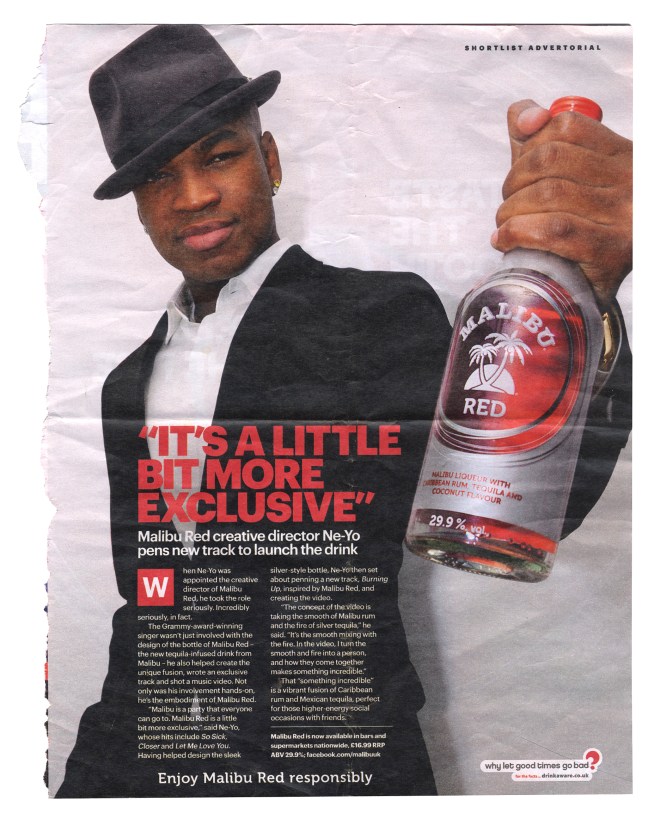
Headline for Shortlist Magazine Malibu Red Advertorial: “It’s a little bit more exclusive.” Apart from the fact that something is exclusive or it isn’t, the very word in the same sentence as the sickly coconut liqueur Malibu is a little, shall we say, rum.

Don’t You Just Love Creative Collaborations?
“When Ne-Yo was appointed the creative director of Malibu Red [I know, who knew you could be?], he took the role seriously. Incredibly seriously, in fact. The Grammy-award-winning singer wasn’t just involved with the design of the bottle of Malibu Red [It’s brilliant. It looks like a bottle]—the new tequila-infused drink from Malibu—[Hold on a moment. Let’s process this. Ne-Yo. Rum. Coconut. Tequila. Yum!]… he also helped create the unique fusion, wrote an exclusive* track and shot a music video. Not only was his involvement hands-on [I know, again. It makes it sound like Ne-Yo is doing this from the bottom of his heart (so generous!) rather than being paid nightclubs-full-of-cash]… he’s the embodiment of Malibu Red [whatever that is].
*There’s that word again.

Ne-Yo, Tell Us About Your Video.
“The concept of the video is taking the smooth of Malibu rum and the fire of silver tequila. It’s the smooth mixing with the fire. In the video, I turn the smooth and the fire into a person… Ne-Yo! Ne-Yo! Enough Smooth ’n’ Fire, already!

Let’s See That Video!
It’s… hopelessly, hopelessly dull. Ne-Yo is the “Smooth,” a Latina everywoman the “Fire.” It takes place in a disco. It’s every bit as bad as that sounds. The song? Like a Forever 21 version of Nelly.

Ne-Yo

FYI
Malibu Red is available in supermarkets nationwide now [that’s a little bit more exclusive… no?]

Five Things I Saw & Heard This Week: Wednesday 28th November

The Return Of Scott Walker
Exciting news for us Scott fans! In a relatively revealing Guardian interview as his new album, Bish Bosch, is launched, Scott talks about his fear of performing, as well as saying that no promoter would put him on anyway, as they’re only interested in money. But Scott could tour cultural festivals, not rock arenas, if he chose. In 2008, for instance, The Barbican put on Drifting and Tilting—The Songs of Scott Walker. It was more opera than rock. Scott, eyes hidden beneath baseball cap, stood at the mixing desk conducting his collaborator Peter Walsh. It was all I could do to drag my eyes away and back to the stage, which teemed with extraordinary visions. The most arresting image? Possibly a boxer using a pig’s carcass as a percussion instrument. Or maybe Gavin Friday as Elvis (“It casts its ruins in shadows/Under Memphis moonlight”), perched on a stool, singing to his stillborn twin Jesse, while a bequiffed and backlit figure strode  from the back of the stage until he assumed gigantic proportions, looming over the whole theatre. Whichever, it was an evening that lives on in the memory. Long may Scott run.

Amy’s Blues
The National Portrait Gallery in London buys a portrait by Marlene Dumas of the late Amy Winehouse, and  the curator says: “Dumas said that she had been very moved by the news of Winehouse’s death.” Which sort of begs the question: why not be moved by something useful like her talent or her voice—while she was alive. What’s “moving” about her death? “Dumas, who is based in Amsterdam, sought out images of Winehouse online for the work which draws the viewer in to the singer’s distinctive eyes and eye liner.” Yes, you read that right. In Art Speak, she sought out images of Amy online. And then copied some of the photos she found, quite badly. So, basically, this mediocre fan painting was co-created by Google Image Search (79,600,000 results).

Kermit The Frog, Meet Miles Davis & Louis Malle & Jeanne Moreau
Genius overlay of Davis’ session (filmed by Malle) recording the soundtrack to Lift To The Scaffold, the great French noir from ’58, with LCD Soundsystem’s New York I Love You, But You’re Bringing Me Down. The film of Davis playing to a huge projection of Moreau walking the streets of Paris at night is just stunning. That’s cut with Kermit on a rock across the river from midtown, and in Times Square. Hats off to Alessandro Grespan for his inspired and crazy jamming together of these two videos. The despairing mood of both pieces is eloquently summed up in James Murphy’s brilliant couplet “There’s a ton of the twist, but we’re fresh out of shout…”

Is It Rolling, Keith?
My favourite moment so far in Crossfire Hurricane, the Stones doc, is the extraordinary stage invasion footage. Keith: “It started, man, on the first tour. Half way through things started to get crazy [here the on-stage cameras filming the concert record a group of young besuited guys pushing the Stones over, singing into Jagger’s mic, attempting to pull Brian Jones’ guitar off, as the soundtrack becomes phased and fragmented]… we didn’t play a show after that, that was ever completed, for three years… we’d take bets on how long a show would last—you’re on, 10 minutes…”

Christies Pop Culture Auction Preview, South Kensington
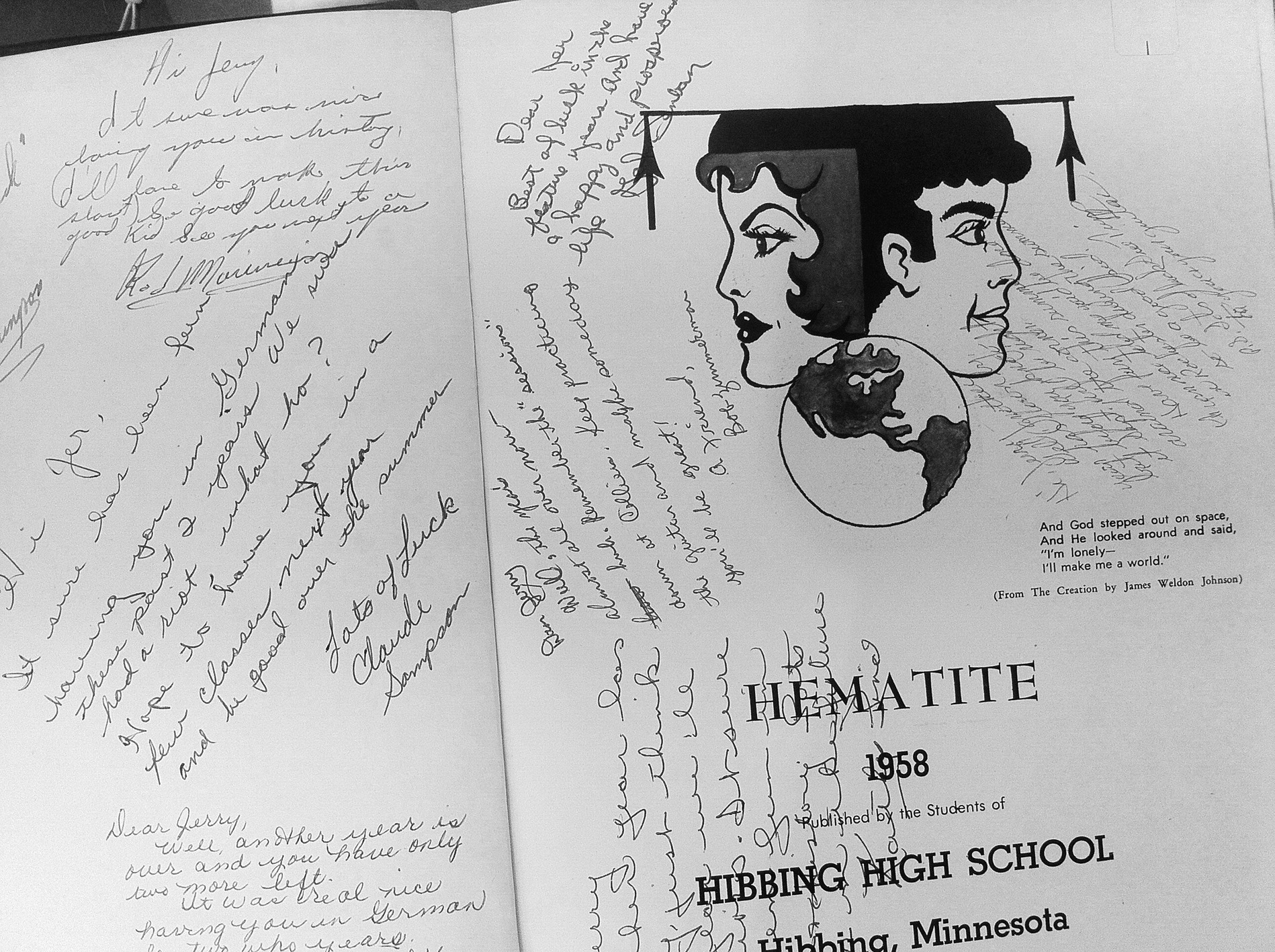
A random sampling of the 20th Century, from chairs that were part of the set of Rick’s Cafe in Casablanca, via Harrison Ford’s bullwhip from Raiders to the ‘Iron Maiden’ from Ken Russell’s Tommy (a snip if it goes for its estimate of £1000). I was there to gaze upon Mitch Mitchell’s snare drum (as featured on Purple Haze, The Wind Cries Mary, Hey Joe etc) and Andy Warhol’s mock-up of an unpublished book of the Stones ’75 tour. Favourite item? Hibbing High School Yearbook, 1958, signed, “Dear Jerry, Well the year’s almost all over now, huh. Remember the “sessions” down at Colliers. Keep practicing the guitar and maybe someday you’ll be great! A friend, Bob Zimmerman”

Jerry’s Yearbook, Hibbing High School, 1958