Five Things I Saw & Heard This Week: Wednesday 3rd October

Tom Morello of Rage Against The Machine, Rolling Stone Magazine
“Paul Ryan claims that he likes Rage’s sound but not the lyrics. Well, I don’t care for Paul Ryan’s sound or his lyrics… Basically, the only thing he’s not raging against is the privileged elite he’s grovelling in front of for campaign contributions. You see, the super-rich must rationalize having more than they could ever spend, while millions of children in the US go to bed hungry every night.” Excellent Raging against The Republican Machine in a magazine that veers worryingly between Tiger Beat-style fawning over popstrels and top-notch political reportage and comment. Read Matt Taibbi on Mitt Romney. Read it and weep.

Rolling Stone Gathers Some Grapes

Excuse my French, but HFL is this? Very lame, I think…

Homeland Trailers, Channel 4
The first one is filled to the brim with all the creeping paranoia of the series, as an childrens’ choir sings the Star Spangled Banner, before clattering drumming (military? Middle Eastern?) drowns it out in a series of shots of the characters all at different places, screaming… The second, using Johnny Cash and Rick Rubin’s God’s Gonna Cut You Down is even better, and is mostly about Claire Danes’ eyes… “Go tell that long-tongue liar/Go and tell that midnight ride/Tell the rambler, the gambler, the back biter/Tell ’em that God’s gonna cut ’em down/Tell ’em that God’s gonna cut ’em down.” Of course, the only question is: Whose God?

More Duquesne On This Blog, Oh!
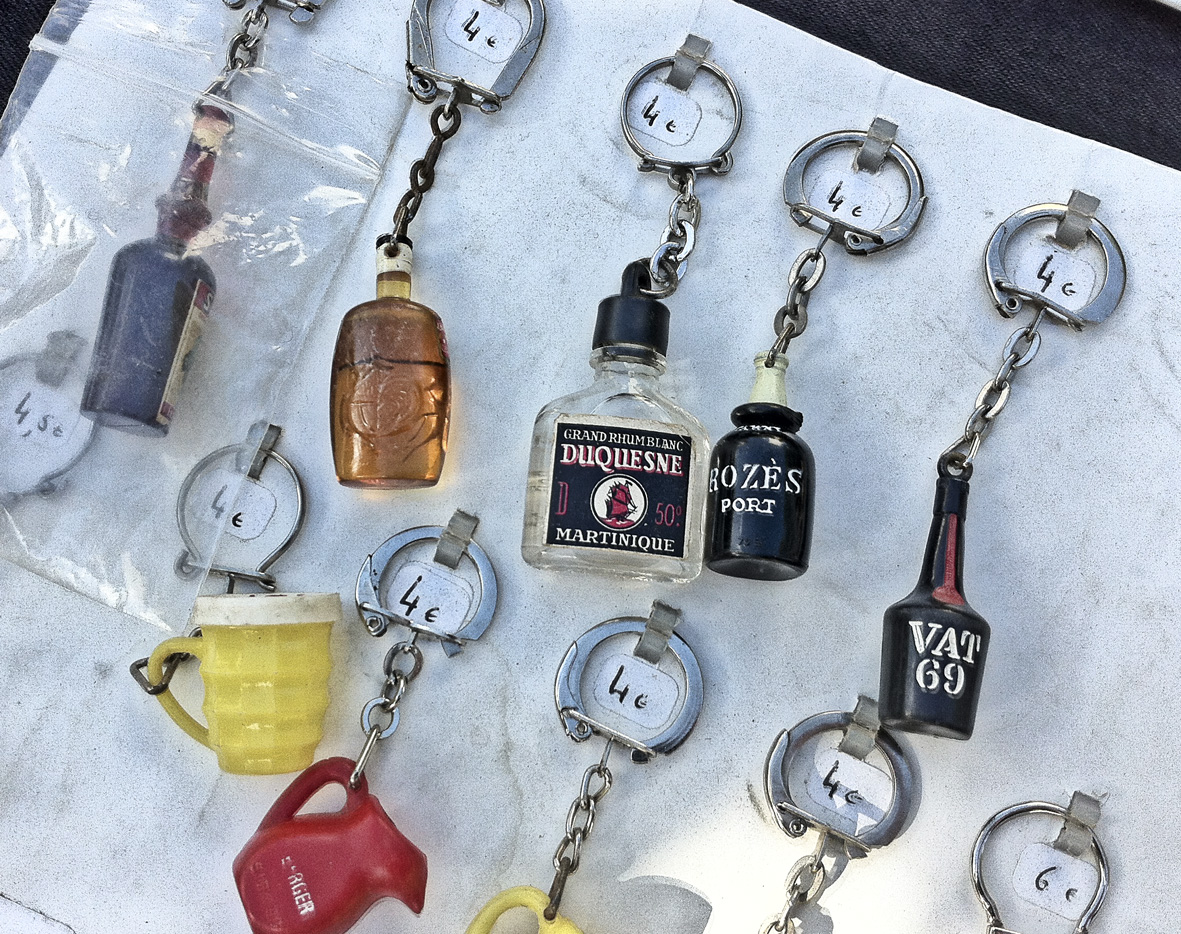
In Paris to see Leonard Cohen (there’ll be a Five Things extra later in the week, folks!) I found this keyring in Vanves’ antiques market. Is there a pun on de Cane [sugar] here?

Hound Dog Taylor Poster, aupassage Restaurant

I’ve been listening to Hound Dog Taylor lately and who should I find on the walls of an artfully lo-fi restaurant but the man himself, complete with great quote: “He couldn’t play shit, but he sure made it sound good!” I should point out that these were his own words, prefaced with “When I die, they’ll say…”

Five Things I Saw & Heard This Week: Wednesday 26th September

Then, Our Next Fixture Is Jethro Tull of Wiesbaden…
Montpellier boss Rene Girard has lashed out at the fixture schedule as his side continue to stutter in their title defence. Girard’s team have struggled in the early part of the season, while big-spending Paris Saint-Germain appear to be finding top gear. Girard was angered that his side had to play Arsenal in the Champions League on Tuesday evening and then face Saint Etienne just a couple of days later on Friday, where they managed to scrape a 1-1 draw. “I am not paranoid. I simply say that it’s a question of fairness. We played Arsenal, one of the best sides in Europe; we did not play Pink Floyd of Kiev,” Girard said scathingly. (I’m guessing that this is an amusing reference to Young Boys of Bern, who recently played Liverpool in the Europa league).

Stephen Collins vs Mumford & Sons. The Man’s A Genius!

Muse, Later, 25th September
Playing Madness, reigned in and close to the chest, they sounded for all the world like the house band in a bar in a Philip K Dick novel, with disco overtones. A Triumph!

Van The Man Sat-Nav: A Step Closer
My friend Steve phones up one evening, the sound of jazz behind him, as he leaves a message on the ansaphone: “Hi Martin, it’s Steve, I’m playing Van live and I just sort of realised the way to do the SatNav is to just play it and let me do it live… not that I can sing like him but you can do it if you’re listening to him, cos stuff occurs. But if you’re sitting there cold with a blank piece of paper you can’t do it. You realise when you’re listening to the tracks, like Tupelo Honey—“Well you can take the A45 or whatever…” and you can do it to the tune so it’s real. That’s the way we’ll do it, alright, Cheers!” So I download the set of instructions from the TomTom site and all I have to do is record Steve and figure out how to save the commands as OGG Vorbis files [what!?!] More anon…

I Saw The Splendor Of The Moonlight, On Honolulu Bay
We had a uke moment, in 1968, with the great Richard Perry-produced God Bless Tiny Tim album, then again in ’72 on Arlo Guthrie’s wonderful Hobo’s Lullaby. There were few sightings until Evan Hurd (great photographer!) gave us Israel Kamakawiwo’ole and his extraordinary “OK, this one’s for Gabby*” version of Over The Rainbow/What A Wonderful World in the early nineties. But now we have The Ukulele Orchestra Of Great Britain for all our ukelele requirements, busting their way through Ennio Morricone, Handel and Lady Gaga in a smorgasbord of styles and genres. At the Albert Hall on Friday they revisited the site of their Proms triumph of last year. Showing someone who’d never heard of them a clip on YouTube I was thrilled to catch Lloyd and I strumming Beethoven’s Ode To Joy along with 1,006 other ukes…

*That’s Gabby Pahinui, whose slack key guitar playing so inspired Ry Cooder that he went to Hawaii to make a record with him. He features heavily on Chicken Skin Music.

Five Things I Saw & Heard This Week: Wednesday 19th September

Oh, Lighten Up Man!
Wynton Marsalis, responding to Mojo’s
Questionnaire, in their November issue:
[I’ve cut this to just the opening of each answer]
What, if push comes to shove, is your all-time favourite album?
I don’t have a favourite album.
What was the first record you ever bought?
Bought? I don’t think I’ve ever bought a record.
Which musician, other than yourself, have you ever wanted to be?
I’ve never wanted to be another musician.
What do you sing in the shower?
I never sing in the shower.
What is your favourite Saturday night record?
I don’t think I’ve ever played a record on a Saturday night—I’ve played a gig almost every Saturday night since I was 13.

To be fair, the rest of the answer to Which musician, other than yourself, have you ever wanted to be? is interesting: “You have no idea what they’ve had to deal with. The person I rate for something musical might have had an endless headache, or a back pain. Every person has something you can’t imagine to deal with.”

Classified Ad Mann
So I’ve just filed an interview with Aimee Mann to Rock’s Backpages and it has this reference to a movie that she’s going to make:
“I’m actually doing a little indie movie. Joe Henry is involved in it and his brother, I think, wrote the screenplay. It’s based on a This American Life episode [TAL is a weekly public radio show broadcast on more than 500 stations, usually centering around a theme that tells stories from everyday life] about this journalist who thinks: suppose she got a bunch of musicians from Craig’s List, just kind of randomly posting, Looking for musicians, and forms a band and puts them in a studio for a day—what would that look like? So I’m playing that woman. And Joe Henry’s going to be in it, and John Doe is going to be in it and Loudon Wainwright… and Joe is doing the music for it. So it sounds interesting, right? Too bad I don’t know to act…”

The next day I get a mailer from a website I like that runs a weekly Mystery Song competition, and (click to enlarge):

The actual version of Rocket Man is, uh, quite interesting…


From the Hammersmith Odeon To Lillehammer: Steven Van Zandt

Van Zandt’s extraordinary profile, seen to great effect in The Sopranos and, this week, Lillyhammer, reminded me of the extraordinary first night at Hammersmith Odeon in 1975, picture captured here by courtesy of the battered Chelsea School of Art photographic department black Pentax, on Tri-X.


Why They Invented The Internet, And Why It’s Come Time To Shut It Down…

Yes, A Bob Dylan Tempest Commonplace, crowd-sourcing the sources of the lyrics on Tempest. They don’t want to read what Bob said about the plagiarism issue in Rolling Stone…


The Harry Smith Conference: A Postscript
Esteemed writer and documentary maker Mick Gold emails about the Conference: “Harry Smith conference had good stuff. Very detailed history of Moonshiners Dance Part One from Anthology, which was funny history of Minneapolis/St Paul. Rani Singh (director of Harry Smith archives) said that when they were reissuing the Anthology in 1997, they asked Alan Lomax for a comment. Lomax’s reply was dismissive, similar to Charters’ – Smith was a nasty piece of work, his Anthology wasn’t that important, he ripped people off. Clearly there are political tensions in how this old music was presented historically, and the message it conveyed. Remember that when Irwin Silber got involved in running Folkways in 1960s, he changed the Anthology cover, substituting a Ben Shahn FSA (Farm Security Administration) shot of a poor farmer for Fludd’s celestial monochord. Perhaps Alchemical versus Popular Front perspective.” Mick had earlier told me that in his opinion, Greil Marcus “created Harry Smith the Magus. Why? Because Harry offered Greil a completely different narrative on the uncovering & collecting of traditional songs & blues from the “voice of the people,” oppressed blacks, Lomax popular front orthodoxy. Harry offered alchemy, esoteric magic, mystification, and he came from the West, all big pluses in the eyes of Greil. Hence Invisible Republic.”

Five Things I Saw & Heard This Week: Wednesday 12th September

When Harry Met Sammy
I don’t normally like to these posts to be long, but as a piece of writing this is too good to edit down. This reminded me again that things are rarely as they seem, rarely as simple as outsiders perceive—those at the centre of events always have a much more complex perspective. And also it reminded me of the importance of primary recollections…

It started when Barney let me know a couple of months ago about an upcoming Harry Smith Conference, America Changed Through Music: Harry Smith’s Anthology of American Folk Music at 60, a one-day conference this Saturday September 15th. It’s hosted by the University of East Anglia’s School of American Studies at UEA London, and will explore the impact and ongoing legacy of an extraordinary cultural artefact—whew! I emailed one of the co-directors, Thomas Ruys Smith, as I’d been talking to Sam & Ann Charters about their time with Moe Asch at Folkways Records, and offered to put him in touch. He said he’d be delighted in Sam’s view. And then Sam emailed me with his view, which is brilliant (if off-message…)

“I’ve had a long, complicated relationship with Harry’s set. I first heard it in New Orleans in 1952 just after it first came out—a folk singer named Billy Faier in the French Quarter had it—then when Annie and I first began living together in 1957 the first thing we bought together was the Harry Smith set. $35 dollars—a lot of money for us. I liked some of it—some of it I already knew—and it all seemed to be to be just part of what had been going on with the reissues of old jazz and blues recordings since the 1930s. Fred Ramsey was doing a twelve volume LP reissue for Moe Asch of the history of jazz at the same time and his volume 1 had a lot of the same kinds of material. When I began working with Moe he said that he had been helping support Harry and they both were junking old 78s on 6th Avenue, just around the corner from the Folkways office. All the records in the collection were up in the office and half of the records that went into the set were his. He said that he and Harry had talked a lot about what they wanted from the set and of course it followed the outlines that the Lomaxes had set up in their folk song anthologies. The LPs were fine and fun—but no big deal.

But—for all those sixties teenagers the world began with Bob Dylan, and if he listened to the set it had to be the roots of everything that ever happened in America. Harry was living in the Chelsea Hotel all this time and in all my experiences with him he was a genuine horse’s ass. I had to shut him up sometimes when I was trying to record people in the Village and he kept drifting into Moe’s office begging for money. All his films were there as well, but I had seen a lot of experimental film and I didn’t think these were very exciting. His great things seemed to be the collection of painted Russian Easter Eggs in his hotel room, and his unending repertoire of string games. I edited an album of Allen Ginsberg’s readings and singing from tapes that Harry made in the hotel room, and at least he got a decent sound.

He made some scrawled notes for a Volume 4 and I was given the luckless task of trying to figure out what he wanted to include from his list—which drew down upon my head the wrath of everyone whose lives had begun with the original three volumes. Harry finally couldn’t pay his hotel bill, so Allen moved him in and supported him, which meant that Harry now became an iconic figure, since Allen always made it known that he only hung out with important figures. Before he died Allen set up in his will a legacy to pay for promotion of the Harry Smith legend. The woman who had the job was a fire-eater who often expressed her dislike for me, but I always felt that she was just doing what she was paid to do. There was eventually a Harry Smith celebration at the St. Marks Church on the Lower East Side where Harry was presented as the only person anyone knew who was probably at least as important as Jesus.

So that’s me and Harry—I wish some of these people could somehow see that what happened in the 1950s was just a continuation of the gathering and collecting of vernacular music in the South that had been going on for nearly a century. Everything I learned was from what people like Fred Ramsey and Bill Russell had done in New Orleans and the South in the 1930s—their recordings of musicians like Leadbelly and Bunk Johnson and Jelly Roll Morton—the books and articles and eventually LPs and films. Why does Harry get the credit for something that was much larger than his set? I dunnow.

I did a radio interview yesterday with someone in America who had just read The Country Blues and he wasn’t really aware that these things could have happened so long ago. At least the people obsessed with the blues don’t go on about Harry—they want to talk about the Stones and the other Brits. I try always to talk about other things, but there is always a silence. At least he didn’t ask me about Dylan.

You can certainly pass this on to Tom—a small muted protest.”

Thankfully, Tom felt that it was “a priceless perspective to get on things—a rich account from a significant individual.” As it is. My dad used to include a couple of the tracks when he did record recitals around the country in the late fifties. I found these notes he made about Richard “Rabbit” Brown’s James Alley Blues.

Bill Colyer Record Recital rough notes

Art Garfunkel: Walking/Singing interface
Reports MSN Music: We did not know that Art Garfunkel has been walking as part of his therapy. He’s currently walking across Greece, en route to Istanbul, a journey that began in Ireland and has continued in 100-mile installments over the past 10 years. He tells us: “I am singing while I walk! I sing because I need to find my voice—I’ve had trouble with it over the last two years—and I can’t live without singing.”

Duquesne by Bob Gumpert
Following last week’s mention of Duquesne, Bob sends these fantastic photos.

1986: Duquesne, PA. The abandoned Duquesne Steel Works, and a view of the dying steel town. Photographs by Robert Gumpert

On My iPod, Danny O’Donoghue, Metro
Fire and Rain by James Taylor. “This is such an emotional song and without doubt one of his best. It’s about the time he spent with junkies, in particular a girl called Suzanne.” Ah, Danny, with his simple, inaccurate view of the world…
The song actually chronicled Taylor’s experiences in mental institutions, such as McLean Hospital in Massachusetts as a senior in high school and his battle with drug addiction (The fire in the title refers to his shock therapy). “Suzanne the plans they made put an end to you,” refers to Suzanne Schnerr, a childhood friend of his who committed suicide while he was away in London recording his first album for Apple Records. Friends at home, concerned that it might distract Taylor from his big break, kept the news from him, and he only found out six months later.

Where’s My Harmonica, Albert? Why, In Beak Street, Bob, At Your Pop-Up Shop…
…just around the corner from Carnaby Street. Underwhelming. I bump into Mark Ellen, whose two-time-listen opinion of Tempest is “Five good songs.” Dead on. Or as my friend Lloyd said, “It’s like one of his theme time radio shows—but just him…”

Bobstore; Cinema downstairs, desultory Don’t Look Back showing; Shop floor and harp.


Five Things I Saw & Heard This Week: Wednesday 5th September

Black Tie White Noise
Evening Standard, last week. Bowie disputes claims made in the Observer by the V&A that he is co-curating the [Bowie Costumes] show. “Contrary to recently published reports: I did not participate in any decisions relating to the exhibition. A close friend of mine tells me that I am neither ‘devastated,’ ‘heartbroken,’ nor made ‘uncontrollably furious,’ by this news item.”

Really?
Interview with Kevin McDonald, Director of Touching The Void and Marley: “Q: Why do you think Marley’s music has proved so enduring? A: He wrote incredibly good tunes. Bob wrote more standards than almost anybody else, apart from Lennon and McCartney.” Did he? Standards? I Shot The Sheriff, Redemption Song, One Love, Three Little Birds, No Woman, No Cry, sure, but are his songs covered regularly, in the way that standards are? Marley’s number 211 on the SecondHandSongs database, a pretty comprehensive list of the most-covered songwriters, some way below Ozzy Osbourne and Marvin Gaye.

I Can Hear That Whistle Blowin’
My friend Steve Way on Duquesne Whistle: “Dylan vid weird. Like Bob is doing a phone ad song, and the director is doing a Sundance lo-fi Korean remake.” True say, Steve, but the world may be a better place for having this song in it—the chorus and thick, dirty riff are just joyous. Duquesne is a city along the Monongahela River in Allegheny County, Pennsylvania. Earl Hines, legendary jazz pianist, was born there. He signed my autograph book once.

I love that—”To, Martin, keep with it” written by Sinclair Traill, editor of Jazz Journal, who then joked around with Earl and they ended up signing their names as Sinclair Hines and Earl Traill…

“Even Cathy Berberian Knows/There’s One Roulade She Can’t Sing.”
The wonderfully titled Berberian Sound Studio featuring Toby Jones opens this week, named for Cathy Berberian, American soprano of the avant-garde. With Umberto Eco she translated works by Jules Feiffer and Woody Allen into Italian. You couldn’t make that sort of detail up. Eco nicknamed her magnificathy. Steely Dan paid their own tribute in the lyric above, from Your Gold Teeth on the Countdown To Ecstacy album.

Musical Marylebone
A few streets separate Joe’s monstrous urban flyover and John’s rather luxe pad. Of course, John’s background was rather more flyover than Joe’s…

Five Things I Saw & Heard This Week: Wednesday 29th August

Let Me Take You By The Hand, And…
Simon left a CD on my desk, sent in by a publicist, of a Ralph McTell sampler, featuring—of course—Streets Of London, with a post-it note on, saying “You’ll probably like this.” I had to disabuse him of that, and then we had a great fifteen minutes watching the fantastic Streets Of London sketch from Big Train, where Kevin Eldon plays a singer-songwriter whose audience won’t allow him to play anything other than the eponymous tune. It not only painfully highlights the one song career but brilliantly skewers the tyranny of a change-resistant audience.

Mark Goes To Memphis, R2
In this compelling documentary [in the interest of full disclosure, it was made by my brother-in-law] where Mark Kermode and his Rockabilly/Skiffle band, The Dodge Brothers head to Memphis to record at the legendary Sun Studios, a really lovely interview with Matt Ross-Spang, the in-house engineer at Sun. “This room is like your garage—white tile, you’re five feet away from the other person, there’s no booths and you gotta play quiet so’s you can hear the singer, and I don’t let you use headphones and you just put a good tape echo on it and call it done. Sam Philips, to me… was on a mission… so touched by music. Took me a long time to figure out but I started limiting myself to what he had in the 50s, a few extra mikes or somethin’ and once I figured out how we can get that feeling, that 50s vibe… [The Dodge Brothers] came in and the first song they did was No. 9 by Tarheel Slim, which is an old Sun song. Nobody knows that record… and they start playing it and I’s like “Oh that’s Tarheel Slim, No. 9,” they’re goin’—“No-one has ever known who sang that!” Of course I’m a rockabilly freak, so I know, but it’s nice to be able to have that conversation with somebody. Cause you don’t get to talk about Tarheel Slim to your girlfriend or anything… or anybody, you know?”

Weird iPod Synchronicity Pt3: August 23rd, Victoria Station, London
Just got to Irvine Welsh’s pick of Five Films in the Metro newspaper where he chooses Double Indemnity and then Eraserhead when David Lynch’s Pinky’s Dream explodes into my headphones. The song is a noir-sounding updating of Jan & Dean’s Deadman’s Curve with Karen O sobbing/pleading… “Pinky, what do you see? Flying down the road… Pinky, tell me, are you laughing, or are you crying? Watch the road, please Pinky, watch the road…” as guitars judder and lurch like an out-of-control Dodge careering down Mulholland Drive. “People go on about David Lynch’s visuals but one of the things he does better than anybody is his work with sound…” says Welsh, spot on.
No. of Tracks on iPod: 1,057.
No. of tracks by D. Lynch: 1

And Now A Message From Our Sponsors
Every advert on tv is poptastic at the moment. Every one. If it isn’t Lily Allen’s appropriation of Professor Longhair’s Big Chief in her song Knock ’Em Out (used by… Kinder Chocolate Eggs, of course) it’s The Trailer Trash Tracys’ Wish You Were Red soundtracking Renault’s new spot. It sounds “like an unholy mix of Best Coast’s Boyfriend, Sweet Jane and Baba O’Reilly,” as correspondents on the excellent website TV Ad Music point out. They also point out that The Trailer Trash Tracys are “hotly-tipped and rubbish-named.”

Sarah’s Record Collection
Rescued from a flooded room, featuring a great Jaques Brel cover photo, and a set of albums I’d forgotten about, which involved a slightly-less-than-stellar-star recreating Hollywood Gold, so that you could put it on the turntable, read from the enclosed script and play costar. I definitely had this Arlene Dahl one, and also, I’m pretty sure, Cesar Romero (but I’m not sure what film you could re-enact with him…)

Five Things I Saw & Heard This Week: Wednesday 22nd August

Garner-A-Go-Go! “This is Jim Rockford; at the tone leave your name and message…”
Talking to Aimee Mann about her new album, she mentioned being drawn to analogue synthesizers and gnarly guitars after revisiting some classics from the early eighties pop-synth era. Among the more obvious markers like the Cars and Blondie, it was great to hear her namecheck the terrific theme to The Rockford Files by Mike Post… and to hear her quote it at the end of the title track of Charmers.

Bits Of Bob
As excerpts of Tempest (not The Tempest—that’s Mr Shakespeare’s, according to Bob himself) filter out, we hear Early Roman Kings (fabulous title, no?) soundtracking some dreary looking US tv series, Strike Back… The song itself is a default Dylan accordion-led 12-bar that gives the band little room to move. Now that Charlie Sexton is back this is disappointing: at Hammersmith last year he showboated so much it could have been called The Charlie Sexton Show, featuring Bob Dylan, as he fired riff after riff into every available space, absolutely thrillingly…

Lyle Lovett, What I’ve Learned, US Esquire, February 2012 (yes, I’ve only just got round to reading it…)
“The inspiration and excitement that you get from being amazed when you give a vague direction to a guitar player like Dean Parks—“Make it sound a little more purple”—and then hear him play exactly the right thing.”

And Talking Of Purple: Fashion Forward Drummer, South Bank, Last Friday Evening

Never seen a drum kit this particular colour. Apparently it’s very… this season.


Photographers on Music: Brilliant!
The advent of blogging has revealed that photographers are a) really thoughtful and smart about their work, the world, the price of coffee, etc, and b) can really write. Here’s two I came across by chance this week. Firstly, Chris Floyd, on his blog Clean Living Under Difficult Circumstances, writing about a complex quick-turnaround portrait of Olympic Cycling Gold Medallist Laura Trott:

“I close my eyes and I think of the canon. The canon are the photographers I draw on in times of doubt. They give me comfort, solace and inspiration. They include Richard Avedon, Helmut Newton, Bruce Weber, Lee Friedlander, Sally Mann, Corrine Day, Glen Luchford, Erwin Blumenfeld, Harry Callahan and, in this case, Irving Penn… I go through the rolodex in my head thinking of them all until I find the one that instinctively feels like the inspirational match for the task at hand. That’s not to say I set about slavishly ripping them off. I use them as my starting point… They are my photographic moral compass. They show me the light, guide the way and keep me company. Once I push off and get underway I’m then going forward under my own steam. By the time I get to the other side I will have, hopefully, added enough of my own ingredients to the dish for it to taste new and different. To understand what I mean then check this out:

Bad Penny Blues by Humphrey Lyttleton (1956).

then this:

Lady Madonna by The Beatles (1968).

Each of them are great but one was a jumping off point for the other. I love it. You can hear the lineage right there.”

I also stumbled (is there a better way, internet-wise, to say this?) via the Black Eyewear blog, across the Secret Diary of Perou (photographer to the stars) and amongst factory-and-dog-related-posts read this fantastic account of his experience of seeing Elizabeth (Cocteau Twins) Fraser at Meltdown. If only more music writing was this good, or this well laid out:

“i am sitting on my own due to a late ticket purchase.
but i’m three rows from the stage.

we all make the mistake of sitting through 30 minutes of support act: four people doing acapella, harmonised, medieval chanting.
all songs sound exactly the same.
unexpectedly, it makes me want to punch someone: almost certainly not what this music was designed for.

elizabeth arrives on stage: a demure, grey haired lady with the voice of an angel.
during the second song: a reworking of a cocteau twins track, i feel tears on my face and i’m glad i’m sitting on my own.
i have crazy tingles over my spine.

but then…

behind elizabeth i notice the bald keyboard player who looks like richard o’brien in the crystal maze, wearing a sparkly, tinsel, double-width, pointed shoulder-padded outfit, postulating between two stacks of keyboards like a prog-rock nightmare.
he is more than a little distracting.
and begins the downfall of my evening’s entertainment.

the audience are annoying.
in between songs, old men shout out ‘we love you liz’. ‘marry me’ and ‘where have you been?’

there is a lesbian couple in front of me who try to dance though seated through all the cocteau twins songs.
one of these women also keeps trying to take photos of elizabeth on an iphone and keeps getting told by the ushers ‘NO PHOTOS’

i am no longer able to enjoy the performance when a girl arrives four songs before the end of the show to take her empty seat next to mine.

she is wearing an overpowering fragrance that smells like a combination of mountain pine fresh toilet duck and lemon fresh toilet duck.
i don’t know if she bathed in it pre-show or if she’s been drinking it, but i am unable think about anything else now.

i am concerned my nasal passages will be permanently damaged by sitting next to this person.

there are two standing ovations.
i sit through the first one
i stand through the second so that i am able to leave swiftly.

for the second encore elizabeth does a version of one of my favourite songs: ‘song to the siren’ which she did with ‘this mortal coil’ (a tim buckley cover)
and it is not so good.
i leave the royal festival hall a little disappointed.

sarah texts from the train station.
she’d left with steve before the first encore “…the memories were better.”

Genius.

Five Things I Saw & Heard This Week: Wednesday 15th August

Emusic Find Of The Week
“My name is Dale Hawkins, and I wanna dedicate this song… to the three cities… that I, uh… had the pleasure of recording this tune in! Give a listen and you’ll hear ’em.”—DALE HAWKINS, cousin to Ronnie, creator of the fabulous Susie Q (if you haven’t heard it in years download it now! James Burton’s guitar—out-of-this-world!). This is from L.A., Memphis & Tyler, Texas, title song of his obscure late sixties release, with Burton, Cooder, Mahal, Penn & Oldham all playing. It’s on the great compilation Country Funk 1969-1975. “Ain’t no bum trip, man,” he drawls over a particularly out-of-place flute solo. “It just goes to show ya, man, you can take the soul pickers out of the soul country, but you can’t take the soul out of the pickers…” As Pitchfork says “Weird, in a totally wonderful way,” and it’s hard to disagree.

From Dakar to Kampala!
We started two weeks ago at the football with Senegal’s lovely anthem and, in some excellent circularity, ended with hymne Uganda—“a musical treat” according to The Guardian’s Peter Bradshaw—at the final medal ceremony, in honour of Stephen Kiprotich’s stunning gold-medal run in the marathon. A musical treat it is—I’d pay good money to hear either Randy Newman or Garth Hudson do an arrangement…

Best Coast, 100 Club, London
I hadn’t been to the 100 since it was saved by Converse’s sponsorship. Very happy to see that nothing much had changed—remarkably branding-free and still sweaty, loud and rocking. Brett was playing bass and guitar with Best Coast, and I took his picture by the plaque that’s there for my uncle, his great grandfather, Ken.

Fifty Shades Of Tortoiseshell

Jazz-themed sunglasses from St Albans. Nice.

Take A Load Off RP
Robert Pattinson in French culture mag Les InRockuptibles: “I’m going to do a movie about The Band, the one that played with Dylan: a beautiful script about the nature of songwriting.” Mmmmmmm… I may be lost for words {although, to be fair, he comes over well in the interview}.

Five Things I Saw & Heard This Week: Wednesday 8th August

Killing Me Softly With Their Song
Now the second season of The Killing has come to an end I’ll hear no more the striking and enigmatic theme, my favourite piece of tv music. Some Great Detectiveness (© Bob Burden’s genius Flaming Carrot) leads me to find that it was written by a couple of London-based musicians (see Alabama 3/The Sopranos for similar US tv/London-based musician interface). Richard File and Wendy Rae Fowler perform as We Fell To Earth—name and logo influenced by the Nic Roeg/David Bowie film The Man Who Fell To Earth. I resolve to find out more…

Readers/Writers
Aditya Chakrabortty in The Guardian: This week Aditya read David Remnick’s profile of Bruce Springsteen. “Is it a sign of age when you read a music piece not because you like the singer, but the journalist?” I don’t think it is. My guide to the quality of writing in a magazine has always been the same—how many pieces have I read here that are about subjects that are of no, or little, interest to me. The higher the number, the better the writing.

Desert Island Discs 1; Saro by Sam Amidon.
In the performance with Bill Frisell live at the Poisson Rouge on Vimeo. Sam essays the song’s chords on an old dustbowl-dull Martin, a professorial Frisell to his left as they take this beautiful ballad for a stroll down by a clear flowing stream. Frisell is such an inspirational player, and, playing off Sam’s elegant and affecting plainsong, wraps his fearless, serpentine lines around the vocal. It’s a wonderfully openhearted performance, and Bill’s smile at the end treasurable.

The Musical Life, New Yorker, July 23
Watts said the difference between playing jazz in clubs and playing rock and roll with the Stones was the volume. “Also in jazz you’re closer,” he said. “In a football stadium, you can’t say you’re closely knit together. It’s difficult to know what Mick’s up to when you can’t even see him. He’s gone around the corner and he’s half a mile away.”—Alec Wilkinson

Olympic Music
The BBC have pulled out their Battles and xx mp3s with a vengeance for the Olympics, tracking short films about the rowers or cyclists with choice selections, but the overwhelming memory of music at the Games will be Vangelis’ bloody Chariots Of Fire. At first I thought the IOC and LOGOC had just done away with the National Anthems altogether in the Medal Ceremonies and gone with the uplifting, glorious and triumphant™ Britfilm classic, but it turns out that it just soundtracks most of it, before ending with the winners anthem. Ol’ Vangelis’ royalty cheque should make interesting reading…

Five Things I Saw & Heard This Week: Wednesday 1st August

Busker, Waterloo Station, 29 July
Playing Jimi Hendrix riffs. Not songs—just riffs. I figure he thinks that the most anyone hears is about 25 seconds, and that he should stick to what he does best, which involves a lot of flashy hand waving and facial grimacing. I gave him £1 for the way he fluttered his hand away from the strings after playing a particularly nice Purple Haze pastiche.

Stand Up For Senegal!
Alone among the national anthems that I’ve heard at this Olympics, the Senegalese song doesn’t have militaristic percussion and brassy horns. It actually has a pretty, pastoral tune, which seemed to float round the stadium rather than bounce off the metal girders, as Uruguay’s did. Senegal went on to float past the Uruguayan defence and win 2-0, playing with ten men for most of the match.

Sounds In Silence
Re-parking the car late the other night. The street is eerily quiet, as is the car, and the radio unexpectedly leaps into life at top volume. Jesus! But it’s only our old friends, Simon and Garfunkel, singing The Sound Of Silence, in the Tom Wilson “Folk Rock Overdub Mix”. I’m not sure that I’ve ever really listened to this but it’s great. Subtly done, albeit in a chart-friendly kind of way, with Bobby Gregg particularly good on drums as he follows Simon’s fingerpicked acoustic. But it’s such a strange notion, isn’t it—to, without the knowledge, cooperation or consent of the act, re-shape the track so radically. And, in the process, reform the act and help to make it huge.

How We Made… The Piano. The Guardian, August 1st
MICHAEL NYMAN Composer/“I had listened to recordings of Holly Hunter, who played Ada, performing Bach and Brahms and thought she’d be best suited to reflective, lyrical music—and useless at the usual Michael Nyman-type stuff. I must have pitched it right because she played with an emotional power that still influences me whenever I perform the score. The soundtrack helped define the feel of the film as it was shooting: Hunter said, as she accepted her Oscar, that it helped her create the character of Ada.”
JANE CAMPION, Director/“The only brief I gave Michael was to compose quite a few pieces that we could choose from. I let him have free rein, but we’d discuss what he’d done and I’d tell him if something could be sadder or happier. When he first visited, I hired a piano thinking he’d want to work through a few ideas, but he sat down, played a couple of notes, and said: Let’s go shopping! I assumed this was a musical genius at work, so decided I’d better go along with it. I trailed him all afternoon, while he bought a shirt and watched some cricket. Finally, I asked if he’d had any thoughts and he said he’d decided to research Scottish folk songs. I knew immediately that this was perfect.”

Bowie: Backsides/Mugshots
Stumbled across two David Bowie artifacts this week: A bootleg of a 1980 TV Show recorded at the Marquee Club, Wardour Street, London, in late October 1973 for the American TV show Midnight Special. I remember that somehow we got tickets and queued down the Soho street for hours to get in. I wasn’t a great Bowie aficionado but I do remember the show, with all its stop/start filming and endless retakes, as being really thrilling. Bowie was backed by the Spiders From Mars, but with Aynsley Dunbar on drums. Luckily, Mick Rock, who was photographing it, wrote about it for Music Scene: “The space in the Marquee is too limited to permit the requisite number of cameras to film simultaneously, so each song had to be reshot from different angles several times. This entailed as many as five or six performances of the same song…. the atmosphere generated by Bowie’s own unique craziness swiftly transformed the clubhouse into something closely resembling a circus ring – Dali style. Throughout Bowie was very patient, very up. He filled in the intervals between takes rapping with the audience, teasing, laughing. After each song he would disappear immediately, reappearing dramatically on cue for the next one in a new costume. He was joined by Marianne Faithfull, in a nun’s cowl and black cape, for the last song, the old Sonny and Cher hit, I Got You Babe. He frolicked about in the true spirit of the song while Marianne watched him, deadpan throughout. During one long break between takes she turned and left the stage, and paraded a pretty bare bottom, as the split in her cape flew open.” I remember that quite vividly.

Secondly, this, the most composed, fashion-forward police mugshot of all time.

“David Bowie, Iggy Pop and two female friends were busted for felony possession of half a pound of marijuana back in March of 1976 at the Americana Hotel in Rochester, N.Y., following a nearby concert. Bowie was held in the Monroe County jail for a few hours before being freed on bail—but this swanky mug shot wasn’t taken until he returned a few days later to face arraignment. The four ended up skating on all charges.”—Joe Robinson, diffuser.fm