FTIS&HTW: Wednesday 27th February

Psychic City by Yacht
I can’t even remember what this song was used for this week, tracking an advert, or a programme segment, or something. All I knew was that it hit all those Blondie/Ze Records/Waitresses buttons. Great—almost dumb, possibly smart—pop.
“I used to live in a voodoo city,
Where every little thing had its own secret life.
I might be washing up the dishes
And the kitchen might say,
“Hang around baby baby, hang around baby baby,
Hang around baby we’ll be baking a cake for you…”

And for when you have a few minutes to spare…
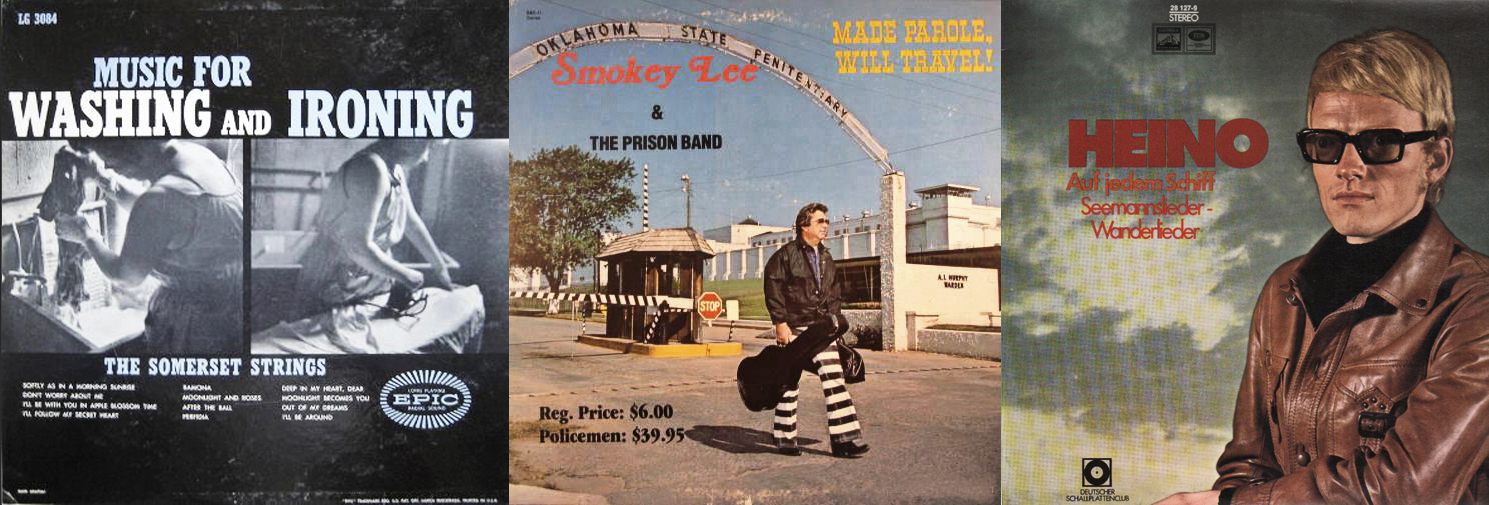
says Steve Caplin, and directs me to http://www.facebook.com/AwkwardBandAndMusicianPhotos. The first two are my favourites from a quick browse. The third? In the week that Heino releases a new album and it shoots to the top of the German charts here’s one he made earlier. As The Guardian reports:  “The album contains cover versions of punk, hip-hop and hard-rock hits—to the disgust of many of the bands who originally performed them [this in reference to Heino’s alleged far-right views].” Heinous, no?
But Made Parole, Will Travel! may just be the finest album title ever…
Covers

Johnny Marr, Shortlist interview
Can you remember the moment you fell in love with the guitar?
“Yeah, I was four or five and there was a little wooden toy hanging in the window of a shop that sold mops and buckets and brooms around the corner from my house in Ardwick. Whenever we walked past it I’d be doing that thing that you see dogs on a lead do, where they just dig into the pavement and don’t move. My mother got so sick of it that she bought it for me. I painted it white and stuck on beer bottle tops to make it look like an electric guitar, and I carried that thing around everywhere. I couldn’t believe it when I discovered there were shops that sold real ones…

Jack&Natty

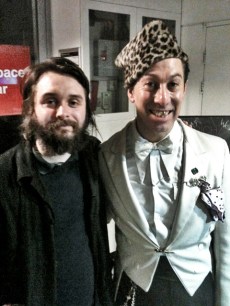
On the left: Natty Bo. Marcel’s Nephew Jack. Not in that order
Note to self: definitely catch the next Yiddish Twist Orchestra gig.

“And the sun don’t shine anymore/And the rains fall down on my door ”
From Rolling Stone via Dave Ashmore: “The Band’s Garth Hudson saw some of his belongings sold off this weekend by his landlord in a Kingston, New York, garage sale after failing to pay rent on his loft space for about seven years. The multi-instrumentalist, most-known for his organ and keyboard playing, kept the space for storage. He stored everything from personal possessions and household items to handwritten sheet music, and among the goodies are uncashed checks, including one issued from EMI in 1979 for $26,000. Hudson’s Facebook page had a note to fans encouraging them to attend the garage sale and purchase items to allow Hudson to buy them back. “We were told everything there was sold,” read the note. “We were not seeking funds, but were asking purchasers to allow us to reimburse them for what they bought as we were not on premises ourselves.” The owner of the space has already made an agreement with an online auction company to sell off the music-related items on April 1st. As for the fans, they’re already on it: one woman bought Hudson’s household items and personal belongings for a few thousand dollars with the apparent intention to return them to him.”
FTIS&HTW: Wednesday 20th February

What I’ve Learned, Thom Yorke, US Esquire
“My grandfather would come to our house in the countryside, borrow one of our bikes, and disappear. He’d come back after dark and we had no idea where he’d been. If he ran into anybody, he’d just ask them where the good nightclub was. He did that right up until his nineties.”

The Disarray Of Staff Benda Bilili

Benda
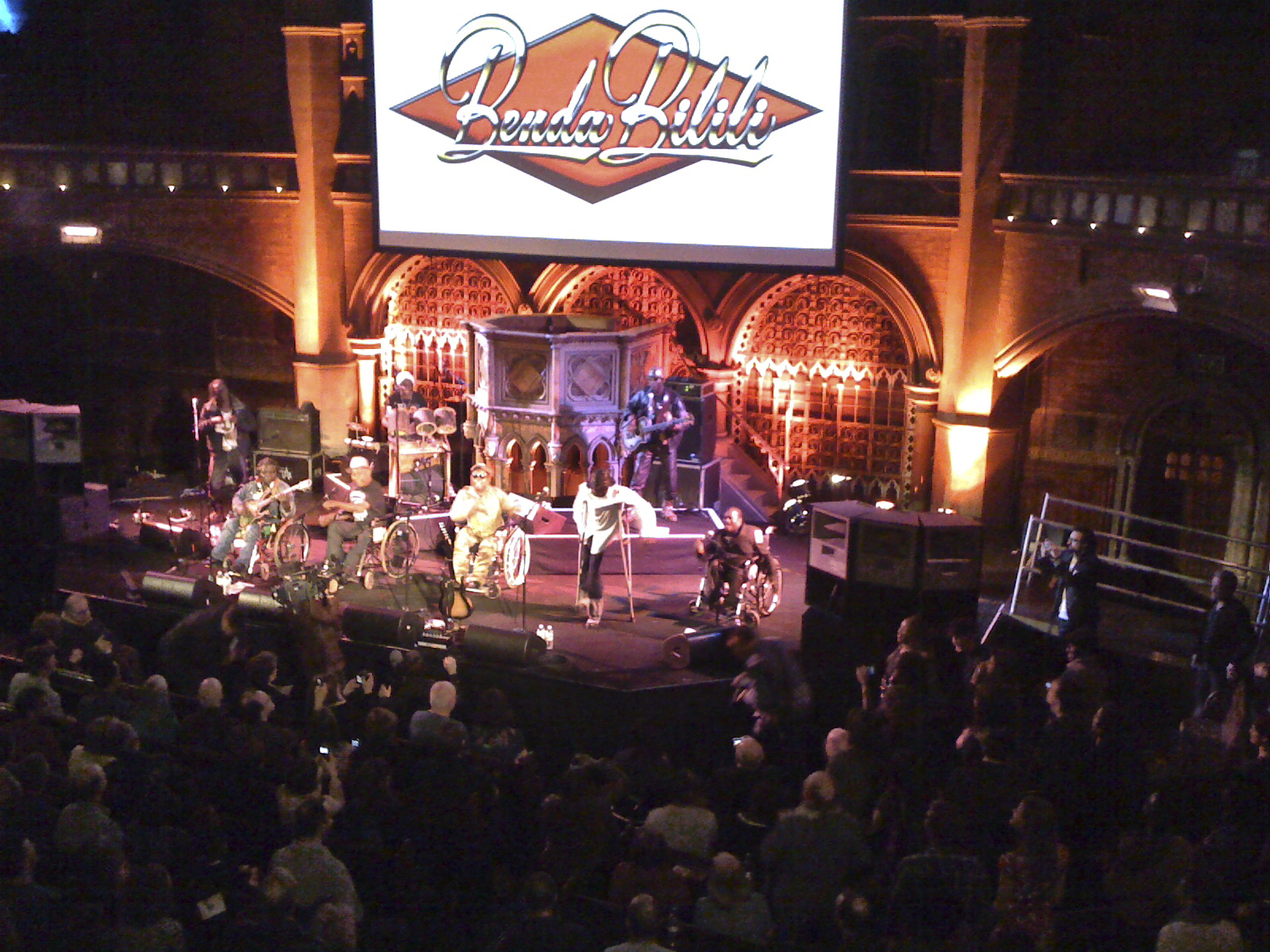
Sad news that SBB are no more. Last year, Marcel and I went to see a preview of the film telling their story, followed by the band in concert, and both were wonderful. The film’s an uplifting piece of work full of great scenes (my favourite being when teen genius Roger—player of self-invented tin-can and wire instrument, having just been found downriver and asked to join the band—is given a stern talking-to by his mother and sister). The show was as riotous as a concert in a chapel can be, and finished with some of the finest dancing I’ve ever seen, especially as most of it was done by men on crutches and in wheelchairs.

Mr Hyde Mailout, extolling virtues of “Birmingham Scene”
IS THIS THE NEXT BIG MUSIC SCENE? shouts the headline. “What do you know about Digbeth? We do have one useful thing you should know about it: it’s been lazily dubbed the “Shoreditch of Birmingham” thanks to three young bands who are rising to prominence after spending their formative years hanging out there. Is “B-Town” 2013’s version of Madchester? Meet the major players and decide…”

So I do. I Soundcloud them all. Three bands from the, uh, West Midz. First up is Swim Deep: According to Mr Hyde, “producing ethereal, synth-heavy music that’s unashamedly poppy, yet also soulful and endearingly rough around the edges.” The band’s vocalist says “[Birmingham bands] are making the UK’s best music. It’s not all the same like in other scenes–it’s a really varied sound.” Mmmm. I say: Ordinary boy vocals. Ordinary melodies. Tinny beats.

I try number two. Jaws. Mr Hyde again: “their fuzzed-out shoegaze-indebted sound can’t remain in the shadows for long in any era that sees a new My Bloody Valentine album so warmly received. The vocalist says: “I heard someone describe us as Ian Curtis In LA, which is pretty cool.” Right. Ordinary boy vocals. Ordinary melodies. Tinny beats.

Sensing a pattern I move to number three, Peace. My Jekyll (sorry, I mean Mr Hyde): “Their gift is writing complex, Foals-esque tracks but with huge, sing-along choruses. The vocalist says: “Our music should make you want to shake and make you want to cry at the same time. And sometimes it should make you want to party.” Ordinary boy vocals, more guitars than the others, slightly less tinny beats.

I’ve got to say, five minutes in the company of each of these bands only made me think Where’s the new here? Why are they all so satisfied with replicating what’s gone before? Why are all the vocals so… dull? And how desperate are journalists to discover a new “scene”?

Lately, A Ken Colyer State Of Mind

Dobells Listeners

Before filming an interview with John Williamson and his charming crew for a BBC 4 documentary, I had looked out some hopefully useful material. Among my favourite finds was this picture, taken by the Brighton Evening Argus, of Doug Dobell’s first shop, shopfitted by my dad, in 1956. The programme, to be shown in late May, focuses on the British Jazz Revival of the late Forties and early Fifties. My job was to help illuminate the extraordinary trip that Ken made to New Orleans in 1952, jumping ship in Mobile to play with some of his heroes, breaking the law in several ways to do so. I also recently compiled this piece for The Stansbury Forum about Ken’s pilgrimage, based on reminiscences and letters from Goin’ Home: The Uncompromising Life and Music of Ken Colyer.

The Mad Opening Number of A Chorus Line
My mother’s birthday. A show. The pre-opening night, the last of the previews, where the audience seems packed with the cast’s relations, which gives a peculiarly heightened air to the whole performance. It’s actually pretty great—in some ways a weirdly prescient view of Reality TV’s audition process—but my favourite musical moment comes right at the beginning. The opening number I Hope I Get It pits frenzied Seventies Lalo Schifrin wah-wah disco, all tom rolls and rim shots, against the Tin Pan Alley tune of the refrain, “I really need this job/Please, God I need this job/I’ve got to ge—t this jo—b.” Cue massed jazz hands and that particularly Michael Bennett-style of angular shock dancing. Magic!

FTIS&HTW: Wednesday 13th February

Down Terrace
An in-your-face saga of the spiralling disintegration of a Brighton criminal clan, the music track for Ben Wheatley’s first film (from 2009) is a fascinating mix of transatlantic rural music. The none-more-English folk music of The Copper Family sits happily next to Robert Johnson’s Little Queen of Spades. Sea Shanties segue into acts of appalling violence while the plaintive, pain-wracked Are You Leaving for the Country? by Karen Dalton soundtracks the disposal of a body. And as terrible as that sounds, the music acts as a kind of “life goes on” comfort, especially in the scenes where the father, played by Robert Hill, sits playing guitar with his band of friends in the living room at the house in Down Terrace.

B Kliban: Lady Gaga’s Stylist, About 30 Years Early
Talking to Adam about the genius of the Canadian cartoonist, and—looking out one of his books—finding this great cartoon.
kliban

Thoughts While Running with Kid Charlemagne by Steely Dan in the Headphones
I’m struck by how this Seventies classic would work as Breaking Bad’s theme tune:

“On the hill the stuff was laced with kerosene
But yours was kitchen clean
Everyone stopped to stare
at your Technicolor motor home…”

“…Now your patrons have all left you in the red
Your low rent friends are dead
This life can be very strange…”

“…Clean this mess up else we’ll all end up in jail
Those test tubes and the scale
Just get them all out of here
Is there gas in the car
Yes, there’s gas in the car
I think the people down the hall
Know who you are…”

I don’t listen to Larry Carlton’s fantastic shape-shifting guitar solo, I don’t listen to Bernard Purdie’s lickety-split drumming, I don’t even listen to Paul Griffin’s funky Clavinet. I just listen to Chuck Rainey’s sublime bass, pumping and prodding and pushing and powering the song along.

From My Friend Bill in the States
ps:  you’ll be amused to know that I’m performing in a Grateful Dead cover band called Feels Like The Stranger, playing our first gig in a Stamford CT bar on March 7th! I’m playing all the Bob Weir rhythm parts on an 18 song set list… sounds easier than done! That dude was all over the place re: chord shaping!! My left hand is a cramped, gnarled and numb mess… thus the name of the band… : ) C’mon on over, I’ll put you on the comp list : ))

Flight (Cassette) Deck
With The Cowboy Junkies’ version of Sweet Jane, Bill Withers’ Ain’t No Sunshine, The Red Hot Chili Peppers’ Under The Bridge, and Marvin’s What’s Goin’ On, Flight is a film about alcoholism and addiction masquerading as a legal/action thriller—with a terrific soundtrack, and a nicely indie feel for a mainstream Hollywood production.

Look out for an FTISHTW Extra! on Bob ’n’ Bette’s Buckets Of Rain Session coming soon

Five Things I Saw & Heard This Week: Wednesday 6th February

From The Blog Of Photographer Heather Harris
“The first four words of vocabulary we learned in Synthesizer 101 class at UCLA (circa 1972, so we’re talking monophonic ARP 2600s) were the descriptions of all musical sound notes: attack, sustain, decay, release. How fitting to the lifeworks of creative types.” Wow. Attack. Sustain. Decay. Release. That’s a manifesto right there, and a great title for a project…

Martin Carthy on Bob Dylan on Desert Island Discs
“The influence of British folk music shows in his later work—he started writing these really anthemic tunes… he was a great performer, a wonderful performer. I don’t believe that anybody who saw his first performance at the King and Queen down in Foley Street would be able to say he gave a bad performance. He stood up, did three songs, absolutely knocked everybody flat. People loved him.”

Is it right that you used to share a flat together?

“No [exasperated exhale]. This story started going round that he stayed with me when he came to London—no, he didn’t. But we did actually chop up a piano. The piano was a wreck, half the keys were missing and it was a very, very cold winter and my wife and I decided to chop up the piano so we took it bit by bit. And by the time Bob came along we were down to the frame. And I’d been given, for my birthday, a Samurai sword and Bob came round to have a cup of tea, and Dorothy—my then wife—said, “Make a fire, Mart,” so I got the sword, and he stood between me and the piano and said, “You can’t do that, it’s a musical instrument!” I said It’s a piece of junk and went to swing at it and before I could swing at it he was whispering in my ear, Can I have a go?

The London Jazz Collector Thinks (A Regular Feature On His Wonderful Site)
“A bent piece of metal pipe with holes called the saxophone transforms human breath into a voice, drums extend the pulse of the heart beat, a piano exchanges ten for eighty-eight fingers, while the bass is the feet on which music walks. Instruments are physical extensions of human form and function that transform man into musician, the ultimate analogue source. Whilst the vocal singing voice can be beautiful, (though often, not) how does it compare with a stream of triplets and sixteenths soaring from Charlie Parker’s alto? It strikes me that not only are records the new antiques, they are works of art, the equal of art framed on gallery walls. You are not just a mere record collector, a figure of fun and pity, poking around in dusty crates. You are, in that immortal expression of Charles Saatchi, an artaholic, in need of a life-sustaining drink.”

This Fabulous Photograph Of John Lee Hooker Explaining It All
John Lee

“I’m not getting any younger, but I’m not feeling very old, Not shoutin’ for my cemetery tomb soon, I’m gonna wait ’til John Lee Hooker makes room…”
Garland Jeffreys, ’Til John Lee Hooker Calls Me, from his latest album (can we still say that?) The King Of Inbetween, where, with the help of the great Larry Campbell, he continues to plow a furrow of his own making, never beaten down, a streetwise NYC poet, part Lou Reed, part Doo-Wop, part John Lee, still a ghost writer with 35mm dreams.

And From Next Week…
For you loyal seventeen followers—or Seventeen Spurious Widows, as an unreleased Bob Dylan song would have it—after one year or 52 posts, and prompted by a great time spent helping out Richard Williams on his new blog (thebluemoment.com, go there now!), a redesign—and to kick it off, a special issue devoted to Bob Dylan and Bette Midler’s hilarious and fascinating Buckets Of Rain session.

Five Things I Saw & Heard This Week: Wednesday 30th January

What In Music’s Name Is This?:
Marcel’s Miller/Moptops Mayhem

A small package arrived in the post. Square, the size of a CD. It was a ESD* and was covered in writing. There was no mystery who it was from, as it was signed, but it had an air of mystery around it.
“Martin, follow these five simple steps to nausea and amazement. 1. Log on to http://forgottenalbums.com/albums/?p=59. 2. Bask in a warm nostalgic glow as you enjoy the album cover. 3. Read the blog, remembering that this guy is not making this album up. 4. Play the CD 5. Ask yourself ‘Why?’ P.S. The guitar solo on Let It Be is THE FINEST thing I’ve ever heard x Marcel.”

Marcel

From:      Martin Colyer
Date:       24 January 2013 07:56:31 GMT
To:           Marcel Ashby
Subject:   Has a song not benefited from the…
Glenn Miller treatment more than Something? God Almighty, that’s horrific! Oh, hold on, I’ve just listened to Michelle. Still trying to locate the original melody. Let It Be? Let It Stop, more like. I’m thinking you shortened it by one track (that great Beatles classic, Bird Cage Walk) just out of the kindness of your heart. I must lie down now.

At least they spent some money on the cover

At least they spent some money on the cover

Oh, and don’t get me started on that guitar solo in Let It Be, which seems to actually be playing a different song. It’s as if there was a surf guitarist walking past the studio door playing, and they grabbed him, hit record and didn’t miss a beat. The fact it has nothing to do with the tune of Let It Be, or, indeed, any tune, is neither here nor there. And the last two notes are to die for. Or something.

*Evil Silver Disc, according to vinyl obsessives.

In Bob News This Week
First impressions, Inside Llewyn Davis Trailer
1) They’ve captured the look of 1962 New York rather well.
2) It’s nice that a lesser-known Bobsong soundtracks this teaser.
3) Looks like Carey Mulligan has some good lines.
4) Bob-strokes-cat a little earlier than Guy Peellaert would have us believe (although the character of Llewyn Davis could equally be based on Dave Van Ronk).
5) John Goodman will have plenty of raucous lines, and his will be the haircut of the film.
6) Fresh from Homeland, F Murray Abraham as the owner of the Gate of Horn Nightclub in Chicago. Which makes him Albert Grossman in this scenario.
7) Oscar Isaac’s teeth are in way-too-good condition for 1962.

Uh Huh—It Was The Manfreds
From Tom McGuinness’ sleeve notes for the Manfred Mann Ages Of Mann compilation CD:
“Bob Dylan’s Mighty Quinn was our third number One. Al Grossman, Dylan’s manager, played us the song.“Why does Dylan get such a useless vocalist to sing his demos?” Manfred asked. “That’s Bob singing”, said Al.”
Oh, and I never knew that Jack Bruce was in Manfred Mann. He plays bass on the great Pretty Flamingo. Or, indeed, that Klaus Voormann replaced Bruce when he left.

Aimee Mann, Ghost World, RFH, Jan 28th
My favourite moment at Aimee’s concert (thanks, Barney!) was her performance of the best post-school/pre-life song ever written. Prompted by a twitter request, this rarely-played (and unknown by the rest of the band) gem stood out. Named for, and inspired by, Daniel Clowes’ great graphic novel, every glorious line rang clear, sat on the cushion of Aimee’s patented J45 strum—“Finals blew, I barely knew/My graduation speech/And with college out of reach/If I can’t find a job it’s down to dad/And Myrtle Beach”—joined by bassist Paul (Mountain Man) Bryan’s harmonies and the trippy off-the-cuff keys of Jebin (Freak Flag) Bruni, all carnival swirl and hum. And by coincidence, watching Community the following night (your next must-rent boxset) and having Jeff and Pierce’s hysterical Spanish Project performance acted out to Aimee’s Wise Up.

Dateline: New Orleans. Brett Mielke Reporting…
“Well, the record shop I first went to and bought Ken’s records back in 2003 survived Katrina and the slow death of record stores! Had a visit and bought a wealth of KC music. Also had a long chat with the clerk who was about my age and knew an unbelievable amount about the music. Fear not, relatives of all generations, the Ken Colyer legacy is still alive and well in the Crescent City…”

NO

Five Things I Saw & Heard This Week: Wednesday 23rd January

Daughter Reviews Les Mis
Running time: 2.5 hours
Spoken word count: 17
Number of times Hugh J cries: 6
Most used facial expression: anguish mixed with constipation
Most enhanced facial feature: lines around the mouth
Number of times stolen bread is mentioned: 12
Laugh-out-loud moments: Sasha B-C and Helena B-C as pick-pocketing inn keepers
Time it takes Cosette and Marius to fall head over heels in love: 4 seconds
Most moving songs: Anne H/I Dreamed a Dream and Samantha Barks/On My Own
Supporting Show Stealers: Daniel Huttlestone as Gavroche and Samantha Barks as Eponine

Reasons That Awards Are Stupid
Chose between these acts for Best International Male at the Brits:
a) Bruce Springsteen b) Frank Ocean c) Goyte d) Jack White e) Michael Bublé

Amazing Facts From Patrick Humphries’ Biography Of Lonnie Donegan, King Of Skiffle
“The first record Art Garfunkel remembers buying for himself was Lonnie’s Rock Island Line; and in Fairfax, California, that same Lonnie song was the very first tune that a shy 17-year-old Harvey Phillip Spector learned to play on the guitar. In New Orleans, the young Dr John—Malcolm “Mac” Rebennack was another who remembers being inspired by the Donegan hit. And way, way down in Texas, Jerry Allison and his buddy, Buddy Holly, were so captivated by Donegan’s Rock Island Line that they began incorporating it into shows they played around Lubbock.”

“Can You Dance To It?”
Listening to a CD lovingly compiled by my friend Tim, of African singles [African Serenades 44: Kenyan Singles] and finding this quote from him on the back: “I taught near Eldoret for two years in the early 1980s, fell in love with the music and then found that my Zigzag-reading, album-sleeve-obsessive completist’s mindset was completely turned upside down because, of course, none of the friends I made cared about who was responsible for that amazing guitar solo or impassioned vocal on individual songs. All they were concerned about was, “Can you dance to it?” Which isn’t a bad take on things when it comes down to it…”

Priceless
Teaser on rocksbackpages.com: “No one can define creativity. If you don’t have it, you can’t expect to understand it…”
Wham!’s Andrew Ridgeley to Smash Hits (1984)

Snow-based Pop Criticism, Marylebone High Street
One direction


Five Things I Saw & Heard This Week: Wednesday 16th January

Marianne Faithfull interview, The Guardian
The Guardian: There’s a fantastic YouTube clip of you in 1973, wearing a nun’s outfit, singing with David Bowie at the Marquee club. It’s like watching an early Lady Gaga.
Marianne Faithfull: “I’ve known that ever since Lady Gaga came along­—I did it much better and long before you! Working with David Bowie was very interesting, but I couldn’t surrender to it. I should have let him produce a record for me, but I’m very perverse in some ways. He’s brilliant, but the entourage were rather daunting.”

It’s amazing how large the Marquee looks in this clip. It was a tiny place, but the US tv crew filming this special in ’73 have made it seem much more expansive. I remember the band looming over the audience. And the costumes. I remember the costumes. But very little else, so it was great to see the space-rock Sonny & Cher again, and to hear the lovely guitar obbligato from Mick Ronson.

I Should Have Known…
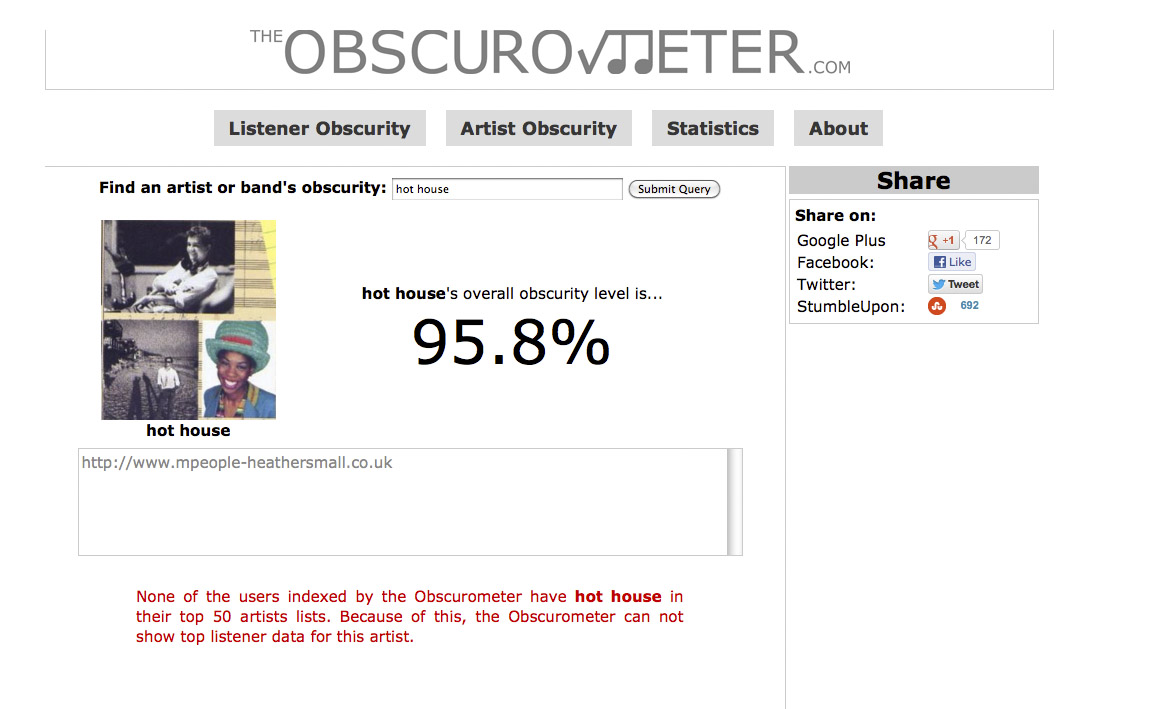
“What is the Obscurometer? Simply put, it’s a tool to measure just how obscure the music you listen to is.” And with that, people who are—or were—in bands, typed their bandnames into the dialogue box and hit return. And, I’m guessing, got a similar result percentage-wise…

Obscureometer

Excellent David Bailey quote
I once saw the world’s grumpiest photographer give a lecture at the Marble Arch Odeon in London. Everyone before him had done lavish slide shows with overviews of their ouevre. Bailey handed a polaroid to a person in the first row and asked them to pass it along. So it was passed along, row by row, as he talked brilliantly about his career, cameras, lenses, models… In the Guardian Weekend Questionnaire he was asked Which living person do you most admire?, and answered: Bob Dylan, because he is like a singing Picasso.

Motörhead: “Down. Down. Stop! Up, Up, A Little Bit, A Bit More—Great, That’s It!”
Lemmy has launched a line of Motörhead branded headphones in the United States. Specifically made for listening to rock music, the all-metal headphones are called Motörheadphönes. “People say we’ve never sold out. No one ever approached us,” said Lemmy, at the US launch earlier this week. I didn’t realise until recently that I saw a very early Motörhead gig (their eleventh), supporting Blue Oyster Cult at the Hammersmith [remember No Sleep ’til Hammersmith?] Odeon. We had gone because BOC had a kind of rock-crit cachet as being “intellegent” hard rock. My lasting memory was of Larry Wallis trying to tune his guitar between songs without turning off his fuzz box (ah, loved those pre-electric tuner days) and getting helped by the audience, as illustrated by the headline…

This Guitar, British Heart Foundation Charity Shop, £25
Made in Valencia by the firm of Vicente Tatay Tomás—not top of the line— with a huge crack along back held down by sellotape (but hey, hasn’t Wille Nelson proved that extra holes in guitars have no effect on the tone…)

Guitar

Five Things I Saw & Heard This Week: Wednesday 9th January

Weird iPod Synchronicity Pt4: Hyde Park Corner, London
As Lana Del Ray sparks into life in my headphones, hitting the chorus of Day At The Races [And I’m off to the races/Cases of Bacardi chasers/Chasing me all over town…] a trap and four outriders, all jodhpurs, riding hats & crops, trots in front of the bus, past Apsley House, and makes their way into Hyde Park.

On The Road Again
Fact Of The Week: At number 17 in the Highest Earning World Tours last year, Leonard Cohen is ahead (at £28.4 million) of Justin Bieber… and at Number 27, The Black Keys are ahead of Celine Dion, having grossed $23.5 million. The Black Keys. $23.5 million. Wow…

emusic Find Of The Month: Menahan Street Band, The Crossing
Recorded in a studio paid for by a Jay Z sample, by some of the musicians behind Sharon Jones and Charles Bradley’s sound, mostly during the night, this instrumental album is wonderful. Some of it is Spaghetti Western, some a kind of handicraft Portishead—try Ivory & Blue: jazz horns, soulful wah-wah guitar, funky Seventies pop drumming. Just the right amount of loose, just the right amount of tight, just the right amount of great.

Jeff Buckey: Three Films In Pipeline…
But the one I’m looking forward to (Brendan Fletcher’s A Pure Drop) is written by the fabulously named Train Houston. You’d have to gravitate towards music in some form with a name like Train Houston.

Bowie Back, Nile Rogers Bio, Letters Of Note
One the evening before David Bowie’s return to PopWorld™ I was reading Nile Rodgers’ very entertaining biography Le Freak, and had reached the part where he talks about recording Let’s Dance with the label-less Bowie.

“As I say to vocalists who are singing a little flat, sharp, or out-of-the-pocket, We’re in the neighbourhood, but we haven’t found the house yet.” David Bowie helped me find the house.

Not long after I arrived in Switzerland, Bowie strolled into my bedroom with a guitar.“Hey, Nile, listen to this, I think it could be a hit.” What followed was was a folksy sketch of a composition with a solid melody: the only problem was it sounded to me like Donovan meets Anthony Newley. And I don’t mean that as a compliment. I’d been mandated to make hits, and could only hear what was missing… I started reworking the song. I soon discovered the diamond in the rough.

[We] asked Claude Nobs, creator of the Montreux Jazz Festival, to round up a handful of local musicians… gone were the strummy chords… I’d replaced them with staccato stabs and a strict harmonic interpretation. I used silence and big open spaces to keep the groove and kept rearranging it on the spot, like I always did with Chic. David quickly got down with the reshaping of his song. We had a lot of fun and laughter in that Swiss studio with those terrific musicians… Laughter is the key to my sessions—the unconditionally loving parent in the room.”

And from Letters Of Note: In November of 1970, a month after signing a five-year publishing deal with Chrys­alis Music, 24-year-old David Bowie wrote the following letter to Bob Grace, the man who signed him, and briefly filled him in on his life so far:

November 17th, 1970
Haddon Hall

Mr. Bob Grace
Chrysalis Music Ltd
388/398 Oxford Street
London W1

Dear Bob
I was born in Brixton and went to some Schools thereabout and studied Art. Then I went into an Advertising Agency which I didn’t like very much. Then I left and joined some Rock ’n’ Roll Bands playing Saxophone and I sang some which nobody liked very much.

As I was already a Beatnik, I had to be a Hippie and I was very heavy and wrote a lot of songs on some beaches and some people liked them. Then I recorded Space Oddity and made some money and spent it which everybody liked.

Now I am 24 and I am married and I am not at all heavy and I’m still writing and my wife is pregnant which I like very much.

LOVE DAVID

Five Things I Saw & Heard This Week: Wednesday 2nd January

Pop Music Lives!
The Graham Norton Show. Girls Aloud. New Single. Love Machine. I roll my eyes at the title. But it’s great, a cracking pop single, with hints of Sweet’s Ballroom Blitz. And, as the chorus powers into view, at the back of my mind, a nagging What Else Does This Sound Like? It only takes a few demented minutes of humming. Step forward The Butterfield Blues Band…

Ok! Hep, Two, Three, Four…
Woodstock Soundtrack, original vinyl, Side Six. The Butterfield Blues Band. Featuring saxophonist “Brother” Gene Dinwiddie. “I got a little somethin’ I’d like to lay on y’all, if you’ll bear with me a minute… please. We’re gonna do a little March right along thru now… It’s a Love March. We don’t carry no guns and things in this army we got. Don’t nobody have to be worried about keepin’ in step, and we ain’t got no uniforms—we’re a poor army. In order to keep our heads above the water and whatnot, we sing to one another, and play to one another and we trying to make each other feel good. Ok! Hep, two, three, four…” On the back of a great Rod Hicks bassline and Phillip Wilson’s martial drumming, Dinwiddie gives his all to the uber-hippie lyrics. As feedback crackles around Buzzy Feiten’s guitar, the horn section (featuring David Sanborn) riff like the most soulful Marching Band ever. And it certainly could be the inspiration for the Girls’ songwriting team, although I doubt it.

John Barry: Licence To Thrill (BBC Four Doc With A Rotten Title…)
I’d totally forgotten his great score for The Ipcress File. It uses one of my favourite instruments, a cimbalom (a kind of hammered dulcimer). One night I was in Budapest at a conference and we were all taken to a Hungarian Folk Dance dinner. It was, hands down, the loudest thing I’ve ever witnessed. The stage floorboards were percussively assaulted by the dancers’ boots and our insides were assaulted by the unholy bass vibrations that this set off. There were two cymbalom players at either side of the stage, hitting seven shades out of their instruments. The pitch of the treble strings as they were struck by the hammers was enough to take the top of your head off. Instant Migraine. Brilliant. I bought the CD.

“Tis The Song, The Sigh Of The Weary, Hard Times, Hard Times, Come Again No More…”
Laura Barton’s wonderful Guardian column, Hail, Hail, Rock & Roll, was one of the inspirations for me to do this blog, so I was sad to read of her hard year in the round-up of favourite moments by Guardian music writers. Here, she talked honestly about the past twelve months, and a rare bright moment. “This was not the happiest of years for me; all through January, on into spring and the summer, I took a slow lesson in falling apart. I could no longer see the beauty in anything—days stood grey and flat, food was flavourless, even music seemed muffled and blunt. By the first Tuesday in March I was experiencing daily panic attacks, and often felt too fearful to leave the house. But that evening Future Islands were playing the Scala in London… They played my favourites of course, and it was one of the finest gigs of my life, but what really made it was the stage invasion—a sudden surge of excitement at the beginning of, I think, Heart Grows Old, and suddenly we were all up there, dancing among the cables and the synths. And I remember in that moment looking down from the edge of the stage, out at all the bright faces and euphoria and glee, and feeling my chest swell with a brief, sweet gulp of long-lost joy.”

R.I.P Fontella Bass
Rescue Me. The best Motown song that was never on Motown, the best Motown bassline that wasn’t a Motown bassline (played by Louis Satterfield). Fontella Bass was a powerful singer, who made some wonderful gospel albums. The one I could find this morning was From The Root To The Source. It has Phillip Wilson, co-writer  of Love March (see above) on drums. To further cement the Butterfield link, I found a YouTube clip of Fontella in the 80s, singing Rescue Me on Dave Sanborn & Jools Holland’s fabulous Sunday Night, with Sanborn on sax. In memory, we’ll play some Fontella Bass tonight.

Bass

Five Things I Saw & Heard This Week: Wednesday 19th December

Dark Was The Night, Cold Was The Ground
As we drove along Spain’s Costa Tropical, past the last remaining sugar cane factory in Europe, the sky turned orange and Blind Willie Johnson came on the CD player. I don’t really have the words to describe this performance, but it may be the loneliest sound ever committed to shellac. Driving as the sun fell it stilled the conversation. Ry Cooder’s soundtrack to Paris, Texas is pretty much based around it. from wikepedia: In 1977 Carl Sagan and a team of researchers were tasked with collecting a representation of Earth and the human experience for sending on the Voyager probe to other life forms in the universe. They collected sounds of frogs, crickets, volcanoes, a human heartbeat, laughter, greetings in 55 languages, and 27 pieces of music on the Voyager Golden Record. Dark Was the Night, Cold Was the Ground was included, according to Sagan, because “Johnson’s song concerns a situation he faced many times: nightfall with no place to sleep. Since humans appeared on Earth, the shroud of night has yet to fall without touching a man or woman in the same plight.”

Sky

Tony Staveacre, Letter To The Guardian
“Ravi Shankar did a great kindness to a young television director in November 1968. The great man was performing a raga in the BBC Riverside Studios (behind the Hammersmith Odeon) to be broadcast as part of the trendy BBC1 pop series How It Is. The trainee director had told the recording engineer to load a 20-minute videotape—that’ll be long enough. But it wasn’t. A raga is an improvisation, unpredictable in content and length. So the tape ran out while the maestro was still playing. The director, close to tears, had to go down to the studio floor, apologise for his incompetence, and plead with the musicians, Would you mind doing it again? The response was a shrug, a beatific smile and: Of course we can – and it will probably be better this time. And it was. The director was fired shortly after that, by telegram. I’ve still got it.”

Wayne Shorter On The Miles Davis’ In A Silent Way Recording Session, Mojo Magazine
“When we recorded it [in February 1969] there were no written-out parts. Miles didn’t want to know what you were going to play. “Play music that doesn’t sound like music,” he once told me. It was to get you out of your comfort zone… if he heard someone practising, he’d say, “Don’t practice!” He told John [McLaughlin], “Play the guitar like you don’t know how to play the guitar.”

In Praise Of Sinead
Clearing the hard drive, I watch an episode of Later from a few weeks ago. Amongst the dreary hipsters (yes Foals, that’s you—the world doesn’t need a Prog-Rock-Slash-Funkapolitan in 2012—songs that want to be instrumentals but still seem to have words) and the old soulsters (Graham Central Station—Where’s Sly? We need Sly! Larry has a microphone attached to his bass by a gooseneck. We can see why this has never caught on. Awful bass sound. They forgot to bring a song) and the Primark Bonnie Tyler that is Ellie Goulding, there is Sinead O’Connor, She is singing Nothing Compares To You. She has a flaccid band (imagine her backed on this song by Marc Ribot and Jay Bellerose instead, for instance) and by rights the song should have been consigned to the I’ve heard it too many times—it has no power left pile in the corner. But. But. She is one of the great natural singers of our age. There’s not an unmelodic note. Hell, there’s not an unmelodic breath between the notes… She rips the bloody guts out of the song and leaves them on the studio floor, focused on extracting everything it has to give. And, even when it’s just her breath you’re listening to, she sounds like no-one else on earth, and that’s a rare, rare thing.

Blue Note? Is That A Code Name?
Ever see something that you wished you’d thought of?
And something that you know how hard it is to do well?
Take a bow, Ty Mattson at Mattson Creative.

Homeland