Five Things: Wednesday 26th February

Of Time And The City
I caught twenty minutes of Terence Davies’ great half doc/half memoir, his love letter to Liverpool. From the Korean War footage, overlaid by the Hollies’ “He Ain’t Heavy, He’s My Brother” – a mixture that shouldn’t work, but does – through Terry’s hilariously voiced-over Yeah Yeah Yeahs when the Beatles come on-screen, to the stunning slum clearance/building of the tower-blocks sequence set to Peggy Lee singing “The Folks Who Live On The Hill”, it never fails to move. If you’ve not seen it, you can watch that scene here.

Jason Wood: The film shows you a Liverpool beyond The Beatles and football, which is what people tend to think about when they think about the city. Your narration is very significant. It lends character because it is so impassioned.

Terence Davies: What was odd was that I was writing this commentary as I was doing it and recording it as a rough guide. We got someone to do part of the narration, but it just didn’t work and the producers said, No, you must do it. I was worried that when you hear your own voice, it can sound a bit like the Queen Mother after she died. All my films have strong Liverpool accents. It always makes me feel a bit embarrassed… At one point they asked me to put in how I lost my accent and I said, “You can’t be serious? You really can’t be serious? I’m not doing that.” I was worried and I was staying with my sister Maisie and I said, “When did I lose my accent?” and she said, “You never had one!”

I have no illusions about my work but I must add I have no illusions about anybody else’s either. I am very strict with myself and I think, “no, that could have been improved”. It was what I thought was right at the time – and you have to stand by that. And if it completely fails, you have got to say, “But that is what I meant at the time.” There’s a line by Vaughan Williams, I think it’s on his Sixth Symphony, when he says, “I don’t know whether I like it, but it is what I meant.” And that’s a wonderful thing to say upon your own work.

Tim Sends This Link
…to Postmodern Jukebox’s rather lovely twenties-styled version of “Sweet Child O’ Mine”, perhaps inspired by Bryan Ferry’s take on his back catalogue. “My goal with Postmodern Jukebox is to get my audience to think of songs not as rigid, ephemeral objects, but like malleable globs of silly putty. Songs can be twisted, shaped, and altered without losing their identities – just as we grow, age, and expire without losing ours – and it is through this exploration that the gap between “high” and “low” art can be bridged most readily.” – Scott Bradlee, founder. Well, OK, Scott! File alongside The Ukelele Orchestra Of Great Britain and Pink Martini. Oh, and the Sad-Faced-Clown version of “Royals” rocks, too. Are you listening, Michael B?

A Quote I Really Liked
Laura Barton talking to Willy Vlautin, singer/guitarist with Richmond Fontaine: We’re sitting in an empty London pub, where the clipped twang of Vlautin’s Nevada accent seems to lift the gloom. Though he now lives in Oregon, he grew up in Reno, his father leaving home when he was four. His mother was left alone to raise their two sons. Although Vlautin was “so shy that I could barely go to school”, he was a diligent student who never seemed to be paid back with good grades. He lived largely inside his own head. “I’ve used escapism as a crutch my whole life,” he says. “I hated being a kid, so I escaped. But I never thought of myself as a rich guy driving a Cadillac hanging with James Bond. I was pragmatic. My big dream was to have an uncle that owned a wrecking yard and then I could just work there, and he’d actually like me and he’d make me dinner. And I would live in that fantasy world. I’d wake up every morning and check in.” …he’d actually like me and he’d make me dinner… That’s a line that could make you cry.

Live Music Extra:
1. Dotter scolds me for not mentioning her ‘awesome’ wedding band

And it’s true. I was so tired after the wedding I could barely think what to say. The band was put together by Mike Pointon, who I collaborated with on Ken’s book, alongside Ray Smith. It was made up of musicians who had played with Ken Colyer (Mike, since he was nineteen) supported by sons of Ken’s peers on drums and bass. They really swung. One guest, bowled over, assumed they’d been together for years, and at the end asked Mike how long “The Lavender Hill Mob” (the venue was on said hill) had played as a unit, and Mike answered “About three hours.” The acoustics were great, the sound of the musicians tight and warm, and the repertoire wide-ranging. Even when they were playing softly during the meal, people were applauding the solos. I’ve never seen that happen at a wedding before.

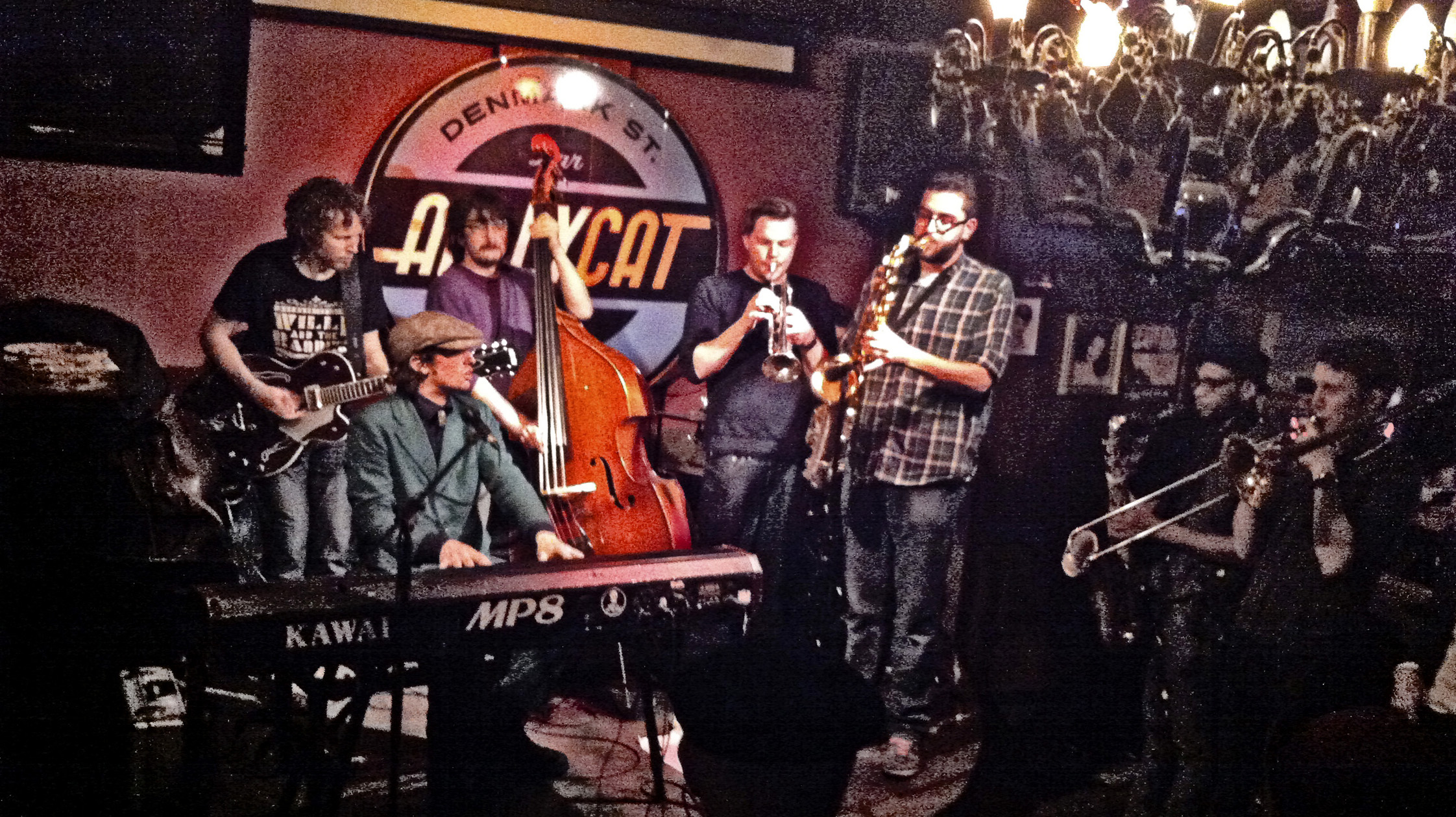
2. Jaz Delorean at The Alleycat
Alleycat
At the Iko’s Record Shop night, it was Lee Dorsey time, the highlight of which was Dom Pipkin’s wonderful re-imagining of “Working In A Coalmine”, in which he left the rhythm section behind and proceeded to conjure up all sorts in a trance-like meditation. I heard Scott Walker, Stravinsky, Booker, and Dr John before he got back on the straight and narrow… The evenings are always fairly ramshackle, with misses and hits, but there’s usually something like this to treasure. Jaz Delorean delivered my favourite band performance with a terrific take on Louis Prima’s medley of “Just A Gigolo/I Ain’t Got Nobody” on the crowded, tiny stage, featuring fabulously sleazy horns and a winning vocal from the guitarist (with the crowd on the chorus). Anyone trying to get to the women’s bathroom had to run the gauntlet of the four horn players (and an accordionist) who couldn’t actually fit on the stage.

3. Avant-improv at The Harrison
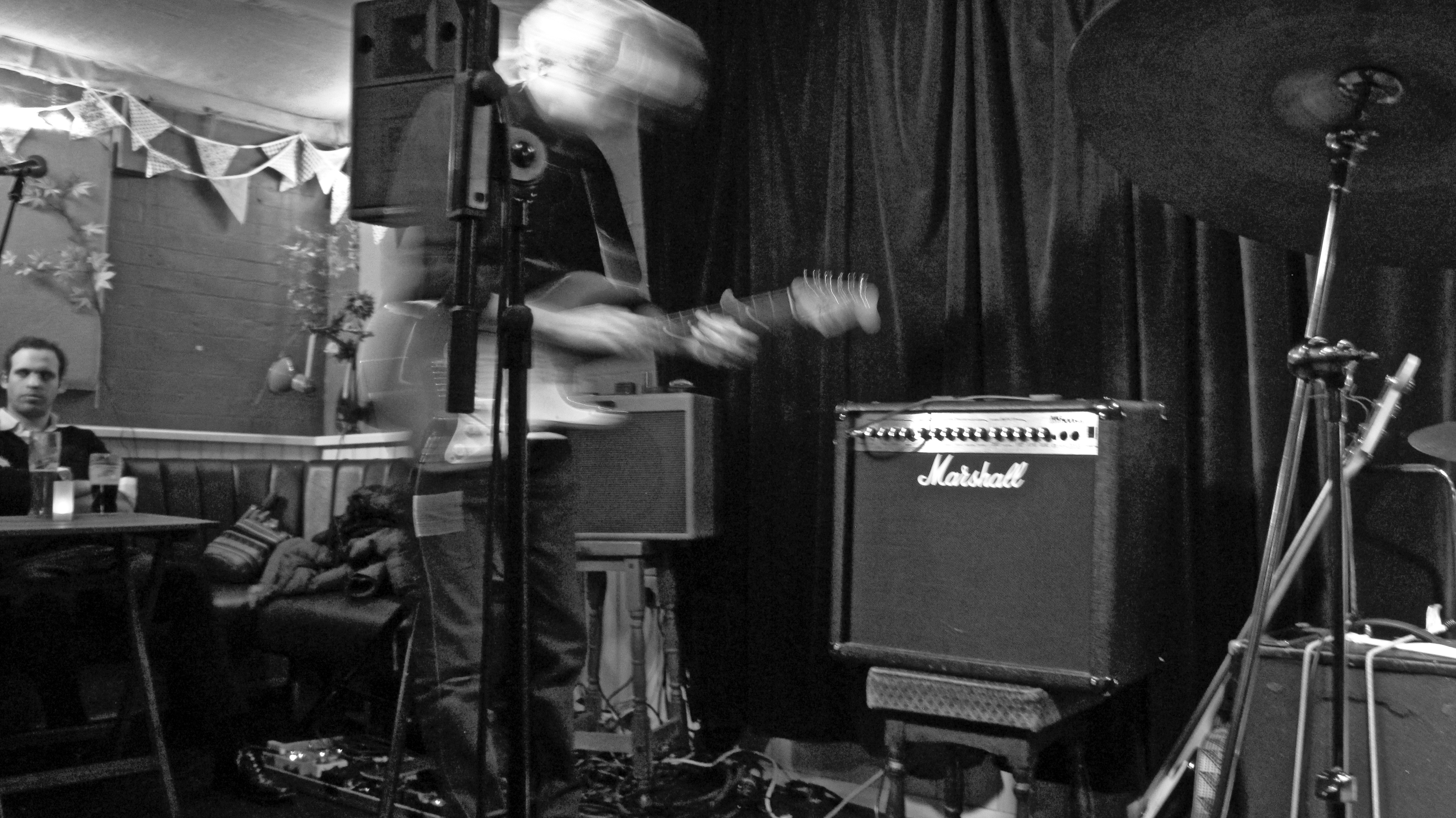
Mark and Tom describe their band, Throttling Tommy, as “the unlistenable in pursuit of the unplayable. A blues-rock power trio without the Marshall stacks and the bass player, who hasn’t turned up. And who have forgotten how to play blues. Or rock. Or anything else, for that matter. Allergic to songs”. A pretty succinct description, if you ask me, and their first gig doesn’t disappoint. I’m a sucker for funk drumming and trem-bar harmonics/histrionics, and they sound wonderful together in this blanket-covered de-mobbed bunkhouse, playing forty minutes without a safety net. Tom has a lovely line in, er, tom/cymbal interfacing, and it’s always fun listening to Mark trying to avoid anything as shocking as a melody. Video here.
Mark

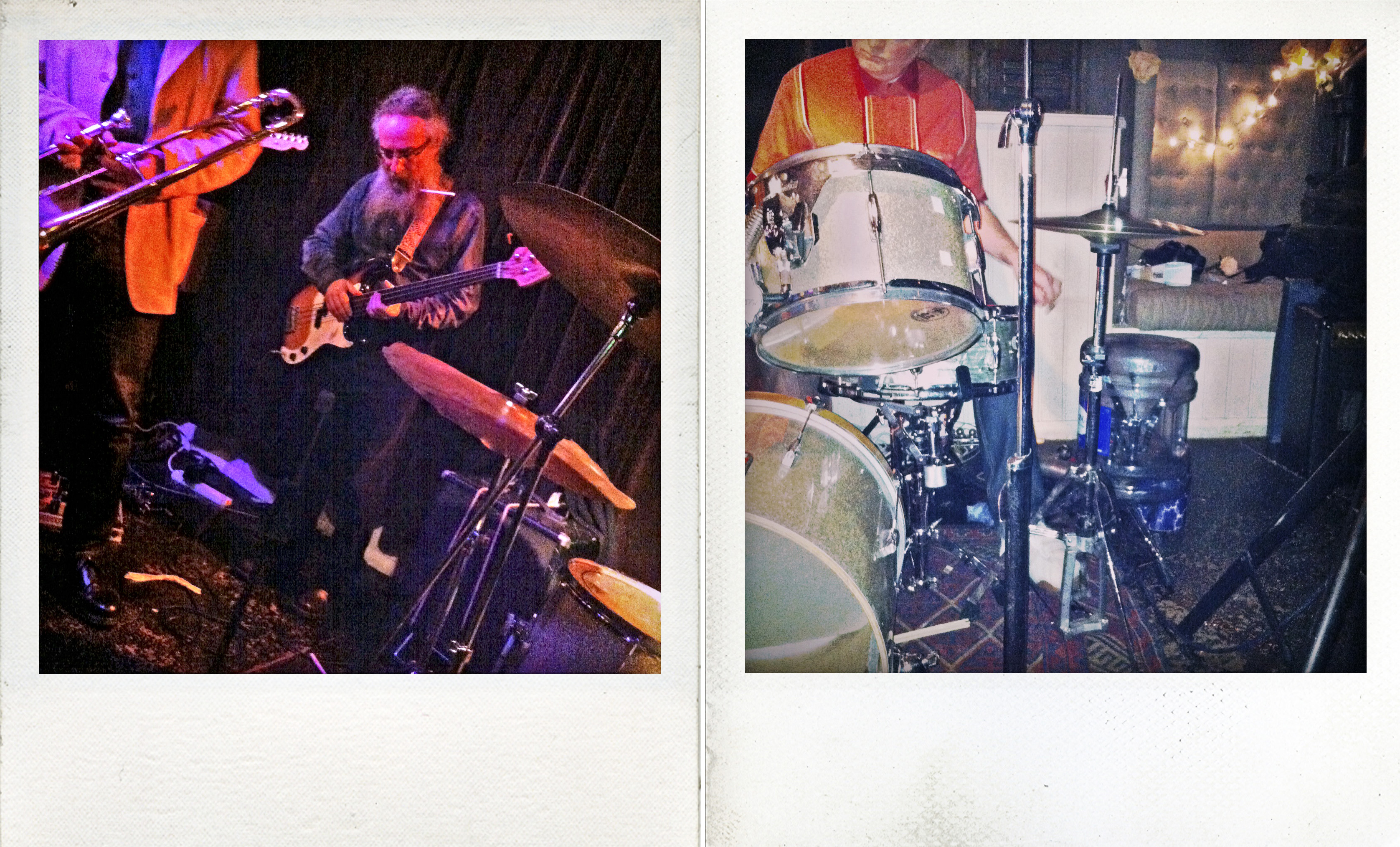
Headliners Horseless Headmen were tight and fascinating. Stand up, G. Painting (guitar, effects king), Paul Taylor (trombone, fabulous tone), Nick Cash (drum kit and percussion, check out the upside-down water bottle) and Ivor Kallin (fretless bass guitar and chopsticks in beard). I love a gig that almost ends when an audience member shouts as an improvisation closes, “That was brilliant! You’ll never top that!” and the band actually have a discussion about whether playing another number (which there’s time for) is a hostage to fortune…
HH2

From our Woodstock Correspondent, John C
“Saw Prince a few times myself. Once in Denver he came out while Vanity 6 was setting up, sat down at a piano to the side of the stage and played for a half an hour. No mic, just for himself. The most mind-boggling stuff. We were up front and close enough to hear. If memory serves, I believe The Time came up after Vanity and before Prince. One of the funkiest nights of my life. I was levitating.”

Five Things: Wednesday 19th February

After last week’s scheduled interruption…

A gift from Bob & Sandy, in which stunning clay figures mash the Day Of The Dead with celebrity icons
Name all six, Win A Prize!

MexicoPrince’s plectrum from his first visit to London, 1981
As Prince plays small gigs in the capital, from front rooms in Leyton to the offices of The Guardian, a look back… I knew of Prince because my friend Mick had given me Prince, the album. I was working in my first  job at the Radio Times and went to the Lyceum  show with two friends from work, Sue and Ruby. I remember it being virtually empty as there hadn’t been much publicity. It was the Dirty Mind band of Andre Cymone on bass, Lisa Coleman and Matt Fink on keyboards, Bobby Z on drums and Dez Dickerson on guitar. The keyboardists were disguised (Matt Fink had some kind of radiation suit on) and the frontline wore underwear and trenchcoats. Quite mad. It was a spectacular show, with Prince’s guitar playing  outstanding, and they went down a storm with the few hundred people there (mostly music-biz types, I think). I was right at the front (well, the whole audience were, actually) and close enough to catch Prince’s plectrum.

Prince

I have a memory of Prince being bad-tempered, not with the audience, but at the empty hall. He stomped off at the end throwing his pick rather petulantly… and cancelled the rest of the tour. I recently read the brilliant Ian Penman on this gig. He hated it. Really, really hated it. See for yourself in this cut-down excerpt (I know I shouldn’t but it is pretty long: “For a wolverine habituee of the sharper clubs and bars of our capital such as myself, this tawdry ‘gig’ was something like a step into the horrors of Hieronymous Bosch from the accustomed gilt-edged decadent sumptuousness of Klimt! The dry ice and fright lights – whose calculated effect is undermined and rendered pretty pathetic by way of the Lyceum’s half-emptiness – turn out to be a good index of the Prince live repertoire’s ancient grasp of sub-cultural subtlety: the plot doesn’t thicken, it keeps its consistency. Heavy, stodgy, overdone, tasteless, lacking in spice or space – you get the picture? ‘Outfront’, Prince prances in unison with his two guitar cohorts – they walk it like they talk it, as the saying goes, every song split down the middle or battered to bed with the tedious exaggeration of third-rate Heavy Metal. Someone remarked to me the next day that oh, you know what these young chaps are like with their Hendrix fixations. Hendrix? It never began to shimmer with a hint of the historical avant-shapelessness or spirited slipstreams or sexual harangues of a Hendrix! This was calculated – Madison Square Garden here we come! – coldly choreographed strut rut muzak, in which context Prince’s thigh flashes and camp come-hither persona is stretched pretty thin. My two fellow funkateers and I unanimously elected to wander away from the endlessly guitar wrenching spectacle after about half an hour – we didn’t really even ‘walk out’; it was more of an embarrassed shuffle.”

I, on the other hand, was obviously taken in by the dry ice and the third-rate Heavy Metal. I still am – see the music player on the right…

Annie Clark review, from our French Correspondent, Steve Way
“St Vincent was awesome at Le Cigalle – small theatre venue, great fun – she has the arty moves, channeling  a deranged Barbie rock android. Did the whole gig, including climbing steps, on high heel strappy black pixie boots. Fiona most impressed.”

Tip Jar in Attendant, a Victorian Men’s urinal turned cafe in Foley Street. Highly recommended for Ironwork, and coffee

Tipjar…and on the playlist as we ate breakfast, The Tallest Man On Earth. Rather great, all in all.

Oh, and I thought I might write about the soul-sapping Brits…
but every record tells a story does it better. Except he fails to mention the strange absence of any discernible talent in Ellie Goulding, Kate Moss’s voice (don’t speak, don’t break the illusion), the pitiful MasterCard plinth, Pharell’s Club Tropicana trousers (I said he’d look back in six months and rue the day, but Miche pointed out that six hours might be more accurate), and the absurd bigging-up of host James Corden by most of the bands (why? He was so poor). OK, that’s it.

Five Things: Wednesday 5th February

Cello/Ship, Excellent Window Display, Selfridges

Cello

Jody Rosen on the Dylan-Chrysler-Superbowl-Halftime-Ad
“So let Germany brew your beer, let Switzerland make your watch, let Asia assemble your phone… we will build your car.” In the era of globalisation let’s not forget that Chrysler is an Italian-owned car company. I was pleased to discover Jody Rosen’s blog on New York Magazine’s website. He was terrific on the Grammies, and great on this: “As Dylan, age 72, moves into the twilight, he can see the boldface obituaries, rearing up on the horizon: Bob Dylan, America’s Great Protest Singer, Dead. There is clearly nothing on earth that irks Bob Dylan more than the specter of those wrongheaded and inevitable headlines. Dylan hasn’t recorded a protest song in decades, but make no mistake: The car ad and the yogurt ad, they’re protests.” Of course, lots of people thought this a ridiculous and untenable position, and Conan O’Brien did a very funny uncut version. And, visually slapdash as the ad is, I like the way that, as Dylan says cool, it runs into the motorcycle revving along the highway.

“As I walked out tonight in the mystic garden/The wounded flowers were dangling from the vine”
Hugh sends a link to a great blog: Gardening With Bob Dylan. “Written by a working gardener, with regular updates, easy ideas and thinking aloud. I have a garden of my own in Kent on clay soil and in a droughty area. I have recently acquired another, in Piemonte, Italy, higher and more continental in climate. I’m female and not very young. Other enthusiasms are garden literature and Bob Dylan. He has something to say about everything, even gardening.”
From the about page: “I’m no kind of aesthetic theoretician. But I have always believed that a successful piece of art will finger the synapses of your brain and your emotions together, setting up sparks between them. With luck you get a multiplicity of resonances, bouncing around, throwing light on both the world and yourself in it. For me, that is what Dylan does; it’s not just music and singing, it’s an open act of creation which you, the listener, have a hand in and a responsibility for. You have to listen. You have to concentrate. You develop meaning together with the singer and your own understanding of the world. To be more prosaic, you need new thoughts as you work in a garden; otherwise you’re going round and round the yearly practices, the endlessly repeated nuggets of advice. I like those thoughts to open and widen the vista in the mind, to go beyond the plant or the material, or the practice. To join things up, to express something beyond themselves, to be part of life. Let me out of the fenced enclave, however beautiful! Dylan’s songs will always lead me somewhere. They’ll connect me up, charm or amuse me, and lead me back to myself again, to what I’m doing, or what I care about. So I write my posts carefully, sticking to one song each time and enjoying the challenge of tying the song to a gardening preoccupation, or the lessons I have learnt in many years of making gardens.”

Bob by Allen
Mick Gold sends this, one of a series of portraits of Dylan taken in 1990 by Allen Ginsberg. Interesting clothing.

Bob by Ginsberg

“Everything dies, baby, that’s a fact…”
Levon Helm, singing “Atlantic City”, in Ain’t In It For My Health, a documentary where mortality weighs heavy as we follow Levon going to a variety of specialists for invasive procedures as he puts together his final album, Electric Dirt.

Some thoughts:

  • It’s fascinating to see Larry Campbell struggle with Levon’s anger. “I would go out on that Grammy night if they could tell me what good it’s gonna do for Rick and Richard… they never wanted to do a thing for ’em when they’se around.”
  • A fine version of Randy Newman’s “Kingfish” with Levon on funky acoustic rhythm guitar.
  • As eloquent as summation of The Band as I’ve ever heard, from Barney Hoskyns.
  • Levon’s Woodstock memories: “Fortunately I’d taken some of that brown acid!” he cackles.
  • Does anyone else remember Jesus, thinner-than-thin with long straight hair? Always shedding his clothes to dance at the Marquee or Reading or the free concerts in the park? More often than not, he was there. And appearing here, in some Wembley ’74 footage of The Band playing “Chest Fever”.
  • “In the Pines”, played to his new grandchild. Starting as a lullaby, it gets more and more intense as it goes on. As Levon plays his Gibson mandolin, a montage plays of him drumming through the ages. “The best seat in the house” he’d say, as he tub thumps behind Ronnie Hawkins in the Hawks, behind Dylan in ’65 and 74, and in The Band. The baby’s mother, Levon’s daughter Amy, can’t stop herself from joining in.

Five Things: Wednesday 29th January

Folk Music Has Another Moment…
A fitting soundtrack to The Naked Rambler (some Nick Drake, I think, and Tom Paxton’s “Rambling Boy”). The Joan Baez documentary I’ve not quite finished watching. BBC4 showing Murray Lerner’s great Festival. The opening of Inside Llewyn Davis and attendant media blitz. And lastly, all the obits for Pete Seeger folk’s been all over everything in the last week or so. My favourite act in Lerner’s film were the amazing Blue Ridge Mountain Dancers, clean-cut college kids looking for all the world like cousins of Buddy Holly and Annette Funicello, high-stepping and twirling, accompanied by Seeger’s banjo-playing, to a standing ovation from the crowd. “In 1962 from in and around the little mountain town of Hendersonville, NC, the so-called Dancingest Little Town in America, a group of teenagers and one adult, 24-year-old James Kesterson, started the Blue Ridge Mountain Dancers. Hendersonville had been the Home of the retired world champion North Carolina Cloggers and a bit of their influence can be seen in the Blue Ridge Mountain Dancers.”

At The Foot Of Richard Williams’ Fine Pete Seeger Tribute
on the Guardian site: Seeger jeans, just in…

Seeger

Happy Traum, Interviewed By Ken Hunt, 1981, Found On rocksbackpages.com
Happy: “It seems to me that folk music is a very funny form musically, because it can be easily a kind of dead issue. I think that’s the way many people do folk music; when it’s put in those terms, it really can lose the vitality that it’s supposed to have. So, naturally I’m attracted to people who can take folk songs and make them alive and make them exciting, without necessarily turning them into something different. I mean, you could play folk songs with a symphonic orchestra or you can play folk songs with a rock and roll band, but it will very often lose the essence just as much as if somebody’s doing an old Burl Ives imitation, which also loses the essence to me. But when Ry Cooder plays a folk song, most of the time he keeps the essential things about that music that attracts me to it and yet at the same time adds something which is fresh and different. So that’s one of the reasons why I think both he and Taj Mahal are very important. Because they take those old songs and add a life to them.”

Excerpt From Neil Young’s Grammy Speech (Producers & Engineers Wing)
“So this is a cool night because we’re all here together… A lot of us, you know, producers and engineers –I’m kind of a producer, partially, an engineer, I’m not really good at either one. It’s hurt my records in the past. We’re performance-oriented: technical things don’t matter that much. That’s only one way of making records. A lot of you out here are craftsmen: just beautiful records, and take great care with every note. And I know I’m not one of them. I like to capture the moment. I like to record the moment. I like to get the first time that I sung the song. I like to get the first time the band plays the song. So there’s a lot of compromises you make to get that feeling, but in the long run, that’s where the pictures are when I hear my words and when I see the pictures while I’m listening. So that’s what we try to record.

I love you all people, because I know what you’re doing. I know how crazy you are about all the things that I don’t care about. Sometimes you make great records, and it’s fantastic. They’re not like my records – sometimes I can’t feel them, but I really appreciate them. No, sometimes I can feel them and I go, “Holy shit, how did they do that? How did they make that record? I know they layered it – it’s not like a documentary where something happens and you take a picture, cinema verite. This is a movie: somebody created all the scenes, and there was the dialogue, and then they did the dialogue again, and there was the foley to do the sounds, and they did all the stuff, and everything’s perfect – but it’s still good.”

There’s nothing wrong with that – it’s just a different way of doing it than I could ever do, because I have so little ability to do that, that it would really suck: over and over again, getting it right. That’s why I’m flat, that’s why it doesn’t matter that there’s bad notes. That doesn’t mean it’s not production – it just means it’s the kind of production that we do.

Some people are here tonight that I’ve worked with over the ages that are just really incredible people. Al Schmitt’s here tonight… because he’s the father of what’s going on here, and he’s still here. He has staying power. And he was recording the way that I want to record now. I’m going to make a record with Al – we’re talking about making a record together where there’s only one mic, but we do a huge orchestra. And when we finish doing that performance, and every guy’s standing the right length from the mic: the background vocal is like “hey-hey-hey,” and of course I’m up here, but they’re right there, so it sounds like that there. So we’re going to do it that way. We’re not going to mix it: we’re going to do it, and mix it while we do it. Everybody can get in the right place, and if it’s not right – well, we’ll move the bass up. Move the bass closer. It’s not loud enough? Move the amp closer, then! It sounds good, but it’s just too quiet, so move it up. Move it in, and the drums? Leave it over there, go back farther.

Do you know how fun that is to do? That is so much fun. It’s like playing music – it’s not making music, it’s playing it… There’s something that happens with one mic. I’ve just never been able to do that, with some rare instances like when I record in a recording booth from a 1940s state fair. I got that sound by closing myself into a telephone booth. And I notice, it sounds just like an old record. And I like the sound of old records! I’ve always loved that.

The thing we do is, we make great stuff in the studio and then we kiss its ass goodbye, because nobody’s ever going to hear it. That’s unfortunate, and it didn’t used to be that way. That’s something that happened to us – that’s an injury we sustained, and it deeply hurt us. So the time has come for us to recover and to bring music back to the people in a way that they can recognize it in their souls – through the window of their souls, their ears. So they can feel and vibrate and so that they can get goosebumps. We cherish those fucking goosebumps. We really need those.”

Some Non-Folk: I walked between the raindrops…
…to work, eschewing my usual Boris Bike, and “Day Dream”, the Ellington/Strayhorn song on Allen Toussaint’s The Bright Mississippi album, sneaked into my earphones. It’s really something, and somehow I’d never properly listened to it before – Joshua Redman on burnished tenor duetting with Toussaint’s exquisite piano. It makes time stand still as I walk past a hundred people standing in the rain in Rathbone Place, victims of a fire alarm drill. It comes to an end as I cross the coffee shop threshold, usurped by Thin Lizzy’s “The Boys Are Back In Town” as I stand in line behind Ian Hislop and Andy Hamilton catching up with one another.
nb, from Michael Hill’s liner notes on Nonesuch Records’ website: Apparently, Redman nailed his solo on the first take. Toussaint praises Redman’s “beautiful tone. I could just listen to him alone, solo. I’d love to catch him on a street corner somewhere. And everyone was hip to him much more than I was. When I told my son about him, he said, ‘Oh yes, he’s the bomb.’ And my son was right. Joshua is a marvelous musician. He’s finely tuned to what he’s looking for in his sound; he doesn’t accept stock.”

Five Things: Wednesday 22nd January

c.c. Phil Spector, John Eastman
Dave sends this great letter from Paul McCartney to Alan Klein.

Klein

Lorde, Everybody Wants To Rule The World
From the Hunger Games: Catching Fire soundtrack. Things I don’t like about this version: The way Ella Maria Lani Yelich-O’Connor sings the word Rule. Things I do like: Everything else.

“Hey, Supe, pick up on this, man… all highway patrol sections. Suspect vehicle: 1970 Dodge Challenger, white in colour!”
Vanishing Point: It’s got night, neon and narcotics, and that wonderful ingredient of Seventies movies: it looks like it’s shot by a photojournalist. Beautiful stills of road vistas, strip towns, old lined faces, the angles of gas stations and wells. It sounds fantastic, the throb of a muscle car engine on heat haze roads, or cutting arcs in the Nevada Desert to tremolo’d guitar. Banjos frail and sirens wail. It’s got Cleavon Little, two years before Blazing Saddles, playing a blind DJ in full flight (The Big Bopper was the model, and Cleavon’s performance undoubtedly an influence on Robin Williams in Good Morning Vietnam). It’s got Delaney & Bonnie as a Christian rock band at a desert festival. It’s got implacable Barry Newman, here reminiscent of James Gandolfini. It’s got a race with a customised E-Type Jag, soundtracked by squalling guitars and hi-hats… For two-thirds it’s a great film (the flashbacks and hallucinations, not so much). If you liked Two Lane Blacktop and Serpico, check it out.

Dallas Buyers club trailer, Empire Leicester Square
In the smallest cinema known to man – around twenty seats – and at a bizarre angle to the way-too-close screen, we see two trailers using music to different effect. The Monuments Men, a film set in the Second World War, features crashing r’n’b/hip hop to try to convince a younger audience that George Clooney and Matt Damon are worth taking a punt on even if, hey, it’s all old-fashioned looking and about saving paintings. The Dallas Buyers Club, on the other hand, goes for the stamp of authenticity (if not accuracy – it’s set in 1985), using the raw emotion of the Alabama Shakes “You Ain’t Alone” to spill between cuts of Matthew McConaughey giving what looks like his best performance yet. And, dammit, it works.

‘Blue Moon’ in Blue Jasmine
Woody Allen’s music editor must wince every time they start a new film. “Shall I go and get the King Oliver, Mr Allen?” This anachronistic schtick, classic jazz in the present day, got old about twenty years ago – now it’s just bizarre, a stylistic tic that means nothing. Yes, I get that Jasmine is a character out of time, Blanche Dubois in a Bernie Madoff world, played by Cate B, acting with a capital A. But bleating on about “Blue Moon” – playing when she met her beau – to a succession of uninterested people is just weird. Added to which, I can’t get the image of Woody Allen sitting in his room writing a character who leaves his wife for a teenage au pair out of my head.

Five Things: Wednesday 8th January

Steve McQueen, Live for Myself. Answer to Nobody Exhibition, Top floor of the Berwick Street Car Park, Soho
Strange but brilliant exhibition space, although a little too big for this mixed cars ’n’ chassis show. Barry Feinstein was such a great chronicler of a certain strain of 60s and 70s celebrity, and the McQueen’s are no exception. From Dave Brolan’s introduction to the book of these pics, Unseen McQueen: “During his long career, Barry photographed presidents, rock musicians and movie stars. He was always looking for some way to make an interesting picture: for him it was always about the picture, not the subject. When the Beatles played their last ever concert at San Francisco’s Candlestick Park in 1966, Barry was there with a movie camera: he needed footage of screaming fans for his movie You Are What You Eat*. He did not film the Beatles because he “didn’t need them.” Bob Neuwirth, Dylan’s confidante and tour manager, told me that of all the people on the 60s scene, Barry was really the cool one that everyone was drawn to and wanted to hang out with, an observation I’ve heard from people who knew Barry through the years..… Lord Buckley dubbed him ‘His Triple Hip-Ness’.”

McQueen

I sent my photo of one of the shots to Bob Gumpert, as he’d shown us some of the film’s locations in San Francisco. “Know the North Beach corner well although Vanessi’s, a famous landmark eatery, has been gone for years. There was a Basque eatery just up the hill seen at the left, now also gone.”

* A film notable for using The Band to back Tiny Tim on “Be My Baby” and “Memphis, Tennessee” for its soundtrack, around the time of the Basement Tapes. I think someone (Pauline Kael, maybe) called You Are What You Eat “the sort of film about youth that Spiro Agnew might make.”

Shortlist Article, What does it Mean to be a Man?
Lewis Dean, 26, West Sussex answered the question, What’s the best bit of advice you’ve ever been given about being a man?
“When I was young my dad turned to me – and it’s crystallised in my mind, what he said – “You’ve got to search for the hero inside yourself.” It really has stuck with me. I thought, “My God, dad, that’s so powerful.” I later realised it was an M People song, so every time I look for inspiration now I have to channel Heather Small and Shovel.”

Ghostpoet (Obaro Ejimiwe), Sixty Second Questionnaire, Making Music Magazine
Have you got a favourite sound? “I really like the reverb in tunnels. It really inspires me. I live in Dalston and in Shoreditch there’s a tunnel leading from Shoreditch High Street to Liverpool Street. There’s sometimes a saxophone player in there. It sounds great.”

US Esquire, What I’ve Learned
Gregg Allman: “People always lean toward who’s the best guitar player, who’s the best singer? I don’t see it that way. They’re all the best, you know? They’ve all gotten your attention, you’ve admired them, you’ve tried to sing like them. That makes them the best, each and every one of ’em.”
Dickey Betts: “I only play slide when I have to. I like to play acoustic slide. I like that. I just… I can do it, you know. But it ain’t my cup of tea. I think it was probably standing next to Duane all these years. I mean, he was so damn good at it. Duane used to say, “I’m not playin’ guitar when I play slide. I’m playin’ harmonica. I’m thinkin’ like a harmonica player.”

Kevin Cummins sent this great photo of Eusebio round Twitter. The United in no way refers to the red side of Manchester…

Eusebio

Five Things: Wednesday 25th December

Cover Girl: Julie London
Michele’s request for a Julie London Christmas album hits a snag. She never did one. But with a little internetting and some Indesign, Julie’s Miss December (from her album, Calender Girl) becomes a fully-fledged seasonal treat.

Christmas-Julie

“Oh the shark has pearly Teeth, Dear…”
Michael Gray on Bobby Darin: “Bobby Darin’s singles were part of my adolescence, and all these decades later I’m still impressed by his work, the multiplicity of his talent and his human decency. He was a songwriter, singer, actor, pianist, guitarist and mentor to RogerMcGuinn; he conquered the pop charts and then dinner-jacket showbiz, yet came to see that turbulent times called for songs of social conscience. As a person he was gracious, articulate, sharp and funny. He was a talented actor, nominated for an Academy Award for Best Supporting Actor in 1963.

As for his records, well OK, not “Splish Splash”, but “Dream Lover”, produced by the Erteguns, was one of the most shimmering records of 1960 – and was followed, very surprisingly, by the best version of “Mack the Knife”, with Darin unarguably the master of this radically different genre. Then came “Beyond the Sea”, a more than worthy successor that didn’t try to replace the Charles Trenet original (“La Mer”, a timeless track blemished only by the ridiculously over-hearty male voice choir at the end). I still love it. I loved a number of his later records too, though often preferring the B-sides. Neil Young said this of him: “I used to be pissed off at Bobby Darin because he changed styles so much. Now I look at him and think he was a genius.”

He sang duets on TV with an extraordinary range of people from Stevie Wonder to Judy Garland, from Dinah Shore to Clyde McPhatter and from Linda Ronstadt to Jimmy Durante. He sang “I’ll Be Your Baby Tonight” with Judy Collins in 1969; he could sing “Cry Me A River” and “Lonesome Whistle Blues”; he could play bluesy harmonica and convincing drum solos; and do fine imitations of Hollywood stars.”

Lovely, and true. Check the version of “Lonesome Whistle Blues”. In a week where I watched Mumford & Sons and The Old Crow Medicine Show’s self-regarding documentary, Big Easy Express, (loosely inspired by Festival Express), the ability to inhabit a Hank Williams song is not to be sneezed at. Darin’s really there, the young pretenders not even in the same State.

Thinking of Bobby Darin, I remembered that Mad Magazine’s opinion of him was less complimentary
Somewhere I have this issue, but found what I was looking for on BobbyDarin.net: “In Oct. 1961, the pop culture magazine Mad introduced a feature entitled “Celebrities Wallets.” It was drawn by George Woodbridge and written by Arnie Kogen. The Magazine stated “With this article, MAD introduces a new feature, based on the proposition that you can tell an awful lot about a person by the scraps of paper and cards and bills and photographs and money he carries around in his wallet. Since we are all basically nosey, we thought it would be exciting to see what famous people carried around in their wallets. So we sent out a special research team to pick some famous pockets…”. Bobby Darin was their first subject.

Darin

Emil & The Detectives, National Theatre
I know it’s a kids’ show, but I was one once, and this – well, this was my favourite book. My copy, foxed with age and with its black and white line drawings badly coloured in, is a treasured possession. I was not let down, especially by the extraordinary Expressionist set design and the Weimar-esque pit band, led by Kevin Amos. Their verve, and the wonderful score by Paul Englishby, added immeasurably to the experience. The choreographing of the children, the commuters and the cycling is really clever, and the use of light to create a city and its sewers, breathtaking. If you’re around, find an excuse to go…

On the way to and from Emil, great busking…
In sheet rain, almost vertical, turning the Hungerford footbridge across the Thames into a swimming pool: Tuba and Melodica, playing “Winter Wonderland”. Tuba. Melodica. Now that’s a combination. Then a clarinettist, playing only the sax solo from Gerry Rafferty’s “Baker Street”, but looping it and using the echo to play around himself. Fabulous. I don’t know if we were paying them for their inspired choices or their fortitude…

Well, that’s a hundred posts reached. Whew! All best to every one of you reading, and have a sterling seasonal sojourn. Back, in some form, in 2014.

5 Things: Wednesday 18th December

I’d never heard of Diana Davies, but came across her by chance
…and found these really interesting collections at the Smithsonian. Great early Newport Folk Fest, and lovely NYC folk scene. Here’s a few favourites, Butterfield, Mother Maybelle, Howlin’ Wolf, Son House, Phil Ochs & Eric Andersen, Bob n’ Don…

Diana

From photographer George Lange’s Blog, Last Ten Minutes
“I photographed BB King a couple of weeks ago in Baltimore. At the end of the shooting, he called me over, and as I kneeled next to his chair, he said, “That was the most enjoyable photo shoot I have ever done.” He then said, “When you go home, kiss Jackson for me.” I had talked about my boys a lot during the shooting, and told BB that he could kiss Jackson (my 5-year-old) himself when he played Red Rocks in two weeks.

This past week, Stephie and I took Jackson and his grandmother Janet to Red Rocks. First up was a visit in the fancy touring bus. Jackson went right back to BB holding court in the back and gave him five. “BB”, Jackson asked. “Call him Mr. King” Stephie corrected. “We are musicians,” BB said. “There are no formalities.” Then Jackson stood right in front of BB and said, “KING! I have some jokes for you.” Jackson then told the one about what do you call a woman in the middle of a tennis court? Annette! A couple of knock knock jokes. We were all hysterical. When I tried to politely slip out, BB asked us to stay longer. He then whispered to me, “Do you see the way Jackson is standing there, poised and talking to me directly? My mother died when I was 9½ and I never learned that.”

We then headed over to the stage. This was Jackson’s first real concert. We walked up the ramps through the great backstage at Red Rocks where everyone from the Beatles to Sinatra to our friend Mac Miller walked the halls. Got into our seats up front. I had a pass to shoot after they cleared the other photographers out, and thought Jackson might like being so close, so he joined me. BB’s second song, “You Are My Sunshine” seemed like a very strange choice, but was so much fun, since Jackson knew the lyrics. On “The Thrill is Gone”, BB spotted Jackson in the audience. From the stage he said, “There is my friend Jackson, we hung together before the show.” He then reached in his pocket and tossed a pendant from the stage through the air, which Jackson caught (thanks to a lot of Little League practice this summer). Later, after the set, Jackson was showing his pendant to everyone and said, “I will never forget this night.”

At the 100 Club
With Hugh to the last lunchtime gig put on by Tony Leppard, one of the redoubtable mainstays of the Ken Colyer Trust. Live New Orleans Jazz sounds great, especially at lunchtime in a dark basement. Hand-hewn, there’s something so emotionally warm about the entwining horns and the grainy, sifty rhythms that within seconds you’re caught up, and May-to-September couples start jiving behind you… Mike Pointon drolly mc’s, adds great trombone, and picks a fine set of songs – “The Glory Of Love”, “Lady Be Good”, some Bunk Johnson blues – and everything swings beautifully. Favourite moments: when drummer Emile Martyn plays the fire extinguisher, on the wall behind him, to punctuate a chorus. And when Adrian Cox on clarinet goes up a gear near the end of his solo on “Lady Be Good” and raises the roof.

Jazz100

For my birthday, Dotter gives me Shaun Usher’s wonderful “Letters Of Note”
An excerpt from a proposal by Steve Albini [recorder extraordinaire] to Nirvana. This is not in the book, but is one of my favorites on the site.

#5: Dough. I explained this to Kurt but I thought I’d better reiterate it here. I do not want and will not take a royalty on any record I record. No points. Period. I think paying a royalty to a producer or engineer is ethically indefensible. The band write the songs. The band play the music. It’s the band’s fans who buy the records. The band is responsible for whether it’s a great record or a horrible record. Royalties belong to the band. I would like to be paid like a plumber: I do the job and you pay me what it’s worth. The record company will expect me to ask for a point or a point and a half. If we assume three million sales, that works out to 400,000 dollars or so. There’s no fucking way I would ever take that much money. I wouldn’t be able to sleep.

I have to be comfortable with the amount of money you pay me, but it’s your money, and I insist that you be comfortable with it as well. Kurt suggested paying me a chunk which I would consider full payment, and then if you really thought I deserved more, paying me another chunk after you’d had a chance to live with the album for a while. That would be fine, but probably more organizational trouble than it’s worth.

Whatever. I trust you guys to be fair to me and I know you must be familiar with what a regular industry goon would want. I will let you make the final decision about what I’m going to be paid. How much you choose to pay me will not affect my enthusiasm for the record. Some people in my position would expect an increase in business after being associated with your band. I, however, already have more work than I can handle, and frankly, the kind of people such superficialities will attract are not people I want to work with. Please don’t consider that an issue.

And on another Shaun Usher site, some fine examples of musician’s letterheads

Letterheady

5 Things: Wednesday 11th December

Mastermind Specialist Subject: Janis Joplin
My score, 5. Competitor’s score, 12. He was good…

Martin Sharp 1942 – 2013
William Yardley, New York Times: “He painted Marilyn Monroe blooming in a Van Gogh vase, devoted decades to documenting the cultural significance of Tiny Tim and was sentenced to prison for breaking obscenity laws in his native Australia. Martin Sharp, who died on Sunday, pursued his distinctive Pop Art for half a century without much concern for whether it was popular. But for a brief period in the late 1960s, his muse helped shape the imagery of rock music. It started with a beer at a bar in London in 1967. Mr. Sharp had arrived the year before to start London Oz, an extension of the irreverent Australian magazine Oz, for which he had been artistic director. At the Speakeasy Club on Margaret Street, he befriended two musicians. When Mr. Sharp mentioned that he had written a poem that might make a good song, one of the musicians said he had just come up with new music but needed lyrics. Mr. Sharp scratched out his poem and his address on a napkin. A couple of weeks later, the musician dropped by and gave him a 45 r.p.m. record. He was a guitar player for a band called Cream. His name was Eric Clapton. On the A side of the 45 was “Strange Brew.” On the B side was Mr. Sharp’s poem put to music, “Tales of Brave Ulysses.”

Bonnie Raitt, BBC4 Sessions
Bonnie, wine bottleneck slide on finger, shubb capo at the second fret, calling up the ghost of Lowell George. What I first thought was a ridiculous manicure was, in fact, a set of white plastic fingerpicks. Every solo was a thing of controlled emotion and dexterity in the service of soul and beauty. She also had Mike Finnigan on keys (who played on Electric Ladyland and toured in Maria Muldaur’s astonishing band in 1975—see below). “I always think of John Lee Hooker when we do this,” she says, as they launch into John Hiatt’s “Thing Called Love” and then plays a wonderful intro before the song becomes a pretty boring chug-a-long. But every time the bottleneck hits the strings it zings. My friend Mark was there and said they all seemed a little tired, and the production team kept asking for retakes, but certain things really worked on TV. Hutch Hutchinson’s use of a small travel bass on “I Can’t Make You Love Me” was great, there was a tremendous “Million Miles”, where she articulated the words way better than Bob, and Finnegan got all Mose Allison on its ass… (not that I much care about articulation, but the song seemed all the more desperate for it). And “Love Has No Pride” nailed you to the wall. Against simpatico bass and pump organ, Raitt played her 1972 classic and bought forty more years of a life lived to it. All X Factor contestants should be forced to watch this performance.

Midnight At The Oasis (Soho Branch)
Reminded of Maria Muldaur at Ronnie Scott’s, a gig I failed to get into, I look up some reviews on rocksbackpages. I remember that I spent a week hassling Barbara Charone in the Warner Brothers press office trying to get an interview with Amos Garrett. I don’t know why. I was at art school and had no journalistic credentials. I think I just wanted to tell Amos how great I thought he was. Karl Dallas in Melody Maker: “She is backed – if that is an adequate word for so brilliant an aggregation – with quite the tightest, most talented little six-piece band any singer was ever blessed with, which came out from behind her and featured pianist Mike Finnigan as singer once in each set. Everything about this band is a joy – from the cool, right-on drumming of Earl Palmer, to the twin guitars of David Wilcox and Amos Garrett, so contrasting and yet so complementary.” Earl Palmer! Rock & Roll History right there. However, neither this review or Charles Sharr Murray’s in NME mentioned the fact that the bassist was James Jamerson, which is bizarre. How could you not mention James Jamerson! (Murray also found the performance bland beyond belief, but then he sneered about Springsteen at the Hammersmith Odeon, and he was wrong there, too.)

Braids XOYO
At sea in a roomful of hipster beards and square rimmed glasses. Of course, there’s no obligation to like the music made by relatives or friends, but there’s nothing nicer than when you do, here in the shape of the ferociously talented Austin, Taylor and Raffaele. Down to a trio from a four-piece, what before was impressive loop-driven modern ambient music has now become thrillingly visceral and really emotional. They were aided by the best sound I have ever heard in a club, or maybe in any venue. Their soundman, John, puts drums, keyboards and guitars through the PA, using no amps (he previously worked for the legendary Clare Bros, leaders in the field). It was whisper-quiet – something I’ve literally never heard before – and it allowed the music to form, in pinsharp detail, in front of your ears. Each mallet stroke or snare lick or signal-processed synth effect or treated vocal sat exactly where it should in the mix, allowing the performance to build to a fantastic climax. Incredible.

Braids