Five Things: Wednesday 29th May

Wayne Miller died last week
Wayne Miller was one of the less famous names at the legendary photo agency Magnum. When we were looking for a cover for our album in 1986, to be called South, we were determined not to have ourselves in the frame. Our first single had used a Weegee photo of a burning building, and we liked the anti-80s feel of black and white photography. In the mid-80s every cover seemed to have sharp pinks and hard yellows and glossy, overlit faces shining out.
Wayne
We were looking for a photo that summed up the feel of a record recorded partly in the Alabama heat of Muscle Shoals, and found it in the book that accompanied Ed Steichen’s famous Family of Man exhibition at the Museum of Modern Art in 1955. The photo we fell in love with was of a couple in a clinch. It was part of a series taken in 1949 of migrant workers – cotton pickers – in California. We thought that the intensity and intimacy was something to behold. There’s another wonderful image in this series of the same couple, the man sitting disconsolately on the bed, with the woman lazily fiddling with her nails. I’m still not sure how we convinced anyone to go with this approach, but we did. Of course, the record company could probably point to the cover having something to do with the paltry sales of the album… The type is cut out of some posters that we had printed by Tribune Showprint, of Earl Park, Indiana. You can read about the rather great Mr. Miller here. If you’re curious, more on our failed career here.

The Clash interviewed, The Guardian
Paul Simenon on musicianship: I’d become musically more capable. I could take off the notes that were painted on the neck of my guitar. But then I did make a mistake in being really confident: I went for one of those jazz basses that didn’t have frets… and when it goes really dark, and you can’t quite hear what you’re playing, it suddenly sounds like you’re drunk. So I said: “You know what? I think I’ll have the frets put back on.” I got a bit carried away. I thought I was getting quite good, but I got a big slap in the face.

…and on presentation: A lot of the looks were down to financial problems. Everyone in those days wore flares and had long hair. So if you went into secondhand stores, there’d be so many straight-legged trousers because everyone wanted flares. That instantly set you apart from everybody else. And also there was another place called Laurence Corner… Mick Jones: Selling army surplus…

I work along the road from where Laurence Corner was, and still fondly remember the green Army Jacket I bought there. Now there’s a chemist in its place, but they’ve put a nice plaque in the window…

Laurence

That Difficult Second Album
Sexual Healing, Pamela Stephenson Connolly’s sex therapy column in The Guardian: “My boyfriend talks too much during sex. We’ve been together for a year and recently he’s started talking to me while we’re intimate. At first it was everyday stuff like what he wants for dinner but then essentially he began ranting. Do you know how hard it is to climax while listening to someone talk about how many bands have produced “disappointing second albums”? I don’t know if I can go on like this.”

Rolling Stone’s Bob Dylan Special
No professional manicures for Bob…

bobmanicure

Stephen Collins’ strip, Guardian Weekend
Still, his wonderful anti-Mumfords bandwagon rolls on…

Scollins

Not room this week for Sam Amidon at Bush Hall, intriguing, strange and moving in equal measure. More next week…

Five Things: Wednesday 1st May

A Rainy Night In Bourges: Le Printemps De Bourges, Loire, France
The annual festival brings a platter of bands to almost every bar in town. Trying to decide where to go and who to see brings the following descriptions from the programme: Superhero Big Beat Surf/Pop Art Punk/Reggae Occitan/Black Death/House Celt Rock Experimental, and my favourite: Rock Noise Folk Blues. This poster in a nearby town would have had me putting money down for tickets, but it was in the past…

B1

Best music we saw was a cracking band called Minou, consisting of Pierre Simon & Sabine Quinet, plus a bald percussionist on electric pads. They play guitars and keyboards, both well, and their oeuvre is some unholy mixture of Kraftwerk, Nirvana and Talking Heads, put over with personality and pizazz and great timing. They were playing in a plastic garden tent, set up in the street, with a pop-up bar serving beer and lethal rum punch, and gave it their all – a welcome relief from the sub-Punk Rock being played in most bars, that the French seem, unaccountably, to be in love with.

Minou

Bob Gumpert Appalled By Ricin Suspect
Josh Marshall, TPM: “We had the first court appearance this morning for James Everett Dutschke. Unlike his predecessor, a flat claim of true innocence does not seem to be in the cards. More shocking, it’s now alleged Dutschke is a Wayne Newton impersonator.”

Bob says: “Perhaps only in Mississippi – the first guy arrested for poison letters was an Elvis impersonator. He was turned loose. The new person arrested is a Wayne Newton impersonator and that is just plain offensive.” To make it even worse for Bob, The Daily Mail reports that “the FBI searched his home, vehicles and former studio last week, after dropping charges against an Elvis impersonator who says he had feuded with Dutschke in the past.” Couldn’t make that up – feudin’ impersonators: Elvis vs Wayne…

The Thick Of It Writer Ian Martin’s 60 thoughts about turning 60, The Guardian
My favourites:
4. It was 1968. Early summer evening, a Saturday. My mate and I were hitching home in the Essex countryside. We got a lift from a happy couple in a boaty car that smelled of leather and engine oil. We were 15, they were proper old, 20-ish. Relaxed and so very much in love. They treated us as equals, laughed at our jokes, we smoked their cigarettes. “Walk Away Renee” by the Four Tops came on the radio. We all sang along to the chorus. I felt a blissful certainty that life as an adult might genuinely be a laugh. The entire encounter lasted no more than 10 minutes. I have thought about that couple every day since. Every day, for 45 years. Imagine that. A Belisha Beacon of kindness pulsing through the murk of a whole life.

58. “Nice snare sound.” Always say this to someone you like when they are playing you terrible music, especially if it’s their demo. This insincere but specific observation allows both parties to sidestep more general, and potentially cruel, discussion. If the person insists, they deserve everything they get, starting with “shit snare sound.”

Portrait Of The Artist, The Guardian: Madeleine Peyroux, Singer
What work of art would you most like to own? “I hate the idea of owning a work of art. But I do own a guitar that I consider a work of art. It’s a 1943 Martin 0-17. I took it on tour with me for 16 years, but I’ve just had to put it back in the closet. It was made in the United States during the second world war, when metal was rationed – there’s no metal in the neck, which means it’s constantly going out of tune.”

Edith Bowman’s 10 Best Songs Ever Written, Stylist Magazine
Marvin Gaye, What’s Going On: “To be honest, I don’t feel there’s a lot I can say about the song itself. Just listening to it says it all. It’s the perfect tonic. It brings out the sunshine. The horn section at the start of the song, coupled with the melodies, makes you want to groove from the first few bars. Instant smiles from the get-go.” Marvin would be pleased that his agonised plea for peace and understanding (opening lines Mother, mother, there’s too many of you crying/Brother, brother, brother, there’s far too many of you dying…) soundtracks Edith’s braindead summer picnics. And she actually says, about Joni Mitchell’s “The River,” “she sings it in a way that makes her feel totally accessible, the fragility in her voice encouraging you to sing along. This is probably quite a ‘girl’s choice’ to be honest…” In what world is choosing a song by one of the greatest songwriters ever to have graced pop music girly? There’s not a lot of fragility in Joni. Bare, naked honesty, yes. Fragility? I don’t think so. This is a woman who got totally pissed off when she played acetates of Court & Spark at a party after Dylan had played the acetates of Planet Waves, and having no-one listen. And knowing that it was a better record. The woman who Dylan whispered to, after they shared a bill together in the early 2000s, “Joni, you make me sound like a hillbilly in comparison.” Oh, Edith. Behave.

FTIS&HTW: Wednesday 20th March

Southland
The fever dream that was Beasts of The Southern Wild led me back to Kate Campbell’s “When Panthers Roamed In Arkansas” – first heard on a CD accompanying the wonderful Oxford American magazine’s Music Issue, maybe ten years ago. The small girl at the centre of the film sees giant aurochs – ancestors of domestic cattle – astride the landscape, a result of the ecological disaster that’s befalling them. Kate Campbell, with a Nashville twang but a Memphis musical sensibility, kicks off the song with a fast “Ode To Billy Joe” vamp, before the horns storm in:
“I miss Elvis in the movies,
With his dyed black hair…
Wish that I could find an ice-cold
Double Cola somewhere,
If I had a time machine
I’d go back when panthers roamed in Arkansas
And buffalo made their home in Tennessee”

The great last verse tips its hat to ecological disaster, too:
“Frogs are disappearing
Through the ozone hole,
I can’t find one song I like
On the radio…
They didn’t have these problems
Way back when panthers roamed…”

From Mick Brown’s great piece about the Discreet Charm of Nando’s in the Sunday Telegraph Magazine
“The most tireless contributor to Rate Your Nando’s [a website for devoted fans of the Chicken chain] is Ryan Wilson, who has eaten more than 1,000 meals in 139 branches across the country. Wilson lost his Nando’s virginity, so to speak (‘Actually it was more enjoyable than losing my virginity. There was some conversation at least’), about 11 years ago at the Birmingham Broad Street branch… He had been taken there by a friend from work named Dylan Wesleyharding. ‘I think,’ Wilson said, ‘his dad got a bit carried away in the 1960s.’ ”

At One Point, Five Cowbells

He's waited over twenty years for this… a happy, happy fan

He’s waited over twenty years for this… a happy, happy fan


Trouble Funk, Islington Assembly Rooms. The DJ plays go-go. As Mark says, we’re about to see ninety minutes of go-go, PLAY SOMETHING ELSE! Big Tony on Earthquake Bass. A beat so relentless it shakes the beer in your glass into a flat, flavourless liquid. “Uptown, Downtown, Around Town, All Aboard!” They do, indeed, Drop The Bomb. And it was great to see the legend that is Bill Brewster, after all these years.

Whatever Happened To Shea Seger?
Watching Cameron Crowe’s We Bought a Zoo (yes, yes, I knew it wouldn’t be up to much) I noticed a familiar name in the credits. The name was Shea Seger, a Texan who – transplanted to London – made a great album, May Street Project, in 2001 featuring a great single, “The Last Time.” I went online to see if anyone else had spotted it. And of course someone had. Kristian Lin in the Fort Worth Weekly, last April: “Even though I didn’t care for the movie when it hit theaters last December, I was intrigued by a minor mystery about it involving Fort Worth singer-songwriter and recent Weekly cover subject Shea Seger. [Early] in the movie a woman hits on Matt Damon. [She’s played by] an actress named Desi Lydic. This character is never named in the film (and indeed never appears on screen again), but in the closing credits, she’s identified as “Shea Seger (Lasagna Mom)”. Given how knowledgeable Cameron Crowe is about music, it seemed inconceivable that this could have been a coincidence. I sent inquiries about this to 20th Century Fox, but nobody there seemed to know [anything]. This week, we got an answer from the filmmaker himself. The writer-director of Say Anything… and Almost Famous tweeted us: “may street project… truly great album. there was an outtake from our elton john doc where he was raving about her too.” No word yet from Shea Seger herself about Crowe associating her with sex-hungry moms, crushes on Matt Damon, or lasagna, but if she gets back to me, I’ll let you all know.”

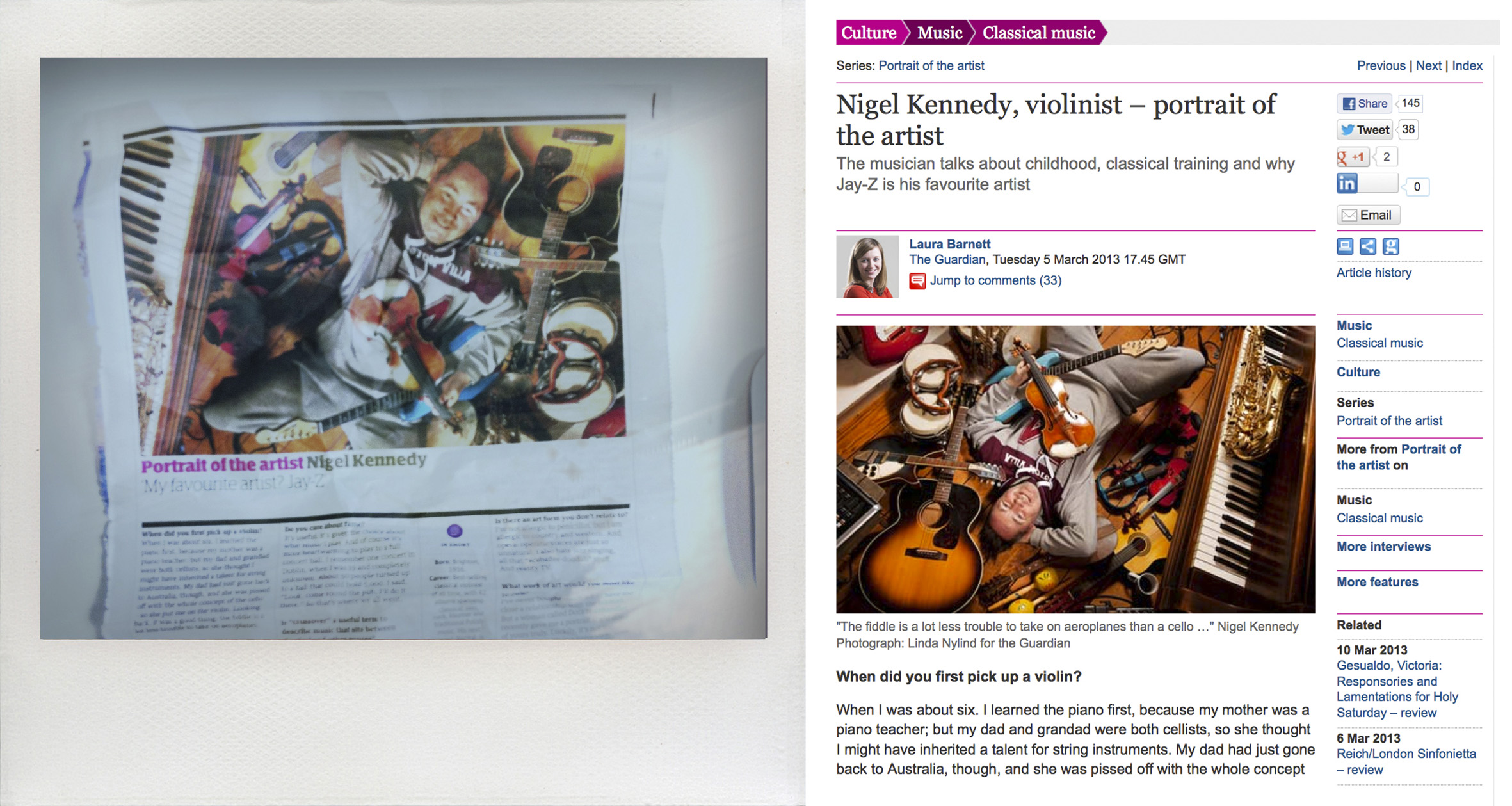
Nigel Kennedy interview, The Guardian
I wonder why Linda Nylind’s picture looks strange. When I catch it on the Guardian website I realise. Someone’s said, he’s upside down, we can’t have that!

Nigel2

Do you care about fame?
It’s useful: it’s given me choice about what music I play. And of course it’s more heartwarming to play to a full concert hall. I remember one concert in Dublin, when I was 19 and completely unknown. About 50 people turned up to a hall that could hold 5,000. I said, “Look, come round the pub, I’ll do it there.” So that’s where we all went.

Is there anything about your career you regret?
Not getting a band of my own together earlier. When I started playing my own stuff, people in the classical world would say: “Who does he think he is, writing his own music when he could be playing Beethoven?” I should have realised sooner that that’s not the point. No one has to be Beethoven: he’s been dead a fair amount of time now.

Five Things I Saw & Heard This Week: Wednesday 2nd January

Pop Music Lives!
The Graham Norton Show. Girls Aloud. New Single. Love Machine. I roll my eyes at the title. But it’s great, a cracking pop single, with hints of Sweet’s Ballroom Blitz. And, as the chorus powers into view, at the back of my mind, a nagging What Else Does This Sound Like? It only takes a few demented minutes of humming. Step forward The Butterfield Blues Band…

Ok! Hep, Two, Three, Four…
Woodstock Soundtrack, original vinyl, Side Six. The Butterfield Blues Band. Featuring saxophonist “Brother” Gene Dinwiddie. “I got a little somethin’ I’d like to lay on y’all, if you’ll bear with me a minute… please. We’re gonna do a little March right along thru now… It’s a Love March. We don’t carry no guns and things in this army we got. Don’t nobody have to be worried about keepin’ in step, and we ain’t got no uniforms—we’re a poor army. In order to keep our heads above the water and whatnot, we sing to one another, and play to one another and we trying to make each other feel good. Ok! Hep, two, three, four…” On the back of a great Rod Hicks bassline and Phillip Wilson’s martial drumming, Dinwiddie gives his all to the uber-hippie lyrics. As feedback crackles around Buzzy Feiten’s guitar, the horn section (featuring David Sanborn) riff like the most soulful Marching Band ever. And it certainly could be the inspiration for the Girls’ songwriting team, although I doubt it.

John Barry: Licence To Thrill (BBC Four Doc With A Rotten Title…)
I’d totally forgotten his great score for The Ipcress File. It uses one of my favourite instruments, a cimbalom (a kind of hammered dulcimer). One night I was in Budapest at a conference and we were all taken to a Hungarian Folk Dance dinner. It was, hands down, the loudest thing I’ve ever witnessed. The stage floorboards were percussively assaulted by the dancers’ boots and our insides were assaulted by the unholy bass vibrations that this set off. There were two cymbalom players at either side of the stage, hitting seven shades out of their instruments. The pitch of the treble strings as they were struck by the hammers was enough to take the top of your head off. Instant Migraine. Brilliant. I bought the CD.

“Tis The Song, The Sigh Of The Weary, Hard Times, Hard Times, Come Again No More…”
Laura Barton’s wonderful Guardian column, Hail, Hail, Rock & Roll, was one of the inspirations for me to do this blog, so I was sad to read of her hard year in the round-up of favourite moments by Guardian music writers. Here, she talked honestly about the past twelve months, and a rare bright moment. “This was not the happiest of years for me; all through January, on into spring and the summer, I took a slow lesson in falling apart. I could no longer see the beauty in anything—days stood grey and flat, food was flavourless, even music seemed muffled and blunt. By the first Tuesday in March I was experiencing daily panic attacks, and often felt too fearful to leave the house. But that evening Future Islands were playing the Scala in London… They played my favourites of course, and it was one of the finest gigs of my life, but what really made it was the stage invasion—a sudden surge of excitement at the beginning of, I think, Heart Grows Old, and suddenly we were all up there, dancing among the cables and the synths. And I remember in that moment looking down from the edge of the stage, out at all the bright faces and euphoria and glee, and feeling my chest swell with a brief, sweet gulp of long-lost joy.”

R.I.P Fontella Bass
Rescue Me. The best Motown song that was never on Motown, the best Motown bassline that wasn’t a Motown bassline (played by Louis Satterfield). Fontella Bass was a powerful singer, who made some wonderful gospel albums. The one I could find this morning was From The Root To The Source. It has Phillip Wilson, co-writer  of Love March (see above) on drums. To further cement the Butterfield link, I found a YouTube clip of Fontella in the 80s, singing Rescue Me on Dave Sanborn & Jools Holland’s fabulous Sunday Night, with Sanborn on sax. In memory, we’ll play some Fontella Bass tonight.

Bass

Five Things I Saw & Heard This Week: Wednesday 5th December

This is the West, Sir. When the legend
becomes fact, print the legend.”
James Stewart as Maxwell Scott, in The Man Who Shot Liberty Valance. As I read Mojo’s obit of Terry Callier, the folk-jazz-soul singer songwriter, my heart sinks as the oft-retold story of his first album is reprinted—yet again. Lois Wilson writes: “The following year saw him team with Prestige producer Samuel Charters. The New Folk Sound should have seated him next to Gil Scott-Heron and Nina Simone, such was its innovative cross-fertilization of jazz, folk, soul, blues and civil rights, but it finally arrived without fanfare in 1968, after Charters went AWOL with the tapes to Mexico.”
Here’s Wikipedia: “He met Samuel Charters of Prestige Records in 1964, and the following year they recorded his debut album. Charters then took the tapes away with him into the Mexican desert, and the album was eventually released in 1968 as The New Folk Sound of Terry Callier.”
From The Guardian, Callier interviewed by Will Hodgkinson: “Callier recorded his album, The New Folk Sound, under the influence of Coltrane, using two upright basses and two acoustic guitars to create a unique sound. The record would probably have been a hit but for the fact that its producer, Samuel Charters, took the tapes of The New Folk Sound on a voyage of self-discovery into the North American desert, where he lived with the Yaki Indians for the next three years.”

I decide to do the journalistic thing and ask someone who was there.
Sam Charters: “There’s been so much confusion there’s no quick answer. I was doing a lot of Chicago folk artists for Prestige, and I heard Terry at a folk club. I talked to him about recording and then I went to his family’s apartment in one of the project buildings one evening and he sang his songs. Sweet family, and he was a very pleasant young guy.

When we came to the studio he had new ideas, and there were two bass players; one on either side of him but with wide distances between. Then he wanted to record in the dark. When we had to turn on the lights between takes to do adjustments I was sure the basses were creeping up on me. Then I did the usual editing and we had the usual Friday afternoon sales meeting at Prestige—the only time we saw Bob Weinstock [owner of Prestige], if he even turned up—and the sales manager said we had to sell it as protest song album, since he was a black folk singer. So that was the promotion pitch, but otherwise it was just another of the Chicago albums I did that didn’t sell a lot, because he didn’t have much of a club audience.

I didn’t think about it again until the stories began circulating that I’d stolen the tapes and taken them to Mexico and that was why the album didn’t come out for two years and was a flop. I was fired about the time the record came out and Annie and I did drive to Mexico and California, but we were back in New York in April for the world premiere of Ives’ 4th Symphony, with Stokowski conducting [Leopold Stokowski conducted it with the American Symphony Orchestra at Carnegie Hall on April 26, 1965].

When the stories started about me and the stolen tapes in Terry’s interviews I regarded it as just one of those weird things. I tried to correct it when there was an article in the New York Times, but the journalist was in love with the story and wouldn’t give it up. Fantasy had the old Prestige album and some sort of recording rights and Bill Belmont called and asked if I’d like to produce a new album and I said very quickly no. Terry did appear in Stockholm a year later and told the same story and I thought of calling him and then I decided—why? His story was much better and he felt good with it and it didn’t matter to me one way or another. I’d produced a lot of records for Prestige that didn’t sell and I’m sure the artists have some equally colorful story.”

Quote Of The Week
Peter Doherty interview, Angelique Chrisafis, The Guardian.
Another French royal whose path he crossed was Carla Bruni, when he was invited to some music sessions at the house she shared with Nicolas Sarkozy, then president.Her house was “a really strange scene, where you’ve got a guy with a submachine gun on each door.” Did he meet Sarkozy? “You’re joking, aren’t you?” he laughs, blaming his bad reputation. “She told me she took him to see Bob Dylan. She had the harmonica that Dylan gave her, and apparently he was like: I don’t want to meet this guy, who is he anyway?”

Bold As Joan Osborne
Another Day, Another Cover, but a sweet one: From Joan Osborne’s album earlier this year, mostly singing songs written by black songwriters, her cover of Jimi’s Bold As Love stands out. Hendrix is rarely covered, especially by non-guitarists, with the notable exception of Emmylou Harris and Daniel Lanois (This Must Be Love on Wrecking Ball). Great Melodies, wonderful changes and sweet, tremulous, touching lyrics are all present in a joyous stew. Osborne’s a great singer—check out her performance of What Becomes Of The Brokenhearted in Standing In The Shadows Of Motown, especially the breakdown halfway through when the Tell Me! Call & Response starts happening…

Title Fight
Adam Ant’s new album title—Adam Ant Is the Blueblack Hussar in Marrying the Gunner’s Daughter—made me vaguely curious as to the longest album title. It turns out to be this 865 character cracker from Chumbawumba in 2008:
The Boy Bands Have Won, and All the Copyists and the Tribute Bands and the TV Talent Show Producers Have Won, If We Allow Our Culture to Be Shaped by Mimicry, Whether from Lack of Ideas or From Exaggerated Respect. You Should Never Try to Freeze Culture. What You Can Do Is Recycle That Culture. Take Your Older Brother’s Hand-Me-Down Jacket and Re-Style It, Re-Fashion It to the Point Where It Becomes Your Own. But Don’t Just Regurgitate Creative History, or Hold Art and Music and Literature as Fixed, Untouchable and Kept Under Glass. The People Who Try to ‘Guard’ Any Particular Form of Music Are, Like the Copyists and Manufactured Bands, Doing It the Worst Disservice, Because the Only Thing That You Can Do to Music That Will Damage It Is Not Change It, Not Make It Your Own. Because Then It Dies, Then It’s Over, Then It’s Done, and the Boy Bands Have Won. Soon to be re-released on Syco Records, apparently.

Liooel Riihie?
Found during iPhoto cull. Travelling in California last year, accidentally turning on the subtitling on the motel’s TV during Lionel Richie’s Who Do You Think You Are? programme.

Lionel

Five Things I Saw & Heard This Week: Wednesday 10th October

Genius Idea Of The Week
Nick Paumgarten writes about record producer Scott Litt, New Yorker, October 1st.
When Scott Litt built a recording studio in the back of his house, in Venice, California, seven years ago, he did it with Bob Dylan in mind. He pictured Dylan sitting there at the Hammond organ, accompanied by nothing but drums and a standup bass. Or maybe in an arrangement featuring a banjo and a trumpet. “I always imagined him having a Louis Armstrong Hello, Dolly sound,” Litt said the other day. “Musically, that’s as American as it gets.” [Sadly, when Litt was hired to engineer Bob’s latest, Tempest, and] …got up the nerve to mention his idea, it didn’t go over very well. [Bob] just went, “Heh heh heh—Hello Dolly.”

This, From The Very Wonderful “Letters Of Note”
In 1919 [at which point he was just 9 years old] Samuel Barber wrote the following letter to his mother and left it on his desk for her to find. She did, and a year later Barber began to compose his first opera, The Rose Tree. He was still only 26 years of age when, in 1936, he finished his most famous work, Adagio for Strings.
“NOTICE to Mother and nobody else
Dear Mother: I have written this to tell you my worrying secret. Now don’t cry when you read it because it is neither yours nor my fault. I suppose I will have to tell it now without any nonsense. To begin with I was not meant to be an athlet [sic]. I was meant to be a composer, and will be I’m sure. I’ll ask you one more thing.—Don’t ask me to try to forget this unpleasant thing and go play football.—Please—Sometimes I’ve been worrying about this so much that it makes me mad (not very),
Love,
Sam Barber II

Roll On, John
Stanley Reynolds’ piece for The Guardian, 3 June 1963, reprinted this week: “Inside the club, down CND symbol smeared walls to a dark and bronchial cave, the dancers have originated the Cavern Stomp, because they did not have room enough to twist. In the dressing room off stage a steady flow of rock artistes come to talk with Mr Bob Wooler, the Cavern’s full-time disc jockey whose visiting card tells you, with Dickensian charm, that he is “a rhythm and blues consultant.” That is The Cavern, duffel coats and feigned boredom. On tour it is like a Hollywood success story. At the Odeon, Manchester, in the Beatles’ dressing room, the four boys were asking a reporter from a disc magazine to please see if she could do something to stop girls from sending them jelly babies. She had once said they liked them. “We’ve got two ton of them now,” John Lennon said. “Tell them to send us E-type Jaguars or button-down shirts.” Someone came in and said two girls had won them in a contest. “Just who are these girls who won us?” John Lennon asked. “I mean, how long have they won us for.”

“Hear What I’m Saying, I’m Not Saying It Right”
Random Acts [a series of short films chosen for their bold and original expressions of creativity] Channel 4.
Comedian and poet Sean Mahoney, directed by Jeremy Cole. An age-old subject, a harrington jacket, a little bit of Mike Skinner in the delivery. Vulnerable and sharp at the same time. A talent. Lovely.

Record Cover Of The Week

Paris flea market purchase. Just listened to. As you’d expect, The Surfaris via St Malo.