Five Things, Saturday, August 5th

THE INTRO
Now we’re all getting fully signed up to the future — it’s Philip K. Dick’s world after all, we just live in it — this week, Five Things touches on A.I., a spooked and possessed Marvin Gaye song, a world of music newly discovered, a video that is so French it should be required viewing at Customs and an extraordinary guitar modification. The saddest news was the passing of Sinead O’Connor. I thought back to a performance of the song every news broadcaster defaulted to this week [“Nothing Compares to You“] in 2012, where I tried to convey just how extraordinary her voice was… and Philip Watson sent me this astonishing performance of “Danny Boy.”

{ONE} THE DYLAN-A.I. INTERFACE
I don’t join things, generally — I’m not very clubbable. The only two clubs I’ve ever been a member of are the Levon Helm Fanclub and Fred’s (an Eighties Soho Club I somehow designed the identity for). But there I was at the Dylan discussion group with a Bob-inspired bottle of wine. I had bought it from Dina, our excellent local wine store, and it was made by Joe Jefferies, a man apparently at “the militant end of the natural wine world.” Originally from Warwickshire, he’s now in the Languedoc and producing wines from volcanic soils (100% Carignan in this one, if you’re asking), and he’d named one 2021 vintage, “Where black is the colour, where none is the number”. Seemed like a good wine for the pre-discussion supper. So, a quiz with the wine as the prize, and I hit on asking Chat GPT to write a review of one of the songs we were discussing — “Can You Please Crawl Out Your Window?“ The first attempt was poor — bland and full of signature A.I. terms. Then I thought I’d ask for a review in the style of Lester Bangs (figuring it would add personality).

It added Lester’s rather dismal and critical view of Bob just enough to make the game (I handed round print-outs, first to guess the author won the prize) last for a little while as suggestions were thrown around and out. Finally, Alan peered up from the murk (our table in Soho House West was very dimly lit) and said,”It’s Chat GBT!”. And as he doesn’t drink, the wine went to Mick.
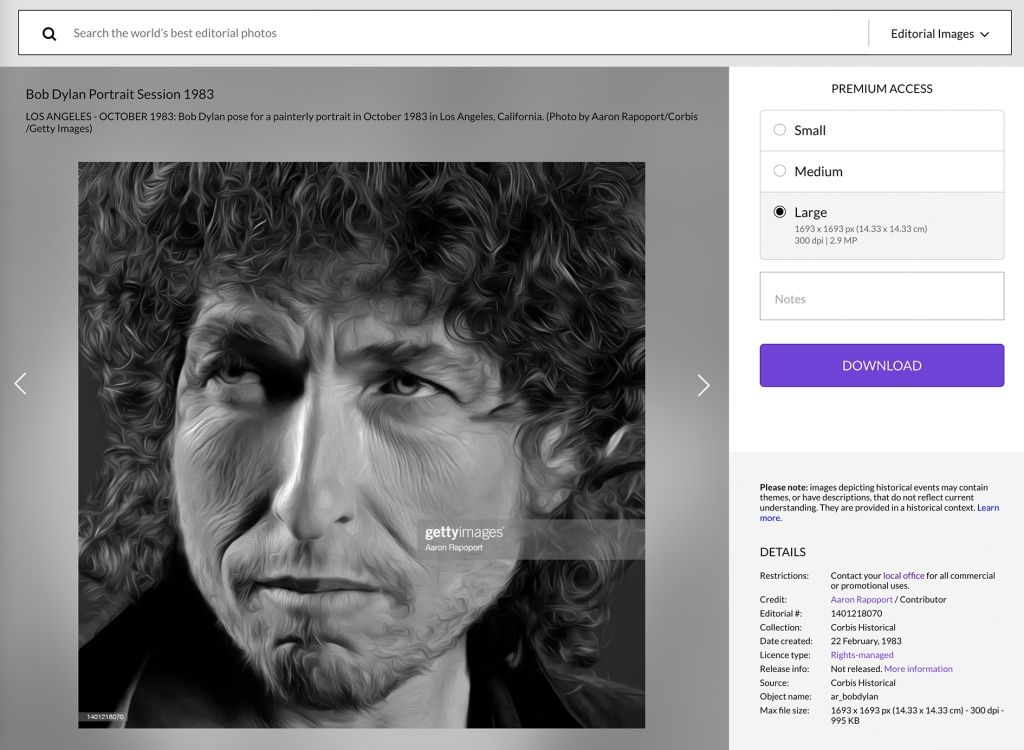
Postscript: I think A.I. had something to do with this weirdness that I found when looking for Dylan pictures on Getty Images: I know Aaron Rapoport’s originals, and they didn’t look like this…
{TWO} THE DEEPEST SOUL
There are still things to discover, Part One:
“Piece of Clay” by Marvin Gaye [hear it in the Music Player on the right].
I don’t know how I found this track, but it comes from the unreleased follow-up to What’s Going On, which was to be titled You’re The Man. Written by Gloria Jones and Pam Sawyer, it’s a brilliant piece of work — and the rough-hewn quality, where the edges haven’t quite been burnished off, make you think it could be a demo. “Father! Stop criticizing your son / Mother please leave your daughters alone / Don’t you see that’s what wrong with the world today / Everybody wants somebody to be their own piece of clay…” As sung by Gaye, that opening line is especially painful.

The intro sounds like it was recorded in a church, an organ laying a carpet under a distorted slide guitar, very Duane Allman at Muscle Shoals, pushing the needles into the red before two drum hits and a crash cymbal silences it. Marvin sings the first line, then doubles his vocal like Al Green. Gospel piano drives the melody into the title line, so beautifully weighted by Marvin. A syncopated bass pushes into the second verse as Marvin heats up. The guitar comes back in, adding blues to the Southern Soul of the song. Then we’re into the middle eight — a call and response with the backing singers, joined by a horn section; it’s as if the entire congregation have picked up instruments. Suddenly, on the phrase lovenot hate, everything drops out, bar the drums and bass as Marvin soars; then, from the back of the church, the fuzzed guitar creeps in, taking us all to a classic gospel ending and down into the fade. 

{THREE} THE LIFE OF REILLY
There are still things to discover, Part Two: The Durutti Column.
Reading the excellent Conquest of the Useless [on Substack], I was sent to a Guardian article by Daniel Dylan Wray on Vini Reilly and the music of the Durutti Column. How did I miss them all those years ago — the music is simply glorious. The first song I hear is “Otis”, referenced in the article.

It is four minutes of heaven. YouTube decides next up is a live performance, “Jacqueline”, with drumming from Bruce Mitchell. I only knew of Bruce as a member of Alberto Y Los Trios Paranois, the art-rock-satire-band, but his duet with Reilly is wonderful, his red brushes flying over the kit in perfect sync with Vini’s guitar and keyboards, his palpable enjoyment wonderful to watch.

{FOUR} THE WAY TO THE NEXT WHISKY BAR…
This was the most extraordinary thing I saw in the week that Jane Birkin passed on. From Off the Fence, the newsletter of The Fence magazine: “Let’s celebrate all that is best in Gallic culture with this amazing video from 1988, which shows a children’s choir decked in full Serge Gainsbourg regalia — whiskies and cigarettes in hand — regale Gainsbourg himself with one of his songs as the Frenchman weeps with emotion. One to warm your stony hearts!”

On a TV appearance toward the end of his life, he was surprised by a choir of children (Les Petits Chanteurs d’Asnières) in full Gainsbourg regalia — black jacket, grey wig, sunglasses, whisky, cigarette, unshaven. They’re singing Serge’s “J’e suis venu te dire que je m’en vais” (“I came to tell you that I’m leaving”) but they’ve changed it to “On est venu te dire qu’on t’aime bien” (We came to tell you that we like you).

{FIVE} THE A-Z OF THE B
Did you know Gene Parsons fitted a Clarence White/Gene Parsons B-Bender to a 1964 Gibson Dove acoustic guitar? I didn’t. Mind blown. Check this out. Nathaniel Murphy, who is playing it, is an Englishman in Chicago, and a fine guitarist.

Five Things: Wednesday 23rd October

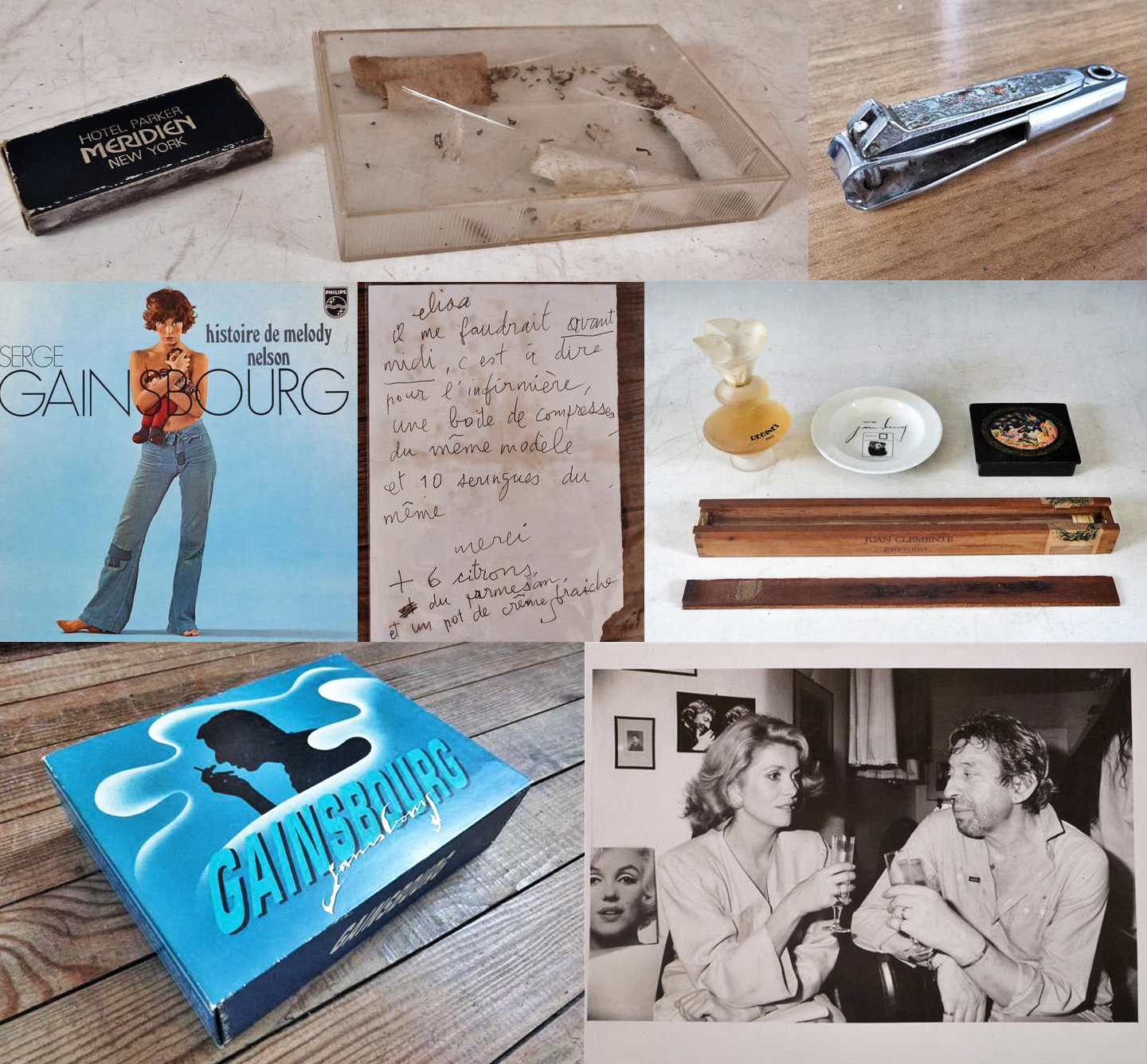
Gainsbourg Auction: + 6 citrons, du parmesan, et un pot de crème fraîche, merci…
A bizarre collection of Serge Gainsbourg’s belongings are at auction on October 31. The list of items include four cigarette butts in a cassette case (estimate £425-£600), a pair of his nail clippers (estimate £40-£70), and a telegram to his wife, Jane Birkin, of controversial Number One single “Je T’aime… Moi Non Plus” fame. Last year his handwritten shopping lists were sold for £6,540. Said David Richard, a spokesperson for the auction house: “When we sold those we realised there was a great interest in items from his everyday life. Quite a lot of the bidders were women and they were prepared to go quite far but it’s always difficult to know how much people are prepared to pay for these things”. Well, here’s a few of my favourite things (but I think I’ll pass on actually bidding):

Serge

From Michael Gray’s Outtakes blog, Mike Bloomfield and Big Joe Williams:
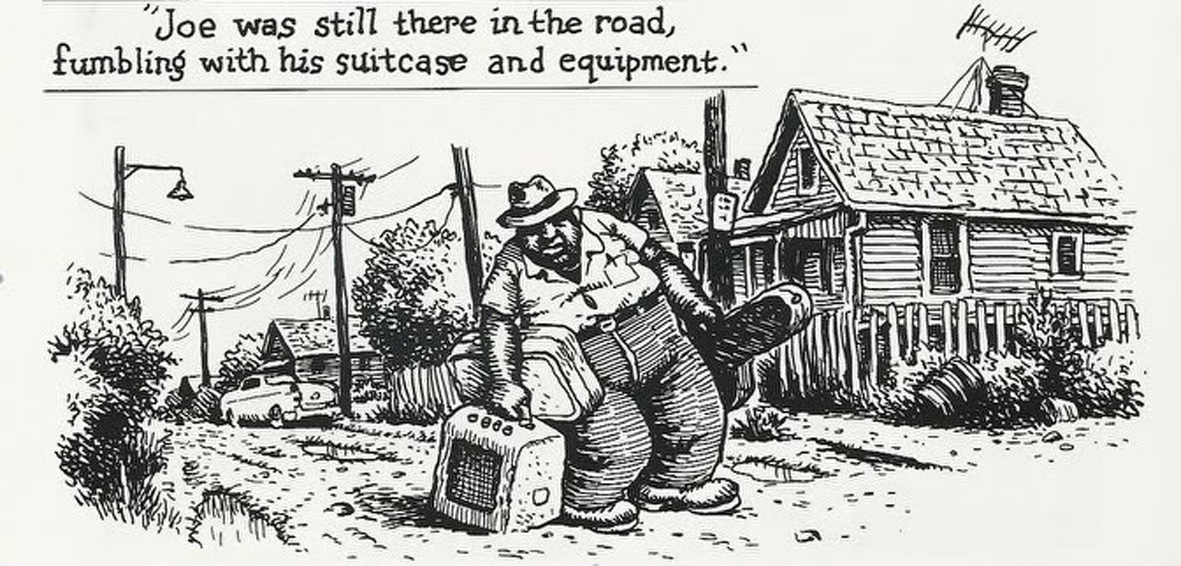
In 1980 Mike Bloomfield published a short memoir, Me and Big Joe, which not only portrayed the difficulties of their relationship very honestly but also, in Peter Narváez’ phrase, illustrated “the cross-cultural triumph of the blues tradition”. Bloomfield wrote: “Joe’s world wasn’t my world, but his music was. It was my life; it would be my life. So playing on was all I could do, and I did it the best that I was able. And the music I played, I knew where it came from; and there was not any way I’d forget.” I really love that sentence, and reading more excerpts discover that the book is compelling, well-written and illustrated by Robert Crumb.

Joe

Favourite Story Of The Week
Tony Bennett questionnaire, The Guardian: Q: You must have mixed with them all… I lived for 15 years in Los Angeles and I still can’t believe that the handsomest man in the world, Cary Grant, and the greatest performer in the world, Fred Astaire… were in my home. I celebrated my 50th birthday with them. Unforgettable.

Did any of them do anything in your home that you’ve had to keep secret? No. But once Dean Martin was in his home, having this mad party, and he was trying to study his lines for a television show so he called up the police and said: “I’m Dean Martin’s neighbour and there’s too much noise coming from his house. Have the police come and slow down the party.” And the police came and broke the party up and he got rid of everybody in the house.

A Note On Packaging The Past
I give into temptation. I’ve bought this music on vinyl, in 1972. In its first digital form on CD in the late eighties. On remastered CD in 2000. And here we are, buying it again in 2013, remixed, re-programmed, repackaged. Rock of Ages by The Band, originally in a three-gatefold sleeve of purple with Bob Cato’s enigmatic oriental statue on the front and mysterious pictures by Magnum’s Ernst Haas (the impressionistic colour ones) and John Scheele (the beautiful B&W’s) on the inside. One of the great live albums of the rock era. As Allen Toussaint says: “They dance by a different drummer, all the time. There was nothing stock about them”. But I baulk at the stupidly-priced Venal-Record-Company-Death-Throes Box Set, with its 5.1 Surround Sound DVD version of the tracks and the Sebastian Robertson soundboard mix of the uncut New Year’s Eve night. Come on. How many times can the people who love this music be ripped off? Yes, I know that everything in Heritage Rock World™ has to be a ‘production’. And, yes, it sounds fantastic, remixed by Robertson and the brilliant Bob Clearmountain with a staggering degree of detail. But then, it always did sound fantastic, I just didn’t know it could sound better, and may never have felt I was missing out…

And Also…
Robbie Robertson’s liner notes are less annoying than usual. I love his comments about Rick Danko: “Rick showed something during this period that I still don’t understand. While singing like a bird, he played a fretless bass… in an unorthodox style that worked against reason and normality.” Toussaint again: “Rick Danko – his approach, there’s nothing like it. Some people, you can tell what school of thought they come from on the bass… I don’t know where Rick Danko comes from. I don’t know his source of reference… it was just his very own thing and I think it was perfect”.


Extra! 5 Things Concerning Leonard Cohen in Paris

Public Piano, Eurostar Terminal, Friday: Hallelujah
In some kind of omen, as we walk through the train terminal, a man sits and starts playing a lovely, stately version of Len’s now-most-famous-song. As he finishes we say thanks for starting our trip off in such perfect style. He advises us to buy a lottery ticket.

Montparnasse Cemetery, Sunday: Gainsbourg
A small detour to the tombs of Man Ray, de Beauvoir and Sartre, and here, covered in metro tokens, roses, kisses and poor pencil drawings, the grave of Serge Gainsbourg.


Olympia Theatre, Sunday: A Pilgrimage
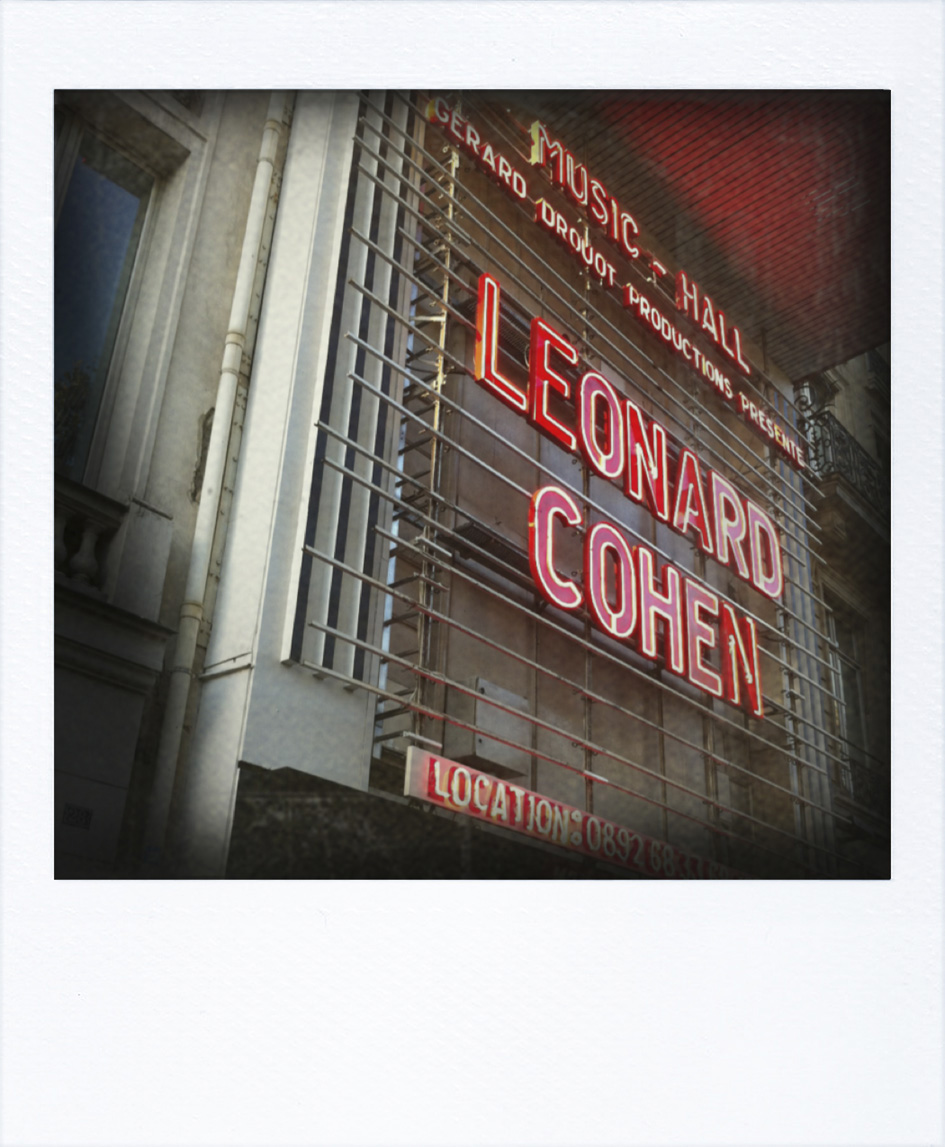
The couple sitting next to us met at a Cohen concert at Leeds University on his first tour in May 1970. And here they were, celebrating at the Paris Olympia 42 years later. And my bad photography has cropped the grey fedora—adopted, I was assured, long before Len.

Olympia Theatre, Sunday.
The Concert: In numbers
33 songs.
3 hours 40 minutes.
3 encores comprising seven songs.
9 musicians, made up of three women and six men—two singers from Kent, England, one from Los Angeles, USA, one from Montreal, Canada; one drummer from Mexico City, Mexico; one keyboardist from Florida, USA; one guitarist from Texas, USA; one bassist from New York State, USA; one violinist from Moldova; one multi-instrumental string player from Zaragoza, Spain.

The Concert: Five Great Moments
1  A brilliant performance of Everybody Knows, every verse a work of genius, every verse a still-accurate assessment of human weakness and failure. Co-written with Sharon Robinson, who later sings a glorious solo version of Alexandra Leaving.
2  A bravura moment at the last verse of The Future where Leonard sings the “There’ll be fires on the road/and the white man dancing,” and bassist Roscoe Beck does a stately piroutte, which is followed by LC singing “And all the lousy little poets/coming round/tryin’ to sound like Charlie Manson/and the white girls dancing,” whereupon the Webb Sisters turn away from their mikes, take one step back and, synchronised, do perfect cartwheels…
3  Leonard soloing on a Jew’s Harp, that most American of instruments on the hoedown breaks of Closing Time, one of two songs (Heart With No Companion being the other) where he sounds uncannily like Tom T. Hall, only deeper. Also, Take This Waltz in a Weimar-ish arrangement, has a hint of The Sensational Alex Harvey Band. Honest.
Night Comes On. I hadn’t dared to hope that I’d hear Leonard sing my favourite song. And sing it he does, causing some spontaneous tears in the audience, its mournful and beautiful melody letting the words cascade in their stoic and weary way, on the cushion of warmth the band create.
I remember catching a version of Who By Fire in the late 80s in a hotel room in LA by chance. It was on Night Music, a show hosted by David Sanborn, with Hal Willner and Jools Holland involved—like a precursor to Later. Sonny Rollins joined Leonard, and played an unaccompanied intro that tore the roof off before the band (including half of Was Not Was and Robben Ford) came in. Tonight, Javier Mas was the star turn, a masterclass in flamenco, playing the bandurria like a man possessed, the elastic strings rolling and tumbling to a frenzied crescendo…

The Concert: Some Observations
You have to make your peace with the fact that a certain amount of drama is missed by muting the drums quite this much. The sound is perfect and balanced, intentionally allowing every word to ring clearly through. To make up for the lack of beat, Larson’s churchy Hammond B3, Alex Bublitchi’s muscular violin and Javier’s Mas’s extraordinary Laud provide thrilling dynamics. Mitch Watkins on guitar (after eleven years in Lyle Lovett’s Large Band) provides structure, architecture and blues—his moaning slur at the end of a Wes Montgomery-like solo on Amen the coup de grâce.

The older-type singer (the ones who aren’t Mick Jagger, anyway) are very fond of the prizefighter pose. Len takes this even further than the bob-and-weave and sings at least half the set on his knees on the patterned rugs that cover the stage, James Brown-style. It also emphasised the supplicant nature of many of the songs: to God, to Poetry, to lust, love, the musicians and to the audience, who he always addresses as “Friends.” His ability to get back up from his knees with grace is very impressive.

The only singer with a deeper voice than Len is Barry White. Fact.

1976: The First Time I Saw Leonard
Was on the south coast of England in 1976. A friend of my mother’s was managing the hotel where Leonard and his musicians were staying and had tickets. I didn’t really know much about his music then—but this was World Music before it had a name, with the flamenco melodies, the gypsy violin and the Moorish oud. Backstage for a meet and greet, we were struck dumb. The next morning, having breakfast at the next table, we were even more tongue-tied.

Leonard, Hand In Pocket, photograph by Michelle Clement.

Five Things I Saw & Heard This Week: Wednesday 14th March

David Whitaker
The death, at 81, of the man responsible for the strings that were sampled by The Verve for Bittersweet Symphony brought forth this excellent little nugget, recounted by Bob Stanley in his Guardian obit: “He spent much of his time in Paris working with the cream of the country’s “yé-yé” scene, including Johnny Hallyday, Sylvie Vartan, Claude François, France Gall and Serge Gainsbourg.  Gainsbourg’s song Comic Strip was recorded in London, with Brigitte Bardot providing back-up vocals. Whitaker later explained how they decided where they worked: “If Serge wanted some new clothes, we recorded in London, and if I wanted some we recorded in Paris.” Ha! There are, by the way, excellent waxworks of both Johnny and Serge in the Musée Grévin in Paris.

Liza with a What?
News comes via Andy Schwartz on the rocksbackpages blog of an album cut by Liza Minelli at Muscle Shoals. Aside from the fact that that we need much more information on this, it make you wonder about any other weird combos that may come out of the woodwork, from a long-gone time when no talent mix was too strange to consider. Prime runners?  The lost Doris Day at Stax album, or the rumoured Mae West: Gettin’ Down & Dirty with Little Beaver Miami masterwork?

Do You Remember The Tyla Gang?
At lunch with friends on Sunday it turns out that Weston’s brother Mike was the drummer in The Tyla Gang. We had a fine time reminiscing about The Nashville Rooms & Bees Make Honey and the London music scene of the early seventies, and Mike had great stories to tell of his times with Brian Eno and Sean Tyla. I saw Ducks Deluxe, Tyla’s band before The Gang, many times at The Fulham Greyhound. Most of my memories of Fulham Palace Road are pretty fuzzy, centering around Nazareth and Head, Hands & Feet.  Oh, and being shouted at by Ian Dury: “Oi, Four Eyes… get your beer off my fucking amp…”

It’s Bill Withers’ World: we just live in it… the Wonderful Still Bill
Everyone is hereby urged to see this fine, fine piece of work, less a music documentary than a meditation on how to live a life. Best human moment: Bill’s visit to an educational project helping kids who stutter (Withers did until the age of 28). Best musical moment: a toss-up between Raul Midón and Bill on the telephone, and at a tribute concert, Bill watching Cornell Dupree glide ’n’ slide through Grandma’s Hands, talent undimmed by illness (even though he has an oxygen tube on). Bill steps onto the stage and sings a verse, but then, as Barney Hoskyns’ wrote: “as if concerned not to upstage the ailing but grinning Dupree—one of soul music’s greatest guitar players—he almost immediately sat down beside him, continuing to sing but deferring to Dupree.” And with his hand resting on Cornell’s knee.

A Strange Englishness
A beautifully compiled curio: Tyneham House, a 14 track CD, beautifully packaged in a Gocco-printed card box with booklet and a ‘bonus’ cassette tape, all illustrated by award-winning artist Frances Castle (a Jarvis Cocker favourite) of Clay Pipe Music. The subject is the Dorset village  requisitioned by the government for ‘training purposes’ by the British Government in the lead-up to WWII. The music itself is by regular conributors to the label’s releases, but all anonymous here, with a mixture of new and archive performances. Perfect English Summer listening. Now we just need the Summer.