Extra! Daniel Kramer’s year with Bob Dylan

I’m re-publishing this following the passing of one of my favourite “Dylan” photographers. It was originally written for Pulp magazine in 2017.

Bob Dylan: A Year and a Day. Photographs by Daniel Kramer

Edited by Nina Wiener / Art Direction by Josh Baker / Design by Jess Sappenfield
Published by Taschen, hardcover in a clamshell box, edition of 1,965 (cute!)

“In retrospect, it’s clear that Bob was in the process of winding up a very large spring. I didn’t know then 
how much of that spring would be let loose in the coming months.” – Daniel Kramer

On July 20th 1965, Bob Dylan, the star of the Greenwich Village Folk Boom, exploded onto the pop charts. America’s first modern singer-songwriter, Dylan, in the six minutes and thirteen seconds that it took for the epochal “Like a Rolling Stone” to be debuted on US radio, virtually created grown-up rock music. But Dylan’s spectacular reinvention of himself and his music had not just happened overnight – it had been brewing for a while. At the beginning of this astonishing, game-changing period – the like of which had previously been the preserve of fine artists such as Matisse and Picasso – photographer Daniel Kramer found himself, through a mixture of talent, persistence and chance, in the position of recording the highs of an extraordinary year in the life of Bob Dylan.

Having first seen Dylan on Steve Allen’s variety show in February, 1964 (“It was the kind of sound I always liked. It reminded me of a voice from the hills… like a voice that had been left out in the rain and rusted…”) Kramer decided that he had to photograph this performer who was brave enough to play songs about social injustice on a mainstream tv show. He called Dylan’s management: “Naturally I was told Mr Dylan was not available. And so it went. I would call, and they would say no.” Eventually, Dylan’s manager, Albert Grossman, picked up the phone. “By this time he knew why I was calling. I convinced him that I was a reasonable, completely sane, published, professional photographer. I was caught by surprise when his almost immediate answer was, Okay, come up to Woodstock next Thursday. You can have an hour. Just like that… just like that!”

5-dylanbook2

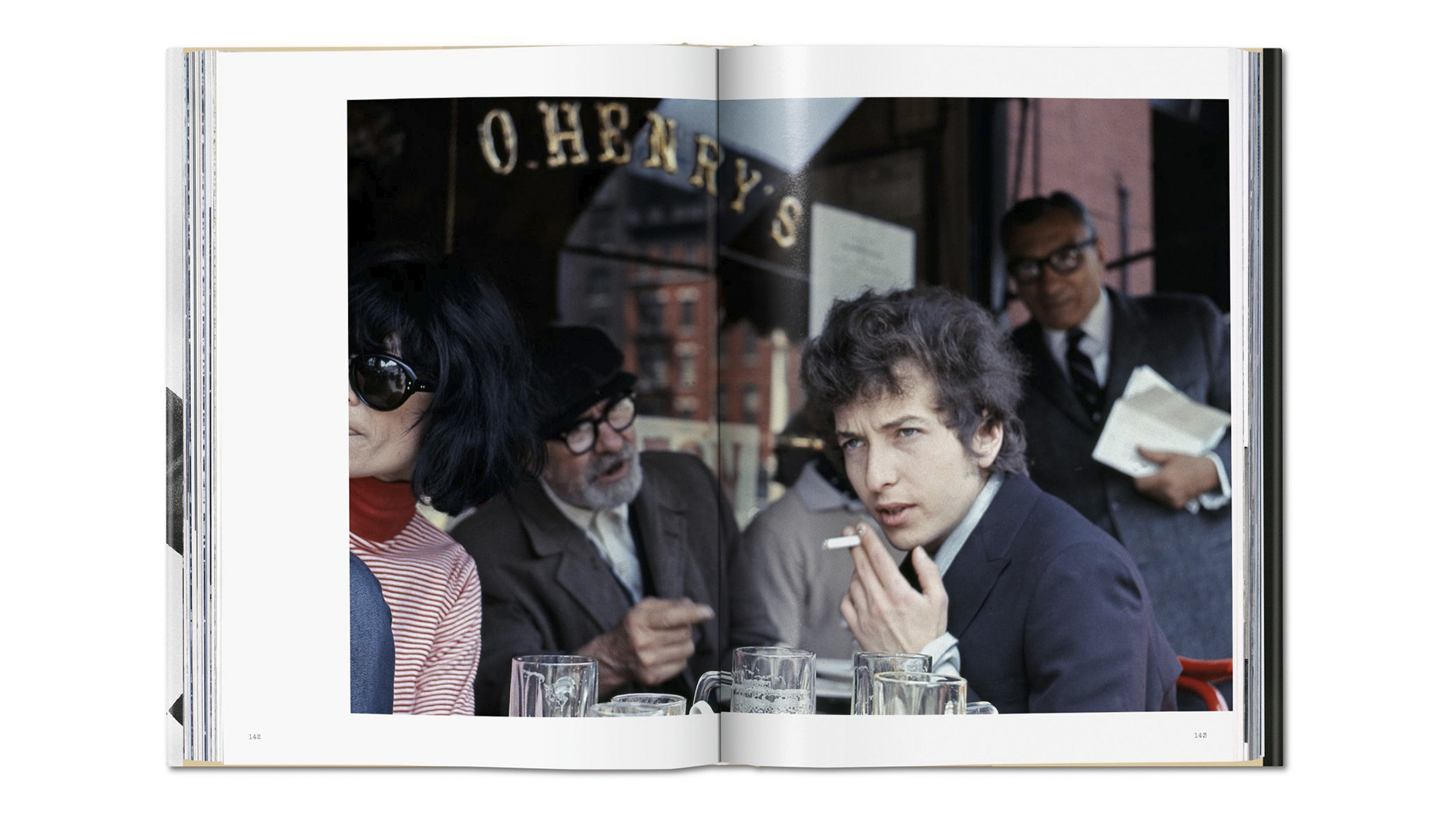
So Kramer drove two hours north of New York City on a bright August morning and spent the day following the 23-year-old musician as he read newspapers, played chess, and hung out with Sally Grossman (Albert’s wife) and his own wife-to-be, Sara Lownds. In the early Sixties, Woodstock was still a sleepy burg, a place where Dylan could keep the increasing intensity of life in New York at bay. The pictures are winningly relaxed and goofy, Dylan obviously finding Kramer a copacetic presence, and from that simple beginning, Kramer found himself photographing Dylan on thirty occasions over the next 365 days.

Kramer had come to photography early, aged 14, and later fell into a job working as an assistant at the studio of the fashion photographer Allan Arbus. “His wife, Diane Arbus, also did her darkroom work there – it turned out to be more than just a job. From Allan I learned to manage a studio, work with models, and run the business – and from Diane, I learned to open my eyes a bit wider, to think about my pictures in new ways.” His next gig was assisting Philippe Halsman, legendary Life magazine cover photographer. “From Philippe, I learned how to make light do your bidding, instead of the other way around, and how to choose a decent wine – and that photography could be a great adventure and a pathway to the whole world.”
5-dylanbook.jpg

From Kramer’s fascinating recollections in the accompanying text, we find that he becomes one of Dylan’s travelling companions. In this role, he’s given both space and time to produce meaningful work. It’s a hallmark of Dylan’s relationships with the producers, musicians and photographers who come into his orbit – once they are admitted, they are allowed to bring their vision with them. Only Alfred Wertheimer on his trips around the country with a young Elvis Presley had such access to a popular star, with similar results – to show the nuts and bolts of the music business and lift the veil at the moment that the cultural plates were shifting.

Listen to any of the session tapes of recent release The Cutting Edge (every single note of music Dylan recorded, complete with false starts and unused takes, throughout 1965, the year of Kramer’s book) and you’ll find that Dylan’s moulding of what’s happening is subtle and understated, only occasionally direct and demanding. And if you met his approval, his world was your oyster. Kramer takes full advantage, producing classic black-and-white reportage backstage, onstage, in cars and cafes.

The book, beautifully laid out, is broken into sections (Woodstock / Town Hall / In the Studio / Bob & Joan / Early ’65 / Forest Hills) by lyrics letterpressed onto heavy matt paper, with Kramer’s excellent narrative set in typewriter, an era-specific evocation of the prevailing technology of the time.

5-dylan2

The sheer size of the book lets you feel that you’re at a really well-curated exhibition, one where the scaling and sequencing of the images are perfectly judged. The detail drawn out of the gorgeous grain of the 35mm Kodak Tri-X film that Kramer used is wonderful, and the book is a much more satisfying way to see these photographs than as individual prints in a gallery.

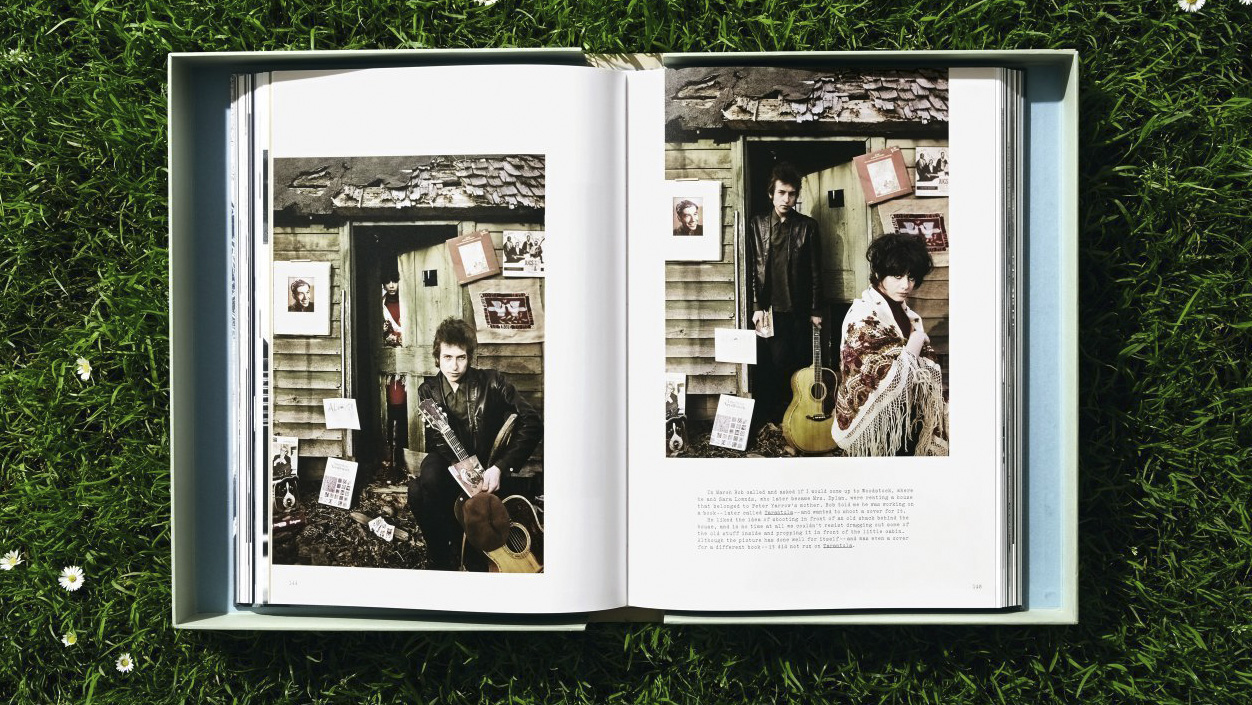
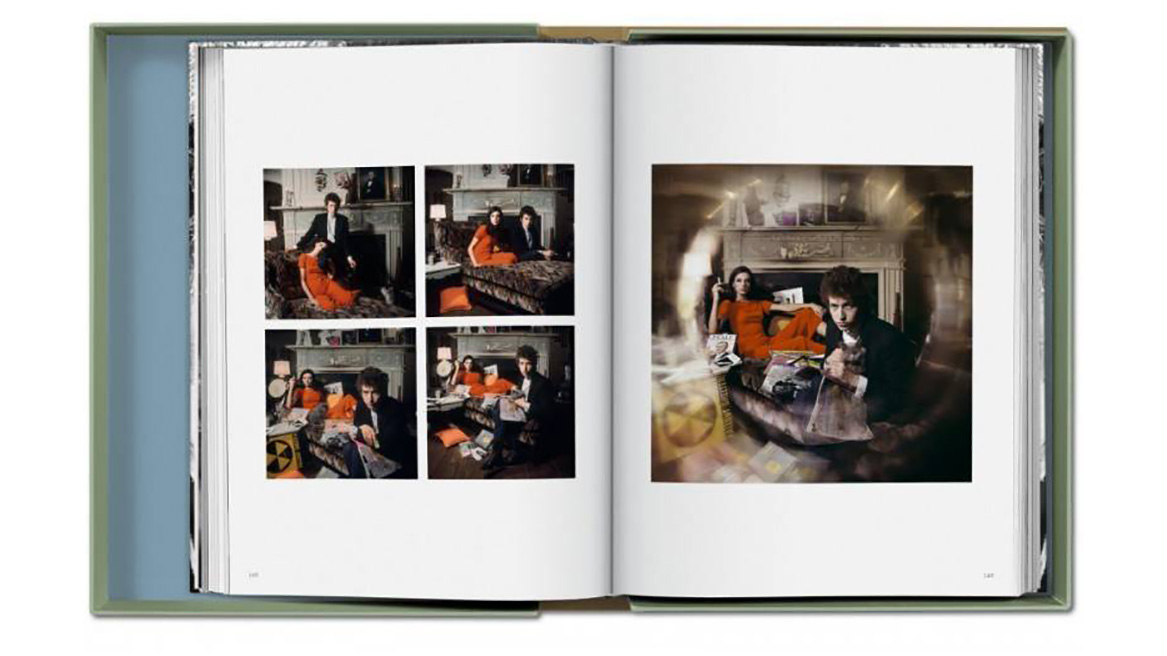
The colour film that Kramer shot of Dylan, the cover session for Bringing It All Back Home, one of the two albums he would release in 1965 (the other, Highway 61 Revisited, also had a cover shot by Kramer) sits happily at the centre of the book, in a section called “Intermission”. Kramer’s studio shoots (including a meeting at Kramer’s New York studio that would provide the cover for Dylan’s first book, Tarantula) give a break between the reportage either side and show that his earlier experiences in the studio with Arbus and Halsman served him well.
5-dylan1

But first, he needed the persuasive techniques of Bob’s manager to make these shoots happen. After Columbia’s art director, John Berg, refuses to commission the (as he saw it) inexperienced Kramer to shoot the cover of Bringing It All Back Home, Grossman intervenes. “Mr Grossman took us [Dylan and Kramer] to the art director’s office, where he proceeded to make a series of predictions of what bad things would happen [to Berg] if I did not get this assignment.”

Having been present at the recording sessions, Kramer knew that he had to deliver something that related to Dylan’s new direction – and a technique he was working on for a fashion shoot with his 4×5 view camera seemed perfect. It enabled him to make “multiple exposures on one sheet of film while moving, blurring, or keeping sharp parts of any single exposure”, a world away from the fly-on-the-wall 35mm reportage that Kramer had been shooting up to this point.

Arranging Dylan in a room set at Grossman’s Woodstock house, with Sally Grossman draped decoratively on a sofa, Kramer adds elements to make his technique work. “We scoured the house and basement to find things to put in the picture so there would be things to ‘move’ when the camera back was revolved. I wanted to say that Bob Dylan was less a folksinger and more a prince of music. So there in the centre of the turning record is Bob Dylan without an instrument, in this beautiful room, seated with a beautiful woman in a red dress… we were lucky to get one exposure with the cat looking into my lens.” Kramer can’t resist telling us that he and John Berg were nominated for a Grammy Award for best album cover photograph…
5-dylan4

Around this time, a new Dylan snaps into view, as the pages turn from images of joking around with old friends to those of Dylan with an early hero, Johnny Cash. Dylan is about to play one of his last acoustic shows and has morphed from the chubby-faced Chaplinesque troubadour to a more angular and focused presence. Over dinner with Cash, he seems to be burning with a particular intensity, fixing Dan Kramer and Cash both with a piercing gaze.

The next stage is about to begin in earnest, and it will lead to the alienation of Dylan’s loyal fanbase. His artistic horizons are widening to take in Pop Art and filmmaking – from Greenwich Village to the Warhol factory was only a matter of a few downtown NY blocks, but in 1965 it was an artistic chasm. On one side, the gruesomely authentic folksters, on the other, the achingly hip (yet blatantly commercial) scenesters. As Dylan moved inexorably across from one to the other, the air was thick with cries of Sell Out! and worse. Kramer finds himself shooting from the inside out.

A show at Forest Hills with electric backing will plunge Dylan into a maelstrom that the world of rock has rarely seen, as a performer’s desire to follow his muse sees him branded a Judas and pelted with objects. Visually, Dylan’s look begins to assume the sharp outlines of an icon – even in a close-field blur, with Albert Grossman far away in the stands of the Forest Hills stadium, Dylan is instantly recognisable, entering the period where he would be drawn by Milton Glaser as a rainbow-headed visualisation of the grooviness and excitement of the middle sixties.

5-dylan forest

And that concert signals the end of Kramer’s travels with Bob. The last shots are of Dylan at one remove from his audience, backlit by blinding spotlights as someone invades the stage, chased by cops. A tour of the US and Europe awaits Dylan, his world accelerating until it culminates in a motorcycle accident that will remove him from the public glare for the following years.

Daniel Kramer moves onto a long and successful career straddling editorial, advertising and motion-picture work, and never photographs Dylan again. And Dylan? Well, he’s still “on the road, heading to another joint…”, not stopping long enough to be pinned down. But we, luckily, have this epic production to linger over, reliving that remarkable year when the times were truly changing.

If you’re receiving the email out, please click on the Date Headline of the page for the full 5 Things experience. It will bring you to the site (which allows you to see the Music Player) and all the links will open in another tab or window in your browser.

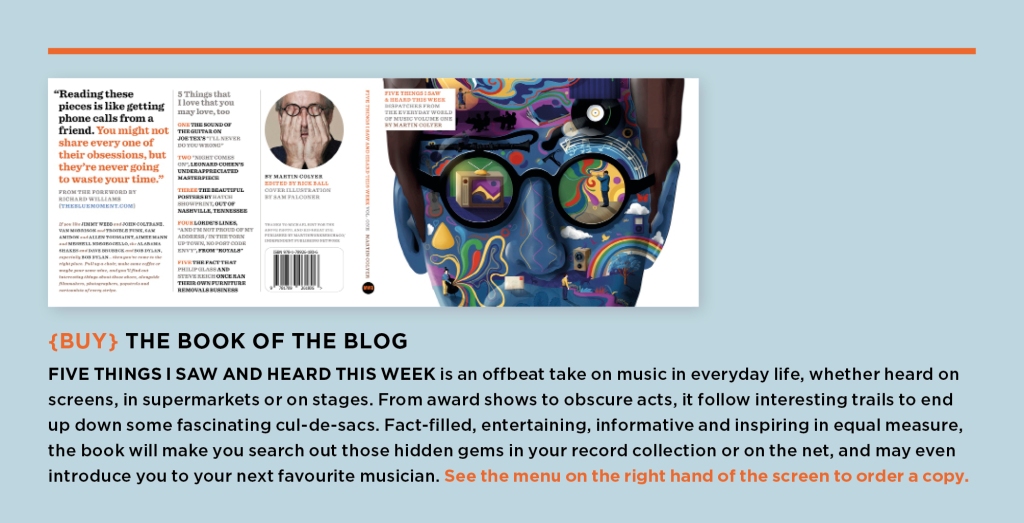
The book of Five Things is available from Amazon here.

Front Cover

“He writes with the insight of someone who has inhabited the world of the professional musician but also with the infectious enthusiasm of someone who is a fan like anyone of us. He also comes at the subject from an entirely personal, slightly sideways perspective, with no agenda and no product to sell. It’s entertaining and inspiring in equal measure.”

“A terrific book, stuffed to the gills with snippets of news items and observations all with a musical theme, pulled together by the watchful eye of Martin Colyer… lovingly compiled, rammed with colour photos and interesting stories. Colyer has a good ear for a tune, an eye for the out-of-ordinary and he can write a bit too.”
Sunday, March 10th, 2024

{ONE} A RAINY NIGHT IN SOHO
Crossing from a Mayfair private view into Soho, I put the airpods in and hit play, and DJ Shadow is thrown up by the randomiser that is Shuffle. It’s “Midnight in a Perfect World” and it is indeed perfect, for this moment, in this imperfect world. I find myself slouching along in time to its wonderful backbeat as I walk through St Anne’s Court to the Elizabeth Line Tottenham Court Road entrance — TfL missed a trick in not calling it TCR [Soho]. Walking in the rain in London at night never loses its appeal.


{TWO} THE RESISTANCE OF POP MUSIC, PT 1
I keep waiting for Pop to Eat Itself, as the most brilliantly named group of the Eighties would have it, but Pop doesn’t seem to be going anywhere, and it’s a driver or important component, in many of the new series and movies on Netflix or Apple or Terrestrial TV. For me, All of Us Strangers has the most evocative use of a single song. Nothing we’ve watched recently was as poignant, melancholy, and controlled as Andrew Haigh’s film. There’s no weakness, and the extraordinary performances of Claire Foy and Jamie Bell are so quiet and nuanced that you catch your breath as their story with their [now] adult son plays out. The film has its theme song, and it’s perfect — the Pet Shop Boys “West End Girls”* with its talk of “too many shadows, whispering voices”, and although it tracks club dancing, its melancholy is worn on its sleeve. And the original video had Tennant’s partner in PSB, Chris Lowe, as a ghostly figure in the street scenes…

* I’d forgotten the verse, “We’ve got no future / we’ve got no past / here today, built to last / In every city, in every nation / from Lake Geneva to the Finland Station.” (The Finland Station in Leningrad is the place where Lenin got off the train on the night of April 3, 1917, to take charge of the Russian revolution), but if anyone’s going to put that in a pure Pop hit it’d be Neil Tennant, no?


{THREE} FILM 2024
I had watched Claire Foy and Andrew Haigh talking about All of Us Strangers (if you’ve seen it, you’ll understand the difficulty) at Mark Kermode’s MK3D show at the BFI on the South Bank. As I had designed the slides for Mark’s show, I’d popped backstage to say hi. It was an interesting Green Room — Claire Foy and Andrew Haigh; Mahalia Belo (director) and Alice Birch (writer, from a novel by Megan Hunter) of The End We Start From, which features an excellent, panicky score by Anna Meredith and a standout performance from Jodie Comer; Jane Giles and Ali Catterall with their film, Scala!!!, about the King’s Cross Cinema and the extraordinarily diverse programming that inspired future generations of filmmakers and musicians; and Jerskin Fendrix, composer of the exceptional Poor Things soundtrack.


{FOUR} THE RESISTANCE OF POP MUSIC, PT 2
Mark Kermode: “Yorgos Lanthimos said he just knew from listening to your album (Winterreise — it came out in 2020, tagged as Indie Pop by Apple Music) that you could do the soundtrack. He said he played the album to Emma Stone and she said that when she heard it, it was like everything exploded, your head exploded into music, which I thought was a fabulous description. But it’s a really big thing to be asked to score a major motion picture straight out the gate. Did you know that you could do it?”
Jerskin: “I spend a lot of time not going to the cinema — I’m sure you might be more familiar with it, but it was an odd mental thing, just being in the studio by myself, already being isolated by lockdown, and thinking everything I’m doing right now is going to end up in a colossal environment in a lot of places in the world. The mental gymnastics of that was sort of impossible…”
Mark: “The score is right at the heart of the film — I think it would be quite easy for the film to be emotionally alienating and I talked to Yorgos and we agreed on this point — what you need is an emotional, visceral reaction. I’m just astonished that it’s your first film. It’s like you were always ready to do this.”
Jerskin: “I think it was very lucky that it was this exact film, this exact project, with this exact director, because my background up until that point had been pop music. I think there’s a level of emotion, and a level of hyper-exaggerated emotion that you can play with in pop song writing, which in most other art forms verges on the cloying.”
Mark: “What was the first pop record you ever bought?”
Jerskin: “The first pop record I remember listening to was The Wild, the Innocent, and the E Street Shuffle by Bruce Springsteen”.
Mark: “Wow! My first one was Alvin Stardust, “Jealous Mind!”

Jerskin then went on to detail his recent love for Carly Rae Jepson’s album Emotion — “Every song has this incredible core”. I checked — it does have all the elements that are present in Jerskin’s own album, and the Poor Things soundtrack — sparkling synth hooks, woozy atmospherics and all sorts of sounds used as beats and percussion without being drums, as well as on-the-nose pop melodies. I ended up talking to Jerskin after the show about Bruce, The Wild etc… and the song that he feels combined everything he loves about Pop Music in all its unabashed brilliance, “Jungleland” (from Born to Run). We also talked pitch-bending (you’ll know if you’ve seen Poor Things), and I ended by wishing him luck for the Oscars, for which his soundtrack has been nominated. How incredible is that? First Soundtrack, first Oscar Nom…


{FIVE} AND THE OSCAR GOES TO…
For Best Original Soundtrack, I think that the Academy will probably give it to Robbie Robertson for his work over four decades with Martin Scorsese. Killers of the Flower Moon is a really powerful soundtrack, full of bluesy foreboding, deep, rough sonics, heartbeats, and overdriven slide guitar. It also has one final send-off of a song, ”Still Standing”, poignant and moving as sung by an eighty-year-old Robertson, sounding as full of piss and vinegar as he did as a sixteen-year-old sending shards of guitar around Ronnie Hawkins as he sang “Who Do You Love.” [Update: I was wrong, Oppenheimer won, soundtrack by the brilliant Ludwig Göransson.]


{EXTRA} SHOALS’ SOUL
I was reminded of James & Bobby Purify’s wonderful track by a nice interview with Dan Penn in The Guardian this week by my friend Garth Cartwright. “I’m Your Puppet” was the only song cut at Muscle Shoals by James and Bobby (their record label sent them to Moman’s American Studio in Memphis for their follow-up), but I’ve always had a soft spot for the song, mainly for its rolling melody line, sitting atop a lovely chord progression. The Guardian piece was timed to the release of a great album that Dan cut on Bobby Purify in 2005 that is only now seeing the light of day: The Inside Track on Bobby Purify (The Last Music Company). It consists of Dan’s heartfelt demos, followed by the album itself. Find it, buy it, support real soul music. 

When we recorded half our first album in Muscle Shoals, Alabama, Mark and I were in thrall to Southern Soul (our more Northern and Western influences being Prince, Ray Charles and Bobby Womack). The classic songs of Penn, Spooner Oldham, Chips Moman, Eddie Hinton, Donnie Fritts and others were really important to us, from “Dark End of the Street” to “Do Right Woman, Do Right Man”. The weeks we spent there were among our best musical memories, warmed by the fantastic hospitality and talent of all at Muscle Shoals Sound. 

A few years later, our career in the dumpster, I asked Mark to add piano and bass to a version I had started recording as a gift for a friend’s wedding [long story]. I can’t sing like the great Purify cousins, so I opted for a cooler, slightly swampier version with a dobro lick replacing the lovely xylophone on the original. I love Mark’s playing here — he has the South in his veins! — with his elegant take on Floyd Cramer’s country piano stylings. Enjoy…

Wednesday, 20th December

Season’s Greetings & a Christmas Song | All the best to all Five Things readers — I’m going to get back into posting more regularly in 2024, promise. In the meantime, a few days out from the 25th, here’s this year’s Christmas song. It’s that old chestnut, “Winter Wonderland”, which was written in 1934 by Felix Bernard and lyricist Richard Bernhard Smith. Smith, a native of Honesdale, Pennsylvania, was inspired to write the lyrics after seeing Honesdale’s Central Park covered in snow while being treated for tuberculosis in the West Mountain Sanitarium in Scranton. Due to its seasonal theme, it is often regarded as a Christmas song. The lyrics are about a couple’s romance during the winter season. A later version, printed in 1947, included a new children’s lyric that transformed it from a romantic winter interlude to a seasonal song about playing in the snow. The snowman mentioned in the song’s bridge was changed from a minister to a circus clown, and the coup

My version kicks off with a 24-year-old Ken Colyer playing “Winter Wonderland” in New Orleans on 24 February 1953, between his stint in the Parish Prison and his deportation from Ellis Island. Ken: “It’s a pleasant pop song from some years back — I remembered it for some reason…” So settle back and hear a blizzard of guitars take you back to Honesdale, Pennsylvania…

Previous Christmas songs…

Wednesday, November 1st

A tribute to Fats, a weird Sixties jam, some notable films, and a rather extraordinary gig…

ONE BEST OPENING PARAGRAPH OF THE WEEK
Amanda Petrusich, The New Yorker, on Fats Domino: “The moments in my life in which I experience the least complicated kinds of joy are usually when I’m listening to a record by a piano player from New Orleans: Jelly Roll Morton, Professor Longhair, Tuts Washington, Champion Jack Dupree, Allen Toussaint, and, especially, Fats Domino. I can’t explain the alchemy – let the biologists map out precisely what happens on a chemical level. It doesn’t matter how leaden or battered I might have been feeling before – how encumbered by my own cynicism, how spiritually ransacked. There’s an exuberance inherent to this music that is purely, mystifyingly transformative. In an instant, everything lightens.”

TWO FATS AND THE BYRDS
Later in the Fats Domino piece, Amanda P, when talking about his first hit, “The Fat Man”, says, “…but I’d still challenge anyone to make it through the bit after the second verse – in which Domino begins to scat in falsetto, approximating the wah-wah-wah sound of a muted Dixieland trumpet – and not be left at least slightly agog. It’s a nonverbal, nonsensical chorus that’s not exactly a chorus, yet is somehow a flawless chorus—effervescent, unexpected, profuse.”

So for lovers of that, I’d recommend this – Domino backed by the Byrds on The Barry Richards Turn On Show (such a title!), one of a number of “free form” TV shows that were on local UHF TV stations around America in the late Sixties. Start at 7 minutes 30 seconds to see Fats teach the Byrds “Walking to New Orleans”. He tells Roger McGuinn to play the two notes that start the song. “No… staccato. Just hit ’em…” and then, satisfied that they at least vaguely understand him, he leads them into the song. Skip Battin (I guess) on drums and Chis Etheridge (I guess again) on bass try to fit into the rolling groove of Fats’ piano, and Clarence White moves over and plays the answer lines back to Fats… “That’s it, three chords, no bridge… no solo”. Fats looks momentarily worried when the tv director asks him if they’re ready to do a take, before Barry wanders back into frame to introduce the song, snapping his fingers to denote that he’s with it. Fats continues the rehearsal until Skip’s got inside the rhythm, then says: “We ready!”

Barry: “Here’s Fats Antoine Domino in a jam with the Byrds, the Byrds, and F– ” at which point Fats cuts him off and starts singing “I’m walking to New Orleans”, the camera shot tight on his extraordinary face. But they’d never rehearsed the ending – after the third verse it trucks along with Fats humming a lovely phrase over and over, while Clarence and Skip answer him before he draws it to a close with a raised arm and a shambling blues ending. It’s really, well, sweet is the only word…

THREE IF YOU’VE GOT TWENTY MINUTES TO SPARE…
Watch Undeniably Donnie, a film about Donny “Flipside” Fritts, whose album from 2015, Oh My Goodness, this short film was made to promote. Kris Kristofferson supplies the narration (“Every morning his hands draw close to the keys of his Wurlitzer piano”) to a wistful and touching portrait of one of the great backroom boys of Alabama music. Known as the Alabama Leaning Man in honour of his totally laidback style – “I’ve only seen him run twice…” says Kris, before adding, “the truth is I’ve never seen him run…”. John Prine, who often recorded in Muscle Shoals, sums Donnie up: “It’s like when you see a character in a movie, and you just feel really close to that one character as the plot develops – usually it’s not the, y’know, main person in the film, it’s a character actor, y’know – and Donnie’s a living, walking character actor…”

FOUR BILL FRISELL: A PORTRAIT

5-frisell richter
On Sunday, I’m hoping that I can get back to the city in time to go to the first London showing of the above film by singer and filmmaker Emma Franz. I’m always transfixed by Bill Frisell’s playing, whether he’s creating soundscapes and atmospherics, or modestly laying out a simple effects-free melody line from an ancient song that speaks to him. His touch is so delicate, yet so intense. If you feel the same way, then there are still some tickets left for the showing at the Curzon Soho this Sunday, November 5th, at 3pm.

Here’s Emma on Bill: “My own life experience includes many years having worked around the world professionally as a musician. I had long been an admirer of Bill Frisell’s music, as he seems to encompass everything that fascinates and excites me about music. In his music, there is individuality and universality, technique and simplicity, diversity, intensity and depth, and the sense of adventure of a child. Bill Frisell has already left a unique stamp on music, been artistically successful and critically acclaimed, yet remains an eternal student; humble, open-minded and constantly self- challenging.” I really like the idea of a musician making this film, and following Bill across his wide-ranging musical life. He’s been quoted as saying: “She got at something that I don’t think anybody’s ever [captured] – you know, it’s about the process, or whatever it is that I [go through]. I felt like you could actually see that.”

FIVE LOREN CONNORS AT CAFE OTO

5-loren2On a screen in a small music venue in Dalston a film is projected. In it a man shuffles around an apartment, struggling to free a record from its packaging. As he bends over you see a scar from some surgery running up his neck and into his hairline. The music that comes from the record when he drops the needle onto it is distant, ethereal, delicate, and distorted. Appalachian Blues, I wonder? Maybe Widescreen American Western Music? The man shuffles through drawings, hundreds of drawings, and hundreds more photocopies. He lays rolls of paint-splashed paper down on the floorboards of an apartment as the ghostly sounds play. That’s my introduction to Loren Connors’ world. The film is, appropriately, called Gestures. Then Connors walks on stage with a cane and a three-quarter sized student model Stratocaster (a Squier Mini, Fender’s diffusion line), sits down and starts a swirling, shifting piece. I’m transfixed. He builds walls of sound and then coaxes up tiny notes that sit on top, all the while using minimal chord shapes and flickering fingers to brush the strings. At times it’s angry and buzzing, but the impression I’m left with is a subtle and mesmerising beauty.

I’m there with Calum. I was saying that I’d never been to Cafe OTO, so Calum kindly gets us tickets for something coming up that he thinks I’d enjoy, and he’s spot-on. He last saw Connors years ago, when his hair was long and draped over his face when he played. Now he looks like one of Christopher Guest’s ensemble players, straight out of A Mighty Wind or Best in Show. At some point in the 45 minute performance, Loren’s partner, Suzanne Langille, starts reciting  a Keats ballad – La Belle Dame sans Merci – “And this is why I sojourn here/Alone and palely loitering/Though the sedge is withered from the lake/And no birds sing.” It’s alternately beguiling and creepy, which is, I think, its intended effect. It ends to wild applause. Loren sits back down, plays for another minute (an encore?) and that’s it. Brilliant.

5-loren

If you’re receiving the email out, please click on the Date Headline of the page for the full 5 Things experience. It will bring you to the site (which allows you to see the Music Player) and all the links will open in another tab or window in your browser.


Five Things I Saw & Heard This Week: Wednesday 31st October

Danny Baker, Shortlist Questionnaire
Who’s the most overrated band of your lifetime? “Queen. A dreadful group. They were neither Led Zeppelin nor Bowie and they played that middle ground in between. Punk rock didn’t come around because of prog rock or anything like that, it came around because of Queen. Abba, Queen and ELO—that was what people were trying to move away from. You can find everything Queen did better elsewhere.”

Bob Dylan & The Poetry Of The Blues
Michael Gray, my favourite writer on Bob Dylan, gives a talk in Canterbury, close enough to drive to. Mick Gold comes with me, supplying an excellent compilation CD and fascinating conversation for our tiny road trip. Michael’s presentation is terrific—funny and revelatory. Over a meal afterwards we talk about the fact that Freddy Koella is both Michael and my favourite Dylan guitarslinger. Mick reveals that the night before, Freddy had guested for two songs at Bob’s Santa Barbara gig—the first time since he was a member of the Never-Ending Tour Band in 2004.
Michael on Freddy: “Freddy was Dylan’s best-ever lead electric guitarist (and just might be the best electric guitarist altogether since the heyday of Hubert Sumlin). Robbie Robertson was near sublime—the next best, a very close second—but Freddy was better. And in The Band all the other musicians were crucial too, whereas in Dylan’s band Freddy had to carry the whole front line. Of course you could say Mike Bloomfield was right up there, but he was, though a virtuoso, essentially more limited (Dylan had to tell him, for Like A Rolling Stone, to play ‘none of that B.B. King shit’); and G.E. Smith was terrific, but safe. You never wondered excitedly what he might do next. Whereas Freddy played by living on the edge, like Bob, fusing Django Reinhardt and Carl Perkins and playing as if it were 1957 now. He was the electric lead guitarist Dylan himself would have been, had Dylan ever bothered to master the instrument.” That line is fantastic, and spot on—“Playing as if it were 1957 now…”

Papa Nez’s Blues
To the Queen Elizabeth Hall with my mum to see her old fave, Mike Nesmith (The First & Second National Band stuff, not The Monkees, just so’s you know). I seem to be making it a point lately to see only Senior Citizens Of Rock™ but it’s just coincidental. It’s instructive to compare and contrast the approaches, however.
Leonard “Ladies’ Man” Cohen, 78, 4 years into his latest group of tours, is in fantastic voice, playing three-and-a half-hour shows with some of the finest musicians on God’s earth and playing versions of his songs that make the original tracks seem pale shadows. It is, in all senses, not just another show. It’s a summation of a life’s work.
Ian “Mott To Trot” Hunter, 73, belts out his impressive and rockin’ back catalogue with ferocious intent, fronting a hell-for-leather combo, The Rant Band. On lead guitar, Mark Bosch is a passionate and note/feel-perfect Seventies/Eighties Noo Yawk (think Leslie West or Mike Rathke) player, matching Hunter every step of the way. His tribute to Mick Ronson, Michael Picasso, is really moving, and the sense of community between him and his fans something to feel.
Mike “Papa Nez” Nesmith, 70, hasn’t played London since 1975, and makes a rather terrible decision. Sold to the audience as cutting edge technology by Nesmith, the three musicians on stage play along with pre-recorded tracks (mostly triggered by the keyboardist), which a) makes the sound terrible, all clunky Casio drums and booming sound effects, and b) forces everyone into a rather tight and metronomic way of playing—an already fairly predictable bass player becomes almost immobile, and the music has no sway or grace. This seems a real shame, as Nesmith’s use of soundscapes on tracks like Nevada Fighter, Bonaparte’s Retreat or Beyond The Blue Horizon were really innovative, especially in a country rock context. There are some beautiful songs here, from Joanne to The Grand Ennui to Rio, and Nesmith has the fine idea of setting up each song with a short piece of fiction contextualising the events that have (supposedly) led up to the song. But the bad sound, the gloopy and excessive synth string playing, the hopeless beats and Nesmith’s out of practice and strained voice leaves us feeling underwhelmed.

www.bullettmedia.com/article/music-journalism-cliches-that-need-to-be-retired-today/
Well, this brilliant broadside by Luke O’Neil makes rock journalism just that bit more difficult (but—hey—upside… potentially better!)

Not So Lucky, Lucky, Lucky
“I love all the PWL stuff slowed down, it sounds great.” says Kylie talking about The Abbey Road Sessions, where she re-records her pop hits of the eighties. I remember when the band I was part of (who NME saw as the antithesis of Stock, Aitken and Waterman’s PWL stuff—Rick Astley, Kylie, Jason Donovan etc.) decided to record a slow version of Kylie’s I Should Be So Lucky for a radio session. Sounded great when Mark roughed it out on piano with Heather, but someone somewhere hit the Irony Alert! button and thought better of it…

Extra! 5 Things Concerning Leonard Cohen in Paris

Public Piano, Eurostar Terminal, Friday: Hallelujah
In some kind of omen, as we walk through the train terminal, a man sits and starts playing a lovely, stately version of Len’s now-most-famous-song. As he finishes we say thanks for starting our trip off in such perfect style. He advises us to buy a lottery ticket.

Montparnasse Cemetery, Sunday: Gainsbourg
A small detour to the tombs of Man Ray, de Beauvoir and Sartre, and here, covered in metro tokens, roses, kisses and poor pencil drawings, the grave of Serge Gainsbourg.


Olympia Theatre, Sunday: A Pilgrimage
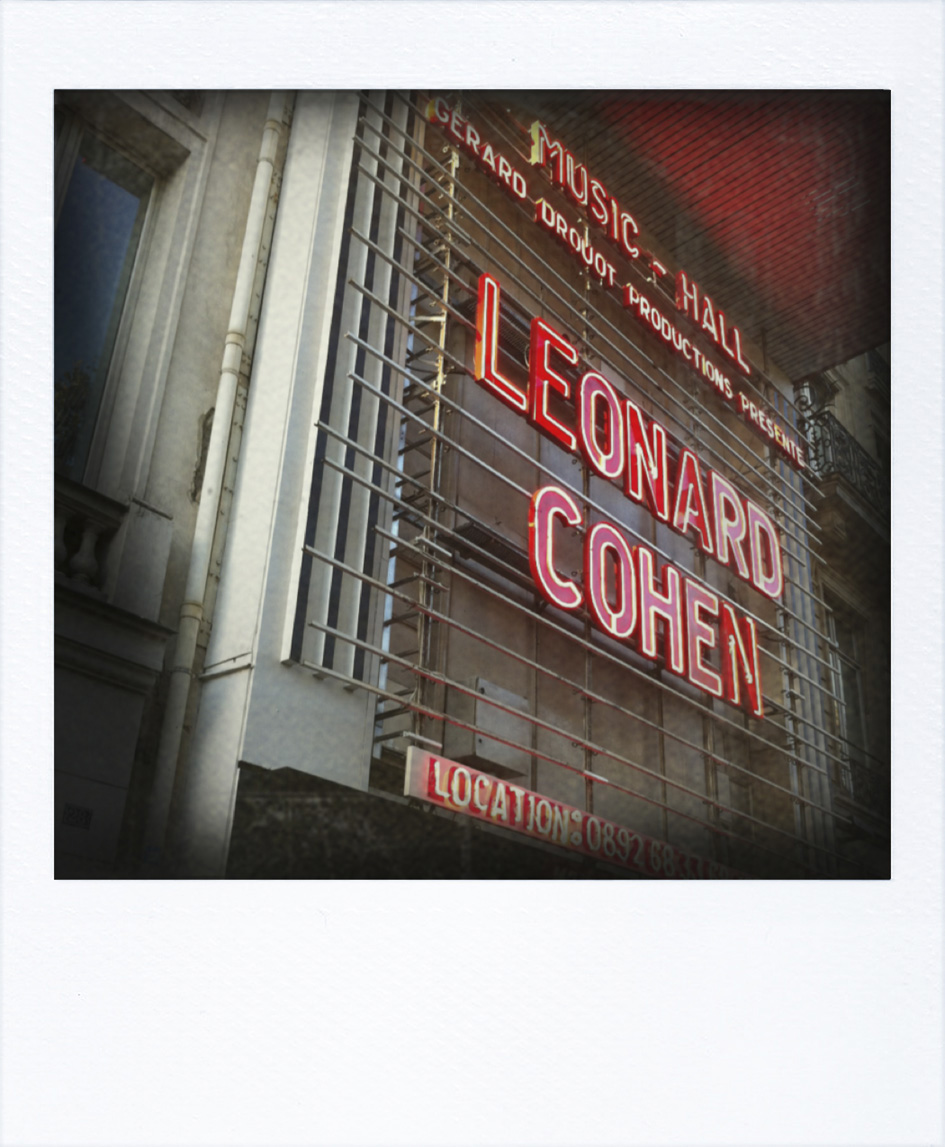
The couple sitting next to us met at a Cohen concert at Leeds University on his first tour in May 1970. And here they were, celebrating at the Paris Olympia 42 years later. And my bad photography has cropped the grey fedora—adopted, I was assured, long before Len.

Olympia Theatre, Sunday.
The Concert: In numbers
33 songs.
3 hours 40 minutes.
3 encores comprising seven songs.
9 musicians, made up of three women and six men—two singers from Kent, England, one from Los Angeles, USA, one from Montreal, Canada; one drummer from Mexico City, Mexico; one keyboardist from Florida, USA; one guitarist from Texas, USA; one bassist from New York State, USA; one violinist from Moldova; one multi-instrumental string player from Zaragoza, Spain.

The Concert: Five Great Moments
1  A brilliant performance of Everybody Knows, every verse a work of genius, every verse a still-accurate assessment of human weakness and failure. Co-written with Sharon Robinson, who later sings a glorious solo version of Alexandra Leaving.
2  A bravura moment at the last verse of The Future where Leonard sings the “There’ll be fires on the road/and the white man dancing,” and bassist Roscoe Beck does a stately piroutte, which is followed by LC singing “And all the lousy little poets/coming round/tryin’ to sound like Charlie Manson/and the white girls dancing,” whereupon the Webb Sisters turn away from their mikes, take one step back and, synchronised, do perfect cartwheels…
3  Leonard soloing on a Jew’s Harp, that most American of instruments on the hoedown breaks of Closing Time, one of two songs (Heart With No Companion being the other) where he sounds uncannily like Tom T. Hall, only deeper. Also, Take This Waltz in a Weimar-ish arrangement, has a hint of The Sensational Alex Harvey Band. Honest.
Night Comes On. I hadn’t dared to hope that I’d hear Leonard sing my favourite song. And sing it he does, causing some spontaneous tears in the audience, its mournful and beautiful melody letting the words cascade in their stoic and weary way, on the cushion of warmth the band create.
I remember catching a version of Who By Fire in the late 80s in a hotel room in LA by chance. It was on Night Music, a show hosted by David Sanborn, with Hal Willner and Jools Holland involved—like a precursor to Later. Sonny Rollins joined Leonard, and played an unaccompanied intro that tore the roof off before the band (including half of Was Not Was and Robben Ford) came in. Tonight, Javier Mas was the star turn, a masterclass in flamenco, playing the bandurria like a man possessed, the elastic strings rolling and tumbling to a frenzied crescendo…

The Concert: Some Observations
You have to make your peace with the fact that a certain amount of drama is missed by muting the drums quite this much. The sound is perfect and balanced, intentionally allowing every word to ring clearly through. To make up for the lack of beat, Larson’s churchy Hammond B3, Alex Bublitchi’s muscular violin and Javier’s Mas’s extraordinary Laud provide thrilling dynamics. Mitch Watkins on guitar (after eleven years in Lyle Lovett’s Large Band) provides structure, architecture and blues—his moaning slur at the end of a Wes Montgomery-like solo on Amen the coup de grâce.

The older-type singer (the ones who aren’t Mick Jagger, anyway) are very fond of the prizefighter pose. Len takes this even further than the bob-and-weave and sings at least half the set on his knees on the patterned rugs that cover the stage, James Brown-style. It also emphasised the supplicant nature of many of the songs: to God, to Poetry, to lust, love, the musicians and to the audience, who he always addresses as “Friends.” His ability to get back up from his knees with grace is very impressive.

The only singer with a deeper voice than Len is Barry White. Fact.

1976: The First Time I Saw Leonard
Was on the south coast of England in 1976. A friend of my mother’s was managing the hotel where Leonard and his musicians were staying and had tickets. I didn’t really know much about his music then—but this was World Music before it had a name, with the flamenco melodies, the gypsy violin and the Moorish oud. Backstage for a meet and greet, we were struck dumb. The next morning, having breakfast at the next table, we were even more tongue-tied.

Leonard, Hand In Pocket, photograph by Michelle Clement.

Five Things I Saw & Heard This Week: Wednesday 15th August

Emusic Find Of The Week
“My name is Dale Hawkins, and I wanna dedicate this song… to the three cities… that I, uh… had the pleasure of recording this tune in! Give a listen and you’ll hear ’em.”—DALE HAWKINS, cousin to Ronnie, creator of the fabulous Susie Q (if you haven’t heard it in years download it now! James Burton’s guitar—out-of-this-world!). This is from L.A., Memphis & Tyler, Texas, title song of his obscure late sixties release, with Burton, Cooder, Mahal, Penn & Oldham all playing. It’s on the great compilation Country Funk 1969-1975. “Ain’t no bum trip, man,” he drawls over a particularly out-of-place flute solo. “It just goes to show ya, man, you can take the soul pickers out of the soul country, but you can’t take the soul out of the pickers…” As Pitchfork says “Weird, in a totally wonderful way,” and it’s hard to disagree.

From Dakar to Kampala!
We started two weeks ago at the football with Senegal’s lovely anthem and, in some excellent circularity, ended with hymne Uganda—“a musical treat” according to The Guardian’s Peter Bradshaw—at the final medal ceremony, in honour of Stephen Kiprotich’s stunning gold-medal run in the marathon. A musical treat it is—I’d pay good money to hear either Randy Newman or Garth Hudson do an arrangement…

Best Coast, 100 Club, London
I hadn’t been to the 100 since it was saved by Converse’s sponsorship. Very happy to see that nothing much had changed—remarkably branding-free and still sweaty, loud and rocking. Brett was playing bass and guitar with Best Coast, and I took his picture by the plaque that’s there for my uncle, his great grandfather, Ken.

Fifty Shades Of Tortoiseshell

Jazz-themed sunglasses from St Albans. Nice.

Take A Load Off RP
Robert Pattinson in French culture mag Les InRockuptibles: “I’m going to do a movie about The Band, the one that played with Dylan: a beautiful script about the nature of songwriting.” Mmmmmmm… I may be lost for words {although, to be fair, he comes over well in the interview}.

Five Things I Saw & Heard This Week: Wednesday 27th June

Hall & Quotes (ouch!)
Rebecca Hall interview, Stylist. There’s a rumour you’re a total music geek… “Yes, that’s true. This is how much of a music geek I am; if I have a day with nothing to do, one of my favourite things is to just sit at my computer and make playlists of pretty much anything. If I could be a musician, I’d do it. I love singing.”
Is there one song you think everyone should listen to?
“That’s a really tough question. Do you mean the song or the version? I always go back to Ella Fitzgerald singing My Man at the Montreux Jazz Festival 1977. It’s not necessarily the song, and it’s not even necessarily her, it’s that particular recording. For some reason, it always gets to me. And I’ve got a bunch of those but that’s the first that comes off the top of my head.”

I’m a sucker for actually bothering to listen to things that people recommend (in all those My Playlist, or Favourite Saturday Night/Sunday Morning Record magazine features), and that’s an interesting response: The song or the version? Sometimes there are particular versions of songs that just work for you. For instance, Rick Danko singing Unfaithful Servant (part of last week’s post). That’s not the version I’d play anyone if I were trying to convince them of the brilliance of the song (that would be the original Band version, if you’re interested). It’s not even the second version I’d play them (that’s Rock Of Ages if you’re still interested). But it is the one that moves me now and makes me hear the song anew.

Anyway: I go to iTunes to get Ella’s Montreux version and find this:

Do explicit songs get a 20p surcharge? No, cause I Let A Song Go Out Of My Heart apparently doesn’t have swearing and is 99p. WHAT IS THIS SWEARING? So I buy it. My Man is lovely, throaty and intense (the last time through Ella hits the title phrase like a tenor sax), starting with a deep breath as Tommy Flanagan picks out the intro. It has all her signatures, and a beautiful virtuoso ending. I can see why Rebecca Hall loves it. I’ve listened to Come Rain and damned if I can find any @#%&*! swearing. If anything, Ella sings like she has a broad smile for the whole song (for me this song is owned by Ray Charles’ glacial take). So, unlike Ella’s My Man, it’s not a version for the ages. Just a version with a 20p surcharge.

The Wide, Wide World Of Sport (And Music)
From Sport Magazine, June 22: BEATS BY DR DRE PRO HEADPHONES: What Modern sportsman doesn’t carry round a hefty pair of cans? “They are noise-cancelling, so great before a big race, and for travelling,” he explains. “I like all kinds of music, from Jay Z to Michael Jackson.”—Team GB swimmer Lian Tancock.

Pot. Kettle. Black.
“After a day with Bono, she might want to put herself back under house arrest.”—Bob Geldof on Aung San Suu Kyi.

Tin Pan Alley, Stefan Grossman, Sound Techniques
Sound Techniques was a studio housed in an old dairy building between Chelsea Embankment and the King’s Road. I was thinking about it because I walked past one of the guitar shops on Denmark Street and idly glanced at a beautiful inlaid Martin acoustic. I looked closer and realised it was a Stefan Grossman signature model. Stefan was, and is, an extremely brilliant  guitarist. I had been talking about him with Sam Charters, who was tasked in the mid-seventies with making a mainstream Grossman record by Transatlantic Records’ Nat Joseph. To this end he hired Alan White, Danny Thompson and Richard Thompson to play. When Sam was in town producing I would hang around the studio after work or college, just enjoying watching the creative process and soaking up the atmosphere (Nick Drake’s albums were recorded at ST), looking down from the control booth to the live room below. I have two memories of those particular sessions: One is watching Sam and Stefan patiently making the curly-headed Richard Thompson overdub one electric guitar part for hour after hour, trying to get him to play it more aggressively. Difference between a session man and an artist in his own right—a session man will say, “You want this? Or this? Or how about this?” Richard just tried to play it better each time. And the other memory was of picking up a comic that was lying in Alan White’s Drum Case and being given very short shrift by the Plastic Ono Band drummer for not asking first…

Maltese Diamond Position Inlays. £4,179.

Best Coast
Always nice to see a relative on stage, even if they are second cousins (did I get that right? Or is it first cousins twice-removed? Or not even cousins but something else?) Whatever, Brett is my cousin Nickie’s son. And bass & guitar player for Best Coast on tour. A grand night had by all!

Best Coast, Shepherd’s Bush Empire, 20th June. Brett and Bethany Cosentino

Five Things I Saw & Heard This Week: Wednesday 13th June

Rick Danko, Unfaithful Servant, LA, 1979: “Easy with him, he’s a human…”
As Eric Andersen wrote, in a farewell letter to Rick: “Your singing remains one of the everlasting glories of American music.” And, though it’s ragged and rough, this is as glorious as it gets. A sweaty club, a febrile atmosphere (it’s not beautifully recorded, but the room fairly crackles—I’ve rarely heard something sound so present). Blondie Chaplin, ex-Beach Boy, is on piano, Rick just singing, not playing bass, someone loosely slapping a tambourine. The crowd is rowdy, and inappropriate for such a heartfelt song. There’s an Elvis-like foldback on the vocal mike, almost sounding like it’s hitting the back wall and touring the room. From Caledonian Mission to It Makes No Difference Rick defined a way of ballad singing that’s unique—a high, white, hilltop soul man, singing American music. Here, he leans in hard, perhaps as a response to the low-down, boozed-up crowd. He fumbles some lyrics, oversings others, but it’s fantastic. Just after he sings “Farewell to my other side, Well, I’d best just take it in stride” he makes the above plea to the crowd, but doesn’t miss a beat. The crowd whistles & whoops and Rick turns it on until the words run out and Paul Butterfield steps up to take the song home with a searing harp solo.

Jo Stafford, Paul Weston, Jonathan and Darlene Edwards
Flicking through an illustrated biography of Frank Sinatra I came across a reference to Jo Stafford (the No 1 singer of the ‘pre-rock’ era, apparently). I’ve got various tracks by her, including a great version of You Belong To Me—a wonderful song nicely covered by Bob Dylan and included on the soundtrack of Natural Born Killers. The book mentioned that she recorded several albums with her husband Paul Weston, spoof records that grew out of a party turn, where he would play bad cocktail piano and she would sing high and out-of-tune. Proustian rush time! These albums were a favourite of my parents, alongside others by Jonathan Winters and Bob Newhart. My dad also had a 78 of Red Ingle & His (Un)Natural Seven’s Tim-Tay-Shun (a spoof of Perry Como’s Temptation). And who is the female vocalist on Tim Tay Shun? Jo Stafford. And they still sound pretty great.

Weird iPod Synchronicity Pt2: June 12th, Victoria Station, London
A song I don’t recognise starts playing, a kind-of bluesy shufflin’ riff with slight Beatles-y overtones in its swirling guitars, as I turn to the G2 section of The Guardian. Steve Miller starts singing: “Way down in Alabama there’s a girl just a waitin’ for me, She don’t have to worry, she don’t have to hurry, Lord, I keep her so happy, she’s my…” And at this point I read the cover line: THIS DRUG RUINS LIVES: HOW SUGAR BECAME A LETHAL ADDICTION by Jacques Peretti. And Steve sings: “Sugar baby, Sugar, sugar baby, Sugar baby, Sugar, sugar baby…”

Really?
World’s Richest DJs:
#10: Moby Net Worth $28 million
#9: Daft Punk Net Worth – $30 million each
#8: Pete Tong Net Worth – $30 million
#7: Judge Jules Net Worth – $40 million
#6: Sasha (DJ) Net Worth – $40 million
#5: Armin Van Buuren Net Worth – $40 million
#4: John Digweed Net Worth – $45 million
#3: Paul van Dyk Net Worth – $50 million
#2: Paul Oakenfold Net Worth – $55 million
#1: DJ Tiesto Net Worth – $65 million

Really 2?

Black and Grey Mesh Eye Logo Trucker Cap, thanks. Oh, on second thoughts…

Five Things I Saw & Heard This Week: Wednesday 30th May

Best Eurovision Moment
After Albania’s rather terrifying sub-Bjork performance, Graham Norton waited a beat, then said: “I’m pretty sure that, if they get her medication right, that need never happen again…”

Pete Doherty Interview by Geoffrey Macnab, The Guardian
Ah, poor Pete, treated badly by everybody as he makes his film debut in Confession of a Child of the Century. Take Charlotte Gainsbourg. She wasn’t “all that happy” about the production, which, he says he knows because he snuck into her room and looked at her journal [!]. She came in “as someone everyone knew but a complete stranger in the immediate environment… you couldn’t be a star.” It was freezing cold on location. Between takes, assistants would “leap on her with loads of blankets and hot-water bottles and I was stood there in 19th-century cotton with lots of holes in it.” And in prison: “It’s horrible, horrible. There are lots of aggressive, money-oriented, very masculine people, but at the same time, there is really nasty homoerotic violence. It’s not the place to be if you are a freethinking man.” And now there’s the film critics! The reviews have been overwhelmingly negative, with Doherty’s own performance deemed “catastrophic” and “calamitous.”

For what it’s worth, I have no great opinion on Doherty’s songwriting talent and I wasn’t impressed by The Libertines, but I saw him play a song at Hal Willner’s Disney night, The Forest of No Return, part of Jarvis Cocker’s Meltdown at the Festival Hall in 2007. With a line-up of luminaries ranging from Nick Cave to Grace Jones (brilliantly terrifying on The Jungle Book’s Trust In Me) Pete took the stage to sing Chim Chim Cheree. We were sitting just behind Kate Moss, Pete’s then-inamorata, who was busy snapping photos. One of the few performers to have memorised the words, strumming a battered acoustic, he totally inhabited the song, and—singing beautifully—essayed a perfect and tender version, rescuing it forever from the clutches of Dick Van Dyke. And that’s no mean feat.

Reissue of the Week
Walked into a guitar shop to discover that Fender have reissued the Kingman, the acoustic played by Elvis, with its classic Fender headstock…

My prized Fender 1968 catalogue

A Night At The Opera
Puccini’s Madame Butterfly. English National Opera. Anthony Minghella’s production. Visually stunning in places. Rousing and expressive music. Awful story, that seems horribly outdated and verging on distasteful. Terrible clunky language which is hard to sing (Pinkerton: “I bought this house for nine hundred and ninety nine years, but with the option, at ev’ry month, to cancel the contract! I must say, in this country, the houses and the contracts are elastic!”). And then sung with seeming disregard for the melodies of the music floating underneath! Interview this week with Emma Rice, director of theatre group Kneehigh: Is there an artform you don’t relate to? “Opera. It’s a dreadful sound. It just doesn’t sound like the human voice.”

Image Of The Week: !Bobama!

!