Five Things I Saw & Heard This Week: Wednesday 13th June

Rick Danko, Unfaithful Servant, LA, 1979: “Easy with him, he’s a human…”
As Eric Andersen wrote, in a farewell letter to Rick: “Your singing remains one of the everlasting glories of American music.” And, though it’s ragged and rough, this is as glorious as it gets. A sweaty club, a febrile atmosphere (it’s not beautifully recorded, but the room fairly crackles—I’ve rarely heard something sound so present). Blondie Chaplin, ex-Beach Boy, is on piano, Rick just singing, not playing bass, someone loosely slapping a tambourine. The crowd is rowdy, and inappropriate for such a heartfelt song. There’s an Elvis-like foldback on the vocal mike, almost sounding like it’s hitting the back wall and touring the room. From Caledonian Mission to It Makes No Difference Rick defined a way of ballad singing that’s unique—a high, white, hilltop soul man, singing American music. Here, he leans in hard, perhaps as a response to the low-down, boozed-up crowd. He fumbles some lyrics, oversings others, but it’s fantastic. Just after he sings “Farewell to my other side, Well, I’d best just take it in stride” he makes the above plea to the crowd, but doesn’t miss a beat. The crowd whistles & whoops and Rick turns it on until the words run out and Paul Butterfield steps up to take the song home with a searing harp solo.

Jo Stafford, Paul Weston, Jonathan and Darlene Edwards
Flicking through an illustrated biography of Frank Sinatra I came across a reference to Jo Stafford (the No 1 singer of the ‘pre-rock’ era, apparently). I’ve got various tracks by her, including a great version of You Belong To Me—a wonderful song nicely covered by Bob Dylan and included on the soundtrack of Natural Born Killers. The book mentioned that she recorded several albums with her husband Paul Weston, spoof records that grew out of a party turn, where he would play bad cocktail piano and she would sing high and out-of-tune. Proustian rush time! These albums were a favourite of my parents, alongside others by Jonathan Winters and Bob Newhart. My dad also had a 78 of Red Ingle & His (Un)Natural Seven’s Tim-Tay-Shun (a spoof of Perry Como’s Temptation). And who is the female vocalist on Tim Tay Shun? Jo Stafford. And they still sound pretty great.

Weird iPod Synchronicity Pt2: June 12th, Victoria Station, London
A song I don’t recognise starts playing, a kind-of bluesy shufflin’ riff with slight Beatles-y overtones in its swirling guitars, as I turn to the G2 section of The Guardian. Steve Miller starts singing: “Way down in Alabama there’s a girl just a waitin’ for me, She don’t have to worry, she don’t have to hurry, Lord, I keep her so happy, she’s my…” And at this point I read the cover line: THIS DRUG RUINS LIVES: HOW SUGAR BECAME A LETHAL ADDICTION by Jacques Peretti. And Steve sings: “Sugar baby, Sugar, sugar baby, Sugar baby, Sugar, sugar baby…”

Really?
World’s Richest DJs:
#10: Moby Net Worth $28 million
#9: Daft Punk Net Worth – $30 million each
#8: Pete Tong Net Worth – $30 million
#7: Judge Jules Net Worth – $40 million
#6: Sasha (DJ) Net Worth – $40 million
#5: Armin Van Buuren Net Worth – $40 million
#4: John Digweed Net Worth – $45 million
#3: Paul van Dyk Net Worth – $50 million
#2: Paul Oakenfold Net Worth – $55 million
#1: DJ Tiesto Net Worth – $65 million

Really 2?

Black and Grey Mesh Eye Logo Trucker Cap, thanks. Oh, on second thoughts…

Five Things I Saw & Heard This Week: Wednesday 30th May

Best Eurovision Moment
After Albania’s rather terrifying sub-Bjork performance, Graham Norton waited a beat, then said: “I’m pretty sure that, if they get her medication right, that need never happen again…”

Pete Doherty Interview by Geoffrey Macnab, The Guardian
Ah, poor Pete, treated badly by everybody as he makes his film debut in Confession of a Child of the Century. Take Charlotte Gainsbourg. She wasn’t “all that happy” about the production, which, he says he knows because he snuck into her room and looked at her journal [!]. She came in “as someone everyone knew but a complete stranger in the immediate environment… you couldn’t be a star.” It was freezing cold on location. Between takes, assistants would “leap on her with loads of blankets and hot-water bottles and I was stood there in 19th-century cotton with lots of holes in it.” And in prison: “It’s horrible, horrible. There are lots of aggressive, money-oriented, very masculine people, but at the same time, there is really nasty homoerotic violence. It’s not the place to be if you are a freethinking man.” And now there’s the film critics! The reviews have been overwhelmingly negative, with Doherty’s own performance deemed “catastrophic” and “calamitous.”

For what it’s worth, I have no great opinion on Doherty’s songwriting talent and I wasn’t impressed by The Libertines, but I saw him play a song at Hal Willner’s Disney night, The Forest of No Return, part of Jarvis Cocker’s Meltdown at the Festival Hall in 2007. With a line-up of luminaries ranging from Nick Cave to Grace Jones (brilliantly terrifying on The Jungle Book’s Trust In Me) Pete took the stage to sing Chim Chim Cheree. We were sitting just behind Kate Moss, Pete’s then-inamorata, who was busy snapping photos. One of the few performers to have memorised the words, strumming a battered acoustic, he totally inhabited the song, and—singing beautifully—essayed a perfect and tender version, rescuing it forever from the clutches of Dick Van Dyke. And that’s no mean feat.

Reissue of the Week
Walked into a guitar shop to discover that Fender have reissued the Kingman, the acoustic played by Elvis, with its classic Fender headstock…

My prized Fender 1968 catalogue

A Night At The Opera
Puccini’s Madame Butterfly. English National Opera. Anthony Minghella’s production. Visually stunning in places. Rousing and expressive music. Awful story, that seems horribly outdated and verging on distasteful. Terrible clunky language which is hard to sing (Pinkerton: “I bought this house for nine hundred and ninety nine years, but with the option, at ev’ry month, to cancel the contract! I must say, in this country, the houses and the contracts are elastic!”). And then sung with seeming disregard for the melodies of the music floating underneath! Interview this week with Emma Rice, director of theatre group Kneehigh: Is there an artform you don’t relate to? “Opera. It’s a dreadful sound. It just doesn’t sound like the human voice.”

Image Of The Week: !Bobama!

!


Five Things I Saw & Heard This Week: Wednesday 23rd May

Modern Family Rocks! Or Is That Soft Rocks?
Haley has been ripped off—her dad gets ready to confront the perpetrator. Phil: “Yeah I got a plan. Either he gives us the money or he gets a private performance from (holds up left fist) England Dan and (right fist) John Ford Coley.” Later, he amends this to “Crosby (left fist), Stills (right fist), Nash (knee), and Young (kicks out his foot).” Baby Boomer scripting par excellence— and Ty Burrell as Phil just gets better and better.

I Missed The Radio Doc About The Missing Bobbie Gentry
Yes, I conspired to miss something I know I’d have loved. I only found out after it broadcast and then—just as my finger was hovering over the play triangle on iPlayer—it disappeared. I can only hope it featured the wonderful Jill Sobule song, Where Is Bobbie Gentry? Set to a clever melody closely modelled on Ode To Billie Jo it tells of a fan’s devotion…

“Out in the desert where the skin slowly cures deep brown
She’s got a little shack, a pickup truck, parked out on the edge of town
It’s just what I imagined, no one knows where’d she be
Maybe she’s in heaven passing black-eyed peas
Where is Bobbie Gentry?

Up in Alaska hauling wood or maybe in Japan
I bet that she’s still beautiful, goes barefoot everywhere she can
Does she still play guitar or write a song or two?
Maybe that was over; she’s got better things to do
Where is Bobbie Gentry?

If I could just find you
Say I love you and then leave you alone
If I could just find you
Say I love you and then leave you alone

1967, Bobbie made it on the Billboard charts
Ten years later, disappeared and broke everybody’s heart
Does she ever go to Chickasaw? Ever go back on that bridge?
Well, I was the baby thrown off the Tallahatchie Bridge
Yeah, I was the baby thrown off the Tallahatchie Bridge…”

Love that middle eight…

That “Bird On A Wire” Was A Real Cracker Of A Movie, Wasn’t It?
Someone has made a a psychological thriller, due out in a couple of weeks, titled after Leonard Cohen’s A Thousand Kisses Deep, from Ten New Songs. It stars Emilia Fox and Dougray Scott (in a pork pie hat, playing jazz trumpet in the bath). Snap judgment from the trailer? Absolutely preposterous.

Niles ’n’ Miles
Fascinating piece hidden away in the Money section of The Guardian, by the always interesting Nile Rogers, in a regular column called My Greatest Mistake. He tells of the many occasions on which Miles Davis would ask Rodgers to write him a song. Nile: “This is a great man who changed my life—and he wanted me to help change his. I believe he kept asking me for about two years, and all that time I couldn’t believe he was serious… he had a funny coding system for when we spoke on the phone at night, like I was calling the president of the US: I had to ring three times and ask for so-and-so and then he would know it was me. I kept doing jazz fusion demos and whenever Miles heard them he’d say to me: “I can do that myself. I want a motherfucking Good Times.” Miles Davis was 100% clear but I didn’t hear him. He was completely sincere and had opened himself up by asking for my help. If I wasn’t so stupid I might have done it.”

Bob. Dylan. Boot. Leg.
From Bobby Keys’ autobiography Every Night’s a Saturday Night we learn that the feet poking out from the Rolls Royce on Delaney & Bonnie & Friends are Bob’s. And the Rolls? Albert Grossman’s.

Five Things I Saw & Heard This Week: Wednesday 18th April

Newsnight v Odd Future Wolf Gang Kill Them All
Oh dear. Old media fails again to report properly on new phenomena… From Stephen Smith’s bizarre “Is this the future of Rock ’n’ Roll?” opening line it was The Day Today all the way. After Brick Stowell explained that he made 300 t-shirts for the pop-up shop (OF are paying their way by selling stuff rather than music at this point), Smith’s supposedly snark aside was: “Are there any washing instructions in here?” How lame is that? A pointlessly combatative interview with OF followed by their manager having to insist they paid taxes, before Smith’s coup de grâce—“Some say the band are a case of new wine in old bottles, or is that a case of old dope in new bongs?” If that’s the level of discourse, if that’s how you’re going to attempt to impart information in the six minute time slot that Newsnight will allow—then why bother? As the kids would say: Jam Yo Hype, Newsnight!

Mystic Malvina
“There were some good things at the Monterey Folk Festival—you must have missed them, or they didn’t appeal to you anyway… A girl named Janis Joplin, square built, impassive, singing blues in a high, skin-prickling voice like a flamenco woman; Bob Dylan, and some others. When thousands of kids are doing something with diligence and devotion, there are going to be some geniuses amongst them—it figures mathematically. And something is coming of this. Bob Dylan is a sign.”

An excerpt from a wonderful letter that folksinger Malvina Reynolds (composer of Little Boxes) wrote to Ralph J Gleason, published by Jeff Gold on his Recordmecca blog. As Jeff says, “Boy, did she ever get that right.” Big Brother & The Holding Company three years in the future and Dylan’s first appearance on the West Coast. “He too was almost completely unknown, and for Reynolds to invoke the genius-word was pretty prescient—and daring, indeed.” Jeff follows this with a letter from a woman called Donna, about Dylan’s 1965 San Francisco Press Conference which is just as good. More and more, these primary sources ring with resonance—the resonance of a time and place, not with hindsight or a critical straightjacket to tie them up in.

Welcome To The Library, Friday evening, 13th April

As far from the jungle as could be—you’d think—the Westminster Reference Library, just off Leicester Square. I used to do my homework there. Tonight it’s the venue for the Sam Amidon Experience.

A power trio unlike any you’ve ever heard. Sam makes the melodies of these old, old folk songs a kind of plainsong—flattened out and dessicated, almost. By repeating and intensifying phrases, voice totally in sync with his unique guitar style, the tunes move forward and shift gears. Behind him, like mad scientists tiptoeing through the cables, his genius accompanyists moved from Slingerland drumkit to computer, from bass to prepared guitar. Take a bow Shahzad Ismaily and Chris Vatalaro. With these two beyond-talented collaborators the show swayed from free jazz to beat poetry to Appalachian ballads (one of which, Prodigal Son, Amidon dedicated to Rick Santorum: “When I left my father’s house, I was well supplied, I made a mistake and I did run, I’m dissatisfied… I believe I’ll go back home, I believe I’ll go back home, I believe I’ll go back home, Acknowledge I done wrong.”)

I took my mum. She found it equal parts beguiling and baffling. She loved the final medley of Climbing High Mountains with R. Kelly’s Relief, where the audience sang the refrain like a hymn. She’d liked to have heard more Beth Orton. Mothers, eh?

Post-Rock Careers: Nine Inch Nails

Literate Rockers Alert!
As Alex Kapranos is to food, so Charlie Fink may be to film, if an enterprising publisher snaps up the Noah & The Whale Film Companion. A really entertaining diary entry in ES Magazine made me warm to a frontman whose band had hardly set my pulses racing at a couple of festival appearances last year. I’ll have to listen anew.


Five Things I Saw & Heard This Week: Wednesday 21st March

Homeland’s sound design
British dramas tend to have clean, neat soundtracks. I don’t mean the musical elements, but the overall soundscape. Often brilliant atmospherics and great scoring, but generally pristine voice recording and foley work. US programmes on the whole have a funkier sound (it may be partly a technical thing, I’m no expert). However, Homeland has taken funky to new levels. It’s oppressively, brilliantly, noisy—all cicadas and compression. [Compression |kəmˈpre sh ən| noun. Compression in audio recording lessens the dynamic range of the audio by reducing the level of the louder parts, resulting in an “in your face” sound. The proper use of compression will bring out the quieter parts of the audio and make the entire piece sound louder.] In each scene, the outside seems as loud as the inside (witness the crickets at night in the episode where Carrie sleeps at her sister’s house and the same background sounds run into Brody’s house. Air conditioners whirr, fridges hum, interview rooms throb. There’s no escape…

emusic find of the month
Late Late Party, a compilation of songs recorded by The Pac-Keys and The Martinis, at Stax in the mid-Sixties, both bands featuring Packy Axton, son of the label’s founders. Like a frat boy version of Booker T and The MGs. Fantastic. Hear Greasy Pumpkin. If you like that, hear the rest.

White On White
I hadn’t reread The White Album by Joan Didion for years. But it’s extraordinary. Against a backdrop of California, Manson and her own mental issues, it’s filled with brilliant passages like this one. After Manzareck and Morrison discuss, in a circular way, where they might rehearse the next day… “I counted the control knobs on the electronic console. There were seventy-six. I was unsure in whose favor the dialogue had been resolved, or if it had been resolved at all. Robby Krieger picked at his guitar, and said that he needed a fuzz box. The producer suggested that he borrow one from the Buffalo Springfield, who were recording in the next studio. Krieger shrugged. Morrison sat down again on the leather couch and leaned back. He lit a match. He studied the flame awhile and then very slowly, very deliberately, lowered it to the fly of his black vinyl pants. Manzarek watched him. The girl who was rubbing Manzarek’s shoulders did not look at anyone. There was a sense that no one was going to leave the room, ever. It would be some weeks before The Doors finished recording this album. I did not see it through.” Read anything about music that good recently?

Karen Dalton 1966
Personal recordings made in her family living room, now released. The folk world’s Billie Holiday sings Darroll Adams rhythmic, pretty Green Green Rocky Road with such a motionless sadness, it’s as if she’s staring transfixed out of her window at the road itself.

Winogrand/Dylan interface
Funny how certain songs leap into your head when prompted by something visual. I was walking down Edgware Road on Monday with the morning sun flooding past street signs and traffic-light poles and jaywalkers, and everything was angles and glare. I always think of views like that as Garry Winogrand mornings, a reference to the great American photographer whose photographs captured the extraordinary cityscapes of New York. A half-remembered lyric comes to mind: “Perhaps it’s the color of the sun cut flat and coverin’/the crossroads I’m standin’ at…” (Bad, bad attempt below)

Five Things I Saw & Heard This Week: Wednesday 29th February

Bruno Mars’ Bass Player, The BRITs
Unassumingly, the coolest man to take the stage on the night, and by a country mile. Bruno Mars—nice Little Willie John look and fine pompadour—played the Wonder-ish Just The Way You Are, and his bassman rose to the challenge. Digging the show, hands bopping over the fretboard like Jamerson re-incarnated, Jamareo Artis didn’t put a beat or a note wrong, even when double-stepping the dance moves. The final high flourish as the song ended was the sublime icing on the cake, sliding his right hand down the fretboard to dampen the last note, before hooking his thumb jauntily in his hip pocket.

Whitney Houston at the BRITs
Watching the jarringly brusque tribute, my mind flashed back to an earlier time: in 1987, in a Park Lane hotel ballroom, Whitney sang her hit du jour, How Will I Know, dancing slightly awkwardly to a backing track on a stage more suited to an army base than an awards show. We were ten yards away, pushing bad food around our plates, and could hear Whitney acoustically, as well as through the PA. She gave it her all, and as the pre-record started to fade, was so into the performance that she continued for a good fifteen seconds, not backing off her volume at all. Jaws hit the table as the most thrilling sound vaulted over us. For those fifteen seconds, she was a blissful and transported teenager, singing in the Lord’s House. In that fakest of environments—an awards show—something real.

Weird iPod Synchronicity Pt1: Feb 28th, Park Lane, London
On the bus going up Park Lane, approaching Speaker’s Corner at Hyde Park yesterday morning. iPod on random. A Dylan track, from a bootleg I haven’t even bothered listening to (it comes from a period I don’t care for, around the time of Under The Red Sky). It’s a shuffle, pretty unmixed sounding, with what sounds like Randy Jackson’s rubbery bass lines bubbling along*. “One time in London I’d gone out for a walk/At the place called Hyde Park, where people talk/Get up on a platform and they tell their point of view/To anyone who’s there, that’s who they’re talkin’ to/There was a man on a platform, talking to some folks, about TV being evil, he wasn’t telling jokes…” Leaving aside the obviously low, McGonagall-esque quality of these lines—possibly some of the worst Bob’s ever penned—How strange is that?

*I remember Randy Jackson saying they were pretty odd sessions. Don Was would line-up different bands of players each time Dylan came to the studio. No-one had the first clue what they were doing. It’s a production technique, I guess…

Bonnie Raitt: Thank You
That’s the song Thank You, from early in her career, although it’s entirely appropriate to thank Bonnie for one of American music’s most satisfying careers. Justin Vernon draw attention last year to her sublime I Can’t Make You Love Me, but there’s so much in Bonnie’s past that’s fine, just waiting for rediscovery. I’m just going to draw attention to a winning radio airshot: The Lost Broadcast: Philadelphia 1972. [Through some grey European law loophole Amazon are selling CD’s of US radio broadcasts from Dylan, Waits and Cohen, among others]. Bonnie introduces it thus: “This is a tune—for all you unseen people out there I’m just going to move to the piano to show how versatile I am—haven’t played a piano for months now, didn’t play it before that since I was a little kid, pubescing in Los Angeles. Playing Dick Dale runs [runs finger down keyboard]—Wipeout! Anyway, this is a tune I wrote over the summer. Ready?”

It’s not a perfect song, part Jackson Brown, part Eric Kaz, a little Philly soul (the taping took place at the legendary Sigma Sound studios), even some Toussaint in the piano melody, but this performance, with Freebo on bass and TJ Tindall on slithery, chiming guitar is a little gem. As she glides her beautiful voice over the phrase “I was all you’d ever need,” hear one of the great American voices—unforced, unglitzy, true.

The Adele Gap
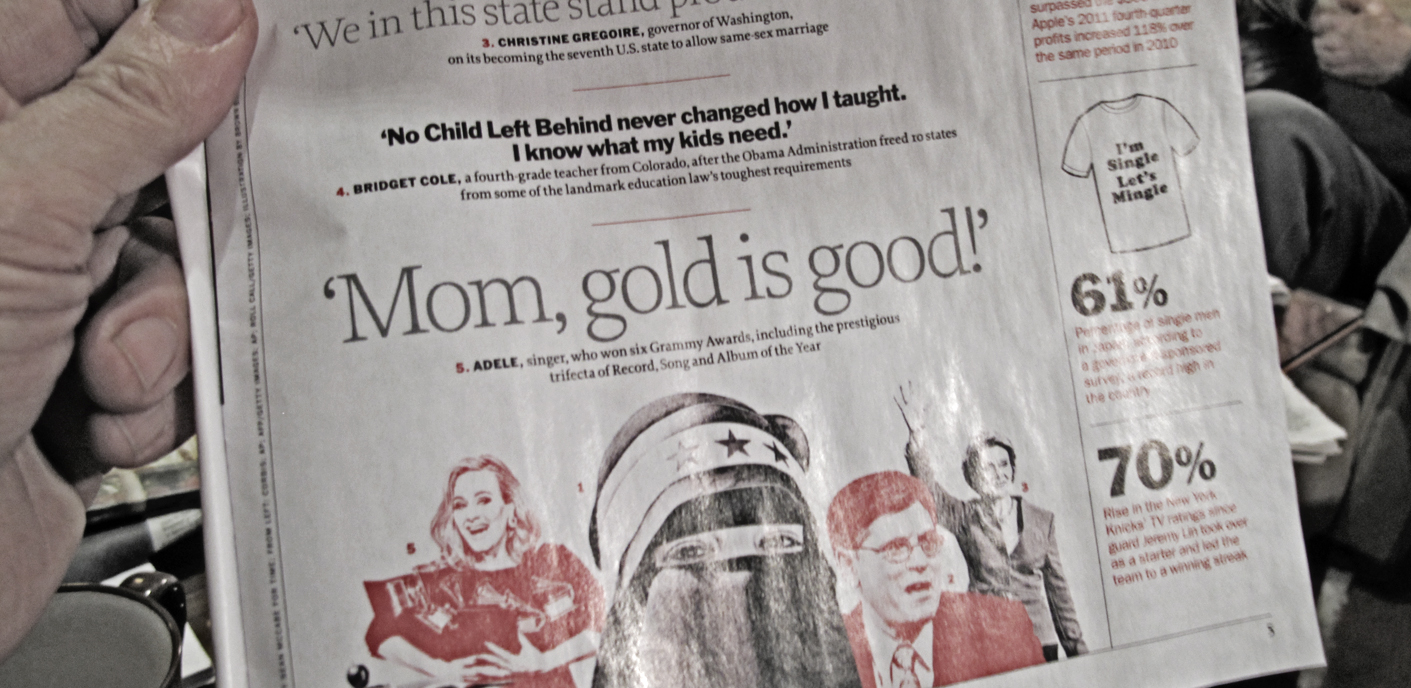
Phrase meaning: the difference between a performer’s singing and speaking voices. Example: “there is no Adele Gap in the case of Leonard Cohen.” See TIME magazine mishearing of Adele Grammy exclamation “Mum! Girl done good!” below.