Friday, 18th September

auction

IMAGES OF THE WEEK
From the upcoming (September 29th) Rock & Pop auction at Sotheby’s in London, these eight lots are my favourites. A spare £150,000 may get you Bob’s original “Hard Rain” lyrics… [From the family of Elisabeth (Lily) Djehizian, the first wife of Hugh Romney (“Wavy Gravy”). Lily met Romney whilst working as a waitress at the Gas Light and was closely associated with many of the artists working in Greenwich Village in the early 1960’s, most notably Lenny Bruce.] Click to enlarge – check out the great Beatles’ (U.S.A.) Ltd. typography.

WELL THIS RAISES THE GAME A LITTLE BIT
Spellbinding six-minute overview of the current state of Kendrick Lamar’s music on the Late Show with Stephen Colbert. Lamar makes most current music look dumb and pallid. It isn’t just the crack rhythm section or the compelling jittery shapes he throws as he sings, it’s the delivery and the timing. He romps through the mid-section with the fantastic beat of To Pimp a Butterfly’s “King Kunte” dissing musical frauds– “I can dig rappin’, but wait! a rapper with a ghost writer? tell me what happened!?“ The song relentlessly builds by moving up a semi-tone every chorus, the two bass players powering it on and on, before it morphs into a effects-driven jazzy end section with an amazing repeated vocal riff on “lovin’ you is complicated…” Staggering.

NOT STAGGERING
Is it just me, or is this as tuneless as I think? One of Apple’s new Apple Music adverts with Leon Bridges, or as he’s known in our house, Aloe Blacc without a decent song. The others aren’t much more convincing – I’m not sure Shamir or Flo Morrisey are doing anything not done better before.

BEST TELEPHONE TREE HOLD MUSIC THIS WEEK!
…and the winner is: Southern Electric, with the Miles Davis Quartet (Miles on trumpet, Red Garland on piano, Paul Chambers on bass and Philly Joe Jones on drums) playing “When I Fall in Love (it Will be Forever)”. It was on repeat and made the resulting 25-minute wait way more pleasant.

FROM MARK MYERS’ WSJ PIECE ON THE MAKING OF STEELY DAN’S “DEACON BLUE”
Strangely, Mr Christlieb is referred to as Pete…
Mr Fagen: “When everything was recorded – the rhythm section, the horns and the background vocals – Walter and I sat in the studio listening back and decided we needed a sax solo, someone to speak for the main character. We liked the sound of a tenor saxophonist who played in Johnny Carson’s Tonight Show band, a cat who blew like crazy when the show went to a commercial. He had this gutsy sound, but we didn’t know who it was.”

Mr Becker: “We had our producer Gary Katz ask around and he found out it was Pete Christlieb. Pete had invented any number of cool harmonic devices that made his playing sound unique. He just sounded like a take-charge soloist, a gunner.”

Pete Christlieb: “I went over to the studio one night after the Tonight Show finished taping at 6:30 p.m. When I listened on headphones to the track Tom [Scott] had arranged, there was just enough space for me to play a solo. As I listened, I realized Donald and Walter were using jazz chord changes, not the block chords of rock. This gave me a solid base for improvisation. They just told me to play what I felt. Hey, I’m a jazz musician, that’s what I do. So I listened again and recorded my first solo. We listened back and they said it was great. I recorded a second take and that’s the one they used. I was gone in a half-hour. The next thing I know I’m hearing myself in every airport bathroom in the world.”

EXTRA! FOR ALL YOU NIGHTHAWKS OUT THERE…
It’s Pete Christlieb’s sax on Tom Waits’ wonderful Nighthawks at the Diner. I found this piece on its recording, a Dan Daley interview with Bones Howe… We started talking about where we could do an album that would have a live feel to it. We thought about clubs, but the well-known ones like the Troubadour were toilets in those days. Then I remembered that Barbra Streisand had made a record at the old Record Plant studios, when they were on 3rd Street near Cahuenga Boulevard. It’s a mall now. There was a room there that she got an entire orchestra into. Back in those days they would just roll the consoles around to where they needed them. So Herb and I said let’s see if we can put tables and chairs in there and get an audience in and record a show. I got Michael Melvoin on piano, and he was one of the greatest jazz arrangers ever; I had Jim Hughart on [upright] bass, Bill Goodwin on drums and Pete Christlieb on sax. It was a totally jazz rhythm section. Herb gave out tickets to all his friends, we set up a bar, put potato chips on the tables and we had a sell-out, two nights, two shows a night, July 30 and 31, 1975. I remember that the opening act was a stripper. Her name was Dewana and her husband was a taxi driver. So for her the band played bump-and-grind music –and there’s no jazz player who has never played a strip joint, so they knew exactly what to do. But it put the room in exactly the right mood. Then Waits came out and sang “Emotional Weather Report”. Then he turned around to face the band and read the classified section of the paper while they played. It was like Allen Ginsberg with a really, really good band.” From Tomwaitsfan.com

nighthawks-soundonsound

Bones Howe’s original layout diagram for the live recording.

Wednesday, 9th September

…including one thing from a couple of weeks ago…

Lonnie

LONNIE HOLLEY AND ALEXIS TAYLOR, DAVID BYRNE’S MELTDOWN, QEH
It’s tough to be a support act – unfamiliar music played to unfamiliar faces, only a few waiting for their favourite tunes. And Alexis Taylor at first seems an odd pairing with Lonnie Holley, as his new album, Await Barbarians, is all Seventies electric piano-driven singer-songwriterness, albeit with lovely Wurlitzer and restlessly inventive guitar [I missed the guitarist’s name].

What gradually pulls me in, though, is the wonderful drumming of Sarah Jones. On a couple of songs (the ones that seem to be teetering on the edge of turning into Neil Young’s “See the Sky About to Rain”) she sounds just like she’s stepped out of the Hi Records Studio in 1972 – the kit compressed and gated so the hats are as loud as the snare, with that deliberate, almost ponderous, beat. It’s wonderful. Her whole approach is really considered, like she feels herself to be totally at the service of the songs, treading carefully through a set of short, sweet tunes – including a cover of “Don’t it Make My Brown Eyes Blue”, where Alexis floats over the song, aided by great distorted guitar. The one exception to this mood was towards the end, when they played a beast of a thing (called something like “Vortex”) that alternately sounded like a Kurosawa soundtrack and Can at their most driven. This was where Sarah Jones took the lead with a swaggering set of tom rolls allied to a mighty beat that gradually drew the other musicians in and built to a blistering crescendo.

During the interval, a couple of rows down, David Byrne is chatting to Robert Wyatt. The QEH is maybe half full as the lights go down. The crowd greet the main act ecstatically, a woman behind me almost sobbing with delight-slash-hysteria, her hands clasped together in supplication.

Stage left, drumkit, stage right, cello. In the middle behind a bank of keyboards, Lonnie Holley, covered in rings and scarves. I have no idea what to expect. “Here we go, here we go… here we go”, says Lonnie softly, his fingers starting the fluttering, repetitive figures on the piano that will set the style for the next hour. These flurries are given shape and dynamics by the excellent cellist and by Lonnie’s voice, often melodically entwined. The drumming is free but receptive to the nuances of Lonnie’s direction. From what I could make out, most of the spontaneous lyrics are platitudes about mother earth and treating each other well, but it’s the mellow and soulful sound of his voice that catches you. It’s a hypnotic thing, found in, say, Al Green’s or Marvin Gaye’s oeuvre – coming from the Gospel tradition, but played out in a certain kind of soul music as seduction. Whatever, it was like being enveloped in warm bathwater, or more accurately, a flotation tank, with the outside world banished for as long as he performed. Priscilla Frank put it nicely in The Huffington Post: “From the rings on his fingers to the words in his mouth, Lonnie Holley is always at work on the art that is Lonnie Holley. He’s a scavenger and a shaman, a performer, a storyteller and a genuine spirit. Despite the relentless barrage of tragedy Holley faced throughout his life, he salvaged his very being like a discarded object left in a sewage pipe, and turned it into something wildly beautiful.” And that’s what the ebb and flow of his show was – beautiful.

A very nice set of B&W photographs of the soundcheck by Stuart Leech, shot for music website The 405, can be found here.

SMILES OF A SUMMER NIGHT
As we set off for Stockholm for a literary festival in Uppsala, where we’ll read some of Sam Charters’ poetry and celebrate his life, I looked for some performances by Peps Persson, a Swedish bluesman who Sam produced. I loved Peps’ first album, especially his version of “The Sky is Crying”. His voice sounds a little like Dave Van Ronk’s (who Sam also produced) on this terrific track “Samma Lea, Snae Blues”. The long-held note at the beginning of the second verse is beautiful, the band cruise with just the right amount of low down groove, just the right amount of precision, and the drummer’s leap to the cymbal at the end is great.

YABBA, YABBA, HEY
Glad to see my favourite post-rock, math-rock combo Battles are back in the fray. This video catches them playing about-to-be-released song “The Yabba”. Always fun to watch John Stanier drumming, and love the way he comes back in at around the 6:00 mark as the song reaches its chaotic conclusion.

THIS WEEK I STUMBLED UPON… 1
I was idly looking for stuff about how Willie and Al Jackson and Howard Grimes got the “Willie Mitchell drum sound” and, as is the internet’s way, I ended up at Al Green playing “Simply Beautiful”, which does not contravene the Trades Description Act in any way, shape or form. And if you like that, check this – his incredible performance of the Gibb Brothers’ “How Can You Mend a Broken Heart”. I had an mp3 of this performance, but didn’t realise there was video… brilliantly directed, too. The opening verse shot in half-profile; the way Al bears down on “mend”, the enraptured kid in the front row. Oh, to be in that tv studio in New York in 1973…

THIS WEEK I STUMBLED UPON… 2
A Post-MusiCares Conversation with Bill Flanagan
Bill: I noticed that some people who were not at the event read the transcript of your speech and didn’t get that some of it was tongue in cheek. When you said, “why me, lord?” in the room you were laughing and so was the audience. In print, some people thought it was all serious.

Bob: Yeah, well you had to be there.

Bill: How did you select all the performers for the Musicares tribute, was that difficult?

Bob: “It really wasn’t. Most all of them had recorded versions of those songs over the years. Garth had made “Make You Feel My Love” a number one hit. Tom Jones had done an incredible version of “What Good Am I.” Beck had recorded “Leopardskin Pillbox Hat.” Bonnie had recorded astonishing versions of “Standing in the Doorway” and “Million Miles.” So no, it wasn’t that hard. I’d even seen Alanis Morissette sing “Subterranean Homesick Blues” somewhere and I couldn’t believe she got that so right, something I’d never been able to do. Neil of course, he’s been doing “Blowin’ In the Wind” for a while and he does it the way it should be done and that song needed to be there. Some people called up right away and wanted to be on the show, so Don Was found a few songs for them. But mostly, they were all recorded versions that we were hearing except maybe for Aaron Neville’s version of “Shooting Star.” I could always hear him singing that song. He’s recorded other songs of mine, all great performances, but for some reason I kept thinking about “Shooting Star,” something he’s never recorded but I knew that he could. I could always hear him singing it for some reason, even when I wrote it. I mean, what can you say? He’s the most soulful of singers, maybe in all of recorded history. If angels sing, they must sing in that voice. I just think his gift is so great. The man has no flaws, never has. He’s always been one of my favorite singers right from the beginning. “Tell it Like it Is,” that could be my theme song. It’s strange, because he’s the kind of performer that can do your songs better than you, but you can’t do his better than him. Really, you can’t say enough about Aaron Neville. We won’t see his likes again.”

TAKE-AWAY PLAYLISTS
Every so often in a shop or cafe you hear something so out of the blue that you have real difficulty placing just who it is, even though you may know the song well. This happened post-dropoff at the McDonald’s on the edge of Stansted Airport. In between the Calvin Harris and Taylor Swift came Polica, who stood out (to me, anyway) like a sore thumb. It’s always nice to hear things you like, unexpectedly. The same thing happened in Pret recently when Jenny Owen Youngs “Led to the Sea” was playing… If you don’t know Polica, start with “Dark Star”. Two drummers, synth, bass, multi-tracked and staggered vocals and a fabulous horn part. What are you waiting for? For Jenny Owen Youngs, start with “Fuck Was I” (as in “What the fuck was I thinking?”). If you like that, try “Woodcut” (The Age Of Rockets Remix), or “Nighty Night”.

JAZZ, NICE (ACCORDING TO SHORTLIST MAGAZINE)
“Looking to fine-tune your style for autumn? Need a new fashion father figure? No musical genre turned out more sharp Gs than jazz…” Dig the fashionista’s take on Max Roach

Roach

Wednesday, April 8th

VISUAL OF THE WEEK

Dylan DeanBob Dylan watches Dean Martin, at home in Woodstock, Summer ’64, from a great set of photos by Douglas Gilbert. “In July of 1964, one year before his music changed from acoustic to electric, I photographed Bob Dylan for LOOK magazine. I spent time with him at his home in Woodstock, New York, in Greenwich Village, and at the Newport Folk Festival. The story was never published. After reviewing the proposed layout, the editors declared Dylan to be “too scruffy for a family magazine” and killed the story.” [Thanks, Bob G].

HOLD ON THERE A MINUTE!
Yes, we all laughed when Peter Bradshaw sent Grace of Monaco up at the Cannes Film Festival. “It is a film so awe-inspiringly wooden that it is basically a fire-risk. The cringe-factor is ionospherically high. A fleet of ambulances may have to be stationed outside the Palais to take tuxed audiences to hospital afterwards to have their toes uncurled under general anaesthetic”. And it’s a very funny review, but having actually seen Diana, with Naomi Watts, a film he uses as an unfavorable comparison, I have to disagree about his heirarchy. Grace may be an undemanding watch, but it’s nicely shot and has a great cast of dependables (Langella, Jacobi, Parker Posey, and Kidman herself). Yes, the plot is nothing (rich people trying to keep their gilded colony afloat), but it actually looks like The Magnificent Ambersons in comparison to Diana. Maybe the music is somehow to blame – Christopher Gunning’s score sounds like Hollywood-orchestra-by-the-yard stuff, and it doesn’t suit the rather cool shooting style of the film, and, at times, drags it into near-melodrama.

CROWDFUND ONE MUSO DOCUMENTARY…
And you come across the radar of a lot of other people trying to crowdfund muso documentaries. “Hey, My name is Steve Duddy and I’m the executive producer of a brand new documentary titled Porcaro: A Band Of Brothers. The Porcaro family is one of the most prolific and iconic families in music. Jeff, Mike, Steve and Joe Porcaro helped shape pop and rock music as we know it today.” All true, but I’m just not convinced there’s a two-hour documentary in it.

HUSH NOW, DON’T EXPLAIN
For me, Billie Holiday was a singer from childhood Sunday mornings, remembered as sun-drenched and suffused with warmth. Too young to appreciate the complexity that she bought to anything she sang, there was still a sense of melancholy and yearning that was half-understood, and put away until one could fully appreciate it. You never hear any popstrels wanting to be Ella, do you? It’s always Billie. That kind of pain travels across time and distance, so the sweet-voiced singers lose out. And, hey – sad songs probably travel better than the happy ones. So, now it’s the centenary of Billie’s birth and Radio 4 have author Julia Blackburn and singer Rebecca (runner-up of the seventh series of The X Factor) Ferguson talking about her. Blackburn’s book, With Billie, was beautifully reviewed in The Guardian by filmmaker Mike Figgis, back in 2005:

“Billie was part of my life growing up on a council estate in Newcastle. My father was obsessed with her and her one-time accompanist, Teddy Wilson. There were two LPs that became central to my understanding of Billie. One was The Billie Holiday Memorial, on Verve records. In her book, Blackburn describes hearing Billie for the first time, while listening to this album. The first track is “I Cried for You” and has Johnny Hodges on alto sax introducing the song. The LP was a compilation of some of her finest tracks and ended with her devastatingly sad version of “For All We Know We May Never Meet Again”. I know every track by heart, every click and each moment where the needle would stick. Blackburn seems to have had the same experience.

When I first started collecting albums myself it was difficult to find any I could afford that my dad didn’t already own, so I would look at cheap editions of LPs. Most were not so good, but I did find one that my dad didn’t have. One of the tracks was “Fine and Mellow”, and I later learned that it was taken from a TV show called The Sound of Jazz. It is my favourite Billie track of all time and I know every note by heart. She is accompanied by Ben Webster, Lester Young, Coleman Hawkins, Gerry Mulligan and Roy Eldridge. Blackburn talks about this track in her book, but I would like to add a different slant. Years after first encountering the LP, I saw a documentary about Billie which included the complete TV footage of “Fine and Mellow”. It was the most profound experience to see how the music was animated: the way the musicians and Billie interacted with each other, the way she moved her head when Young was playing his solo. I’d go as far as to say it is my favourite piece of film of all time. There is no other jazz footage I am aware of that comes even close to this in describing the beauty of jazz improvisation.” Wonderful.

I also found these reminicences: “Jazz critic Nat Hentoff recalled that during rehearsals, Billie Holiday and Lester Young kept to opposite sides of the room. During the performance of “Fine and Mellow”, Hentoff recalled, “Lester got up, and he played the purest blues I have ever heard, and [he and Holiday] were looking at each other, their eyes were sort of interlocked, and she was sort of nodding and half-smiling. It was as if they were both remembering what had been – whatever that was. And in the control room we were all crying. When the show was over, they went their separate ways.”

Arranger and bandleader Ray Ellis: “I would say that the most emotional moment was her listening to the playback of “I’m a Fool to Want You”. There were tears in her eyes… After we finished the album I went into the control room and listened to all the takes. I must admit I was unhappy with her performance, but I was just listening musically instead of emotionally. It wasn’t until I heard the final mix a few weeks later that I realized how great her performance really was.”

On Woman’s Hour, Rebecca Ferguson does a fine version of “Don’t Explain” – she doesn’t overly over-soul [or should that be over-jazz?] and there’s a lovely grain to her voice – hear the way she sings “You are my joy… and you are my pain”. It’s remarkable to hear her speak in a quiet, almost dour Liverpool accent, then sing like this.

JUST LOVELY
This wonderful remincence of Muddy Waters by John Moore, on The Guardian’s music blog: “A couple of weeks into guitar lessons with a lovely schoolteacher called Jill, who had written a song for Rags, the Blue Peter Horse that was broadcast on BBC1, I was able to play “Oh Where, Oh Where Has My Little Dog Gone?” – a sad lament to a lost pooch. As I strummed it for Peter, hopefully, I felt sure it would earn his approval. It didn’t. He was polite enough, of course, but as my parents beamed with pride at their six-string wunderkind, he asked if this was really the kind of thing I wanted to play.

Come to think of it, no, I replied. Then the suburban epiphany began, and the devil’s music came to Wokingham. The man in the sharp suit, with the cigarette glowing in the side of his mouth, picked up my guitar and began to play.
“Gypsy woman told my mother, before I was born/You got a boy child comin’, gonna be a son of a gun…”

The words, and sheer brutality of the riff, almost broke me in two.

And that’s when it started, year zero: from teenybopper to bluesman in one evening. As far as I was concerned, the little dog could stay lost, all I wanted was a John the Conqueroo, and a black cat bone – which, with our own midnight black, ancient moggy, was a distinct possibility.

Hearing a 12-year-old boy with a chorister voice, growling that “He’d Just Like To Make Love To You”, was enough to make our next-door neighbour Joan cry with laughter. I went electric soon after this, and she wasn’t laughing then – and I got called much worse than Judas. My love of Muddy Waters has stood me in good stead. At secondary school, it earned me the protection of the school psychopath. He’d learned that a boy in the first year had been blowing a blues harp on Winnersh station as the downhome train came in. He loved Chicago blues, and until he was expelled for arson, I was untouchable.”

SOMETHING I LEARNED

Sharon
That Sharon Robinson, great Leonard Cohen collaborator, is not a front person; some people work best in the engine room. Coming into the front room that is west London’s Bush Hall, we’re treated to the kind of performance that requires ‘notes’ – from a musical director, promoter or friend, whoever will say: “Don’t play that song, rehearse that one some more, don’t cover the electronic keyboard with a shawl that makes it look like she’s trying to reach the dead, do away with the pre-recorded drum tracks that bring John Shuttleworth to mind and hire a percussionist instead, don’t be exposed up there while your son doesn’t really cut the mustard as accompanist, with erratic timing and lack of articulation…” The trumpet player was great, but there needed to be more sonic variation.

Also, if Leonard’s songs take up fifty percent of your set, you really need to tell illuminating anecdotes of your time working with one of music’s finest and most interesting lyricists. Something about the working relationship, with a sense of detail that will make an audience feel special. Sharon Robinson has a wonderful voice, and sings with conviction but lacks the killer instinct of the true performer. It was not unenjoyable (in fact we may have been the only people to not love it – the audience were pretty ecstatic) but it would have been so much better with a great rhythm section at an intimate club like Ronnie’s.

In a week of such nostalgia (not even mentioning Linda Grant’s lightly cringe-inducing piece on the potential passing of Joni Mitchell by, in effect, saying  “You may be saddened by Joni dying, but I will be the most saddened person ever. I will, I promise – the most saddened person in the whole of the world. She wrote my life – did I tell you how sad I’d feel?”) here’s hoping next week’s blog will be a little more forward looking.

Saturday, 7th March

VISUAL OF THE WEEK

Bob Vid

From Mr Dylan’s bonkers film noir for “The Night We Called It A Day”.

FROM OUR CORRESPONDENT IN THE FIELD
Tim uses my ticket to a Guardian screening of Midlake: Live in Denton as I wasn’t around, and files this report: “The film was a bit disappointing. Everything was shot handheld, going in and out of focus, etc, which gave it the look of a home movie. The hometown footage, randomly scattered throughout the concert, added to the home-movie vibe, shots of band members and friends having a barbecue, walking around town, etc. Denton came across as more normal – population 120,000, two universities – than quirky and the band seemed very sincere but not especially interesting musicians. Knowing nothing of their music, I didn’t hear any lyric or riff that caught my imagination. That said, the Q&A with lead singer Eric Pulido was enjoyable. He came across as very honest, open and, yes, sincere. It says something about the changing face of rock ’n’ roll, though, when you hear a musician discuss his work/life balance, reveal that he sits on his hometown’s historic buildings commission and say that he is currently listening to a lot of ELO, Supertramp and Wings…”

MISTER DYNAMITE: THE RISE OF JAMES BROWN
An excellent example of building a documentary by getting all of the blocks in place: great interviews with people who were there, or who had specific musical points to make, and fantastic source films (whether home videos, tv shows, news broadcasts or features). But most importantly of all, the confidence to not cut flashily away from incredible footage of the songs themselves – to let the groove run long enough to mesmerize the viewer, and reveal the musical heart of the story.

There was so much here. No matter how many times you’ve seen the TAMI show footage it still staggers. This was Brown’s breakthrough moment, thrust before a huge white audience, beside The Stones, The Beach Boys and Gerry & The Pacemakers, among others. As his ‘Cape Man’ Mr Ray, says, “He come out there like a shot out of a gun, man, dancin’ all across the stage. It’s kinda hard to beat, when you’re an artist that can sing and dance”. Mr Ray then gets his moment, flinging the cape over Brown’s shoulders as he mimes collapsing from sheer fervour – as Mick Jagger (in a very funny interview) says, “It’s obviously an act, but you worry about him!”

Following the smash and grab of “Outasite!” and turning up the emotional volume with “Please Please Please”, the band prepare to go into “Night Train”. Drummer Melvin Parker’s eyes smile as he remembers that moment. “Sam the bass player whispers in my ear, says ‘Melvin, let’s see if those guys can keep up with this…’ and it’s Night! Night! Train!” He mimes smashing down his stick on the snare – “It was off to the races!” They then proceed to play it at a sensational tempo, but James and his three back-up boys look like there’s nothing they’d rather be doing. The fluid glide of the camera moves back across the stage with Brown as he does the push-ups, the astonishing Ali-like shuffle, the dervish splits, and catches his grin of satisfaction as he saunters off the stage, his work done.

“TOO WHITE TO BE BLACK, TOO BLACK TO BE WHITE”: GARLAND JEFFREYS AT THE MUSICIAN, LEICESTER
It’s dark in the mean streets of Leicester’s industrial quarter, and I was glad when I saw a light, a single point surrounded by the hulks of abandoned buildings. It’s the front window of the Musician, a tiny club. Great. This is where you want to connect with a gloriously rootsy r&b/rock band: pretty much one long room, a bunch of die hard fans, a compact stage – and on it a group of people who really, really know what they’re doing. This is a band who sound as muscular and dense and driving as you’d want, without sacrificing any detail. They’re locked in tight, Charly Roth’s keys answering Mark Bosch’s guitar as the bass and drums (Brian Stanley and Tom Curiano) lock like Al Jackson and Duck Dunn. When they left us with a tribute to his Syracuse University student friend Lou, they played “I’m Waiting for The Man” with a perfect lowdown Memphis undertow. The sound is terrific, better than one has a right to expect of a whistlestop date following a visit to Scotland the night before. On Facebook, Robert Maddock reported that “Malc the soundman has been there forever, and he said it was the best performance he had ever witnessed at the Musician.”

There was an elegance, a finesse to what they were doing, even as they thundered through “Til John Lee Hooker Calls Me”, dizzying blues licks spinning from Mark Bosch’s guitar over the song’s Junior Parker chassis, making the recorded version sound polite. There was the easy familiarity of music loved for a long time and played with friends – I have no idea if it was, but that’s what it sounded like to me. A good guide for a gig is how often the musicians smile at each other, over small mistakes or turnarounds they pull off dead on time. And Garland’s band were smiling a lot. In ways, it had the feeling of the early E Street Band, a lot of passion and humour in the music, rooted in r&b but with rock and latin seeping in. It was that New York brew of “Spanish Harlem” and “Stand By Me’, added to the Doo-Wop of Frankie Lymon and the street corner bands, with a side order of VU.

The best thing is that the songs are properly rooted – songs, as my friend Michael would say, “that sound like they’re from somewhere”. Often they’re reportage from his life: the centerpiece of the set was a chilling “Mystery Kids”, about his fearful wait for his father to arrive home, that I can’t do justice to now.* “Coney Island Winter”, “It’s What I Am”, “Roller Coaster Town” – each one great. And from someone who’s had a career as long as his, in a business that is rarely easy, there’s not a trace of cynicism about Garland Jeffreys. He warmly talks to locals who he apparently knows from a transplanted-to-New-York musician, and asks after their grandkids. It’s something to see.

The audience (all 85 of us) raise the roof and there’s much glad-handing and back slapping. I moved off into the night, the songs running around my head as I got lost in the circles of the centre, passing empty office blocks with hoardings promising a new dawn of luxury apartments with gyms and saunas and twenty-four hour concierge services. In my head I was still standing on Coney Island, twenty two blocks from the city…

More next week. Oh, and I’d also like to thank bassist Brian Stanley for a fascinating conversation that covered NY musicians, Late Night Show bands, Real Estate and Michael Jackson’s drummers.

AND ON THE PLAYLIST THIS WEEK…
Having watched the making of Aja a few weeks ago, I’m surprised to see The Bloomsbury Theatre lists an afternoon chat with its producer Gary Katz. So I’ve spent some time listing to The Royal Scam (not least for Paul Griffin’s amazing piano playing on “Sign In Stranger”). Here’s the tracking session for that song, which runs a little slow, and also the track for “Kid Charlemagne”, before overdubbing. The line-up is (approximately) Bernard Purdie on drums, Chuck Rainey on bass, Larry Carlton and Walter Becker on guitars, Don Grolnick on Fender Rhodes, Paul Griffin on Clavinet (KC) and piano (SIS).

Wednesday, 25th February

VISUAL OF THE WEEK

BobworldBob’s World. We just live in it, according to this Slate Map. It lists every place mentioned in a Dylan lyric. Although the one I clicked on at random seemed wrong: surely the “Brighton girls are like the moon” line in “Sign on the Window” refers to Brighton Beach in Brooklyn, and not Brighton, East Sussex?

A QUOTE TO QUOTE
My favourite paragraph of newsy rock criticism so far this year, which encapsulates the mundanity of BRIT-schooled talent. Mark Beaumont in the Guardian… “This year’s fresh lump of unreconstructed fossil fuel being lobbed into the music industry’s spluttering furnace is critics’ choice winner James Bay, the latest in an endless stream of lowest-common-denominator trad singer-songwriter money-spinners, with an inexplicable 8m YouTube views, but this time – crucially – in a hat. The hat, let’s make no bones, is magnificent, a charcoal Panama worthy of the latter years of Razorlight, but its resplendent brim hides a chronic deficiency of personality, presence and ideas.”

OSCAR MUSIC
So in the last six weeks we manage to watch almost every major film in Oscar contention and stay up to watch the show, which turns out to be a damp squib, strangely underpowered. It’s a consequence, I think, of Neil Patrick Harris’s rather laid back and ironic presenting style, which didn’t get the required reactive energy from the audience. The opening musical number was a bravura technical display, and funny enough, but it was downhill from there. It reached a nadir with Lady Gaga singing a medley of all the songs from The Sound of Music which seemed to go on all dawn. Straight. With no contemporary ‘edge’. It was all we could do to stay awake. Maybe we were asleep and it never happened, it was all just some terrible hallucination.

So, on that note, my nominations for musical performances in the films of 2014 would be as follows:
1) Drummer Carla Azar (Wendy & Lisa, PJ Harvey, Jack White), who is terrific playing Nana, the drummer in Frank’s band in Frank, the amusing (and somewhat tragic) fictional re-telling of the career of Chris (Frank Sidebottom) Sievey.
2) Charlie Sexton, long-time Dylan sideman, in the wonderful Boyhood, playing Ethan Hawke’s brother, and some lovely guitar behind Hawke as he sings a (pretty good) self-written song.
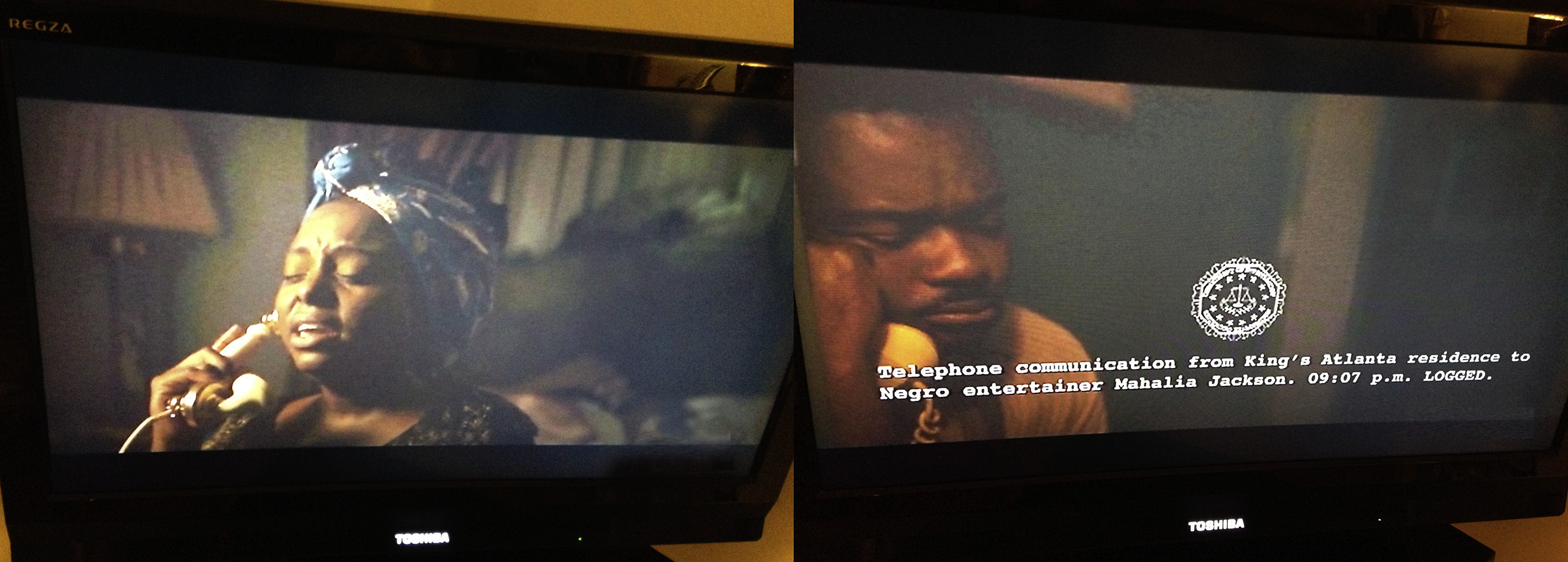
3) The scene in Selma where Martin Luther King phones Mahalia Jackson late at night for some support, which comes in the form of a mesmerizing song… and then an FBI phonetap log comes up on the screen…

MLK

4) Antonio Sanchez’s improvised drum score for Birdman, the only music in the film (apart from a minute of Rachmaninov’s Symphony No. 2 in E Minor). Fascinating to hear how it came together, in Vanity Fair’s piece: “An accomplished improvisational musician, Sanchez knew how to improvise to the beat in his own head or with other musicians onstage. But improvising to actual images, especially those that had not even been filmed yet, was more of a challenge. So Iñárritu pulled a chair up to Sanchez’s drum kit and talked him through the movie, motioning every time that Keaton’s character would advance to the next part of the scene.

“So [Iñárritu] would be sitting in front of me with his eyes closed and all of a sudden he would raise his hand. And I would think, OK, that means Riggan opened a door, so I would switch or do an accent or do something with the texture. We would try the scene again and then try a different kind of intensity and color… A lot of people think of the drums as a monochromatic instrument… and a lot of people do play that way but I have been experimenting with playing on the sides, the wood, on the rims, with my hands, with brushes, mallets, branches—anything to get a very wide range sonically.” He even stacked cymbals to make them sound less washy and sustained and more dry and trashy.

Iñárritu played the demos during rehearsals to make sure they worked. And they did, but he and Sanchez both agreed that the drums sounded “almost too good, too pristine” for a movie set inside an old Broadway theater. The two re-teamed in L.A., and Sanchez re-created some of his improv-ed tracks with a different drum kit that had been detuned and outfitted with vintage heads. The two also took the drums onto the street to experiment with hand-held moving microphones so that they did not have to rely on reverb, echo, and volume effects for some of the scenes in which Keaton walks through Times Square, weaving in and out of crowds alongside an actual street musician.”

ON THE PLAYLIST THIS WEEK
Annoyed that I’m out of town on Friday – having just heard that Garland Jeffreys is playing in West Kensington – I check to see which other towns he’s playing on this short tour and discover that we can hit Leicester on Sunday night on the way back, and see him there. Who doesn’t love “35mm Dreams”, “Wild in the Streets” and “Ghost Writer”? I know I have, since 1975. As the New Yorker put it: “Last month, the Village Voice published its list of the sixty best songs ever written about New York City. Coming in at No. 7 was Jeffreys’s “Wild in the Streets,” a hissing, insinuating, insistent piece from 1973. No argument here, but you could print up a list of the Brooklyn native’s catalogue, tack it to the wall, step back ten paces, and throw a dart, and you’d be almost guaranteed to hit another great New York City song. Jeffreys, who is seventy-one, is still a dynamo.” And I can’t wait to hear him sing “In the heat of the summer/Better call up the plumber/And turn on the street pump/To cool me off…/With your newspaper writers/And your big crime fighters/You still need a drugstore/To cure my cough…”

AND…
I’m hoping that Mark Bosch is on lead guitar. From photos on Jeffreys’ website it seems he is – when I saw him with Ian Hunter’s Rant Band, I thought him a “passionate and note/feel-perfect Seventies/Eighties Noo Yawk (think Leslie West or Mike Rathke) player, matching Hunter every step of the way”.

Wednesday, 17 December

A ‘Five Things’ film recommendation
I notice that Whiplash is coming out early in the New Year. I saw it at the London Film Festival, and thought it was a terrific addition to a small genre: the struggling musician film. It’s really difficult to make fictional music films. As John Jeremiah Sullivan wrote of Oscar Isaac in Inside Llewyn Davis, “It’s easy to find actors who can play and sing, and it’s easy to find musicians who believe they can act, but to find someone who can do both at the level needed, and at the same time, is rare… the problem with putting live performance in a narrative movie, the reason nobody does it, is you can’t splice the film together later; if the tempo is even a hair off between takes, the flow is ruined.” Issac was like a metronome, according to T Bone Burnette, who “sat off camera with a stopwatch, timing his individual measures.” What also makes Whiplash work is its twist on the “inspirational teacher movie”: As its young director, Damien Chazelle, says, “it’s structured like any inspirational teacher movie is structured, except my teacher is an asshole.”

Joe Keohane, in American Esquire captured it well: “The gist: Andrew Neyman (Miles Teller) is a first-year student at the top conservatory in New York. He’s a promising jazz drummer, but no one seems to notice. Legendary music teacher Terence Fletcher (J. K. Simmons) takes the kid under his wing, and sure enough, over time, whole worlds of potential are revealed. Ah, the magic of great teaching! Thing is, Fletcher isn’t a great teacher in the way, say, Robin Williams was in Dead Poets Society. He’s more of a sadistic monster, a bulging forehead vein of a man who believes there are no two more harmful words than good job. He screams at his students, pits them against one another, and pushes them until they cry and bleed… Sure, it might sound like something Ayn Rand wrote with Gordon Ramsay and the Wall Street Journal editorial board, but thankfully Whiplash resists any easy conclusions. It just looks at greatness, the seductive power of it, the collateral damage done in its pursuit, and asks, again and again: Is it worth it? You watch the drumming and you look at the human wreckage trailing in its wake, and it doesn’t look good, frankly. But then you watch more of that drumming, the stray beads of sweat on the ride and the blood on the snare, riot straining against rhythm, the whole of it capturing something elemental and profound, and you think, in spite of yourself, It is.

“The American jazz musician who saved my life”
Hidden away in Family (for the most part, a fairly ghastly section of the Saturday Guardian), this astonishing tale. It’s introduced thus: “Aged 21, Francois Grosjean’s father introduced him to a dinner guest one night, with a cryptic remark. They never met again but 45 years later, he discovered that this old friend of his parents had been pivotal to his existence.” He is looking through a short autobiography his mother wrote: “As I was reading about her pregnancy, I came across a few sentences that startled me, and that I had to read twice. My mother had written, “One day (my husband) brought home to dinner an American soldier, Jimmy Davis, a musician. He had just finished writing a song called “Lover Man” which became a big success. He persuaded me that it was wrong to abort. With his help, I decided to keep the baby.” It starts his search to find out more about Jimmy Davis…

Bob. An Audience of one. Totally Bonkers: “Will he experience the complete euphoria?”
Gabe alerts me to this, in which a Swedish company asks (with a little help from Google Translate) this: “Do we have more fun together with others? In Experiment Alone gambling company Paf investigates the role of community to human enjoyment and well-being. After five experiments and with more than 700,000 viewers, We Have Reached now the Grand Finale. One of Sweden’s, perhaps even the world’s, biggest Bob Dylan fans Is About To See his idol performances at an arena gig – all alone. How Will Frederick Find the experiment? Will he experience the complete euphoria or Will a feeling of emptiness come creeping It When there is no one to share the experience with?” Hear Bob and Band play Buddy Holly’s “Heartbeat” to an almost empty theatre, and the sound of one man clapping. Then hear Bob do a truly weird, deconstructed, voodoo version of “Blueberry Hill” that sounds like a bad New Orleans dream…

Jonny Trunk’s demented ordering instructions for his release of rare Brazilian album “Tam…Tam…Tam…!”
“Yes, I’d not heard of it either until August this year, which is why the LP is quite unexpected. Originally it was released in 1958 (in Brazil), and is a recording made relating to a musical extravaganza called “Braziliana” that toured the world in the 1950s. The music is a potent mix of hypnotic tribal chants, rhythms and extraordinary melodies – it sounds like no other album I can think of… The more you listen to Tam…Tam…Tam…! the more of the future you hear. To Order:
1) First decide what you version you would like.
2) Find yourself the correct note(s) – £5, £10. £20 etc.
3) Find yourself a piece of paper, upon which you must write i) your name, ii) your address, and iii) what format(s) you would like.
4) At the bottom of the paper draw something to do with Brazil or Brazilians. And yes, I know what you are thinking. Your drawing could be as good or as bad as you like. A simple football will suffice.
5) Finally wrap your money up in the paper, put it in an envelope and send it.

Image Of The Week: Gods Own Junkyard
At Lights of Soho, Brewer Street, the great creations of Neon Man, Chris Bracey…

Neon


Wednesday, 10 December

Idiosyncratic Careers Continue/1
Joni Mitchell at 71, still an admirable toughie. She continues to work – her next project is a four-part ballet culled from her back catalogue. She was recently interviewed by Billboard: “I’ve had a very full life. I don’t miss much of anything. I can’t sing anymore – don’t miss it. I can’t play anymore – don’t miss it. I’ve got all these instruments laying around and hopefully one day I’ll pick them up. But I do want to start writing my short stories, that’s what I want to do after I get this ballet out of the way. If it can happen, great – if it becomes apparent it’s not gonna happen, alright, I’ve got plenty to do. And I’ll still paint.”

At the British Library
A highly recommended Gothic Exhibition drew us here (and it is exceptionally good), but if you are in the area it’s worth popping in for 15 minutes to see the Treasures of The British Library, a permanent exhibition of highlights. Here you’ll find Jane Austen’s writing desk, the Magna Carta and a great selection of handwritten Beatles lyrics (here’s “A Hard Day’s Night” scrawled on a child’s birthday card).

Beatles1

Idiosyncratic Careers Continue/2
And Bob Dylan announces an album of Frank Sinatra covers, with these words: “It was a real privilege to make this album. I’ve wanted to do something like this for a long time but was never brave enough to approach 30-piece complicated arrangements and refine them down for a 5-piece band. That’s the key to all these performances. We knew these songs extremely well. It was all done live. Maybe one or two takes. No overdubbing. No vocal booths. No headphones. No separate tracking, and, for the most part, mixed as it was recorded. I don’t see myself as covering these songs in any way. They’ve been covered enough. Buried, as a matter a fact. What me and my band are basically doing is uncovering them. Lifting them out of the grave and bringing them into the light of day.” Michael Gray’s take on it is here. All of this reminds me of a great Dylan performance of “Restless Farewell” at Mr Sinatra’s 80th birthday bash. Frank’s request, apparently, and obviously chosen for its proto-“My Way” lyrics, the best of which was this couplet… “And the dirt of gossip blows into my face/And the dust of rumors covers me…” Accompanied by an orchestra, a lovely, lonesome fiddle and a guitarist that slips a “Maggie’s Farm” quote in near the end. And as it finishes and the applause starts, Bob nods and says, “Happy Birthday, Mr Frank”.

Heal’s has pre-Christmas festivities, with incredible G&T’s and this stack ’o’ Speakers

Stack

Barney sent me this a few weeks ago, but I’ve just re-found it.
I love the fact that it’s Hudson’s Menswear Dept.

Rockin' Revols

Five Things, Wednesday 27th August

From Denny Tedesco’s Kickstarter project comes a Spector Symphony
“My biggest mistake in making this film was my estimating time. As of today, I’m on my 6607th day since I started shooting the The Wrecking Crew. That is 18 years, 1 month, and 2 days since that first day when I brought together Hal Blaine, my father Tommy, Carol Kaye and Plas Johnson. With the money that was raised on Kickstarter, we paid off the most important bill, which was the Musicians Union. The great thing is the musicians will be receiving payments for their work. I apologize for the delay and I really appreciate your patience and support. We know the film will be released theatrically in a limited market that allows us to earn national press and reviews. DVDs and Downloads will go out after that theatrical run. In the meantime, I continue to cut outtakes. Today’s short film involves Pianist Mike Lang, a Beatle, Cher and Harry Nilsson.”

My knowledge of Mike Lang is limited to the fact that Tom Waits used him on several albums, rather than play the piano himself, which, come to think of it, says quite a lot. And he’s also a very good interviewee. You can hear “A Love Like Yours” in the music player on the right.

CristinaFrom Britt Julious’ Britticisms blog comes a tale of self-plagiarism
Looking for some info on Cristina’s second album (inspired by Dave Heasman’s comment a couple of weeks back) I found this: “Cristina’s Sleep it Off: an album so unsuccessful that sleeve designer Jean-Paul Goude simply used the same aesthetics a year later for the cover of Slave to the Rhythm by his muse, Grace Jones.” There’s an interesting early Prince cover on the album I’d not heard before, “When You Were Mine”. I don’t know if it was done before or after the Bette Bright version, which I had as a picture disc, and remember fondly.

From my Brother-In-Law comes an urgent message
“Hey Mart, Tim and I are wondering if you can interpret the titles on this Dylan cover album from the 60s by Aufray. It’s in the house we’re staying in…” Nick and Tim

Hughes

Job done (my favorite is the translation of “Motorpsycho Nitemare”) I looked up the wonderfully named Hugues Aufray, who was in Dylan’s orbit in the mid-60’s. The following is from an RFI Musique piece: In 1965, Aufray chante Dylan was released, his first album of French covers of Dylan songs.

Hugues Aufray: I’d made a couple of records by 1961 when Maurice Chevalier invited me to New York to represent France at a charity gala. I discovered the most amazing city, the capital of the 20th century, filled with the most extraordinary artists. I went back to New York the minute I could, playing as a support act to Peter, Paul & Mary at The Blue Angel. I spent six months there and one night I ventured down to the Village to this real dive, Gerde’s Folk City, and watched this young guy with a harmonica. He was already singing the songs that went on to become absolute classics. For me, translating Dylan was something I wanted to do on an artistic level as well as a human level. It’s like when you read a fantastic book and you want to share it with your friends. The problem was that back in 1962-63, nobody in Paris knew who Bob Dylan was. (Record label owner) Eddie Barclay didn’t want to hear about anyone recording Dylan covers! The other problem was that Dylan’s manager, Albert Grossman, took almost two years to get back to me and authorise the French covers.

On recently finishing a third album of Dylan songs: The record company suggested I do an album of duets, getting guest artists to record new versions of my greatest hits with me. I thought that was a bit of a rehash… but I went away and thought it over and decided that if I took the same concept but applied it to Dylan songs everyone would get a lot more out of it… ever since I’d written the French version of “Forever Young” I’d hoped to record it with Johnny Hallyday. I can’t imagine anyone better than Johnny singing May you stay forever young! What I really wanted to do was bring out Dylan’s melodies. These days, he’s into the idea of destructuring his songs on stage even if that means disappointing his fans… The thing is, Dylan’s never appreciated being followed by a pack of people who don’t really understand who he is. And he doesn’t mind pissing people off. What I’ve tried to do is restore the primitive musicality of the songs. I collaborated closely with the American musicians on the album – most of whom have worked with Dylan at some point – trying to come up with arrangements which would bring out the melody, the harmony and the poetic cadence of each song. When Jane [Birkin] came into the studio [to record “Just Like A Woman”] she had a few problems with the melody and the fact that the lyrics were in French… And to be honest I didn’t know what to make of the final version. But when I played it to my friends and associates they all said “Wow! It’s brilliant! She takes the same musical liberties as Dylan himself!”

From the pages (or should that be screens) of Narratively…
Narratively is a great online magazine (and at the moment it’s Jazz Week, with pieces on Lee Morgan, the grandchildren of the 1940’s East LA Barrio denizens picking up Zoot Suits again, a busking saxist and Nick LaRocca of the ODJB). I really liked this story of an artisan New York trumpet maker, told by Melissa Smith, with photos byEuniceChoi.

“Most people don’t know who Josh Landress is. Most people will never know who Josh Landress is. If he is lucky, people will eventually know of him, long after he has stopped doing what he is doing. Josh Landress makes trumpets. It takes him approximately seventy hours over the course of two or three months to finish building one, and even then he can’t be sure his clients will be happy – an economic reality that could dissuade even the most committed craftsman… Popular brands are churned out in factories by the thousands. In his ten years bending, tweaking and molding brass, Landress has made forty-nine. He earns money mainly by repairing factory-made trumpets—Bessons, Bachs, Benges and Schilkes—hammering out dinks, filling up cracks, cleaning gunk that has accumulated inside, replacing mouthpieces, tweaking valves.

The steps for making a horn aren’t necessarily complicated, but they are painstakingly tedious. Landress is a stickler for construction. He does all of his work in his cramped studio, a job which in the wrong hands could be considered a bit thankless. To make the lead pipe, Landress begins with a sheet of brass. He cuts it to size using a template. He files the edge, eliminating any burrs, then folds and hammers it over a mandrel, a steel form in the shape of a tube. After the sheet is shaped, Landress seals the seam by heating the tube with a miniature blowtorch while adding silver, a bonding agent. When that’s done, he lets the brass cool in order to manipulate it. Heating and cooling change the molecular structure of the metal so it’s more malleable, and Landress can bully it into shape. He cleans the tube, puts it back on the mandrel, hammers again to flatten the inside, then wedges it between two metal rollers to smooth out the shape and round off any rough edges, particularly around the seam. Then he goes back three steps and starts again; heats, cools, shapes; then again, heats, cools, shapes, until he considers it perfect. To show me what perfect doesn’t look like, Landress lifted a lead pipe up against the light, pointed out a faint line running along the interior, a seam that he hadn’t successfully burnished out, and threw the pipe into the recycling bin.”

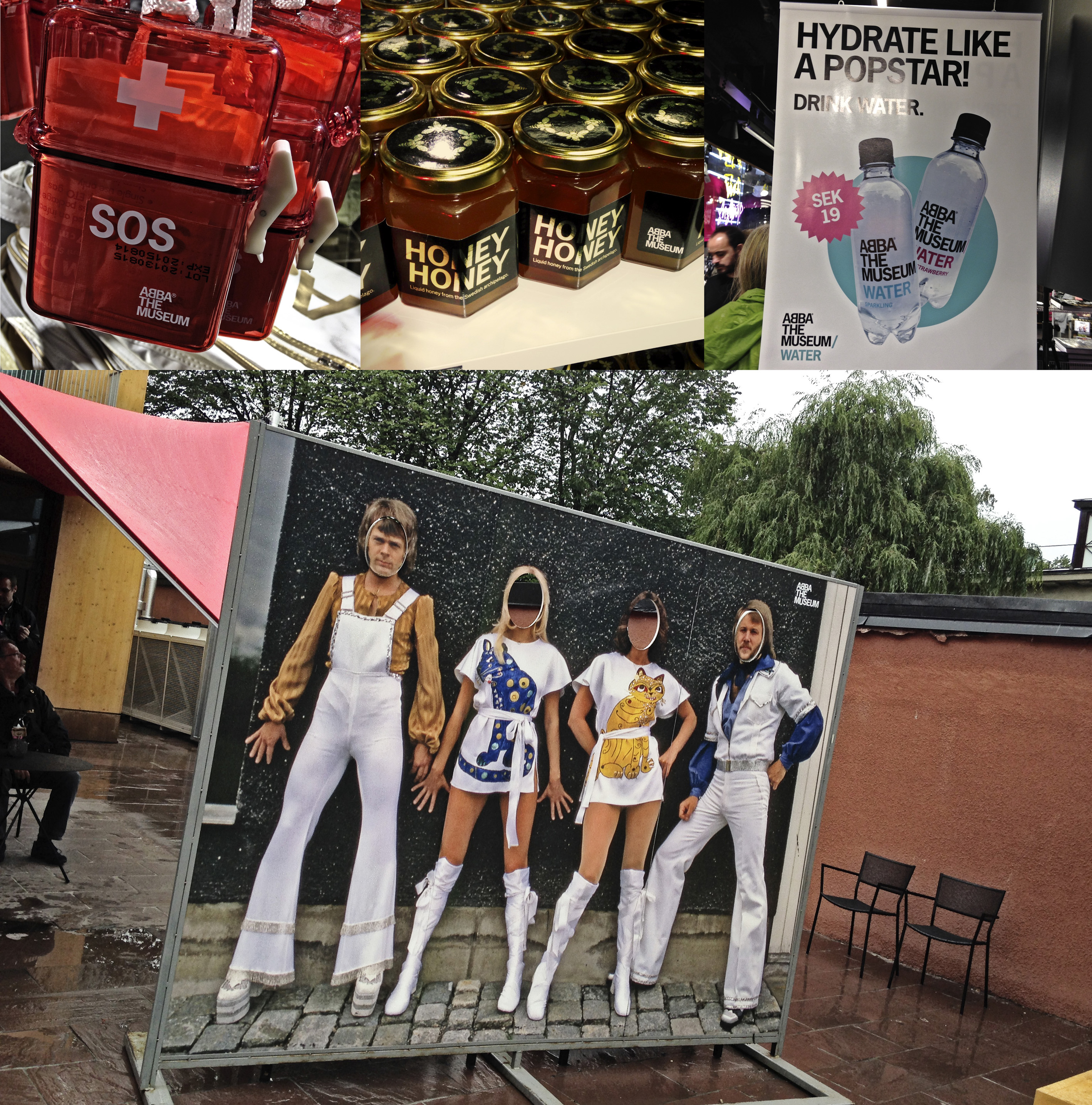
From the Streets of Stockholm (more next week…)

Abba2

Five Things, Wednesday 7th August

“She’s all I got is gone”: David Bromberg & Larry Campbell at Bush Hall
After a vivid ride through London on the back of Kevin’s motorbike (a big BMW, as used by the Met, for all you bike fans) we turn up at Bush Hall to see Dylan sidemen from different eras making a joyous noise – two performers who really love playing together, picking songs that they’ve probably played forever. Yes, there are plenty of phenomenal guitarists out there, but often they’re players whose virtuosity is almost a barrier to connection. That’s not the case here. This was a conversation between erudite practitioners who transmuted the pleasure they find in playing into the audience’s unalloyed enjoyment.

LCDB

Towering over all the risqué blues songs (Bromberg’s speciality) and the transposed Irish and Texan fiddle tunes (Larry’s bag) is a performance of “Delia” that is just hypnotic. For ten minutes, Bromberg sings and recounts the origins of the song against honeyed and stately tick-tock fingerpicking, while Campbell embellishes the tune with a swooping, swooning accompaniment on the bottleneck, finding beautiful, piercing melodies for as long as the song takes to wend its way to the last sigh. And every verse ends with the sad and resigned statement above, sing/spoken in the most poignant fashion. I’d a been happy if it had lasted twice as long.

Autopsy: Karen Carpenter, Channel 5
Alternately fascinating and grim (with actors playing Karen, Richard and their parents) as only programmes called Autopsy can be, this peculiarly tragic episode piled up the evidence for a recovery from anorexia, only for her to be failed by a pitifully weakened heart. My friend Andrew and I saw the Carpenters play a midnight show at the London Palladium in 1976 (yes, ’76, the year of Punk). It was in aid of Capital Radio’s Help a London Child, and you had to queue at Capital’s HQ at Euston Tower at seven in the morning. With a soft toy. So we did. The show was great – Richard’s dreadful vaudeville numbers, Karen’s drum solo and all. Tony Pelusi ripped out the classic guitar solo on “Goodbye to Love”, and Karen sang like she always did, trying to keep that melancholy tear at the edge of her voice at bay.

Bolt Dances to The Proclaimers, Hampden Park
And sets off a string of memories: I first saw The Proclaimers, as did most of Britain, when they appeared on The Tube. Our band was on that Friday, too, along with the Psychedelic Furs. We had travelled up to Newcastle, where the studios of Tyne Tees were, on the Quayside, and my day had already been made by the sight of Bobby Charlton being signed in at Reception. I remember two things well from the show. One was talking to Mars Williams, sax player for the Furs, and interesting to me as he had been a member of The Waitresses. They were a band I loved, for its mixture of Patty Donahue’s knowing sarcasm and the NY new wave of Chris Butler’s songs (songs with titles like “They’re All Out Of Liquor, Let’s Find Another Party” and “I Could Rule the World If I Could Only Get the Parts”). I tended to buy anything that I could find on their label, Ze Records. Among their bizarre acts (Mutant Disco became the quick catch-all for what their releases sounded like) was an early version of Lana Del Ray who went by the name of Cristina (”Is That All There Is?” is still a masterpiece) and the stunning Material (including Bill Laswell and Fred Maher) whose “Busting Out”, with Nona Hendryx singing, you really need to hear. This a nice piece about The WaitressesI Know what Girls like: The Waitresses and the limits of the “Female-Fronted Band by Lindsay Zoladz on Pitchfork.

The other thing I remember was being intrigued by The Proclaimers’ Buddy Holly-like appearance and the closeness of their singing, like one voice with two sides. I told them they were great and would go far, one of the rare occasions that I was right. I loved seeing the Commonwealth Games audience singing “I’m Gonna Be (500 Miles)” as Usain Bolt shook down his arms, then threw out the pointed finger a few times before miming walking as the crowd hit the chorus. Then he conducted the spectators for a bit before going into the “Pulp Fiction Eyes”. I’m not sure he would have remained so loose if he’d been about to run his banner event, the 100 metres, but here he allows himself to be enticed by the crowd’s reaction…

Dennis Hopper, The Lost Album, Royal Academy

Hopper


Richard Williams writes so well about this exhibition (and the use of The Band’s “The Weight” here) that I’m not sure that I can add anything much. Oh, except that my problem with exhibitions of photography are often about sizing. 400 10×8 prints is a lot to look at, and there’s too much here that is run-of-the-mill. The good ones deserve better printing to bring out the shadow detail, and sometimes more scale would be a good thing: Double Standard works well as a huge poster at the entrance, but its charms are lessened as a 10×8, where it looks a poor cousin to a Friedlander, Winogrand or Frank shot (above: the blow up/an introductory caption/watching a loop of Easy Rider from the balcony.) By the cafe is a small temporary screening room where Easy Rider and The Last Movie are shown a couple of times a day. I caught the last thirty minutes of Easy Rider, which looks pretty dated but is carried by its fervour – it feels like something that Fonda and Hopper needed to make, and not a studio product. I remembered that a cover version of “The Weight” was used on the soundtrack album, but had forgotten that “It’s Alright, Ma” – a song that eloquently addresses some of the film’s concerns – is used at the end. Sadly it’s a woefully lackluster version by Roger McGuinn, and just proves that it’s one of those Bob songs that should never be covered.

Nice!
Upon leaving the Royal Academy, this “Jazz” sweater caught my eye in Burlington Arcade. The word we’re looking for is “why”.

Jazz Sweater


Five Things: Wednesday, 23rd July

Is it Just Me…
Or are flares and bell bottoms making a comeback? First it was the percussionist with the Brian Jonestown Massacre with his flares, then this week I saw a young hipstery type in Berners Street with what was defiantly a pair of bell bottoms, literally covering his shoes. I know everything comes around in the end, but are these two a fashion-forward tip of the iceberg?

Attempted Fig Leaf for People building Apartments for multimillionaires, Fitzrovia
As we see, dead rocks stars can’t control who takes their name in vain. The estate agent gibberish on this window is chilling.

Fitzroy

Now That’s What I Call A Compilation
And not just because it features Ken Colyer playing “The Red Flag”. From likeahammerinthesink: “Since the beginning of this year I have been making one compilation CD each month. The tracks on each mix come from CDs from charity shops (mostly from my local one) and I exclude music bought elsewhere… that is the only constraint. The mixes tend to be combinations of the popular and the obscure so include jazz, pop, noise and anything else that I like.”

Recommended: Tim’s Vermeer
At the end of this really interesting film about trying to discover why Vermeer’s paintings feel the way they do, the credits roll with, yes, “When I Paint My Masterpiece” playing. Groan. Obvious. But wait, it’s a different Bob version. It’s great. It sounds like the Jesse Ed Davis and Leon Russell session, Dylan’s singing is nasal and ragged and it has a corny, but great, showbizzy ending… apparently Dylan was “very fond” of the film and allowed its use, thus continuing the tradition of giving filmmakers (the Coens, Cameron Crowe) alternate versions for use in their films. nb. Also noticed Damien Tedesco amongst the sound recordists and wondered if he was a relation of Wrecking Crew star Alumni, guitarist Tommy Tedesco…

Not Recommended: YSL
Slightly tedious biopic of Yves Saint Laurent. Very difficult to have as your central character a man who looks at the floor all the time. The early parts are best, before the drug addled tedium of the Seventies. The music during the scene where YSL gets the idea for his Mondrian-inspired dresses is a cracking piece of garage rock, that the credits pin down as The Bossmen from 1966 (Dick Wagner’s first band before The Frost and a career working with Alice Cooper and Lou Reed). It’s called “On The Road” and it’s all you’d want from a mid-Sixties band from Saginaw, Michigan. “I walked a million miles since Sunday/And still I got no place to go”.