Five Things I Saw & Heard This Week: Wednesday 11th July

Poliça/Dark Star
Reasons to Hate: Huge amounts of reverb. Achingly trendy/Hipster friendly. Arty Double tracked female vocal. Iconic Grateful Dead title. [Dangerous to pilfer Iconic Grateful Dead titles]. Reasons To Love: Wonderful live drumming with a huge open-room sound. Sometimes there’s nothing better than a pummeling four-on-the-floor (hey, even Take That’s Shine has a fabulous drum track, all Rak Studios, circa Mickie Most). Cracking tune. And the arty double-tracked vocal really works, weaving in and out of unison. It reminds me of Al Green singing around and off himself in How Can You Mend A Broken Heart? Add all this to some great twanging bass and slightly out-of-focus horns and it’s a winner. Granted, this could end up wearing thin over more than a few tracks, but Dark Star and Lay Your Cards Out (for another great melody and truly insane drumming) are absolutely terrific.

Seven Is The Magic Number
A review of a new version of Sophocles’ Antigone by Anne Carson (Antigonick) in the New Yorker printed this fine single-verse version of the siege of Thebes: “Seven gates/and in each gate a man/and in each man a death/at the seventh gate.” Seven is a very lyrical number— especially in country blues. There’s Muddy Waters, singing Willie Dixon’s Hoochie Coochie Man: “On the seventh hour/On the seventh day/On the seventh month/The seven doctors say/He was born for good luck/And that you’ll see/I got seven hundred dollars/Don’t you mess with me.” Or Dylan’s Ballad Of Hollis Brown: “There’s seven breezes a-blowin’/All around the cabin door/Seven shots sound out/Like the ocean’s pounding roar/There’s seven people dead/On a south Dakota farm/Somewhere in the distance/There’s seven new people born.”

Nora Ephron (and Susan Edmiston) interview Bob Dylan, Albert Grossman’s office, late summer, 1965
But negro rhythm and blues has been around underground for at least twelve years. What brought it out now?
The English did that. They brought it out. They hipped everybody. You read an interview asking who the Beatles’ favourite singer was and they say Chuck Berry. You never used to hear Chuck Berry records on the radio—hard blues. The English did that. England is great and beautiful, though in other ways kinda messy. Though not outside London…”
In what way messy?
There’s a snobbishness. What you see people doing to other people. It’s not only class. It’s not that simple. It’s a kind of Queen kind of thing. Some people are royalty and some are not.” Plus ça change…

Best Thing I Read About The Gracelands Controversy
Following Stuart Jeffries’ Guardian review of the 25th anniversary documentary, where he concluded that Paul Simon should have left the music alone:—“it gave the chance to hear unsullied the South African music that thrilled Simon 25 years ago. How lovely to hear, for instance, accordionist Forere Motloheloa laying down a groove without Paul Simon singing over it. If only it had remained the music Simon loved, rather than the music he, having loved, used.”*

Widlow, on the Guardian’s blog, answered with this: “Paul Simon clearly was a politically naive, contrary, slightly obsessive, perfectionist artist, who may have thought himself above such things as needing permission from the ANC. But what he produced was akin to Jesse Owens at the 1936 Olympics: a body of work that incarnated the exact opposite of the Apartheid philosophy, that sang out “Mixing cultures is good”, that proclaimed “These musicians are virtuosos and their culture is vibrant”, that put Black and White people into the same studio and had them eating and drinking together and using the same toilets and calling each other Brother…”

*This footage of the original 1985 sessions was extraordinary. There were children and babies sitting on the studio floor as the guitarists danced around the backing singers, vaulting their legs over their guitars (!) with the monumental bass and accordian lines of what became Boy In The Bubble booming out…

Leaving On A Jet Plane
Photo found in PA Photos: Britain in the 60s. British pop groups, bound for the USA on a tour which will yield half a million dollars. They are the Jimi Hendrix Experience, Eric Burdon and the Animals, The Alan Price Set and Eire Apparent. Eire Apparent?

Five Things I Saw & Heard This Week: Wednesday 4th July

Take A Giant Step Around The Block
In the office Hugh started singing Goin’ Back (I can’t remember why. Nor can he) and I said, “Oh, the Monkees did the original version of that…” and he said he was sure it was Dusty Springfield. We were both convinced it was written by Goffin and King (we were right), but a short Wiki later it turned out that Dusty’s was the first released (although Goldie of Goldie & The Gingerbreads had recorded first it before falling out with G&K over some changes she’d made to the lyrics). Anyway… the song I was actually thinking of was Take A Giant Step, also by Goffin & King, that was on the Monkees first album. Then I said, “Oh that was recorded around the corner, at the Philips recording studios at Marble Arch.” As it was, as well as You Don’t Have To Say You Love Me and If You Go Away. Philips Studios opened in 1956, located in the basement of Stanhope House, close to Marble Arch. It was also used by the Walker Brothers for Make It Easy On Yourself and The Sun Ain’t Gonna Shine Anymore. By 1983 the studio had become part of the Polygram group, was put on the market and bought by Paul Weller who renamed it Solid Bond.

Paul Weller—“Dusty Springfield, The Walker Brothers and all that recorded in Philips Studios. And then all of a sudden this desk wasn’t ‘any good’ any more and this tape machine wasn’t ‘any good’ any more and everything had to be digital. And as soon as we all went digital, man, everyone sounded the fucking same. From country & western to funk to rock’n’roll or whatever, everybody sounded glassy and linear. A technical thing, but it’s true.” And so he sold it, and all the equipment.

Well, I went down the road to see what was still there. I passed Le Pain Quotidien—where we had lunch the other day and, bizarrely, Paul Weller walked past with some dry cleaning—and negotiated safe passage past the machine-gun wielding cops outside Tony Blair’s house in Connaught Square. I found an imposing set of steps leading to Stanhope House (1), an excellent resprayed Sixties mini—can’t you just see Dusty holding down her bouffant to squeeze into it? (2), a Middle Eastern electronics shop selling translated copies of Tony Blair’s biography, next to some irons and hair trimmers (3), and, next door, a shop whose purpose I couldn’t pin down. There were replicas of the creature from Alien, some crash helmets and petrol cowlings with airbrushed women on. There were TVs and mobile phones. There was a five string G+L bass (4). I asked how much the bass was. “Ah, that’s not for sale. It’s in the window to attract attention.” It’s things like this—it was the least attention-grabbing part of the display (except to me, that is)—that make me love Edgware Road.


Dusty vs Scotty
It’s great when you dig out something that you really loved as a teenager and it still sounds as great, in every way, as you remembered it! I’m gathering tracks to make up a DJ set for illustration Collective ART SCHOOL DISCO—I know, what were they thinking?—I’ve never DJ’d in my life, but they said I didn’t have to stand there actually doing anything clever, I could just give them a CD… They are pitching up at Boxpark in Shoreditch to illustrate to the Sounds Of Disco for the day, so I was looking for stuff we loved in our Manresa Road studios from 75-79. Scotty was loved for Draw Your Brakes from The Harder They Come soundtrack, and for the most fabulous and wonderful Skank In Bed. YouTube it (it’s not available in any other way as far as I know). Over a version of Breakfast In Bed (as heard on Dusty In Memphis, written by Eddie Hinton and Donnie ‘Flipside’ Fritts) Scotty sings, shouts and pleads with Lorna —who did the version of the song that Scotty is freaking out over—and then breaks off to admonish his musicians in a, frankly, undescribable, way. Majestically bonkers.

Another Mag Done Gone/Word Down
“Sad news, sad news, come to me where I sit.” Word Magazine closed this week. Now who’s going to interview all those amazing and interesting characters that no-one else has the brains to talk to? And provide a home for the peerless Rob Fitzpatrick, whose writing about the end of music just gets better and better:
On Neil Young’s
Americana: “But if you remove the comfort blanket of (in this case entirely unwanted) hero worship for a moment—and I love Neil Young dearly—what you’re left with is a record that no one in their right mind could possibly want to play more than once or twice. There is a great deal to be said for recording quickly and intuitively, but not much for bashing through everything once and then calling it a day.”
On the myth of Scott Walker:
“For example, a discourse on the song Patriot (A Single) runs aground when the writer can’t decide what Walker really meant in a particular line. “It’s virtually impossible to say,” they admit, “and Walker has always been sparing with his explanations…” All of which makes me think, “Well, if you don’t know and he won’t, or can’t, say, what is the point of all this? What are we doing here?” Sometimes it’s important to step back and open a window and remember that this is pop music; it’s not meant to hurt this much.”
On the shelf life of bands: “ If I were a musician, the question I hope I would ask myself more than any other is: who cares? …the facts are simple: a hundred years of recorded music is available at the touch of a button to anyone who cares to listen. Are you really sure it’s necessary to put out another LP? It is more than ten years since The Cranberries released a record, but despite no one on Earth missing them, they have decided to make another. Sadly, 30 seconds into the first tremulous, ponderous, say-nothing, waltz-time. half-arsed shrug of a track you will be screaming at the sky. Here’s Cast… John Power’s relentless lack of imagination makes Beady Eye sound like Sun Ra.  Criticising Guided by Voices is a bit like criticising weather—momentarily distracting, but entirely pointless when it just keeps coming anyway.”
On Karen Dalton’s 1966: In 1966 Dalton was 29 years old and had left New York to live in a remote cabin in Colorado with her husband, Richard Tucker, and children. Most nights they would gather around a log fire and sing and on one of those nights a friend called Carl Baron, who’d sweated up to this address-free outpost with his precious reel-to-reel tape recorder, captured the songs as they were sung. Forty-five years later, the ghosts of that evening have finally been let loose… Dalton certainly doesn’t seem to be performing these songs; this is eavesdropping on a grand scale and it has all the dark thrill and guilty tang that comes with that behaviour. We are the unseen watchers, the eyes at the window, the ears at the wall, and there is, I think, a psychic cost involved in that deal. Friends and lovers trading songs around a sparking grate is one thing: having those same moments digitally diseminated decades after your death is quite another. The covers and the traditional songs that inhabit this exquisitely presented recording are deeply moving and I wouldn’t want to be without them, but rarely, if ever, have I been as haunted by a collection as I am by 1966.…on 1966 [Dalton] sounds relaxed. Safe. At peace. Whether you’re willing to risk disturbing that hard-won peace by listening in is, of course, entirely up to you.”

I’m bereft.

Inappropriate Musical Illustration
“Hey, I just met you, and this is crazy, but here’s my number, so call me, maybe?

Ripped from the sketchbook, illustrator John Cuneo’s visual reaction to the Carly Rae Jepsen song that has been driving America mad (judging by the comments after John’s post). nb—John has informed me that “I draw to praise that song, not to bury it.”

Next—Fontella Bass?
Always nice to to discover a typeface named after a great soul singer. (Staton by Henrik Kubel, a2-type, 2010)

Five Things I Saw & Heard This Week: Wednesday 27th June

Hall & Quotes (ouch!)
Rebecca Hall interview, Stylist. There’s a rumour you’re a total music geek… “Yes, that’s true. This is how much of a music geek I am; if I have a day with nothing to do, one of my favourite things is to just sit at my computer and make playlists of pretty much anything. If I could be a musician, I’d do it. I love singing.”
Is there one song you think everyone should listen to?
“That’s a really tough question. Do you mean the song or the version? I always go back to Ella Fitzgerald singing My Man at the Montreux Jazz Festival 1977. It’s not necessarily the song, and it’s not even necessarily her, it’s that particular recording. For some reason, it always gets to me. And I’ve got a bunch of those but that’s the first that comes off the top of my head.”

I’m a sucker for actually bothering to listen to things that people recommend (in all those My Playlist, or Favourite Saturday Night/Sunday Morning Record magazine features), and that’s an interesting response: The song or the version? Sometimes there are particular versions of songs that just work for you. For instance, Rick Danko singing Unfaithful Servant (part of last week’s post). That’s not the version I’d play anyone if I were trying to convince them of the brilliance of the song (that would be the original Band version, if you’re interested). It’s not even the second version I’d play them (that’s Rock Of Ages if you’re still interested). But it is the one that moves me now and makes me hear the song anew.

Anyway: I go to iTunes to get Ella’s Montreux version and find this:

Do explicit songs get a 20p surcharge? No, cause I Let A Song Go Out Of My Heart apparently doesn’t have swearing and is 99p. WHAT IS THIS SWEARING? So I buy it. My Man is lovely, throaty and intense (the last time through Ella hits the title phrase like a tenor sax), starting with a deep breath as Tommy Flanagan picks out the intro. It has all her signatures, and a beautiful virtuoso ending. I can see why Rebecca Hall loves it. I’ve listened to Come Rain and damned if I can find any @#%&*! swearing. If anything, Ella sings like she has a broad smile for the whole song (for me this song is owned by Ray Charles’ glacial take). So, unlike Ella’s My Man, it’s not a version for the ages. Just a version with a 20p surcharge.

The Wide, Wide World Of Sport (And Music)
From Sport Magazine, June 22: BEATS BY DR DRE PRO HEADPHONES: What Modern sportsman doesn’t carry round a hefty pair of cans? “They are noise-cancelling, so great before a big race, and for travelling,” he explains. “I like all kinds of music, from Jay Z to Michael Jackson.”—Team GB swimmer Lian Tancock.

Pot. Kettle. Black.
“After a day with Bono, she might want to put herself back under house arrest.”—Bob Geldof on Aung San Suu Kyi.

Tin Pan Alley, Stefan Grossman, Sound Techniques
Sound Techniques was a studio housed in an old dairy building between Chelsea Embankment and the King’s Road. I was thinking about it because I walked past one of the guitar shops on Denmark Street and idly glanced at a beautiful inlaid Martin acoustic. I looked closer and realised it was a Stefan Grossman signature model. Stefan was, and is, an extremely brilliant  guitarist. I had been talking about him with Sam Charters, who was tasked in the mid-seventies with making a mainstream Grossman record by Transatlantic Records’ Nat Joseph. To this end he hired Alan White, Danny Thompson and Richard Thompson to play. When Sam was in town producing I would hang around the studio after work or college, just enjoying watching the creative process and soaking up the atmosphere (Nick Drake’s albums were recorded at ST), looking down from the control booth to the live room below. I have two memories of those particular sessions: One is watching Sam and Stefan patiently making the curly-headed Richard Thompson overdub one electric guitar part for hour after hour, trying to get him to play it more aggressively. Difference between a session man and an artist in his own right—a session man will say, “You want this? Or this? Or how about this?” Richard just tried to play it better each time. And the other memory was of picking up a comic that was lying in Alan White’s Drum Case and being given very short shrift by the Plastic Ono Band drummer for not asking first…

Maltese Diamond Position Inlays. £4,179.

Best Coast
Always nice to see a relative on stage, even if they are second cousins (did I get that right? Or is it first cousins twice-removed? Or not even cousins but something else?) Whatever, Brett is my cousin Nickie’s son. And bass & guitar player for Best Coast on tour. A grand night had by all!

Best Coast, Shepherd’s Bush Empire, 20th June. Brett and Bethany Cosentino

Five Things I Saw & Heard This Week: Wednesday 20th June

School’s Out (For Ever?)
“Baby taking her GCSE’s. Passing of time is wonderful. Means never again I will hear a school choir sing I Believe I Can Fly. Thank Christ.”—Alison Moyet on Twitter. Amusing that R. Kelly has written the modern school anthem of positivity & inspiration—may I humbly suggest that all schools now switch to R. Kelly’s Relief. Great, great tune, beautifully covered by Sam Amidon as a folk ballad, has that anthem thing going on, teeming with hope, if not quite actualité.

“The storm is over, and I’m so glad the sun is shining
Confusion everywhere, without a clue on how to make things better
A toast to the man upstairs, ’cause he puts the pieces back together
Now let’s step to a new tune, ’cause everything is o.k.
You’re alright, and I’m alright, well, let’s celebrate.
What a relief to know that—we are one
What a relief to know that—the war is over
What a relief to know that—there is an angel in the sky
What a relief to know that—love is still alive”

Imagine a hundred ten-year-olds singing that.

Nostalgia Time 1. Mixing Buddy Guy And Junior Wells, Vanguard Studios, NYC, 1968
Sam Charters has been staying with us and I managed to find some pictures, among them this gem—a Three Track Machine (cutting edge, apparently), a vacant studio in Midtown, a twelve year old wannabe engineer.

The Poetry Of Aaron Copland
Came across this great piece I’d ripped out of the New Yorker years ago, by Alex Ross: “There is an affecting recording of the elderly Copland rehearsing Appalachian Spring with the Columbia Chamber Ensemble. When he reaches the ending, an evocation of the American frontier in ageless majesty, his reedy, confident Brooklyn voice turns sweet and sentimental: ‘Softer, sul tasto, misterioso, great mood here… That’s my favourite place in the whole piece… Organlike. It should have a very special quality, as if you weren’t moving your bows… That sounds too timid. It should sound rounder and more satisfying. Not distant. Quietly present. No diminuendos, like an organ sound. Take it freshly again, like an Amen.’ Copland conjures a perfect American Sunday in which the music of all peoples stems from the open doors of a white-steepled church that does not yet exist.”

For Emily, Wherever They May Find Her
From thetrichordist: Recently Emily White, an intern at NPR All Songs Considered wrote a post on the NPR blog in which she acknowledged that while she had 11,000 songs in her music library, she’s only paid for 15 CDs in her life. Our intention is not to embarrass or shame her. We believe young people like Emily White who are fully engaged in the music scene are the artist’s biggest allies. We also believe–for reasons we’ll get into–that she has been been badly misinformed by the Free Culture movement. We only ask the opportunity to present a countervailing viewpoint.
David Lowery [Camper Van Beethoven, Cracker] wrote this open letter. It’s worth reading
. Here’s an excerpt:

“The existential questions that your generation gets to answer are these:
• Why do we value the network and hardware that delivers music but not the music itself?
• Why are we willing to pay for computers, iPods, smartphones, data plans, and high speed internet access but not the music itself?
• Why do we gladly give our money to some of the largest richest corporations in the world but not the companies and individuals who create and sell music?

This is a bit of hyperbole to emphasize the point. But it’s as if:
Networks: Giant mega corporations. Cool! have some money!
Hardware: Giant mega corporations. Cool! have some money!
Artists: 99.9 % lower middle class. Screw you, you greedy bastards!

Congratulations, your generation is the first generation in history to rebel by unsticking it to the man and instead sticking it to the weirdo freak musicians!”

Nostalgia Time 2. Sid Vicious Stole My Corgi Toys
Nah he didn’t. But the Punk Britannia series on BBC4 put me in mind of Simon, as I knew himJohn Simon Ritchie—an extremely nice playmate. My mother’s friend Rene was Anne Beverly’s sister and was often called on to help a fairly troubled woman navigate her messy life. We lived in the same block as Rene and her son David, and Simon—a shy kid— spent time there, when the need arose. I remember long afternoons spent on our hands and knees with Corgi cars in David’s tiny bedroom… At some point he stopped coming round to play and we all moved on to other things. I saw Simon twice more. Once on Shaftesbury Avenue, looking in the window of a music shop, long greatcoat, hair cut like Bowie, fidgeting, mumbling, smiling. And then as Sid, on a tube train—summer of 77 I’m guessing, definitely a member of the Pistols—leather and chains, when I felt too intimidated to say anything, but we exchanged a glance and sort-of-knew that in some previous life we had known each other.

John Simon Ritchie, School Photo

Five Things I Saw & Heard This Week: Wednesday 13th June

Rick Danko, Unfaithful Servant, LA, 1979: “Easy with him, he’s a human…”
As Eric Andersen wrote, in a farewell letter to Rick: “Your singing remains one of the everlasting glories of American music.” And, though it’s ragged and rough, this is as glorious as it gets. A sweaty club, a febrile atmosphere (it’s not beautifully recorded, but the room fairly crackles—I’ve rarely heard something sound so present). Blondie Chaplin, ex-Beach Boy, is on piano, Rick just singing, not playing bass, someone loosely slapping a tambourine. The crowd is rowdy, and inappropriate for such a heartfelt song. There’s an Elvis-like foldback on the vocal mike, almost sounding like it’s hitting the back wall and touring the room. From Caledonian Mission to It Makes No Difference Rick defined a way of ballad singing that’s unique—a high, white, hilltop soul man, singing American music. Here, he leans in hard, perhaps as a response to the low-down, boozed-up crowd. He fumbles some lyrics, oversings others, but it’s fantastic. Just after he sings “Farewell to my other side, Well, I’d best just take it in stride” he makes the above plea to the crowd, but doesn’t miss a beat. The crowd whistles & whoops and Rick turns it on until the words run out and Paul Butterfield steps up to take the song home with a searing harp solo.

Jo Stafford, Paul Weston, Jonathan and Darlene Edwards
Flicking through an illustrated biography of Frank Sinatra I came across a reference to Jo Stafford (the No 1 singer of the ‘pre-rock’ era, apparently). I’ve got various tracks by her, including a great version of You Belong To Me—a wonderful song nicely covered by Bob Dylan and included on the soundtrack of Natural Born Killers. The book mentioned that she recorded several albums with her husband Paul Weston, spoof records that grew out of a party turn, where he would play bad cocktail piano and she would sing high and out-of-tune. Proustian rush time! These albums were a favourite of my parents, alongside others by Jonathan Winters and Bob Newhart. My dad also had a 78 of Red Ingle & His (Un)Natural Seven’s Tim-Tay-Shun (a spoof of Perry Como’s Temptation). And who is the female vocalist on Tim Tay Shun? Jo Stafford. And they still sound pretty great.

Weird iPod Synchronicity Pt2: June 12th, Victoria Station, London
A song I don’t recognise starts playing, a kind-of bluesy shufflin’ riff with slight Beatles-y overtones in its swirling guitars, as I turn to the G2 section of The Guardian. Steve Miller starts singing: “Way down in Alabama there’s a girl just a waitin’ for me, She don’t have to worry, she don’t have to hurry, Lord, I keep her so happy, she’s my…” And at this point I read the cover line: THIS DRUG RUINS LIVES: HOW SUGAR BECAME A LETHAL ADDICTION by Jacques Peretti. And Steve sings: “Sugar baby, Sugar, sugar baby, Sugar baby, Sugar, sugar baby…”

Really?
World’s Richest DJs:
#10: Moby Net Worth $28 million
#9: Daft Punk Net Worth – $30 million each
#8: Pete Tong Net Worth – $30 million
#7: Judge Jules Net Worth – $40 million
#6: Sasha (DJ) Net Worth – $40 million
#5: Armin Van Buuren Net Worth – $40 million
#4: John Digweed Net Worth – $45 million
#3: Paul van Dyk Net Worth – $50 million
#2: Paul Oakenfold Net Worth – $55 million
#1: DJ Tiesto Net Worth – $65 million

Really 2?

Black and Grey Mesh Eye Logo Trucker Cap, thanks. Oh, on second thoughts…

Five Things I Saw & Heard This Week: Wednesday 6th June

Jubilee Concert Song Choices
Cliff Richard. Devil Woman. Wronged man song. “She’s just a Devil Woman, with evil on her mind.” Give that man a knighthood! Oh, they did…
Robbie Williams. Mack The Knife. Song about a murderer. “Now on the sidewalk… whoo, sunny mornin’, Lies a body just oozin’ life.” Don’t harsh my mellow, Rob!
Ed Sheeran. A Team. Song about a junkie prostitute. “Go mad for a couple grams… And in a pipe she flies to the Motherland, Or sells love to another man.” Thanks, Ed!
Tom Jones. Mama Told Me Not To Come. Song about drug-fuelled party. “That cigarette you’re smoking ’bout to scare me half to death.” Delilah. Song about death and adultery. “She stood there laughing—I felt the knife in my hand and she laughed no more.” Loving the imagery, Sir Tom!
Stevie Wonder. Superstition. “Thirteen month old baby, broke the lookin’ glass, Seven years of bad luck, the good things in your past.” Hmmmm…

No respite, not even in popular Classical music…
Renee Fleming. Un Bel Di Vedremo (from Madame Butterfly). Deluded woman waits for philandering, unpleasant husband to return.

Best Thing About The Jubilee Concert
Grace Jones. Slave To The Rhythm. The Hula Hoop. Enough said.

The genius of Spy Magazine, now complete and online

Al Hirshfield draws the British editors who made their careers in NYC in the 90s. Diggin’ Anna Wintour as Paul McCartney!

2012-1951
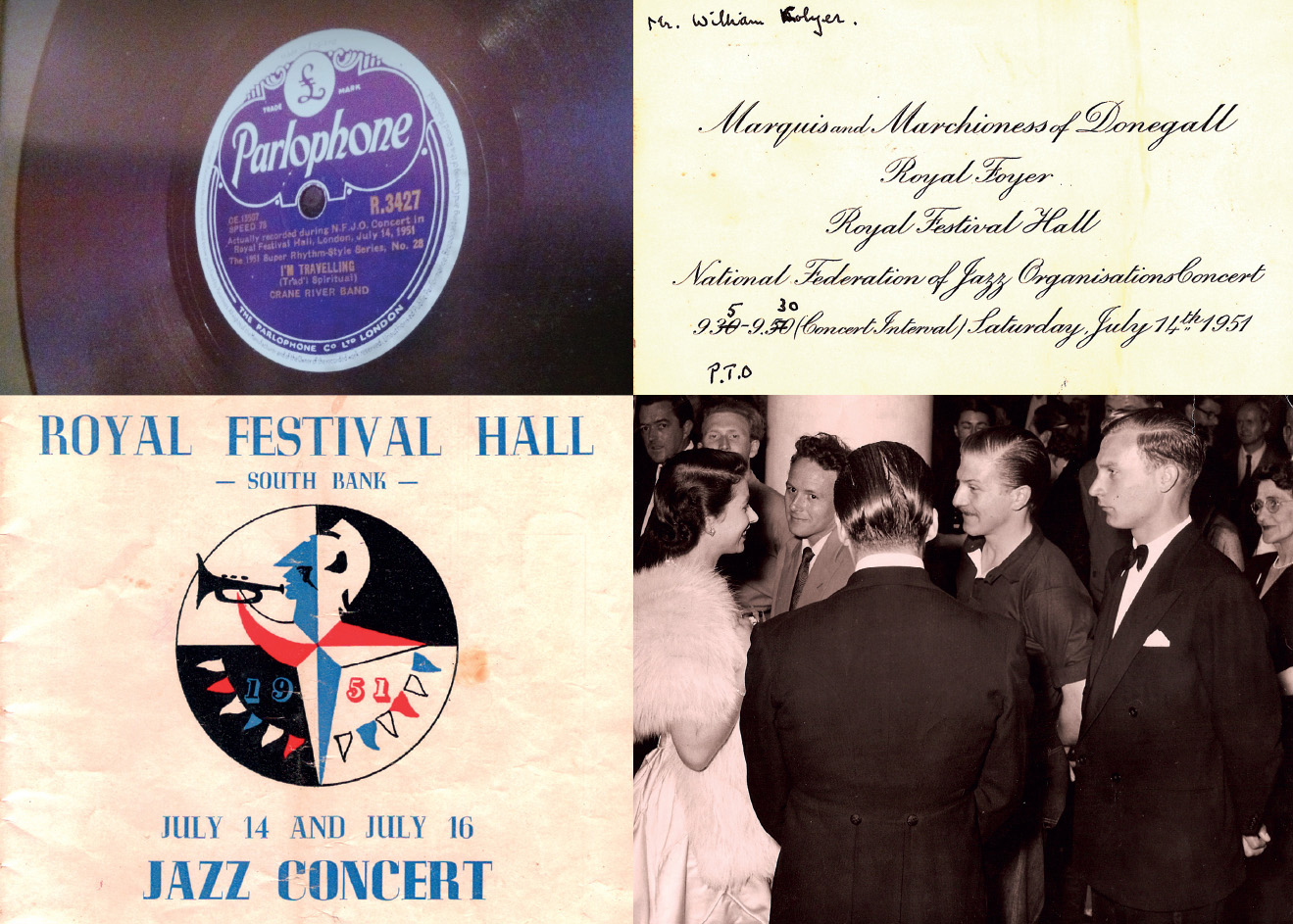
In this Jubilee Week, a look back at the Festival Of Britain, put in mind by a lovely present from the erstwhile jazz drummer Colin Bowden. A framed 78 by the Crane River Jazz Band (on the Parlophone label) of I’m Travelling, with Ken Colyer on cornet and Bill Colyer on washboard. Colin: “That record of I’m Travelling was the first major recording I ever did, because I was in the audience!” Colin was a schoolboy at the time, but went on to become one of the major figures in the Traditional Jazz revival of the early fifties.

Clockwise: Parlophone 78, Bill’s misspelled invite, Princess Elizabeth meets Ken, Programme cover

Five Things I Saw & Heard This Week: Wednesday 30th May

Best Eurovision Moment
After Albania’s rather terrifying sub-Bjork performance, Graham Norton waited a beat, then said: “I’m pretty sure that, if they get her medication right, that need never happen again…”

Pete Doherty Interview by Geoffrey Macnab, The Guardian
Ah, poor Pete, treated badly by everybody as he makes his film debut in Confession of a Child of the Century. Take Charlotte Gainsbourg. She wasn’t “all that happy” about the production, which, he says he knows because he snuck into her room and looked at her journal [!]. She came in “as someone everyone knew but a complete stranger in the immediate environment… you couldn’t be a star.” It was freezing cold on location. Between takes, assistants would “leap on her with loads of blankets and hot-water bottles and I was stood there in 19th-century cotton with lots of holes in it.” And in prison: “It’s horrible, horrible. There are lots of aggressive, money-oriented, very masculine people, but at the same time, there is really nasty homoerotic violence. It’s not the place to be if you are a freethinking man.” And now there’s the film critics! The reviews have been overwhelmingly negative, with Doherty’s own performance deemed “catastrophic” and “calamitous.”

For what it’s worth, I have no great opinion on Doherty’s songwriting talent and I wasn’t impressed by The Libertines, but I saw him play a song at Hal Willner’s Disney night, The Forest of No Return, part of Jarvis Cocker’s Meltdown at the Festival Hall in 2007. With a line-up of luminaries ranging from Nick Cave to Grace Jones (brilliantly terrifying on The Jungle Book’s Trust In Me) Pete took the stage to sing Chim Chim Cheree. We were sitting just behind Kate Moss, Pete’s then-inamorata, who was busy snapping photos. One of the few performers to have memorised the words, strumming a battered acoustic, he totally inhabited the song, and—singing beautifully—essayed a perfect and tender version, rescuing it forever from the clutches of Dick Van Dyke. And that’s no mean feat.

Reissue of the Week
Walked into a guitar shop to discover that Fender have reissued the Kingman, the acoustic played by Elvis, with its classic Fender headstock…

My prized Fender 1968 catalogue

A Night At The Opera
Puccini’s Madame Butterfly. English National Opera. Anthony Minghella’s production. Visually stunning in places. Rousing and expressive music. Awful story, that seems horribly outdated and verging on distasteful. Terrible clunky language which is hard to sing (Pinkerton: “I bought this house for nine hundred and ninety nine years, but with the option, at ev’ry month, to cancel the contract! I must say, in this country, the houses and the contracts are elastic!”). And then sung with seeming disregard for the melodies of the music floating underneath! Interview this week with Emma Rice, director of theatre group Kneehigh: Is there an artform you don’t relate to? “Opera. It’s a dreadful sound. It just doesn’t sound like the human voice.”

Image Of The Week: !Bobama!

!


Five Things I Saw & Heard This Week: Wednesday 23rd May

Modern Family Rocks! Or Is That Soft Rocks?
Haley has been ripped off—her dad gets ready to confront the perpetrator. Phil: “Yeah I got a plan. Either he gives us the money or he gets a private performance from (holds up left fist) England Dan and (right fist) John Ford Coley.” Later, he amends this to “Crosby (left fist), Stills (right fist), Nash (knee), and Young (kicks out his foot).” Baby Boomer scripting par excellence— and Ty Burrell as Phil just gets better and better.

I Missed The Radio Doc About The Missing Bobbie Gentry
Yes, I conspired to miss something I know I’d have loved. I only found out after it broadcast and then—just as my finger was hovering over the play triangle on iPlayer—it disappeared. I can only hope it featured the wonderful Jill Sobule song, Where Is Bobbie Gentry? Set to a clever melody closely modelled on Ode To Billie Jo it tells of a fan’s devotion…

“Out in the desert where the skin slowly cures deep brown
She’s got a little shack, a pickup truck, parked out on the edge of town
It’s just what I imagined, no one knows where’d she be
Maybe she’s in heaven passing black-eyed peas
Where is Bobbie Gentry?

Up in Alaska hauling wood or maybe in Japan
I bet that she’s still beautiful, goes barefoot everywhere she can
Does she still play guitar or write a song or two?
Maybe that was over; she’s got better things to do
Where is Bobbie Gentry?

If I could just find you
Say I love you and then leave you alone
If I could just find you
Say I love you and then leave you alone

1967, Bobbie made it on the Billboard charts
Ten years later, disappeared and broke everybody’s heart
Does she ever go to Chickasaw? Ever go back on that bridge?
Well, I was the baby thrown off the Tallahatchie Bridge
Yeah, I was the baby thrown off the Tallahatchie Bridge…”

Love that middle eight…

That “Bird On A Wire” Was A Real Cracker Of A Movie, Wasn’t It?
Someone has made a a psychological thriller, due out in a couple of weeks, titled after Leonard Cohen’s A Thousand Kisses Deep, from Ten New Songs. It stars Emilia Fox and Dougray Scott (in a pork pie hat, playing jazz trumpet in the bath). Snap judgment from the trailer? Absolutely preposterous.

Niles ’n’ Miles
Fascinating piece hidden away in the Money section of The Guardian, by the always interesting Nile Rogers, in a regular column called My Greatest Mistake. He tells of the many occasions on which Miles Davis would ask Rodgers to write him a song. Nile: “This is a great man who changed my life—and he wanted me to help change his. I believe he kept asking me for about two years, and all that time I couldn’t believe he was serious… he had a funny coding system for when we spoke on the phone at night, like I was calling the president of the US: I had to ring three times and ask for so-and-so and then he would know it was me. I kept doing jazz fusion demos and whenever Miles heard them he’d say to me: “I can do that myself. I want a motherfucking Good Times.” Miles Davis was 100% clear but I didn’t hear him. He was completely sincere and had opened himself up by asking for my help. If I wasn’t so stupid I might have done it.”

Bob. Dylan. Boot. Leg.
From Bobby Keys’ autobiography Every Night’s a Saturday Night we learn that the feet poking out from the Rolls Royce on Delaney & Bonnie & Friends are Bob’s. And the Rolls? Albert Grossman’s.

Extra! 5 Things Concerning Willis Earl Beal

Declaiming Charles Bukowski at the start…

Tabernacle Testifying

Tabernacle Testifying

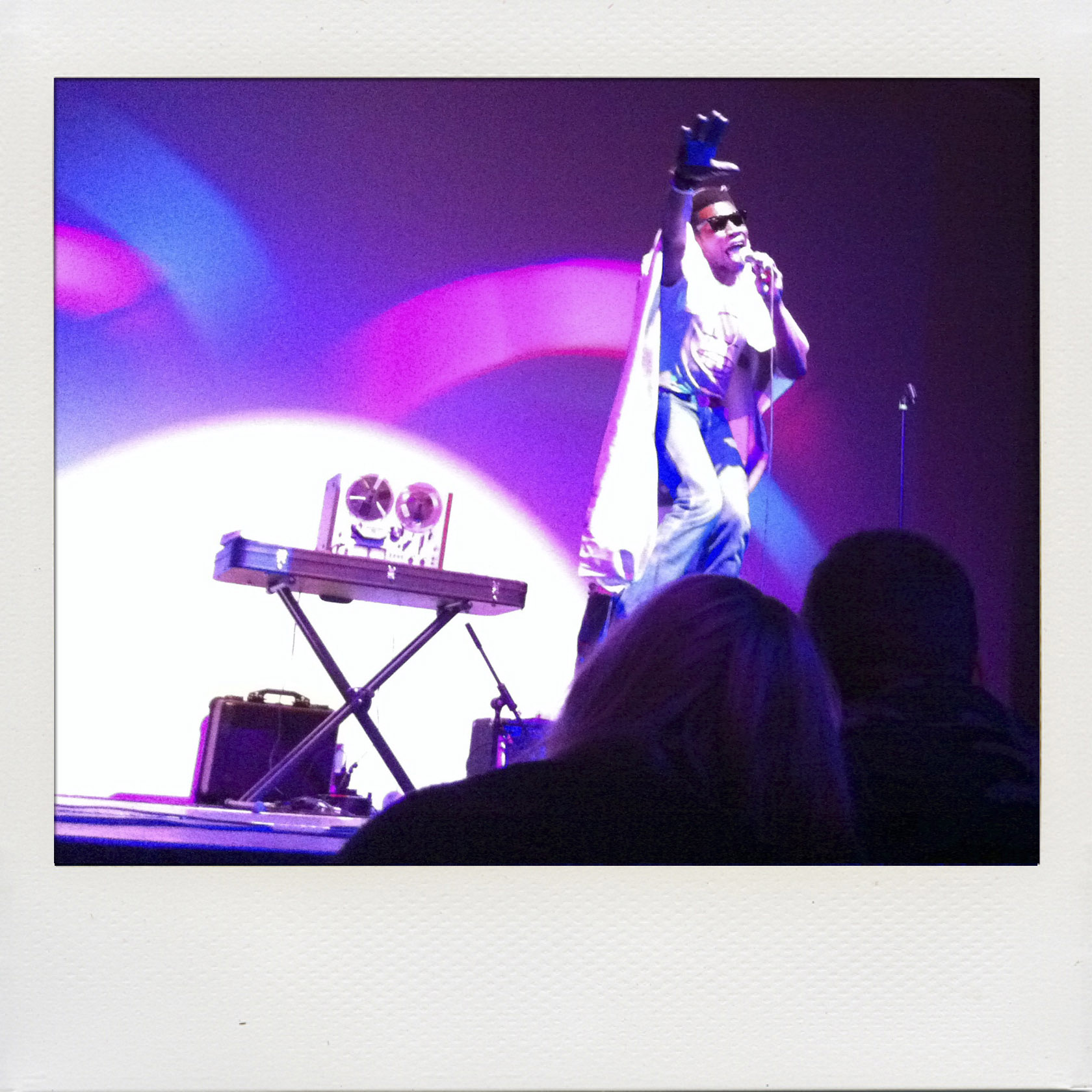
“I’m a wizard, not a Musician”: Willis Earl Beal at The Tabernacle

OK.

1 The look John Carlos, Mexico City 1968. One black-gloved hand. (On the right hand, though Carlos’s was on the left, but he looks more like Carlos than Smith). Cross that with Aaron Neville in his muscle/t-shirt days. Sunglasses. Tight jeans. Cowboy boots. Occasional wearing of a sheet as a cape. Sheet starts evening covering up AKAI reel-to-reel.

2 Poses With cape, and standing on chair, superhero. Stalking stage with mic: Grace Jones meets Emo Philips. Albequerque-back-porch-stretched-out-almost-horizontal-feet-crossed for one song.

3 Voice Paul Robeson. Tom Waits. The Mavericks’ Raul Malo. Something of James Carr. I’m just trying to give pointers. He doesn’t really sing/sound like any of ’em.

4 Tools Simple. Shaker Simple in comparison to most. Aforementioned reel-to-reel tape recorder (gotta love a performer whose set list is contained on a reel of tape). Open-tuned electric guitar, played on lap with strings fretted by thumb, Richie Havens-style, and amp. Drink that looks like Rum and Coca Cola. Belt, taken off and used to whip chair at one point.

5 Songs Some are no more than a backing track of cheap synth beat overlaid by buzzing insect sound, here mutated into a compelling signal to noise. One of the guitar songs is almost a classic Southern Soul Ballad. I don’t know what their titles are, I’d only heard one track before going, but all are declaimed with a frightening intensity, and as we’re all sitting/standing very close, it’s a little like watching performance art.

I love an act that grabs the evening by the scruff of the neck and, by force of will, carries an audience­—even as they’re trying to get a handle on what the hell’s been put in front of them. And ends it with: “We need you to buy the album, Acousmatic Sorcery…  [long pause] …the action figures [long pause] …the pencils… [long pause] …and if you do I will then personally come to your house and give you benediction.”

The Set Up

The Set Up

Five Things I Saw & Heard This Week: Wednesday 16th May

Donald ‘Duck’ Dunn, Royal Albert Hall, April 15, 1970
In the middle of his set supporting Creedence Clearwater Revival, Tony Joe White stepped up to the mic and introduced his band: two of the Dixie Flyers (Mike Utley on organ and Sammy Creason on drums) and—on bass, ladies and gentlemen—the legendary ‘Duck’ Dunn, Memphis maestro (Booker T, Otis, Eddie, Wilson). Not content with Duck’s luminous, numinous credits, Tony Joe informed the audience that we had a Champion in the house (my memory fails me with the precise details, but it was something like All-State Tennessee Hall of Fame Champion). Yes a Champion of… the YoYo. And there, on the stage of The Royal Albert Hall, ‘Duck’ Walked The Dog… he Hopped The Fence… he went Around The World… he Looped The Loop… and 5,000 people whooped for joy, as they gave him a standing ovation.

Julie Delpy, The Film Programme, R4
In a really entertaining interview by Francine Stock, Delpy talks about her new film in which the action takes place over 48 hours. “I like the unity of time, maybe because I’m not very good at storytelling in time-lapse, and I hate the time-lapse sequence of montage with, like, music. Like the typical one was a nice trendy song of the time, then you have a montage of time passing or whatever (laughs)—I just can’t do that! I like unity of time, like when shit hits the fan it really usually happens on like a very short period of time… In Before Sunset the idea of doing it in real time, hour and a half, came from me…”

A Veteran Vibe
Aimlessly flipping from channel to channel, a great juxtaposition: Charles Aznavour (now 87, about 57 at the time of this recording of She) and Engelbert Humperdinck (formerly Gerry Dorsey, let’s not forget, currently 76). Aznavour sings like a piano player, jamming words together in entirely unnatural fits and starts, cramming then letting one word run long— a European version of gospel’s tension-and-release? Whatever, it’s mesmerising, especially as the camera just holds the same closeup of his face throughout the song. Humperdinck sings Britain’s Song For Europe entry, Love Will Set You Free, and, leaving aside whether the song is derivative or fine—what did you expect?—he gave it some going over. The voice was strong, his pitch was dead-on and he negotiated the tricky key change (a Eurovision must) with aplomb. All the best for Baku, Eng!

Alberto Y Los Trios Paranoias
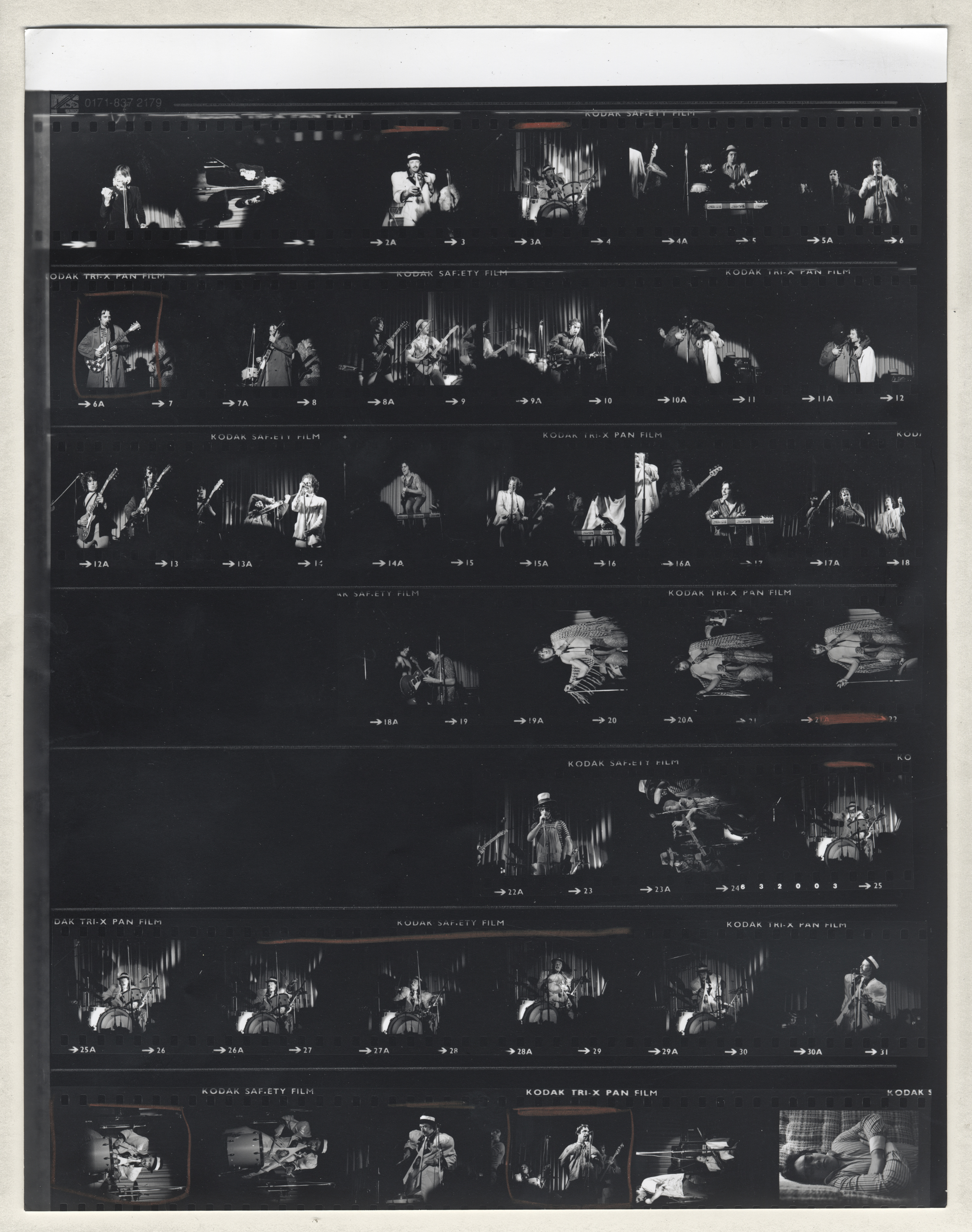
Simon was saying that I should be aware of the Cardiacs, a band I’d entirely missed in the eighties and nineties, and on their Wiki entry I noticed a name from the past—listed as an inspiration—a name you don’t forget. The Albertos were a band I happily watched countless times [mostly, I think, at the Marquee] as they purveyed a wildly cynical take on the music business. It’s hard to describe the shows. Look through the contact sheet of a roll I shot at one of the gigs (it enlarges if you click on it) and you’ll get a sense of what they were like. See drummer Bruce Mitchell—widest shoulders this side of Dick Tracy plus huge wooden nude-girl tie! The worrying balaclava-and-gun look! That alarming codpiece! CP Lee, wearing a Peter Cook-like belted raincoat in the photos and playing a Stars & Stripes guitar, went on to write a great book about Dylan’s infamous ’66 Manchester Free Trade Hall gig, Like The Night. The Albertos were a one-off—they were really good musicians and were also hysterically funny. There’s not many bands you could say that about. [nb: final frame shows my friend Kwok, asleep on my mother’s couch.]

New Sandwich Bar In Town

Really?