Transcripts from the everyday world of music by Martin Colyer
BRILLIANT
With a generic soundtrack halfway between Bowie’s “Heroes” and U2’s “Beautiful Day”, and created entirely from stock footage, this is one Presidential campaign ad you should watch. “Wherever I go… so do lens flares, and fields in sunlight…”
MISSING MELODY
I’d finally managed to get tickets to see Melody Gardot, bought a few months ago, and then it happened that we needed to go to the US over the weekend that she was playing the Palladium (“Now this is a classy joint, got curtains and everything”, said Tom Waits in 1980 as he stood on its stage. “Ya should see some of the toilets we’ve been playing lately…”). So, I’m even more annoyed to have missed it when Kevin (who had kindly bought the tickets from me) texts a capsule review the day after: “Blinding gig! The girl’s got mojo running through her like rock has Brighton: muscular Muscle Shoals gospel blues, jazz ballads, New Orleans heat, Chicago melancholy and most of the Mississippi in between, with an odd Philly soul detour. Strong presence of the Female Holy Trinity throughout: Nina, Aretha and Janis, and the Ghost of Saturday Night himself.”
FOR FANS OF FRETLESS INSTRUMENTS EVERYWHERE…
Ki&Ki. Gotta love something played with a spatula…

HELLO IN THERE
Bob sends a link to this beautiful piece about John Prine by Dan Barry of the New York Times, saying… “…the first graph is very nice, I think”. “A man in search of a pint found one in an Irish establishment in Midtown. He was short and everyday, save for his spikes of gray-white hair and a sizable indentation in his neck — the mark of something endured. He looked like a guy who’d been around, and was grateful to still be.”
It’s all great, I think. A little more: “Then came the neck cancer, which Mr. Prine approached with wit and wonder to leaven the fear. His surgeon at MD Anderson Cancer Center in Houston fashioned a shield for his vocal cords — as if he were Pavarotti, Mr. Prine joked, instead of a performer who talked more than sang. “He was going to all this trouble,” he recalled, “and I finally said, ‘Have you ever heard me sing?’”
Prine also was an early crowdfunder: “He is also admired as a trailblazer for his early rejection of the recording-industry model, which he felt exploited singers and songwriters. When he co-founded an independent label, Oh Boy Records, in 1981, fans sent enough checks in advance of the next album that costs were already covered.”
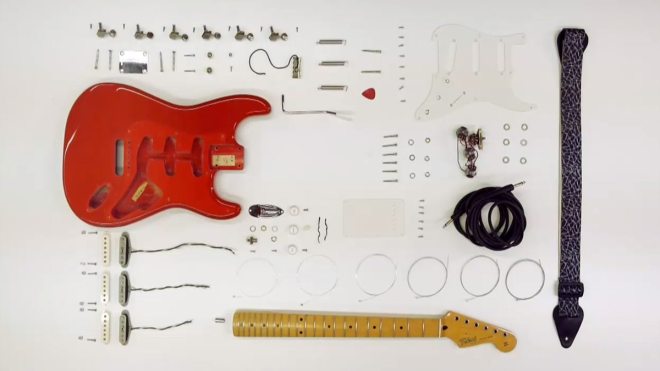
JAMES MAY, “THE REASSEMBLER”, BBC4
I’m the target audience for this – in Jerry Garcia’s words I’m “Old and in the way…” and it’s a cool idea, but it missed several tricks, mostly musical. It was perfectly interesting (up to a point) but the archive footage and voiceovers were a disaster – if you’ve chosen to reassemble a (Japanese Tokai copy) Fender Stratocaster, then give us a little of Leo Fender and his brilliance, not a seen-a-thousand-times-before clip of girls screaming in 1964 at Keith Richards playing a Les Paul. Find out why the Strat’s the shape it is, interview some players, tell us why the tremolo bar came about – because James May’s bumbling Everyman is by now a fairly tired shtick. Hold on – why was it a copy? A new Fender’s only about £350…
EXTRA! CORPORATE CORNER! GET YOUR WALLETS OUT!
From every record tells a story – a story of Exhibitionism and greed: “A Stones-branded football table is offered for £4,750, there’s a £2,500 backgammon set, a £940 record case and the most appalling smoking jacket based on Exile on Main St from Turnbull and Asser – a snip at £1,450. For those on relative budgets but still with money to burn there are Smythson notebooks (£50 each or £265 for a set) a £42.50 Steiff teddy, Lulu Guinness clutch bags (£295), or suitably gaudy Villebrequin swimming trunks (£180) and t-shirts (£85). Thank goodness there hasn’t been a global financial crisis and period of austerity recently…”
I FOUND THIS POST FUNNY – I’M NOT SURE WHY…
Rock Stars at Breakfast, plus Groucho Marx. Here’s Elvis, at the Jefferson Hotel in Richmond, VA. This shot is from possibly the greatest rock photobook of all time – Elvis ’56 by Alfred Wertheimer. His site has most of the great photographs, if you’ve not seen them.

FORGOT THIS SHOT FROM A WHILE AGO…
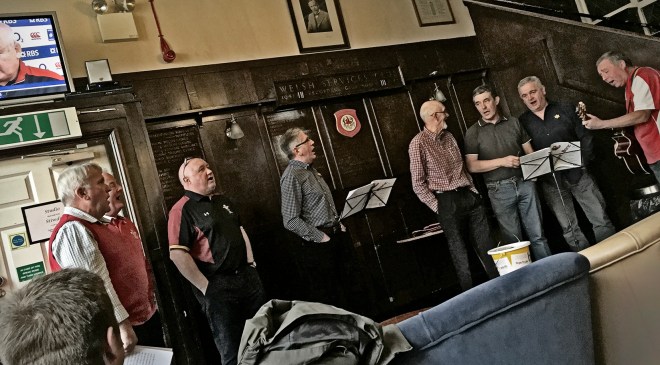
In March, at London Welsh in Gray’s Inn Road. Just before the Wales/England rugby match kicked off, a group of fans – presumably part of a Welsh choir – put on an impromptu (and properly emotional) performance.
IS THIS RON WOOD’S FINEST ARTWORK?
Thankfully portrait-free… set list for the Stones in Lima, Peru.

DJANGO, JIMMY, MERLE, WILLIE
Watch two great singers at work together… Merle’s body shapes and gestures in front of the microphone are fantastic. and it’s good to see that Willie’s still playing “Trigger” – I thought it was a permanent exhibit in the Country Music Hall of Fame in Nashville.
AN EXCELLENT USE OF TWITTER
Pete Paphides notes the passing of George Martin, in the modern style… (read from the bottom up).

I failed to post a Five Things before leaving on a trip to the States, so here it is, slightly amended, on our return. Extras to follow on Woodstock & Detroit, people…
MARINA HYDE ON FIRE!
“In the meantime, we must turn our attentions to Kanye, who places his personal debt at $53m, explaining to the world: “If I spent my money on my ideas, I could not afford to take care of my family. I am in a place that so many artists end up.” Like various notables before him, Kanye declares: “I wanted the world to know my struggle.” (Then how about writing a $10 book entitled My Struggle? There must be at least 5.3 million ironists who would buy a copy of the German edition.)
Admittedly, his wife did claim this week to be “transferring 53m into our joint account”, but the suspicion must be that Kanye wishes to place himself on a more independent footing than one underwritten by the Bank of Kim. Not that he is against bailouts. In fact, the sense that Kanye is simply too big to fail was my takeout from a series of tweets he posted shortly after the debt ones, imploring Silicon Valley bigwigs to invest in his “ideas”. These ideas remain tantalisingly unspecified, though the past few days of tweeting alone have yielded such standouts as: “I don’t personally like suit jackets any more”, “I believe that Kim is our modern day everything”, and the peerless “super-inspired by my visit to Ikea today”.
But back to his plea for financial intervention. Lost in Showbiz would argue that what is taking shape is nothing less than a new theory of celebronomics: a theory that argues that an entirely free Kanye West market is not the most beneficial model for society. Yes, you can hope that the billionaire private sector plays a part. But governments have a responsibility to intervene at various stages in the cycle in order to provide the shared goal: full Kanye. Thus, far from encouraging thrift in a downturn, the state should actively encourage spending on Kanye West products. I hereby christen this theory Kanyesian economics, in honour of its leading thinker, and implore governments across the world to subscribe to its principles without delay.” – from The Guardian.
CALUM STORRIE’S EXCELLENT METHODOLOGY!
From Calum’s likeahammerinthesink blog, this excellence issues forth, complete with a how-to:

And the result? Beautiful. You could do an entire film soundtrack using this method.
JACO’S JOURNEY!
The DVD arrives in the post, directed by the excellent team of Stephen Kijak & Mr Paul Marchand. There is so much here, from Pastorious’ love for the guitar playing of Willie ‘Little Beaver’ Hale to his encyclopedic knowledge of big band jazz, learned from his father (a pro jazz singer – “there was no bad music played in our house!”). Loved this bit of Super 8 of an early Pastorious band in Miami, with Jaco on drums…
 As a teenager, the only clothes he owned were two pairs of cords and three t-shirts – a wardrobe that would fit into his Fender bass case. When he joined Wayne Cochran (I’ve said it before, but you just have to check out Wayne Cochran on YouTube), the tuxedo (that all band members had to wear) was too big for his wiry frame, so he’d wear his compete wardrobe under it. Jerry Jemmott interviews him in 1984 for a bass lesson DVD and lists his accomplishments, telling him that a generation of bass players have been inspired by him, and ends up asking him, “How do you feel about that?”. He looks up, slightly lost in a mist and says, “Just gimme a gig!”
INTERNET + DATA = GLORIOUS MADNESS!
I mean, really, this is some kind of voodoo. I know I have a penchant for this sort of stuff, but this is as good as the HipHop Billboard No 1s from a couple of weeks ago. Every Noise at Once – every genre, every tributary in that genre. Check out Geechy Wiley’s “Last Kind Word Blues”, one of the strangest, most naggingly mysterious blues ever written. You could, as Em would say, lose yourself in the music. Personally, I’m just off to negotiate my way around dark psytrance.*

AND FINALLY…
… do yourself a favour and read this exceptional piece by David Remnick in The New Yorker, on the complex majesty that is Aretha. As the time draws nearer that we all may be able to see the Amazing Grace concerts – as filmed by Sidney Pollack – Remnick pays tribute to America’s greatest voice. As the Prez says, “American history wells up when Aretha sings. That’s why, when she sits down at a piano and sings “A Natural Woman,” she can move me to tears – the same way that Ray Charles’s version of “America the Beautiful” will always be in my view the most patriotic piece of music ever performed – because it captures the fullness of the American experience, the view from the bottom as well as the top, the good and the bad, and the possibility of synthesis, reconciliation, transcendence.”
* I did. But you’ll be pleased to know that I’m recovered now…
NUMBER ONE: A BUNCH OF DOGS

If you have yearning for a stripped-back Pink Martini, or a Hall & Oates-sized hole in your musical life, or would even just like a slightly more flexible Rhiannon Giddens, then Lake Street Dive may be your new band of choice. Hipped to them by this, sent straight from the sketchbook of our worthy constituent and Woodstock Correspondent, John Cuneo, executed in his downtime between illustrating covers for The New Yorker. It’s inspired by their new single, “Call Off Your Dogs”. Here’s a live version from the Colbert Show. Dig the Jamerson /Fender bass stylings of the excellent upright bassist Bridget Kearney. Singer Rachael Price has a nice grain to her voice and is tasteful in the best sense of the word. The first clip I saw was this, a cute and sultry live take on “I Want You Back” on a Boston street corner.
NUMBER TWO: A RULE OF THUMB
…is that if Richard Williams has already written about something then writer beware. So I’m not going to write about either of these: Bill Frisell’s guesting on both Lucinda Williams’ The Ghosts of Highway 20 and I Long to See You by Charles Lloyd and The Marvels (I liked this more than Richard, I think, being no expert in Charles Lloyd). And now I can’t write about Ray Stevens’ “Mr Businessman”, one of the great anti-corporate protest songs of the 60s. We were having a conversation about the love of fairly obscure songs from the 60s in the South, and I was saying how much I loved John Fred and The Playboy Band’s “Judy in Disguise (with Glasses)”, and Richard said did I know “Hey Hey Bunny”, which I didn’t, but which is terrific. He then pulled out his iPhone and called up the lyrics to Mr Businessman. Spectacular. Read about it (and Bill & Lucinda & Charles Lloyd, too) here. And finally, am hugely enjoying the Tom Jones bio (written with Giles Smith, and recommended by Richard here), a bracingly honest look at a pop star life.
NUMBER THREE: A WORLD OF NO
AeroDrums is their name, avoiding them is your game.
NUMBER FOUR: A SHEERAN TAKEDOWN
Barbara Ellen in The Observer: “Australian actress Margot Robbie has revealed how she confused Prince Harry for Ed Sheeran at a star-studded party that the royal had gatecrashed. Clearly, both men have red hair, but Robbie says that it was because Harry was “not wearing his crown”. Robbie also revealed that Harry was “offended”, which seems a tad rich. What’s Harry got to be offended about? As it happens, I’ve criticised Sheeran in the past and with just cause. His global success as a singing pyjama case, dribbling saccharine platitudes into the poptastic-sphere, means that the music industry is now obsessed with signing other highly lucrative singing pyjama cases at the expense of different kinds of music. Or, to be technically correct, at the expense of music…”
NUMBER FIVE: A KOOL KRISTIAN KANYE
So this week it’s illustrators sending me illustrations, Mr John Cuneo swiftly followed by the estimable Marco Ventura, depicting Mr West as a religious icon for Rolling Stone. Captures well the slight truculence that always seems to attend Kanye. Now that he’s been outflanked by Kendrick Lamar, he seems in danger of disappearing into the fashion world’s luxe embrace.

ONE: BOB!
So he was not only down in the basement mixing up medicine and making tapes, but squirreling away mountains of artifacts in a hideaway storage facility. Thus the late period curtain-reveal of Bob Dylan’s career continues. This is from the NYT piece by Ben Sisario on Dylan’s huge secret $60 million archive: “Humanizing touches appear, but in small and scattered pieces. There is a wallet from the mid-1960s containing Johnny Cash’s phone number and Otis Redding’s business card. We can see the 1969 telegram from “Peter and Dennis” (Fonda and Hopper, that is) about the use of “It’s Alright, Ma (I’m Only Bleeding)” in the film “Easy Rider,” but the response is by a lawyer. Amid these mountains of paper, Mr. Dylan, the man, remains an enigma.”

TWO: IGGY!
From Big O: It’s already a big deal to have a celebrity in class but what happens when it is Iggy Pop, 68, who poses nude for your art class? Twenty-one artists, aged 19 to 80, at the New York Academy of Art were greeted by a naked Iggy Pop on February 21, 2016 as the rocker was recruited by the Brooklyn Museum to serve as the class’ nude model. Rolling Stone reported that conceptual artist Jeremy Deller, who was the driving force behind the Iggy Pop Life Class project, said: “For me it makes perfect sense for Iggy Pop to be the subject of a life class; his body is central to an understanding of rock music and its place within American culture. His body has witnessed much and should be documented.”
THREE: ENNIO!
How nice to see a dynamic B&W photograph used on a concert poster for once…

FOUR: MAVIS!
Mick Gold treats me to a viewing of the very affecting Mavis! at BAFTA. Highly recommended for its story of family ties and Civil Rights – for Mavis Staples, it’s always all about the music. No diva-ishness, no dilution – the struggle runs through her like a seam of coal. Most moving moments: a visit to Levon Helm in his studio, rail thin and gaunt, intently listening while Mavis sings to him, and finally being compelled to join in by the beauty of her voice; Mavis talking about Pops with Jeff Tweedy and his son, and feeling the love of another musical family in the projects that they’ve recorded with her.
Other highlights: the least gnomic Bob Dylan interview, possibly ever, and the performances with her current band, a terrific ensemble consisting of guitarist Rick Holmstrom, bassist Jeff Turmes and drummer Stephen Hodges (whose work I mainly knew from the swordfishtrombones-era Tom Waits).
Mick sent me this, from the filmmaker’s notes: Many people have wondered what it was like to ‘meet Dylan.’ WTTW rented a suite in the North Side hotel where Dylan was staying. We invited Mavis and her sister Yvonne to watch the interview; they had not seen Dylan since Mavis sang background on Dylan’s “Like a Rolling Stone for David Letterman’s 10th anniversary show in 1992. Dylan arrived on time and alone. He wore a black riverboat gambler outfit, framed by a black cowboy hat and black gypsy boots. Like a schoolboy, Dylan tiptoed into the room with a shy stride. He carried a single red rose for Mavis. They embraced… Dylan and the Staples had some good times. This didn’t make it into our documentary, but Pervis (who left the group in 1970) recalled Dylan diving off a board at the motel where they were staying during the Newport Folk Festival. “He jumped off the board and his shorts came off,” Staples said. “I went in and got ’em. I thought something happened to him because he had his boots on, too. We got to be friends. We bought some wine, and he wrote “A Hard Rain’s a-Gonna Fall” on the back of a shirt board.” I asked Dylan about this story. He said it “pretty much sounds right” and that he wrote many songs on many different objects.
In an interesting interview with Noah Schaffer for Arts Fuse, Holmstrom explained his philosophy for backing Mavis: “I really think Mavis sounds best in a stripped down setting because it gives her voice more room to resonate. Plus, a lot of my favorite Staples Singers stuff was just Pops Staples on guitar and their voices, occasionally with bass and drums too. To me, that’s where the deep Staples vocal blend really shines. It’s as if the singers are an orchestra horn section, punching and popping lines, being a lead instrument at times, not just singing “oohs and aah’s.” If you add too much it takes away from what makes it so soulful in the first place. We like to use silence and a bigger range of dynamics than most bands. We try to play really quiet at times so that when we play at medium volume it has an impact, rather than starting on 10 and staying there all night. It also makes it easier on the six singers to really sing rather than strain to hear ourselves. It’s something we have to constantly work on, remind ourselves of.”
FIVE: MICHAEL ABRAHAMS!
If only all health warnings were like this…
Thanks this week to Marc Myers of JazzWax fame for running some fine Terry Cryer shots of Sister Rosetta Tharpe with Ken Colyer this week. Marc had written about Sister Rosetta and linked to the fine BBC documentary about her, so I had sent him the shots out of interest.
Oh, and look out for a Five Things Extra! next week on all the strange Woodstock related events and coincidences that seemed to happen in the last few days.
THERE’S ONLY ONE NANCY BANKS-SMITH…
For two weeks in the late 90s I sat across an office from Nancy Banks-Smith, one of my favourite newspaper writers, but I never plucked up the courage to actually speak to her – I found The Guardian too intimidating an operation to do something as forward as that. And as stand-in Art Director on the Guardian Weekend magazine for the estimable Mark Porter, I was much too concerned with hanging on by my fingernails, attempting to not screw up. I was reminded of those days by this excellent letter to The Guardian, from John Steele:
“To include PG Wodehouse, Terry Wogan and the Grateful Dead in one paragraph (Nancy Banks-Smith, 1 February) must be a first in British and probably world journalism – a truly amazing feat and somehow it seems to make sense.”
And here was Nancy’s para:“He started life, like PG Wodehouse, as a bank clerk, but the moment he picked up a mic he knew he could do it. “Never mind the music, it’s the talking that’s important,” he once said insouciantly, while treading all over the Grateful Dead.”
BUT THERE WERE TWO EVENINGS WITH MARK KERMODE…

I’d recently done some slides – blown up and half-toned stills – for a series of events with Mark Kermode at the BFI, where he shoots the filmic breeze with an audience. One of the highlights was in the Sound & Vision segment (I’d used a still from The Conversation with Gene Hackman and John Cazale in their surveillance van) where Mark showed a clip from Girlhood, where the girls dance to Rihanna’s “Diamonds”. It’s a burnished and beautiful scene with the camera following the girls’ rhythms as they dance and mime to the song.
A few days later we saw (and heard) Mark and his band with Mike Hammond, the Dodge Brothers, soundtrack some short silents at my brother-in-law’s extraordinary birthday show at the Cinema Museum in Kennington – a terrific place that should be better known. If you love the history and artifacts of film, go immediately.
THEN THREE GIGS IN ONE WEEK…
1) was Natacha Atlas at Ronnie’s (thanks, Kevin!) with a stunningly creative band. She was playing her new album, Myriad Road, a collaboration with Lebanese/French trumpeter and producer Ibrahim Maalouf.  This show took the album and ran with it. The trumpet of Hayden Powell and the violin of Samy Bishai worked together as a sinuous horn section and separately as expressive soloists, and there was wonderfully tough and detailed piano from Alcyona Mick as well as the fantastic foundation of Andy Hamill on bass and Asaf Sirkis on drums. There was literally not a dull moment – the whole thing felt like a souped-up and more muscular version of the album. For a few numbers they were joined by two percussionists, and the hand drum player led the audience in trance-inducing feature that raised the roof. Atlas sang beautifully, mostly in Arabic, and was a generous host – she really shared the spotlight – and the smiles that wreathed the player’s faces said it all.
2) was Beirut at the Roundhouse, where a band with two trumpets played, essentially, world/film music – but made it sound like the best kind of Pop. You know, a Balkan/Mariachi/Marc Almond/Scott Walker/Western Movies kind of Pop, which went down a storm with a wildly enthusiastic crowd. About the only thing not to like was the bass drum sound that gigs often feature – a cardboard-y thump. Zac Condon and his gang were supported by a laconic Aussie guitar player lumbered with the (as he himself admitted from the stage , “I’m stuck with it, regrettably…”) moniker of D. D Dumbo. A spiky Chinese/Malian/Blues-sound wrung from a 12-string Danelectro, with a snare and tom and a loop pedal, he made music located somewhere on the spectrum between Battles and Bon Iver. Marcel and I were suitably impressed.
Every couple of years I feel the need for a dose of 3) the bracing Poliça, and on this trip they were playing the Village Underground, an art space in Shoreditch. As Steve said, we could have been in Berlin, in a Wenders film. The building itself is an old industrial space that feels like, well, an old industrial space. Not gussied up at all. The sound of the band was overwhelming – you felt the bass in the pit of your stomach and the twin drummers in your chest. Most of the songs were new, but all tight and short, glacial pop melodies over a pummeling beat, with Channy Leaneagh in great voice. The next day, Steve emailed to say that they sound “prettier” on Spotify, and that he was missing the bass. I think we had enough bass that night to last at least the next two months…
FOLLOWED BY “FOUR DAYS GONE”…
This week I discovered a Steve Stills’ box set that had a solo demo, dating from the Springfield days, of one of my favourites among his songs. Stills had a good way with creeping paranoia and anti-authoritarianism – see “For What it’s Worth” or “America’s Children”, and played a great version of this on his ’74 solo tour (a performance with fabulous drumming from Russ Kunkel). This demo (on the music player to the right) boasts a beautifully plaintive, pining melody. I like piano played by guitarists (Dylan, Young and Keith Richards spring to mind) as they have an almost untutored approach and often find interesting phrases that the more adept keyboardist may never stumble upon.
AND FIVE OR SO CITIES (NOT FORGETTING THE MOTOR CITY!)
Ivy Jo Hunter, songwriter, interviewed by Dave Simpson in The Guardian: “In those days, you could rob a bank easier than you could get into the record business. I wanted to be a singer, but they needed writers. I started putting “Dancing in the Street” together on a little piano upstairs that anyone could use. I couldn’t really play, but I had a bassline and found some chords to go with it. Afterwards, James Jamerson, the legendary Motown bassist, said he’d never had so much fun playing one note. I’d wanted to write a melancholy song, but when Marvin heard it, he said: “That’s not a sad song. That sounds more like dancing in the street.” That became the title and half an hour later the song was finished. All the “Calling out around the world, are you ready for a brand new beat?” lyrics just flowed out. Mickey and Marvin put in the mentions of “Philadelphia, PA, Baltimore and DC” – cities they’d visited on tours. I added: “And don’t forget the Motor City.” We got the drumbeat by hitting a tambourine with a stick and routing the echo through the bathroom. Soon the rest of the industry were losing their minds trying to get that sound, with all their expensive equipment, but they never could. I didn’t really like the finished record, but then I had no concept of what made a hit. When Mick Jagger and David Bowie covered it in 1985, I made more money in two years than I had made in the previous 20. I would have kissed their butts in the middle of Broadway.”
ONE. THIS. THIS IS AMAZING…

Found at Polygraph. I’ll let them introduce themselves: “Polygraph is a publication that explores popular culture with data and visual storytelling. Sorta. This thing is in its infancy. We’re making it up as we go”. This here is a moving flow chart of what Hip Hop’s Billboard Top 10 sounded like from 1989-2015, blending tracks every time the No 1 record changes. If you want to track the Pop-isation of Hip Hop go from Kirko Bangz “Drank in My Cup” on May 28th, 2012 thru to Pitbull’s “Timber” on February 7th, 2014. And then weep a little.
TWO. RADIO 4 ON SONG
Interesting interview with Bonnie Raitt on Woman’s Hour, with a nice mention of Dobell’s, (where she found a Sippie Wallace album in the early Seventies) and a fascinating programme on the commercialization of Gospel music, The Gospel Truth, presented by the financial educator Alvin Hall. The whole show had a very powerful soundtrack (it starts with Obama singing “Amazing Grace” at the funeral of one of those killed in a massacre in Charleston) and ended with “Everything’s Coming Up Jesus!” by contemporary gospellers Livre, which features a great bass part and a swooping chorus strong enough that I had to go and find it immediately.
THREE: THE BLACK SABBATH STORY
I have no idea how I had missed the story of Black Sabbath’s formation and Tony Iommi’s accident until now, but I had. It’s retold very nicely at Every Record Tells a Story here. And here’s a couple of excerpts: “Tony Iommi had been a sheet metal worker but the machine had come down on his right hand and severed the tips of the middle and ring fingers. There’s never a good hand to lose a finger or two from, but as a left handed guitar player, the right hand is definitely the worst option. What’s more, the accident occurred on the day he was due to quit the job to take up music as a full time profession… A friend bought a profoundly depressed Iommi an album by Django Reinhardt. Django played gypsy jazz and used just two fingers to fret chords after burning his hand in a fire, and played the most intricate melodies. This inspired Iommi. He still couldn’t play with two fingers, but like when the A-Team were trapped by gangsters in a garage with just their van, a couple of conveniently discarded sheets of metal and a welder’s torch, he got busy on his escape. Iommi made a couple of thimbles from melted fairy liquid bottles, glued on leather to the sanded down tips and finally – and crucially – loosened the strings so he didn’t need to press so hard. Slowly and surely Iommi gained his confidence and technique with these Blue Peter-esque improvised finger tips. A deeper tone and slower sound began to emerge…”
“Black Sabbath was released on Friday 13th February 1970. The critics hated it, but it reached number eight in the UK charts and number 23 in the USA. Judas Priest, Metallica, Iron Maiden, Nirvana, Slayer, Mastodon and countless others all owe their careers to this album. An entire genre of music invented by a guitarist without a full set of fingers, a jazz drummer, a former abattoir worker and, best of all, a trainee accountant. And the most amazing part of this story? They recorded the whole album in just eight hours in a tiny studio at the back of what is now a guitar shop in Soho. Eight hours. It took them eight hours to invent heavy metal.”
FOUR: YET MORE INTERESTING LOOKING MUSIC FILMS
Two films are in production about the not-widely-known Danny Gatton, a guitarist of fearsome dexterity. For a flavour, try this. As Damien Fanelli wrote in Guitar World last year: “The late Danny Gatton had a nickname: “The Humbler.” As in, “You think you’re so great? Let’s see you go head to head with Gatton. You will be humbled.” Gatton, who also was known as the Telemaster and the world’s greatest unknown guitarist (a nickname he shared with his friend Roy Buchanan) could play country, rockabilly, jazz and blues guitar with equal authority – and sometimes with a beer bottle! In this legendary clip from his 1991 Austin City Limits appearances, watch as Gatton plays slide guitar, overhand-style, using a full bottle of beer as a slide. Of course, since the bottle is full, some suds find their way onto his Fender Tele’s neck. So Gatton whips out a towel to wipe off the beer; only he keeps the towel on the neck – and simply keeps on playing. What’s most impressive about this sequence is just how fun and musical his playing is, despite the beer-bottle theatrics. Although there’s a good deal of showmanship involved, it’s by no means all about showmanship; as always, his playing is humbling.”
FIVE: FILLMORE EAST MEMORIES
Marc Myers’ always fascinating blog, JazzWax, leads me to this slightly hysterical (in a good way) piece about the Fillmore East, legendary NYC music venue, by resident historian of the Bowery Boogie, Allison B. Siegel [“as an urban historian, Allison can be found exploring and documenting buildings wherever she goes making it very hard to walk down the street with her”]. In March 7, 1968, Loew’s Commodore Theatre became the Fillmore East, renamed by the man behind the Fillmore West in SF, Bill Graham. It closed a few years later, and sadly “what was once the entrance to a whimsical place of drama and comedy, laughter and light shows, music and camaraderie, sex, drugs, disco and rock n roll is now… a bank.”
AND LASTLY…
This week I have mostly been swooning over the pace, attack and grace of both Riyad Mahrez of Leicester City and Billy Preston of Los Angeles. Dig Billy’s Wurlitzer playing on “Funny How Time Slips Away” from a CD I’d lost but now have found: Rhythm, Country and Blues, one of the best to be found in the Various Artists/Tributes to Something section of the record store. Produced by Don Was, the whole thing is highly recommended, from Patti Labelle and Travis Tritt’s “When Something Is Wrong With My Baby” to “Rainy Night In Georgia” by Conway Twitty and Sam Moore (of Sam & Dave fame). And who knew that Lyle and Al would sound so good together? In one of those odd coincidences the CD arrived on the day I found this great sketch from my friend, illustrator John Cuneo…

IMAGE OF THE WEEK
Best thing we bought in Paris last weekend: from the Vanves flea market – it’s hard to resist Monks playing music, I find. Best thing we saw but didn’t buy: this Philips’ Rosita music centre.

ONE. ENOUGH SINGER-SONGWRITERS, ALREADY
Ian Gittings wrote about the plague in The Guardian: “Jamie Lawson, a Devon-born singer-songwriter had put out three albums over a decade-long career to almost blanket indifference… Ed Sheeran released the fourth last year [on his new record label], expressing hope that it would pick up play at “my dad’s dinner parties”. This should have been the kiss of death but was instead inexplicably regarded as a recommendation: on the verge of his 40th birthday, Lawson saw the record go to No 1. This precipitous rise from obscurity is baffling, as Lawson is such an unremarkable, journeyman talent. In the currently cluttered field of showily sensitive male singer-songwriters, he possesses no discernible selling point. He is Sheeran without the endearing glimpses of wit and humanity; Damien Rice minus the depths and the dark side [actually I think Gittings is letting him off lightly here, it’s even worse than that – Ed].”
Fronting a functional band with an ingratiating grin apparently welded to his face, Lawson primarily suggests some ghastly amalgam of James Blunt and Ben Haenow. His excruciatingly sentimental lyrics could be the handiwork of a moonlighting Clintons cards copywriter: the jaw-droppingly platitudinous “Someone for Everyone” (“Don’t worry/If you can’t find love in a hurry”) could very easily be retitled There are More Fish in the Sea, or At Least You’ve Got Your Health.”
And one of those “showily sensitive male singer-songwriters” is Jack Savoretti. I saw him do a couple of songs as a short support act to Paulo Conte, his record company playing up his Italian heritage in hopes that Conte fans would flock to follow Jack too.
Last week he played the Graham Norton Show, and while he seems a nice enough fellow, his performance was a patchwork of all the current crop’s failings. There was a sub-Coldplay chord sequence powering music that exists on some glassy plane entirely separate from the voice, with no interaction and no give and take. Far from it being a social activity, this is music that doesn’t move about the room, talk amongst itself or tell an interesting story. It just sits there like an Ikea sideboard, neat and bland, with a flimsy and hollow core. So even though the band can play, and he can sing, it’s all for nothing. His vocal was at 10 on the emotional richter scale by the end of the first chorus, and there’s no way here for the listener to invest in a narrative arc. And it’s all topped off with a ridiculous lyric, blathering on about the fall of Empires and such like, topped off with the awful title phrase “If I could catapult my heart/to where you are”. Just imagine that line in your head. Go on. Whoa! Enough negativity! Here’s something I liked…
TWO. INSTRUMENT CORNER
Bob G sent me this link to Behold, an interesting Photo blog, where Ed Stilley makes an Outsider Artform of guitars. “God Instructed Him in a Dream to Make Guitars and Give Them Away to Kids, So He Did”. Can’t beat that for a headline. And the solution to limited access to parts results in a truly unique 12-string guitar.
THREE. A NICE PIECE IN THE NEW YORKER
Elon Green on Mavis Staples’ new album, which will release in mid-Feb followed by a new documentary, Mavis!: “The new record, Mavis thought, presented an opportunity to do something different. Radically so; her inspiration came, in part, from Pharrell Williams’s galactically popular “Happy.” She’d sung it to herself each morning, and it had, more or less, lodged itself in her brain. “When the world was just so upside down, [Williams] brought a lot of people up with that song,” Mavis said recently. “I’ve been making people cry for so many years, and I just want to sing something joyful.” And at the end, this: “As for Mavis, she has only one regret about the record, set for release on February 19th. “I wish I could have gotten old Dylan to write a song for me,” she said. A lifetime ago, Mavis and Bob Dylan were in love. “We may have smooched,” she says in the documentary. Dylan, in fact, went to so far as to ask Pops for Mavis’s hand in marriage. He was denied.”
FOUR. THIS YEAR WE’RE LOOKING FORWARD TO THIS FILM…
The Jaco Pastorious documentary, co-directed by Stephen Kijak who did such a great job with Scott Walker in 30 Century Man. One YouTube comment from StevieDebe kind of sums up the end of the story: “When I met him on the street, 6th Avenue and 3rd St, I said Are you Pastorius? He said, That’s right, Jaco Pastorius, best bass player in the world… can I borrow $16? To which I said gladly yes!” It has a nice trailer, with an imperious Joni Mitchell – “I like originals… pause, drags on her cigarette… Jaco was an original”. It could be time for me to drag out my old chestnut, “The Night I Met Joni (and Jaco)”, except that I won’t. You can find it here if you’re so minded.
FIVE. A FASCINATING PIECE IN VANITY FAIR…
by Michael Lewis, where he takes on the mantle of William Goldman to illuminate the strange route movies take to get made. This is apropos of The Big Short: “ Having said all that, the movies that have been made from my books have, in my view, been pretty great. It’s no use trying to shift gears here and claim credit for this. There’s no obvious correlation between the quality of a movie and the quality of the book it springs from: good movies have been made from bad books, just as bad movies have been made from good books.
Each of the three times I have sat in the darkened room and watched for the first time a movie of my book I have felt simple delighted surprise. With each movie the surprise has been greater. The Blind Side wasn’t that hard to imagine as a movie – at the heart of the book was a bizarre and moving family drama. Moneyball was hard to imagine as a movie, but at least it was about baseball and thus organically linked to popular culture. Wall Street, even in the aftermath of a financial crisis that has cost so many so much, is not. The behavior of our money people is still treated as a subject for specialists. This is a huge cultural mistake. High finance touches –ruins – the lives of ordinary people in a way that, say, baseball does not, unless you are a Cubs fan. And yet, ordinary people, even those who have been most violated, are never left with a clear sense of how they’ve been touched or by whom. Wall Street, like a clever pervert, is often suspected but seldom understood and never convicted.”
BREAKING BLING
In a distinguished lineage that includes Peter Sellers doing “A Hard Day’s Night” in the style of Richard III, and Burt Lancaster fronting The Highwaymen, intoning “The Birdman of Alcatraz”, we have Actors meeting Song, in this case, Drake’s “Hotline Bling” narrated by Bryan Cranston (amongst others). Enjoy.
FAVOURITE SONG I HEARD AND THEN SET OUT TO TRACE…
A hot summer’s day and I’ve just parked the car in a side street in Walthamstow, about to pick up some pegboard that was being made up for me. Bleeding out of a car with closed windows is this great tune, with the repeated refrain – “I’ve got a girl on the other side of town, she’s waiting for me to come around…” There are those moments when a piece of music just seems so right for that time and that place. I motion to the guy inside and politely enquire if he knows who’s singing and what it’s called – but he doesn’t, although he agrees that it is a top tune. I find out a while later – Barry Boom singing Lou Ragland’s “Making Love”. It seems that it’s one of the best Lovers Rock tunes out there. It’s here, if you’re interested.
JAMIE XX – I KNOW THERE’S GONNA BE (GOOD TIMES)
It’s always nice to hear a sample of The Persuasions. Unfortunately, there’s not a lot about the rest of Jamie’s song that’s very interesting. I saw The Persuasions once at Gaz’s Rockin’ Blues in a ridiculously hot basement where the audience was on the stage with the group. Two feet from acapella doo-wop is a great place to be. Here’s their lovely version of Dylan’s “The Man in Me”.
And if you like that, this is my absolute favourite, a doo-wop classic, “Looking for an Echo”. What a cracking title – a phrase that sums up a lot of what life’s about. Written by a folkie [Kenny Vance] who acted – guest star on Kojak and The A Team, no less – its yearning and touching lyric hitting dead centre on that large nostalgia target…
And if we went to a party / and they wouldn’t let us sing
We’d lock ourselves in the bathroom / so nobody could get in
’Cause we were looking for an echo / an answer to our sound
A place to be in harmony / a place we almost found…
BEST ONE-STOP SHOP FOR CLASSIC JAZZ COVERS…
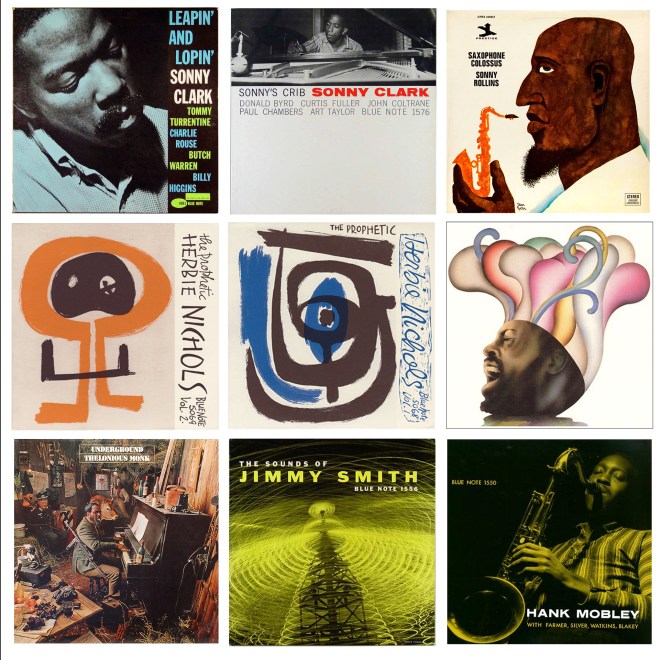
…was this post by London Jazz Collector. Virtually every major design style from the Fifties until now is captured in these stunning albums. As the man says… “These are my personal choices, you can see where I’m coming from. Portraiture cements the relationship between the musician and the instrument. Record = hearing, Cover = seeing, Great music, great covers, brings it all together.”
ANOTHER TIME, ANOTHER PLACE
I love a story that dates time like this: “I started working for Selmers around the Truvoice/Grey crocodile era, and left around the grey/silver speaker-cloth era.” Just brilliant. This memoir by Patrick Kirby was found when I was looking for stuff on Selmer amps, whose store used to be at 114-116 Charing Cross Road. After talking about Teisco guitars (see earlier posts), Mark had mentioned that Selmer amps were really sought after as they were so amazing, and that he had once been the proud owner of one. Brett (Best Coast) had mentioned them too, so I realised that was why they now go for thousands instead of hundreds…
“My colleague in the Organ Salon was an unlikely chap called Ted Woodman, who was totally sold on Art Tatum. When I first saw Ted playing Jazz on organ I feared he was having an epileptic fit, or was on drugs… his eyes rolling as he writhed his arms over the keyboards, twisting and turning his legs across the massive 32 note pedalboard, swinging his head around dangerously. Soon after, having seen Alan Haven on TV with the Beatles, doing exactly the same thing, I quickly picked up the art and with the encouragement of a guy called John Bell, who ran the drum department (and was rather nifty with the skins himself), we were out playing jazz gigs in dodgy Soho clip-joints most nights, earning on average 10 shillings each a session (then fondly known as half-a-knicker).
“John and I used to beg and borrow keyboards from the store for gigs, but eventually saved up and bought a second-hand Lowrey Heritage organ from Selmers. I discovered some of the words to a Sergeant Pepper song written on the polished wooden top, and thought this was sacrilege until I found out from John that this was the organ that Selmers used to hire to EMI, Abbey Road! For Bob Dylan and The Band, appearing at the legendary Isle of Wight Music Festival, Selmer engineers took weeks customising a Lowrey H25 console organ. The result was the most amazing set of sounds you’ve ever heard.”
THE NOTE OF A ROOM
From a terrific interview with Richard Flanagan on Bookclub, R4. They were discussing his 2014 Man Booker Prize winning novel The Narrow Road to the Deep North, which is set among prisoners of war who were forced by the Japanese to work on the notorious Thai-Burma railway. He reads an excerpt where a widow is talking to her visitor about love: “I have a friend in Ferntree who teaches piano, very musical she is. I’m tone deaf myself, but one day she was telling me how every room has a note – you just have to find it. She started warbling away, up and down, and suddenly, one note came back to us, just bounced back off the walls and rose from the floor and filled the place with this perfect hum, this beautiful sound, like you’ve thrown a plum and an orchard comes back at you. You wouldn’t believe it Mr Evans… these two completely different things, a note and a room, finding each other. It sounded right. Am I being ridiculous – do you think that’s what we mean by love, Mr Evans?”
Flanagan stops reading, and a member of the audience joins in: “Yes, I really noticed that passage in the book, ’cause I’m sort of a failed musician and I know exactly that feeling you get in a room when it just works right to play music in, and I thought it was a lovely metaphor for love, that I’ve never seen used elsewhere before, and I just wondered how you came to think about it…”
Flanagan: “I was drinking with some musicians one night and we ended in a wine cellar in Hobart, in a vineyard in Tasmania and they told me that every room has a note – and I’d never heard this before. Then they started ‘pitching’ their throats, going up and down the scales ’til they found the note of that room and then suddenly it all came back, and as a musician you know this, but I didn’t know it, and I cannot tell you what an extraordinary sound it is when you find the exact pitch of a room, and you hear it coming to you. The whole room thrums with it. It is the most beautiful resonance with the world…”


 Five Things I Saw & Heard This Week