Five Things I Saw & Heard This Week: Wednesday 14th March

David Whitaker
The death, at 81, of the man responsible for the strings that were sampled by The Verve for Bittersweet Symphony brought forth this excellent little nugget, recounted by Bob Stanley in his Guardian obit: “He spent much of his time in Paris working with the cream of the country’s “yé-yé” scene, including Johnny Hallyday, Sylvie Vartan, Claude François, France Gall and Serge Gainsbourg.  Gainsbourg’s song Comic Strip was recorded in London, with Brigitte Bardot providing back-up vocals. Whitaker later explained how they decided where they worked: “If Serge wanted some new clothes, we recorded in London, and if I wanted some we recorded in Paris.” Ha! There are, by the way, excellent waxworks of both Johnny and Serge in the Musée Grévin in Paris.

Liza with a What?
News comes via Andy Schwartz on the rocksbackpages blog of an album cut by Liza Minelli at Muscle Shoals. Aside from the fact that that we need much more information on this, it make you wonder about any other weird combos that may come out of the woodwork, from a long-gone time when no talent mix was too strange to consider. Prime runners?  The lost Doris Day at Stax album, or the rumoured Mae West: Gettin’ Down & Dirty with Little Beaver Miami masterwork?

Do You Remember The Tyla Gang?
At lunch with friends on Sunday it turns out that Weston’s brother Mike was the drummer in The Tyla Gang. We had a fine time reminiscing about The Nashville Rooms & Bees Make Honey and the London music scene of the early seventies, and Mike had great stories to tell of his times with Brian Eno and Sean Tyla. I saw Ducks Deluxe, Tyla’s band before The Gang, many times at The Fulham Greyhound. Most of my memories of Fulham Palace Road are pretty fuzzy, centering around Nazareth and Head, Hands & Feet.  Oh, and being shouted at by Ian Dury: “Oi, Four Eyes… get your beer off my fucking amp…”

It’s Bill Withers’ World: we just live in it… the Wonderful Still Bill
Everyone is hereby urged to see this fine, fine piece of work, less a music documentary than a meditation on how to live a life. Best human moment: Bill’s visit to an educational project helping kids who stutter (Withers did until the age of 28). Best musical moment: a toss-up between Raul Midón and Bill on the telephone, and at a tribute concert, Bill watching Cornell Dupree glide ’n’ slide through Grandma’s Hands, talent undimmed by illness (even though he has an oxygen tube on). Bill steps onto the stage and sings a verse, but then, as Barney Hoskyns’ wrote: “as if concerned not to upstage the ailing but grinning Dupree—one of soul music’s greatest guitar players—he almost immediately sat down beside him, continuing to sing but deferring to Dupree.” And with his hand resting on Cornell’s knee.

A Strange Englishness
A beautifully compiled curio: Tyneham House, a 14 track CD, beautifully packaged in a Gocco-printed card box with booklet and a ‘bonus’ cassette tape, all illustrated by award-winning artist Frances Castle (a Jarvis Cocker favourite) of Clay Pipe Music. The subject is the Dorset village  requisitioned by the government for ‘training purposes’ by the British Government in the lead-up to WWII. The music itself is by regular conributors to the label’s releases, but all anonymous here, with a mixture of new and archive performances. Perfect English Summer listening. Now we just need the Summer.

Five Things I Saw & Heard This Week: Wednesday 7th March

Busker, Charing Cross tube station, Thursday 1st March
An alto saxist, playing Ewan McColl’s The First Time Ever I Saw Your Face, with every phrase so extended it took the entire length of the subway corridor for the tune to fall into place, which it did, rather beautifully. And at 30p, cheaper than an iTunes download.

Dark Ages Musician-Fan Communication
Found in a folder of old things: this returned envelope from a simpler, less efficient time. Attempting to join the Levon Helm Organisation, which would have given me an 8″x10″ glossy and a quarterly newsletter. For $6. MySpace, Facebook, Twitter? What? Who needs ’em?

For illustration fans: The early Isabelle Dervaux rubber airmail stamps are trumped by the United States Post Office Returned To Sender.

Close Up to a Clarinet
I’m working on a book with a great musician, Sammy Rimington. Sammy’s played clarinet over the years with some of the greats of the Jazz world, as well as with the likes of Muddy Waters and Ry Cooder, and I asked if he’d bring his clarinet the next time we met to work on the book, a scrapbook of his life. He obliged and, sitting two feet away from him as I pushed the record button, was struck by how great it was to be in such proximity to a) a great musician, and b) that most gorgeously fluid and smoky-sounding instrument.

Pro-Rata Music Documentaries
Talking with my friend Steve Way about the Gerry Rafferty doc, he proposed that future music documentaries should be made in appropriate formats. eg: Punk Rock documentaries should be very short, preferably under three minutes; Prog Rock documentaries should be be extremely long and in multiple parts (the “Gatefold” approach).

Kasabian vs Lou Reed, Friday 2nd March
The Graham Norton Show, BBC1. Kasabian are so bad, so indie dishwater bland, they make me want to crawl into a hole and die. All the moves, all the thin jeans and pointy shoes and shades in the world couldn’t rescue the flaccid strumming and the la la la’s. Goldie Hawn attempted to describe this sorry mess, causing the singer (looking for all the world like someone’s dodgy bearded uncle) to reference Be My Baby and Roy Orbison.

Oh Please.

Fuck. And Off.

Over on BBC2 a few minutes later, a discussion about Lou Reed reaching seventy. After a clip from Later, of Lou with Metallica, writer Christina Patterson made this observation: “I kind of think—why should he carry on doing the same stuff? He did some stuff absolutely brilliantly, that’s more than most of us do in a lifetime and I think it’s a great temptation for artists to do the same thing again and again… And I think good on him… to try and do something fresh. Personally I think it’s disastrous, but I don’t see there’s anything wrong in the quest…” Absolutely spot on. But then Lou’s done something great in the first place, unlike Kasabian. Result? Victory for Lou!

Five Things I Saw & Heard This Week: Wednesday 29th February

Bruno Mars’ Bass Player, The BRITs
Unassumingly, the coolest man to take the stage on the night, and by a country mile. Bruno Mars—nice Little Willie John look and fine pompadour—played the Wonder-ish Just The Way You Are, and his bassman rose to the challenge. Digging the show, hands bopping over the fretboard like Jamerson re-incarnated, Jamareo Artis didn’t put a beat or a note wrong, even when double-stepping the dance moves. The final high flourish as the song ended was the sublime icing on the cake, sliding his right hand down the fretboard to dampen the last note, before hooking his thumb jauntily in his hip pocket.

Whitney Houston at the BRITs
Watching the jarringly brusque tribute, my mind flashed back to an earlier time: in 1987, in a Park Lane hotel ballroom, Whitney sang her hit du jour, How Will I Know, dancing slightly awkwardly to a backing track on a stage more suited to an army base than an awards show. We were ten yards away, pushing bad food around our plates, and could hear Whitney acoustically, as well as through the PA. She gave it her all, and as the pre-record started to fade, was so into the performance that she continued for a good fifteen seconds, not backing off her volume at all. Jaws hit the table as the most thrilling sound vaulted over us. For those fifteen seconds, she was a blissful and transported teenager, singing in the Lord’s House. In that fakest of environments—an awards show—something real.

Weird iPod Synchronicity Pt1: Feb 28th, Park Lane, London
On the bus going up Park Lane, approaching Speaker’s Corner at Hyde Park yesterday morning. iPod on random. A Dylan track, from a bootleg I haven’t even bothered listening to (it comes from a period I don’t care for, around the time of Under The Red Sky). It’s a shuffle, pretty unmixed sounding, with what sounds like Randy Jackson’s rubbery bass lines bubbling along*. “One time in London I’d gone out for a walk/At the place called Hyde Park, where people talk/Get up on a platform and they tell their point of view/To anyone who’s there, that’s who they’re talkin’ to/There was a man on a platform, talking to some folks, about TV being evil, he wasn’t telling jokes…” Leaving aside the obviously low, McGonagall-esque quality of these lines—possibly some of the worst Bob’s ever penned—How strange is that?

*I remember Randy Jackson saying they were pretty odd sessions. Don Was would line-up different bands of players each time Dylan came to the studio. No-one had the first clue what they were doing. It’s a production technique, I guess…

Bonnie Raitt: Thank You
That’s the song Thank You, from early in her career, although it’s entirely appropriate to thank Bonnie for one of American music’s most satisfying careers. Justin Vernon draw attention last year to her sublime I Can’t Make You Love Me, but there’s so much in Bonnie’s past that’s fine, just waiting for rediscovery. I’m just going to draw attention to a winning radio airshot: The Lost Broadcast: Philadelphia 1972. [Through some grey European law loophole Amazon are selling CD’s of US radio broadcasts from Dylan, Waits and Cohen, among others]. Bonnie introduces it thus: “This is a tune—for all you unseen people out there I’m just going to move to the piano to show how versatile I am—haven’t played a piano for months now, didn’t play it before that since I was a little kid, pubescing in Los Angeles. Playing Dick Dale runs [runs finger down keyboard]—Wipeout! Anyway, this is a tune I wrote over the summer. Ready?”

It’s not a perfect song, part Jackson Brown, part Eric Kaz, a little Philly soul (the taping took place at the legendary Sigma Sound studios), even some Toussaint in the piano melody, but this performance, with Freebo on bass and TJ Tindall on slithery, chiming guitar is a little gem. As she glides her beautiful voice over the phrase “I was all you’d ever need,” hear one of the great American voices—unforced, unglitzy, true.

The Adele Gap
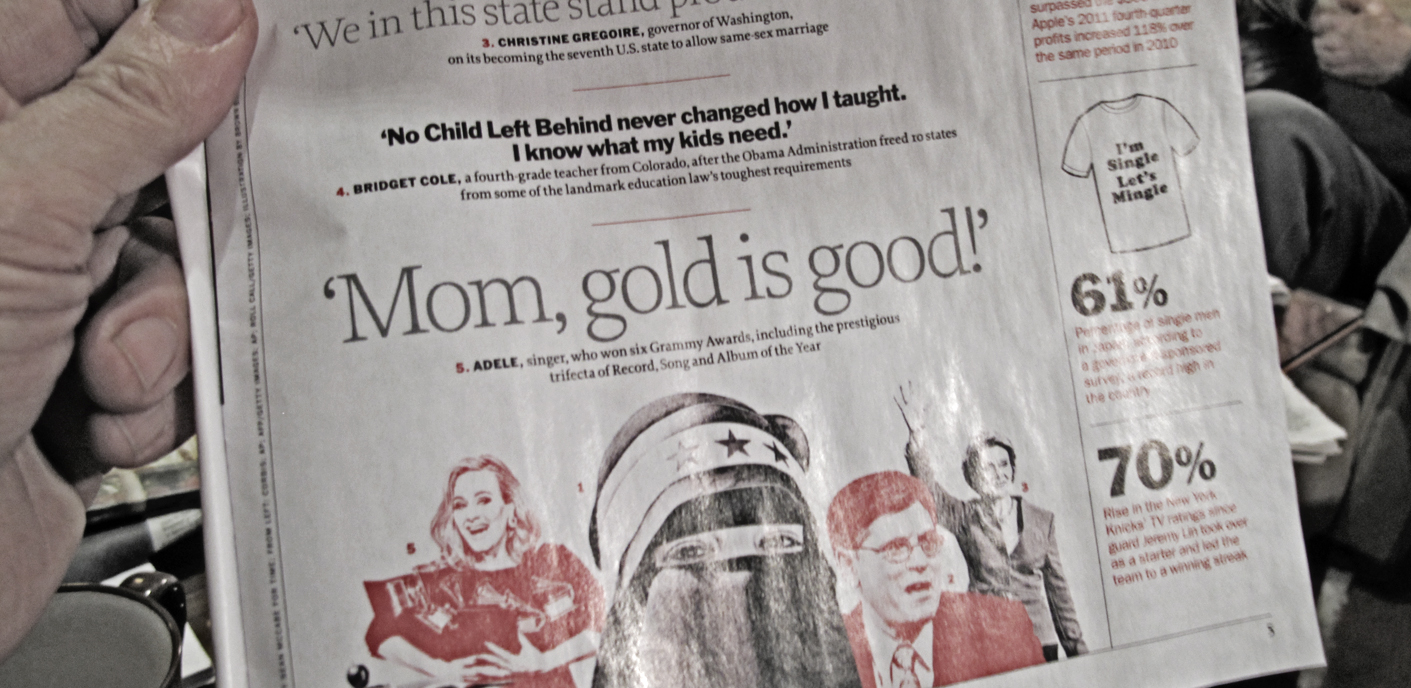
Phrase meaning: the difference between a performer’s singing and speaking voices. Example: “there is no Adele Gap in the case of Leonard Cohen.” See TIME magazine mishearing of Adele Grammy exclamation “Mum! Girl done good!” below.