Five Things: Wednesday 25th September

I Liked This Painting

Laura

Glanced through the window of the Riflemaker’s Gallery – once the Indica Gallery where Yoko Ono’s show in November 1966 had one J.Lennon as a visitor – a rather lovely painting with stylistic echoes of John Currin. Take the Night off (Laura Marling) by Stuart Pearson Wright [oil on canvas, 2013, 60 x 40 cm].

I Liked This Email
From Our Woodstock Correspondent, John Cuneo:
“I thought of you after reading that lovely Springsteen/burger story on your blog, and then 20 minutes later when I went out for a walk and said hello to a passing David Sancious  (he of the early E Street Band, and, I gather, just back from the road touring with Sting). We were about  mile out from downtown, across the street from the Bear Cafe  (the restaurant that Albert Grossman opened) and right at the bottom of Striebel Rd (where Dylan had his bike spill). I’ve never spoken a word to the guy before, but there was no one else around and it would have been awkward to not acknowledge each other, so I smiled and blurted out a “Hello David”, as if we see each other every day. Being from Jersey, I feel it’s my inherited geographical privilege to refer to all the E St. members by their first name ( I plan to go with just “Steve”, not Little Steven, if the opportunity presents itself).

I Liked This Poem
Bob Johnson, at the end of the Another Self Portrait Short Documentary.
“Down the kerb and around the bend he came and
It’ll never end now because he’s been on this rollercoaster ride ever since he left Minnesota.
He’s been brutalised, sunrised, baptised in the waters of the Village.
Still it goes on, from Soho to Moscow to Oslo.
They speak of this trip, this battleship, who sailed in the harbour of Tin Pan Alley and sank it with his Subterranean Homesick Blues.
There isn’t but one Bob Dylan.”

BobAnd now Bob,
metalwork artist,
is Cold Irons Bound
(or, as the Guardian
would have it,
singing “Ballad of
a Tin Man“).

I Liked Seeing Jimmy Nail On ’Later’
Just after the Kings Of Leon had vied for the title of World’s Most Unexciting Rock Band (they looked to be boring themselves to death with the sludge coming out of their amps), it was excellent to spy Jimmy Nail (Spender!) singing backing vox for Sting, looking in great shape. I remember our friend Sarah doing the costumes on Spender, and saying that she was off to work with Jimmy again on a “Country-singing-Newcastle-Boy-goes-to-Nashville“ story and that they were searching for an American actress who could sing. I remembered “Too Close”, sung beautifully by Amy Madigan on Ry Cooder’s Alamo Bay soundtrack and gave Sarah the record to play to the director and producer. Lo, they hired her! I hadn’t realised (’til a quick search told me) that Amy had form: throughout the late 1970s she played keyboard, percussion, and vocals behind Steve Goodman on tour. Sting’s luxury brand of Steely Dan Light™ came dripping with expensive guitar playing, like so many Swarovsky crystals flung over a bolt of minor ninths and flattened fifths. It was the aural equivalent of a Gucci Ad. For songs about the shipworkers of Newcastle, that’s sort of weird.

I Liked Zigaboo Modeliste At The 100 Club
A party in the summer of ’75 in Kennington. My friend Mick Gardner commandeers the deck and puts on the newly released album by the Meters, Fire On The Bayou. The evening had been a whirl of great funk records but this topped them all, and I recall thinking I would never in my life hear something funkier than this. I thought of that night on Sunday, listening, or rather feeling, the viscerally thrilling drumming of Joseph Modeliste, the Meters drummer. It was a terrific show, presented with avuncular charm (should that be afunkular?) by a master. Mark pointed out that the band were obviously inspired by the girls joyfully dancing at the foot of the stage, rather than the less-well coordinated gaggle of middle-aged white men behind, offering a variety of dance styles that covered the waterfront. To be fair, it was impossible not to dance, such was the floor-shaking power of Zig’s snare and hi-hat. Most things that you wanted to hear were played (“Africa”, “Just Kissed My Baby”, “People Say”, “Hey Pocky Way”), each better than the last.

Five Things: Wednesday 18th September

Amy Winehouse Exhibition, Jewish Museum
A touching collection of the memorabilia of someone who died too young.

AmyOne of the records displayed, Sarah Vaughn’s The Divine One, still had its Record & Tape Exchange sticker. Starting at £10, by the time Amy bought it, the price was a bargain £3.

The songs our parents gave us, The Guardian
My favourite piece of writing here was Lucy Mangan’s: “Wichita Lineman” (the words of Jimmy Webb sung by Glen Campbell) had been playing in the background for years until one day when I was about seven or eight. I suddenly seemed to become old enough to hear, properly at last, one of my mum and dad’s favourite songs. The words didn’t make much sense at first – for a start, I would need Wichita, lineman and county explained to me once it had finished – but I could hear the… well, I would need a new word for that too, but a long time later I would come across “yearning” and be able to give a name to that strange ache the music produced in me.

From then on I played and replayed that record on my own account… I was in love – with the words now even more than the music (though in later years an ex-boyfriend would explain to me what every part of the latter was doing and why and how it was working all together to produce something even greater than the sum of its parts, which made me fall in love with him all over again). “I am a lineman for the county, and I drive the main road/Searching in the sun for another overload …”

It’s the sparest of songs – just 16 lines, 13 if you don’t count the repeated final verse – and it suited our family’s inexpressive collective temperament perfectly. Whatever damage I did to their enjoyment during those first obsessive months has since been repaired and now when we gather we will play it, and it alone has the power to still us all while we follow that battered stoic across the state and, separately together, indulge in a little vicarious longing of our own.

One Night In Soho: Part One
It started with Barney’s phone call to come see a screening of Inside Llewyn Davis, the Coen’s take on a would-be Folk Star in Greenwich Village, ’62. The night before I’d watched a Mastermind contestant do his Two Minutes on the LIfe and Work of Bob Dylan. He scores 13. I knew one he didn’t – the studio in Minneapolis where Bob re-recorded Blood On The Tracks (that’s Sound 80, pop pickers). He knew one I didn’t – the two books of the Old Testament that feature in the lyrics of “Jokerman” (that’s Deuteronomy and Leviticus, fact fans). And I screwed up an easy one, by interrupting and shouting Robert Shelton! when they asked about the night in the Village when Dylan was reviewed in the New York Times, when the answer was the name of the club (The Gaslight).

And the Coen’s film centres, dramatically, on that very night. Which made me wonder about the mainstream audience reaction to a film that turns on a concert review… The evocation of time and place is predictably good, and its sense of humour is not a million miles from A Mighty Wind, especially the hysterical record session where Justin Timberlake (half of folk duo Jim and Jean with Carey Mulligan) is attempting to cash in with an assumed name (The John Glenn Singers), and a Space Race ditty (“Dear Mr Kennedy”). The supporting actor casting is worthy of Broadway Danny Rose or Stardust Memories – extraordinary faces, pungent performances. Carey Mulligan rocks an acerbic fringe, John Goodman is monstrously withering, and Oscar David is really convincing as an almost-good-enough troubadour. If you know your Village in the early Sixties, go see it. If not? Not so sure. I’d be interested to know what an impartial observer would make of it.

One Night In Soho: Part Two
The restaurants of Soho seem to be having a Boogie/Swamp moment. If it’s not the Allmans and John Fogerty’s “The Old Man Down The Road” (ooo-eee – remember that? Creedence in all but name?) playing in ramen joint Bone Daddies, it’s Canned Heat at Pizza Pilgrims, which is where I found myself after the film. As I walked to meet Tim in St Giles, I passed this in Soho Square, screening off the Crossrail development. It seems that Dobells is unavoidable at the moment…

Soho

One NIght In Soho: Part Three
Tim’s spot, The Alleycat in Denmark Street, is a dive, in all the best senses of the word. Every other Tuesday, #4 on the door, and Paloma Faith’s Musical Director, Dom Pipkin, playing excellent Longhair/Booker piano, his keyboard sonically split, with bass in the left hand and electric piano in the right. Along with a drummer doing the right thing (staying on the hi-hat, not much cymbal action) and a lowdown trombonist, they make a holy noise. Dom’s dad is coaxed up for Doctor Jazz, N.O. style, before he and his wife head off for Wales, a man in a cap adds fine accordian, the young dudes in the audience groove, and we’re all happily transported to Claibourne Avenue and Rampart Street for a couple of hours. Catch Dom and The Iko’s on Sunday where they are promoting and supporting Zigaboo Modeliste at the 100 Club. I tell my mother about it, and she says that’s how it used to be, and so we make a date to hit The Alleycat some future Tuesday.

Dom

Five Things: Wednesday 11th September

Another Self Portrait Deluxe Edition: An Accountancy Issue
I – yes, yes, a Dylan Nutter™ – go for the one with the extra two discs and a couple of books. But wait! A 3-CD set of this ilk (we’ll ignore the remastered ‘Original Self Portrait’ Disc) would probably retail at about £19.99, say £23.99 if we’re being generous, with a fair sized book and box. We have to ignore the fact that I’d lazily thought it included a film of the Isle Of Wight Performance (not sure where I got that idea – I do have some video somewhere of a few songs). So then I’m thinking “Well, at least I have handsome books with wonderful liner notes and essays”. And one of the books has those things, by Michael Simmonds and Greil Marcus, and it holds the discs as well. But the other book is a bizarre hotch-potch of photo sessions from this period mixed with press clippings and foreign single covers. John Cohen is a good photographer (his Young Bob book is terrific, as is There Is No Eye), but his work is ill-served by reproducing repetitive and poorly-focused shots of a one-expression Bob. The reproduction looks cheap – flat and badly balanced –and Al Clayton’s Nashville black and whites really suffer. The proofreading is appalling – Jack Keroac, anyone? The guilty man is Bob’s house designer, Geoff Gans, a man who wouldn’t know a smart quote if it hit him. The production copyright credit reads: ©2013 Perceived Value Publications. I feel wound up – it works out that this extra book has set me back around £55. Can I Have My Money Back, Please Sir, as Billy Connolly and Gerry Rafferty once sang.

See the music player for a couple of versions that didn’t make the cut, but should have…

Hurry, Hurry, Buy Your Bob Dylan ’66 Tour Treggings Now!
Into Marks & Spencer, past the embalmed-looking Annie Leibovitz portraits of Britain’s great and good women (someone should be reprimanded for making the riverboat Helen Mirren look like she’s stepped out of Are You Being Served?, what with that jaunty cap and scarf). My gaze alights on a rack of these. The Dylan ’66 Houndstooth! As created by the Hawks’ favourite tailor in Toronto! If only they were for men (and came with a jacket) then my fashion decisions for Bob at the RAH in November would be sorted… Oh, and Treggings? A cross between trousers and leggings, obviously.

Bob Treggings

Ken Colyer visits Eddie Condon’s club, NYC, early 50’s
A great selection of Jazz photos from the 50s in colour, by Nat Singerman, runs in the New York Times Magazine. One of them shows Eddie Condon’s band.

Condon and Band by Nat; A table card that Ken had  autographed by Condon.

Condon and Band by Nat Singerman; A table card that Ken had autographed by Condon.

Around 1950, my uncle Ken was in the Merch and visited Condon’s club. He paints a vivid picture:
“I got washed and changed, once again forgetting that nightlife doesn’t start ’til later this side of the ocean. I shined my shoes and I was ready to go with my sub in my pocket. There were still four dollars to the pound. I had read about Eddie Condon’s club and heard their once-a-month town hall concerts on the BBC at home. I had no idea where the club was. New York is a big place. I saw a news-stand and asked if they had a Downbeat. “No, don’t you know it’s not due out ’til next week?” I didn’t know about the New Yorker then, which has an excellent section devoted to nightlife with Whitney Balliett’s pithy descriptions of each place and its style of entertainment. I walked on until I saw a cabby tinkering under the bonnet of his cab. “Do you know Eddie Condon’s club?”

“Hop in; I’ll be with you in a minute.” He didn’t want to lose a fare. I got in the cab. It had seen better days, in fact it was a wreck. But I didn’t mind as long as it got me there. I was sure I would find the place like a homing pigeon finds his home. The cabbie finally got the engine going and we started cruising.

“What was the name of that place?” I told him. “What sort of musicians play there?” “Jazz musicians.” “Who’s playing beside Condon?”

He’d got me there. I didn’t know Eddie’s present lineup. I mentioned a few names, then Pee Wee Russell. “Pee Wee, he’s a friend of mine, know him well. I took him for his medical when he got drafted. He told me to wait; he was only gone ten minutes. They threw him out because he was seventy proof. Now I’ve got an idea it might be the old Howdy Club. Used to be a burlesque joint, they’ve got these marvellous old dolls in the chorus line, not one under sixty. Want me to try there?” he asked, eyeing the clock.

“Go ahead,” I said. We drove into Greenwich Village, turned a corner and there was the ‘mutton chop’ sign David Stone Martin designed for Eddie hanging over the entrance. I was elated. I gave the cabbie a generous tip. He told me not to forget the address: West Third Street. Before he pulled away he called: “Don’t forget to tell Pee Wee his old friend Al brought you here. So long, pal.”

There was a commissionaire in livery standing by the door looking dignified. He saw me reading the board. “Are all these people playing tonight?” “Yes, but it’s a little early yet. They don’t start playing ’til nine. Why don’t you go to that little bar down the road and have a drink. Come back about eight-thirty and you’ll get a seat right by the band.”

I said, “Thanks, I will.” He was no hustler. I found out later that Eddie wouldn’t allow it. He had played enough clip joints himself and also considered it was important to encourage youngsters to listen to the music. And they turned a blind eye if you were obviously under age.

On each table was a small green card. On one side it gave the personnel: Pee Wee Russell, clarinet; Wild Bill Davison, cornet; George Brunis, trombone; Gene Schroeder, piano; Sid Weiss, bass; Maurey Feld, drums; Eddie Condon, guitar, and Joe Sullivan, intermission piano. On the other it proclaimed: “Jazz in its finest flower,” a quote from my favourite critic, Whitney Balliett.

As I sipped a beer the band turned up. George oiled his slide with an elaborate flourish, then the band kicked off. Within a couple of numbers they were playing with a power, swing and tonal quality I would not have believed possible. It struck me for the first time that the gramophone record is badly misleading when it comes to jazz. No recording could ever completely capture the greatness of this music. As each number got rocking I seemed to be suspended, just sitting on air. And when the music finished I flopped back on my chair as though physically exhausted.

The sensation I got from hearing Wild Bill for the first time was a sort of numb joy that such a man lived and played. If Louis Armstrong was better in person, then it was beyond my imagination. His teaming with Brunis heightened this reaction. When Edmond Hall took over from Pee Wee, playing his cutting electric phrases, it was almost more than I could bear.

Brunis was entertaining to watch. While playing excellent trombone, he constantly screwed his body into the most awkward-looking positions, sometimes jamming one leg against the piano. If there was a drunk in the room he would play snatches of I’m Forever Blowing Bubbles, or something equally appropriate, in the most syrupy manner, during the breaks, then crack back in with glorious golden-toned tail-gate.

Pee Wee, with his broken comb moustache and a slightly distant look in his eyes, was also entertaining. I was told he had a select band of fans, who follow him mainly to watch his weird expressions that contort his face while he plays. Also he is a little eccentric and difficult to get to know, but if you knew anything about poodles, he would open up and be friendly.

As nightclub prices go in New York, Eddie’s were very reasonable. But I still had to make every beer last as long as I could. The waiters didn’t like this too much. The first night I left comparatively early. I felt a little sick but hadn’t drunk very much. It was the emotional impact that was making me feel groggy. The old Negro toilet attendant was sympathetic and understanding. That’s OK, son, I know how it is.

David Bailey Names Exhibition After His Favourite Song, ”Stardust“.
I work my way through all the versions I own. Top of the pops: Larry Adler’s fabulous harmonica, alternately shuddering and gliding over the timeless Hoagy Carmichael melody. And of course, the fantastic scene in Woody Allen’s Stardust Memories where he eats breakfast as Louis Armstrong plays his giddily great take. As the instrumental first half unwinds, Sandy, played by Allen, talks: “It was one of those great spring days, and you knew summer would be coming soon… We came back to the apartment , we were just sitting around and I put on a record of Louis Armstrong, which is music that I grew up loving, and it was very, very pretty, and I happened to glance over and I saw Dorrie sitting there… and, I dunno, I guess it was the combination of everything – the sound of the music, and the breeze and how beautiful Dorrie looked to me and for one brief moment everything seemed to come together perfectly and I felt happy, almost indestructible, in a way…” and Charlotte Rampling fixes the camera with one of cinema’s greatest stares, as Armstrong’s vocal comes in, singing and scatting Mitchell Parish’s words, giving the merest approximation of the actual lyrics. And then it cuts to the cinema audience watching it, split between a woman saying, “That was so beautiful”, and another shouting, “Why do all comedians turn out to be sentimental bores!”

Rock Murals: Are They Ever A Good Thing?
Seen near our new offices, off Carnaby Street

Carnaby

Five Things: Wednesday 4th September

Aerophones & Drones
Have you ever been in a small room with a bagpiper playing full blast? Actually, that may be the only way to play them – there’s nothing tentative or half-throttle about the mechanics of the bagpipe. The noise is utterly overwhelming, a melodious fire alarm, a wailing mourner. At the funeral of a great friend of my mother’s – a proud Scotswoman – the piper played the most melancholy air, and it was startlingly moving. He walked up to the coffin, executed an about turn, and headed out of the small chapel still playing, the pipes fading into the distance as he strode off…

Nutters & Jazzers
Asking for The Bootleg Series Vol. 10 – Another Self Portrait at HMV, I’m informed that they sold out as soon as they arrived. “All those Dylan Nutters”, I’m informed by the friendly man at the desk, which I guess means that he [generously] doesn’t number me amongst them. Reminds me of standing in the queue at Ronnie’s for the Booker T Q&A when a guy comes up and asks what the line is waiting for. When told, he says, “Thought it looked like a Jazz Queue”.

And Talking of Portraits: Bob Dylan Pastels, National Portrait Gallery
Bob’s strange jagged faces, rooted in the FSA photographs of the depression, are mostly quite poor. A few have something more going on – but there’s nothing, really nothing to get excited by. For that you have to see the other musician exhibited at the NPG. A room down from Dylan is a portrait series by Humphrey Ocean, who some may remember as the bass player in Kilburn And The High Roads, Ian Dury’s first foray away from art and into rock. Ocean’s paintings of friends, sloppy gouaches that somehow capture expression, tilt and attitude, are wonderful. This is a properly arrived-at style, whereas Bob’s, one feels, is still on the road.

In A Silent Way
My friend, photographer Bob Gumpert, gets a gig shooting 2 Chainz, a rapper, and finds he enjoys it. He sends the last paragraph of this piece – about crowded, loud clubs – by British poet, writer and explorer Robert Twigger (who lives in Cairo), in Aeon Magazine. I look up the article and it’s great. Some excerpts:

“A film director once told me that shooting exteriors in Cairo is a nightmare. Often they fake it, using Tunisian locations instead. The reason is the sound: the hum, they call it. You get it even if you shoot at 3am on Zamalek island, the wealthy garden district in the middle of the Nile. It’s the aural equivalent of smog; hardly noticeable at first, not a problem for many, but insidious, worming its way inside you, rattling you, shaking you up like a cornflake packet. Your contents never settle. Someone told me a story about a man who bought adulterated cocaine. A flake of aluminium sulphate lodged in his sinus and burned a hole right through his skull and into his brain. I pictured Cairo’s hum as a slow acid eating its way through the fragile bones of the ear, into the cortex.

As you get older you value silence more. Your nerves get jangled more easily. Loud music becomes less and less attractive. Instead of wanting to rev up, you seek ways to calm down. But I suspect the search for real silence goes deeper than just a desire to relax. It’s no accident that many religious orders have vows of silence. Only in silence can the soul unburden itself and then listen out for subtler signs, information from the unknown inner regions.

How much silence does a person need? You can get greedy for it, addicted to it. I know people who spend half their time in the desert and the other half working out how to get back to it. They are running away from life, some say; they are certainly running away from noise. Recent research suggests that long-term exposure to noise doesn’t just damage hearing (and the average decibel level in Cairo is 85, often getting to 95 and higher, which is only slightly quieter than standing next to a jackhammer); it damages your heart. Continuous noise causes chronic stress. Stress hormones become your constant companion, circulating day and night, wearing out your heart. That must be why the first few days in the desert seem so wonderfully rejuvenating. I’ve seen an elderly man — a retired heart surgeon, coincidentally — go from doddering around the camp to springing along the edge of dunes and rocky cliffs. That’s the power of silence.

You know you’re cured when you relish the sound of loud pop music again. Crowded clubs hold no fear; the pumping bass seems like a familiar friend, not a message from the Antichrist. You can ‘take it’. Modern life is ‘OK’. You’ve detoxed and the result is that you seem more youthful. Young people haven’t filled themselves up with noise (yet), so they actively seek it out. For those who have had too much, then emptied it out, the glad return to a noisy world is invigorating. How long does the immunity last? About two weeks, if you’re lucky”.

All Aboard! If you remember The Vengaboys, that is…
The brilliant Tom Scott, web thinker with a comedic bent, defaces a london bus timetable in some style. I really want to visit the Curaçao Spaceport…

Vengabus

See also Two Drums and a Cymbal Fall off a Cliff (b’doom, tssh).

Five Things: Wednesday 28th August

Simmy Richman interview with Stephen Stills, The Independent
Is it true that you play percussion on the Bee Gees’ “You Should Be Dancing”?
We were in the studio next door making a CSN album and David was all full of himself and saying this is going to be the album of the year. I went, “No it’s not, that’s being recorded across the hall,” cos I’d heard some of that Saturday Night Fever stuff and I knew it was totally unique and going to be a monster. So I played timbales and for a long time that was my only platinum single.

You have a reputation for sometimes being short with journalists…
I had a torturous day in New York one time where someone had fed a writer this thing that I had tried out for the Monkees and failed. The truth was that I wanted to sell my songs to a hit TV show to make money. The thought of being a pretend Beatle on TV was so appalling that I couldn’t imagine it, but I went down and said I know a kid, and I sent them Peter Tork. This journalist kept saying, “But they turned you down right?” I was like, “You’re not getting the point.” So I ended up going fuck you! Often the journalist has already written the piece and all they’re looking for you to do is to confirm their obnoxious preconceptions. There’s a point where you just go – fuck fame, fuck being famous, fuck being a celebrity, fuck this. I’m a fucking musician. Take my picture and make it up.

Thanks for not being like that with me. That was an absolute pleasure.
It was. I love that I talked about all the things you were warned not to talk to me about. High fives on that!

Bruce Springsteen I
Daughter sends link to this very sweet blog entry, and while I have issues with the design aesthetics, the tale itself is funny and heartwarming.

Bruce Springsteen II
Then my inbox pops up with: “Springsteen: Saint In The City – this book covers the year from Springsteen’s birth to 1974,  the year before his breakthrough album Born To Run”. Personally, I like the ‘about the author’ bit: “Craig Statham has an MA in History from the University of Edinburgh. He currently works for East Lothian Council and has previously published four successful books on local Scottish history. The author believes that to fully understand Springsteen’s recorded work it is necessary to understand the formative years that shaped him. It covers: The genealogy of the Springsteen family from earliest times; his relationships with his managers – how whenever success beckoned he would move in a new direction; the development of his drive to sound like Van Morrison and Joe Cocker (in the Bruce Springsteen Band); the fight to get support from Columbia Records and how the musicians changed the rules to all-night Monopoly sessions”.

Heard And Seen at the at the Zoological Museum
Artist in museums. Not sure that they really work, and feel they’re always overshadowed by the exhibits. So poor Sam Risley Billingham is onto a hiding to nothing with his “Structurally amassed beat-mix soundscape” when up against A Jar Of Moles.

Zoology

Guardian Fashion

Bella

Can anyone explain this particular bit of fashion to me? And why poor Anastasia has been forced to a) stand like that, and b) wear ‘cute’ animal ears. In the meantime, I’ll look forward to the Gil Scott Heron one.

Five Things: Wednesday 21st August

Booker T Jones, Ronnie Scott’s Q&A, Saturday Afternoon
I ask how come Booker T played bass on “Knocking On Heaven’s Door”. He replied [spoken in the soft but strong voice of a man who thinks before he speaks]: “In my community, out in Malibu, musicians would very often stop by, and one of them was Bob Dylan. He would come, and bring an acoustic guitar or play one of mine and play his songs… try out his songs on me. In my little studio. Bring his electric guitar, plug it into my tape recorder, which I never thought to turn on (as he says this his eyes widen slightly and he smiles to himself – the audience cracks up). Anyway, he was working on this movie with Jason Robards and Sam Peckinpah and thought to ask me to come play bass with him on that song, late one… late… early one morning, so we went out to Burbank and recorded that. I was a bass player from the beginning – that was how I made my living. I started out at the Flamingo Rooms. I was known around Memphis as a bass player, just happened to play the Hammond because of “Green Onions” at Stax. At heart, I still have my bass”.

Bob Dylan, “Went To See The Gypsy”, Another Self Portrait
Streamed by The Guardian, and the only track I’ve heard so far, this demo version of an (imagined?) visit to see Elvis in Vegas is like a stunning precursor to “Blind Willie McTell”. Dylan doesn’t seem to have yet fixed the melody in his mind but the passion of the performance carries it to a wonderful outro where the guitar accompaniment (David Bromberg, I’m guessing) is fantastic, like Robbie Robertson on “Dirge” or Mark Knopfler on “Blind Willie”.

The Conventions Will Apply
That awful blight of current TV programmes – they spend the first ten minutes telling you what the other 50 will consist of – reached a nadir with the documentary on Fairport Convention. A series of talking heads said “they changed English Folk Music” fourteen different ways, as did Frank Skinner on the voiceover (and over). None of the unthrilling footage of the current band trundling around in coaches and playing was doing the job, so they must have figured we’d better tell the viewer how great and influential they were. What turned out to be an interesting programme with some neat footage was ill-served by the turgid and off-putting start. Film makers don’t do that kind of thing. They generally trust the audience. It has to be the dead hand of the commissioners.

An Olympic Night
Evening Standard: “A former London recording studio where everyone from Jimi Hendrix to the Spice Girls made albums is to return to its original life as a cinema. Olympic Studios in Church Road, Barnes, will reopen on October 14 with two screens, a café and dining room and a members’ club, after local businessman Stephen Burdge stepped in to save it. One recording studio will remain in the basement.”

In the 70s, Tony’s mum’s friend says that he runs Olympic Studios. We’re 16 years old. We believe him. Why would he say it if it wasn’t true? So we go along one evening and he lets us in. I have a very vague recollection of creeping around on a balmy night, trying not to be conspicuous. I email Tony and ask him who we saw recording and he says: “Colin Skeith let us in. He claimed he ran the place but was, in fact, merely the raging alcoholic janitor. We saw Rod Stewart, Pete Townsend and a very angry Leslie West!” Tony is unforthcoming on why Leslie West was so angry. If you don’t remember Leslie West, he was a great ‘Rock Guitarist’, most famously in Mountain, with Felix Pappalardi on Gibson EB-1 violin bass. Check out their version of Jack Bruce’s “Theme From An Imaginary Western” on the Woodstock 2 soundtrack. Still sounds great.

As Seen On Twitter: Don’t Diss Vanilla Fudge

RWIP

Five Things: Wednesday 14th August

Nice Promo For The Blind Boys Of Alabama
Their new album, produced by Justin Vernon (Bon Iver) sounds pretty good from the clips. Listen out for Shara Worden singing “I’ll Find A Way”, written by Motown guitarist Ted Lucas (no, me neither) that in the short clip sounds just great. Vernon has taste in female singers – his cover of Bonnie Raitt’s “I Can’t Make You Love Me” testifies to that – and I’ll give him the benefit on his hyperbole about Worden. There’s a touching moment where Shara plays the finished item for Ted’s widow and rushes for the tissue box.

True Say, Will!
“Sometimes a band arrives and becomes extremely popular without good reason. Who are the million people who bought the debut album by White Lies, the trio from Ealing in West London? And who are the ever-growing hordes piling into arenas to hear their polished but unremarkable pop-rock? What do they hear in White Lies that can’t be heard from any number of Eighties-influenced bands, or indeed on albums by actual bands from the Eighties? Perhaps the answer is in White Lies’ ability to make euphoric, reverb-drenched, large-scale music that hints at dark edges but doesn’t actually have any, thereby making the listener feel they might be exploring hidden depths without running the risk of being exposed to anything challenging or depressing… and lyrics that suggest something meaningful without containing too many specifics that might alienate potential listeners.” Will Hodginson, The Times.

Urban Proms, BBC/Coolio’s Cash
The Urban Proms was pretty good musically, although most of what I saw cleaved to the Coolio template of “Gansta’s Paradise”, namely hip hop/rap/grime/whatevs with, er, a string section. But the between-songs links were crucifyingly embarrassing. I Name and Shame: Sarah-Jane Crawford (BBC Radio 3) and Charlie Sloth (BBC Radio 1Xtra). Unbelievably bad, with Sloth a kind of lightweight, unfunny James Corden. I know. Imagine that. By the way, if you want to profit from “Gansta’s Paradise” go to the Royalty Exchange where $140,000 will get you a cut of Coolio’s copyrights. I seem to remember this idea not panning out so well for David Bowie’s investors a while back.

Karen Black, RIP
I’ll always treasure her Rayette in Five Easy Pieces, loving Tammy Wynette with all her heart. First seen as a late teen in a Stockholm Cinema in the afternoon, told by friends that it couldn’t be missed, and they were dead-on. Even now ”Stand By Your Man” gets me, with its strangely off-beat army of acoustic guitars punching home the chorus. Ryan Gilbey, in his Guardian obit, wrote well:

“These parts were strikingly different from one another, but they had in common Black’s knack for conveying her characters’ rich and troubled inner lives, their cramped or thwarted dreams. The consummate example could be found in her Oscar-nominated performance as Rayette, the Tammy Wynette-loving girlfriend to Nicholson’s discontented antihero Bobby Dupea, in Five Easy Pieces. There was a comical but achingly sad intellectual gap between the two. Bobby resented her. Crucially, the audience never did. “I dig Rayette, she’s not dumb, she’s just not into thinking,” said Black in 1970. “I didn’t have to know anybody like her to play her. I mean, I’m like her, in ways. Rayette enjoys things as she sees them, she doesn’t have to add significances. She can just love the dog, love the cat. See? There are many things she does not know, but that’s cool; she doesn’t intrude on anybody else’s trip. And she’s going to survive.”

Southcliffe
Wonderfully nuanced use of sound in this slightly pointless mass-murderer tale. The amped up folk band in the nightime town square are all bass and a tiny bit of vocals, Otis and James Carr on the car stereo sound exactly right, the metal band in a bar is as muffled and chaotic as it would be in life. Bass thrash, guitar blur, gruff vox. The Pretenders’ “Brass In Pocket” in the pub makes you remember what a great and unusual song that is.

“Got brass in pocket
Got bottle, I’m gonna use it
Intention, I feel inventive
Gonna make you, make you, make you notice

Got motion, restrained emotion
Been driving, Detroit leaning
No reason, just seems so pleasing,
Gonna make you, make you, make you notice”

Extra: Deke’s Car. Sunday. Definition of Rock (abilly) ’n’ Roll

Belair

Five Things: Wednesday 7th August

Selfridges Shoe Department
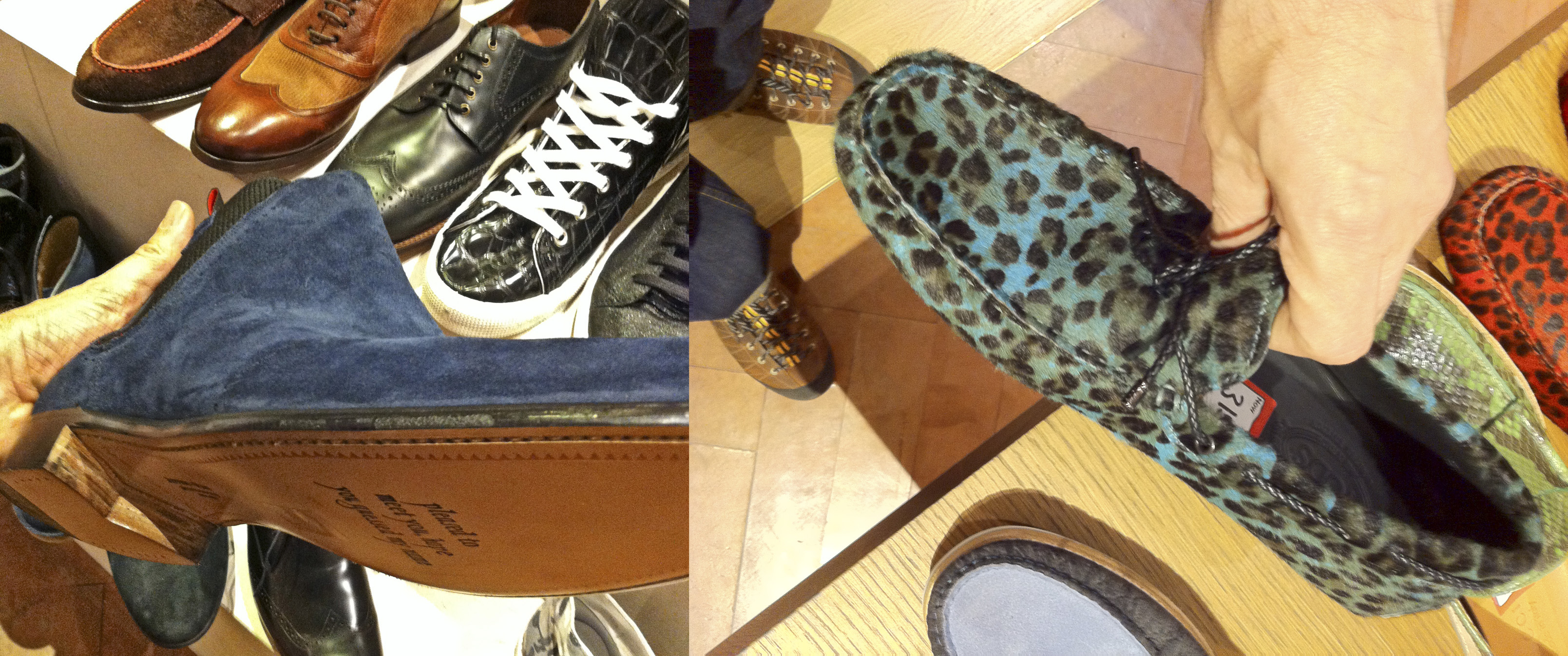
Blue suede shoes by Jeffery West, with the deathly “Please allow me to introduce myself…” line that we can’t seem to avoid, engraved on the sole. And don’t you step on my blue leopardskin shoes, either. {fyi: Both remained unbought.}

Blue SuedeFavourite Song Of The Summer (so far)
Lana Del Rey has covered Nancy Sinatra and Lee Hazlewood’s 1967 track ‘Summer Wine’, (“Strawberries, cherries and an angel’s kiss in spring/My summer wine is really made from all these things”) with, appropriately, her boyfriend – Barrie-James O’Neill of Scottish rockers Kassidy – stepping into Lee Hazlewood’s cowboy boots. It’s bass-heavy and groovy, with gloriously woozy backing vox. It ends with a distant peal of thunder, a snatch of Billie Holiday, some chattering and some beachside noises. In a great piece of iPhone synchronicity it merges into the start of Kevin Ayers “Song From The Bottom Of A Well” with its treated guitars and booming noises (sounding exactly like the song’s title) static-ing between the speakers like some early version of Scott Walker’s Drift.

Underneath Putney Bridge, Sunday

FormbyUkelele practising/busking.
We do a quick duet on
”I’ll See You In My Dreams,”
the Isham Jones/Gus Kahn
tune from 1924 that
Joe Brown played to close
the George Harrison tribute
concert in 2002.


Missive from Tim, RE: The Alleycat
”Just to let you know the Iko’s New Orleans Music Shop at the Alleycat is fab. The excellent house band played tunes by Champion Jack Dupree, Professor Longhair,  Jelly Roll Morton, the Band (”Ophelia“) and more. The jam session that followed was of an amazingly high standard and the vibe was all-inclusive, everyone from twentysomethings to pensioners, dreads to suits. I had to drag myself away at midnight to catch the tube, though apparently they carry on to 2am…“ From the venue website: The Alleycat sits just beneath the fabled Regent Sound Studios which was set up at 4 Denmark Street in 1963. With the Rolling Stones recording their first album here, The Kinks recording ”You Really Got Me”, Black Sabbath recording “Paranoid” as well as many other seminal moments of music history, the studio took off as the place to be seen to be making music.

Late Afternoon, Tottenham Court Road
Have Mercy

Taxi advertising my friend MJ Paranzino’s choir, quite possibly a first in choral advertising, swiftly followed by a roller-derby flash mob gyrating to “Disco Inferno”, blasting from a tricycle with giant speakers. We once worked with the co-writer of DI, Ron “Have Mercy” Kersey, cutting a version of Willie Nelson’s “Crazy” in LA. Ron was fabulously louche, feet on the control board as he lazily played the bassline on a synthesiser, gassing and joking with his engineer, the wonderfully named Hill Swimmer. My memories of the session are of Mark playing the most beautiful Reggie Young-like parallel fourths to the general amazement of the studio gatherees, and Ron asking where the hell he’d learned to play like that, and if he was available for sessions. And of sitting against the wall of the recording room as Alex Brown (Ron’s partner and genius vocal arranger/songwriter for the likes of Anita Baker and Whitney) and her girls sang the backing vocals. What on the record sounds sweet and swooping was delivered to the microphones at an ear-bending volume and hair-raising power. Heather and I stepped back into the control room, emotional and speechless. Ron then had an acetate cut and took us to his local bar, where he would play stuff he was working on to the patrons, for feedback! I can see him there, sipping a gin and tonic through a thin black straw, laughing, enjoying their bemused reaction.

Five Things: Wednesday 31st July

Everyday I Have The Blues…
Or everyday that Richard posts, anyway. And in a good way. Not to be bossy or anything, but you really should all be following thebluemoment, for the way Richard Williams illuminates popular (and some other kinds of) music with a lucidity that shines out of the computer screen. This week, one of the things that propelled him to the keys was Frances Ha. “It’s not often I want to get up and dance in the aisles of a cinema, but that’s how I felt halfway through Noah Baumbach’s Frances Ha the other night, when David Bowie’s “Modern Love” erupted out of the speakers. I’ve never been keen on Bowie (although I admire the stuff from his Berlin period), but “Modern Love” is one of those tracks — like Boffalongo’s “Dancing in the Moonlight”, Danny Wilson’s “Mary’s Prayer” or the New Radicals’ “You Get What You Give” — that automatically quicken the heartbeat and turn the world’s colours up a shade. It doesn’t matter who it’s by. Listen without prejudice, as someone once suggested.”

Last Night I Had A Dream…
…in which Bill Nighy suggests I listen to the music of GT Moore and the Reggae Guitars. Strange.

Neil, hung
NeilHanging Henry Diltz’s beautiful photo of NY at Balboa Stadium in 1969 (bought at a strikingly strange auction after a showing of Legends Of The Canyon), I put iTunes on a random Neil Young playlist and it threw up something I had never heard (let alone knowingly owned). It’s from the Citizen Kane Junior Blues bootleg recorded at the Bottom Line in New York in May, 1974. Young was there to see Ry Cooder – and was so inspired that, when Ry had finished, he got up on the stage and played for an hour. Most of the material was unknown to the audience, being from the as-yet unreleased On The Beach. “Greensleeves was my heart of gold” sings Neil, before talking amusingly about depressing folksingers… Hear it in the music player to your right.

Now That’s a Record Cover
H HawesFrom London Jazz Collector’s blog, the moody Hampton Hawes, caught in a great sepia mood. And look at its recording venue: Live at the Police Academy, Chavez Ravine, June 28, 1955, Los Angeles, CA. In related news; if you can, look up a copy of Ry Cooder’s Chavez Ravine, a concept album which tells the story of the Mexican-American community demolished in the 1950s in order to build public housing, which, this being LA, was never built. Eventually the Brooklyn Dodgers built a stadium on the site as part of their move to Los Angeles. Fantastic music, especially good on hot summer days, with fine guest vocalists and astonishing percussion.

Best. Busker. Ever.
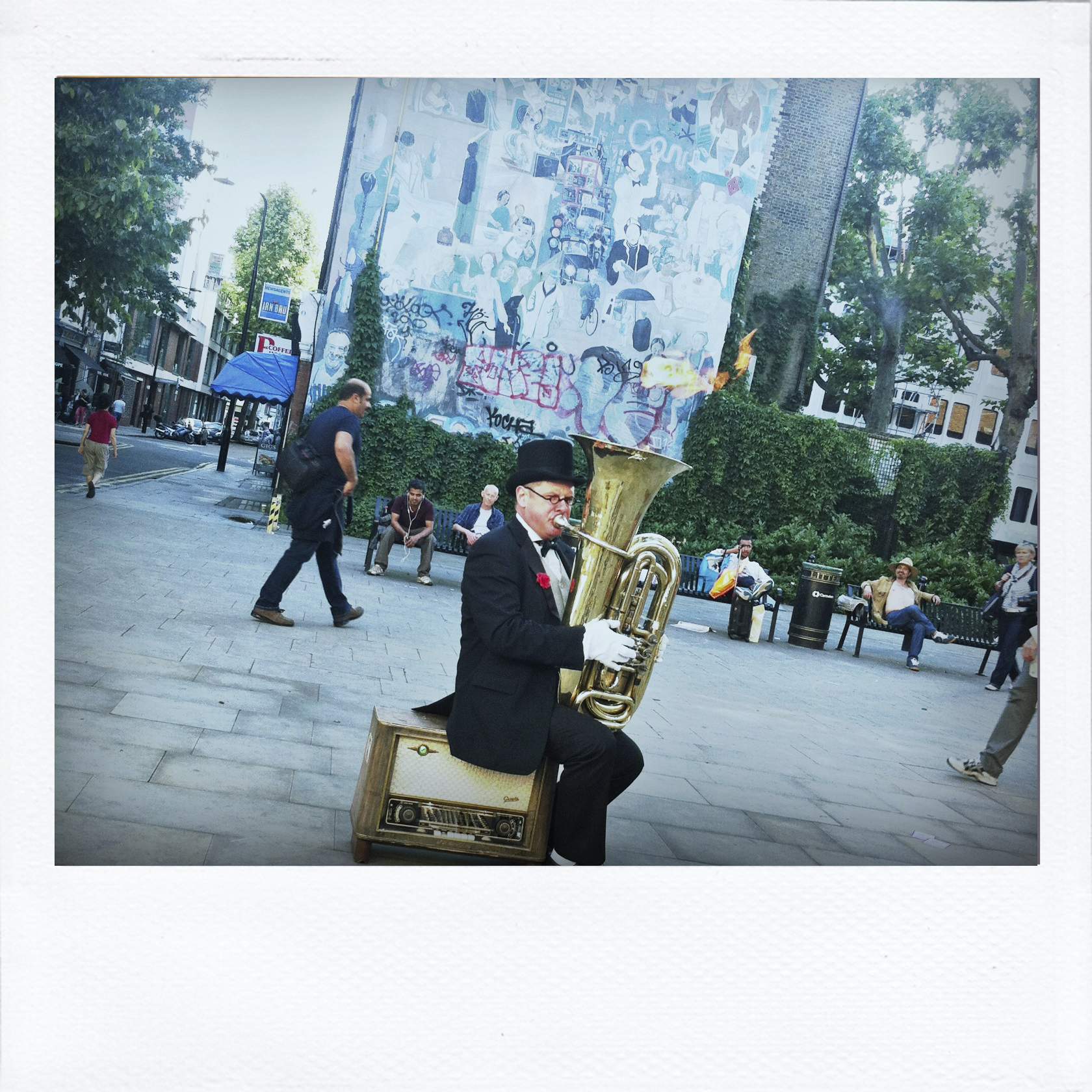
Donovan (“Sunny Goodge Street”) meets Arthur Brown (“Fire”)  at twilight by the American Church.

Tubafire

One Thing: Wednesday 24th July

Consumed by moving house, saying goodbye to the loft, some nostalgia…
so only this pic this week, of the loft wall, if you’ll indulge me. Normal service resumed next week.

Loft

Out Of Left Field
Ken at the 51; Skiffle Group – Ken, Alexis, Lonnie, Chris, Bill; a ticket for the Rock Island Line; Bill’s old mucker, stride great Ralph Sutton; Ken with Sister Rosetta, photographed by Terry Cryer; on the beach at Malibu and on Jimmy Johnson’s car, Muscle Shoals; Bob Mitchum and Jane Greer still from Out Of The Past.

Stuck In The Middle
MLK glasses , watch and radio; Bob in studio, 1965, by Daniel Kramer; Sonny Terry & Brownie McGhee, signed to Bill; Buddy Guy & Junior Wells, 1970; Wayne Miller photo of couple, as used on Hot House cover; George Lewis applauds, by Terry Cryer; my photo of Joni Mitchell watching Neil Young at Mariposa Folk Fest, Toronto, 1972, 100 Club matches, Armstrong and Django memorabilia.

Right In Time
Mr Cohen by Mr Antonio Olmos; Muscle Shoals sign; Mark at the Wurli in the studio in the Shoals; Bill in Hamburg, 1955; Motor racing at Crystal Palace, early 60s; reprint of Monterey Pop poster.