Extra! Woodstock Mania, part 2

Woodstock Two Full Tilt, Theatre Royal, Stratford East
So, a few days after The Last Waltz revisited we head to the the theatre to see Full Tilt, a musical play about Janis Joplin, who was of course managed (as were The Band) by the Squire of Woodstock, Albert Grossman.
“On stage a woman stands, the greatest rock singer of her generation. Behind her is the hottest band that a record company can buy. In front of her, an audience of thousands of expectant fans. She is Janis Joplin. She is utterly alone.” So, it’s pretty much a salty monologue with a band for the performances. There are a few scenes where other characters – a night desk clerk, a road manager – intrude, but it’s pretty much Angie Darcy’s show as Janis. The musicians who make up her band (Big Brother in parts, Kozmic Blues at others) are some of Scotland’s finest – guitarist Harry Ward, Andy Barbour on keyboards, bassist Jon Mackenzie and James Grant on drums. The simple set, not much more than a dressing room, may be underpowered, but it’s the only thing that is. By the end we (wife, mother, daughter) have winced at the sad facts of a life shaped by bullying, heartache and drink, have heard the word “Maaaaann”, drawled at least 150 times, and had the roof raised by a bravura performance of “Piece of My Heart”.

Woodstock Three Small Town Talk launch, Rough Trade East

A few days later, it gets more Woodstock-y at Barney’s reading – with guest, Graham Parker – to launch his new book. Recommended for its fascinating portrait of a small town unique in American music history, the book has a lot of time for the less famous among its denizens – Karen Dalton, the Muldaurs, Bobby Charles, Paul Butterfield and the floating pool of musicians who would come to define East Coast Americana. Graham Parker, who lived in Woodstock for a while, told us of his most memorable musical moment there: “I had the extraordinary experience of working with Garth Hudson, which was a full-day experience, for three songs… he fell asleep at one point, then he woke up and said, “Where did all these women come from?” There was just me and the engineer… [Garth has a narcoleptic condition]. We’d agreed on a fee – and he beat me down by a thousand dollars at the end! “Uh, that’s too much…”

Extra! Woodstock Mania, part 1

In the lead up to a trip to the States (that would include lunch in Woodstock with this blog’s local Correspondent), a series of random events coalesced around the subject of that small town in the Saugerties. So with three weeks to go ’til we left, we started with this…

Woodstock One The Last Waltz Recreated
An Irish group, called “The Group”, bring a show they have done for a few years now to London for the first time. In it “The Group” play most of the songs from The Last Waltz, the movie of The Band’s swansong concert. 
Tim sees a small listing in Time Out, and a few days later we find ourselves (Tim, Alison, Alex and me) at the Islington Assembly Rooms watching a live concert that is a tribute to a movie that was made about a live concert.

lastwaltz

The picture shows Winterland, er, Islington. From left, Unknown, Ronnie Hawkins, Rick Danko, Neil Young, Van the Man, Robbie Robertson (obscured), Bob Dylan, Eric Clapton, Neil Diamond (and Muddy Waters), Joni Mitchell and Paul Butterfield. But I’m sure you could tell that [click to enlarge].

The musicians all dress as the guys in The Band did on that night and they make a fair fist (Tim’s phrase) of the songs. There’s a horn section at the back, from which “Garth Hudson” steps out to take a couple of sax solos. They’ve got the moves down, from Robbie Robertson’s flailing hand shtick while soloing to Rick Danko’s bobbing and weaving (the bass player is pretty uncanny, actually, musically as well as visually). Behind them a very poor presentation of bad graphics and clips from the film is run from a Windows Laptop (boys! Really…). It’s great to hear the songs played well, although you can never quite shrug off the Tribute Band™ feel.

The revolving guest artists (who ranged far and wide at the The Last Waltz) are played by a motley crew. To actually convey how strange this whole thing was, I will just tell you that the same person played both Neil Diamond and Muddy Waters. Diamond spot on, Muddy, well… less spot on.Thankfully, we were spared “The Staples” singing “The Weight”. Eric Clapton was played by a very short older gent with a silver grey afro, who virtually had to be restrained from “Clapton-ing” everything he played on after “Farther On up the Road”. As the entire audience roared the chorus of “The Weight” back at the stage it was hard to tell who was in charge of the whole thing – the band or the crowd, a fair proportion of whom appeared to be friends of the group. Whatever, it made for a fitting end to a mad celebration of a unique event.

Woodstock Two Full Tilt…
follows next week.


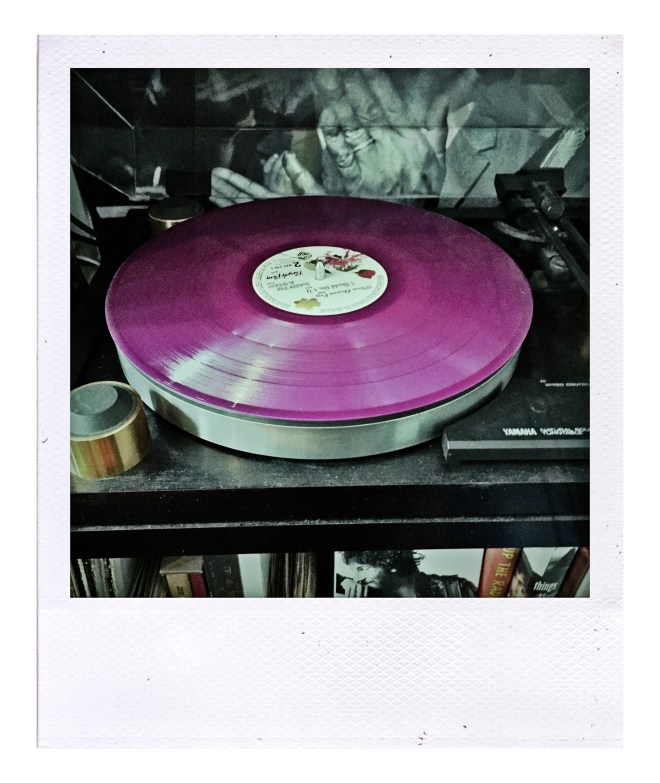
Extra, April 22nd: Gotta Broken Heart Again

purple


Thursday, January 14th. Five Things that I Didn’t Write About in 2015, Part Two.

BREAKING BLING
In a distinguished lineage that includes Peter Sellers doing “A Hard Day’s Night” in the style of Richard III, and Burt Lancaster fronting The Highwaymen, intoning “The Birdman of Alcatraz”, we have Actors meeting Song, in this case, Drake’s “Hotline Bling” narrated by Bryan Cranston (amongst others). Enjoy.

FAVOURITE SONG I HEARD AND THEN SET OUT TO TRACE…
A hot summer’s day and I’ve just parked the car in a side street in Walthamstow, about to pick up some pegboard that was being made up for me. Bleeding out of a car with closed windows is this great tune, with the repeated refrain – “I’ve got a girl on the other side of town, she’s waiting for me to come around…” There are those moments when a piece of music just seems so right for that time and that place. I motion to the guy inside and politely enquire if he knows who’s singing and what it’s called ­– but he doesn’t, although he agrees that it is a top tune. I find out a while later – Barry Boom singing Lou Ragland’s “Making Love”. It seems that it’s one of the best Lovers Rock tunes out there. It’s here, if you’re interested.

JAMIE XX – I KNOW THERE’S GONNA BE (GOOD TIMES)
It’s always nice to hear a sample of The Persuasions. Unfortunately, there’s not a lot about the rest of Jamie’s song that’s very interesting. I saw The Persuasions once at Gaz’s Rockin’ Blues in a ridiculously hot basement where the audience was on the stage with the group. Two feet from acapella doo-wop is a great place to be. Here’s their lovely version of Dylan’s “The Man in Me”.

And if you like that, this is my absolute favourite, a doo-wop classic, “Looking for an Echo”. What a cracking title – a phrase that sums up a lot of what life’s about. Written by a folkie [Kenny Vance] who acted – guest star on Kojak and The A Team, no less – its yearning and touching lyric hitting dead centre on that large nostalgia target…

And if we went to a party / and they wouldn’t let us sing
We’d lock ourselves in the bathroom / so nobody could get in
’Cause we were looking for an echo / an answer to our sound
A place to be in harmony / a place we almost found…

BEST ONE-STOP SHOP FOR CLASSIC JAZZ COVERS…
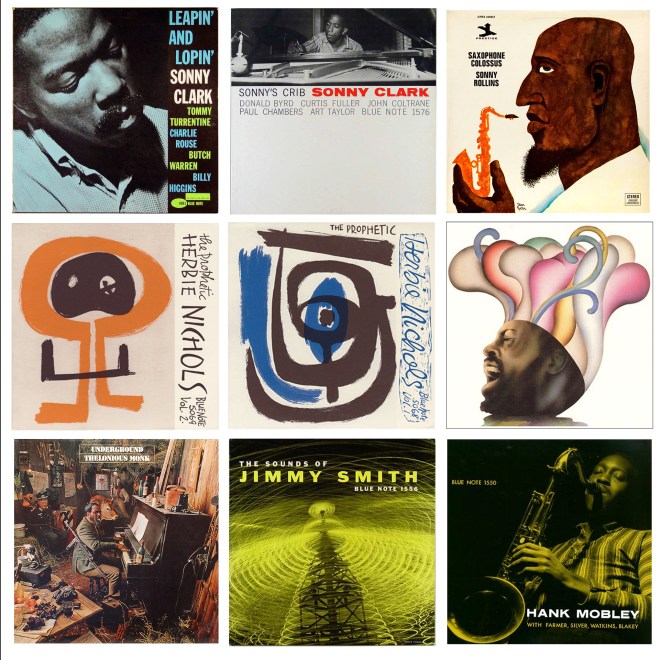
…was this post by London Jazz Collector. Virtually every major design style from the Fifties until now is captured in these stunning albums. As the man says… “These are my personal choices, you can see where I’m coming from. Portraiture cements the relationship between the musician and the instrument. Record = hearing, Cover = seeing, Great music, great covers, brings it all together.”

top-covers-late-entries2

ANOTHER TIME, ANOTHER PLACE
I love a story that dates time like this: “I started working for Selmers around the Truvoice/Grey crocodile era, and left around the grey/silver speaker-cloth era.” Just brilliant. This memoir by Patrick Kirby was found when I was looking for stuff on Selmer amps, whose store used to be at 114-116 Charing Cross Road. After talking about Teisco guitars (see earlier posts), Mark had mentioned that Selmer amps were really sought after as they were so amazing, and that he had once been the proud owner of one. Brett (Best Coast) had mentioned them too, so I realised that was why they now go for thousands instead of hundreds…

“My colleague in the Organ Salon was an unlikely chap called Ted Woodman, who was totally sold on Art Tatum. When I first saw Ted playing Jazz on organ I feared he was having an epileptic fit, or was on drugs… his eyes rolling as he writhed his arms over the keyboards, twisting and turning his legs across the massive 32 note pedalboard, swinging his head around dangerously. Soon after, having seen Alan Haven on TV with the Beatles, doing exactly the same thing, I quickly picked up the art and with the encouragement of a guy called John Bell, who ran the drum department (and was rather nifty with the skins himself), we were out playing jazz gigs in dodgy Soho clip-joints most nights, earning on average 10 shillings each a session (then fondly known as half-a-knicker).

“John and I used to beg and borrow keyboards from the store for gigs, but eventually saved up and bought a second-hand Lowrey Heritage organ from Selmers. I discovered some of the words to a Sergeant Pepper song written on the polished wooden top, and thought this was sacrilege until I found out from John that this was the organ that Selmers used to hire to EMI, Abbey Road! For Bob Dylan and The Band, appearing at the legendary Isle of Wight Music Festival, Selmer engineers took weeks customising a Lowrey H25 console organ. The result was the most amazing set of sounds you’ve ever heard.”

THE NOTE OF A ROOM
From a terrific interview with Richard Flanagan on Bookclub, R4. They were discussing his 2014 Man Booker Prize winning novel The Narrow Road to the Deep North, which is set among prisoners of war who were forced by the Japanese to work on the notorious Thai-Burma railway. He reads an excerpt where a widow is talking to her visitor about love:
“I have a friend in Ferntree who teaches piano, very musical she is. I’m tone deaf myself, but one day she was telling me how every room has a note – you just have to find it. She started warbling away, up and down, and suddenly, one note came back to us, just bounced back off the walls and rose from the floor and filled the place with this perfect hum, this beautiful sound, like you’ve thrown a plum and an orchard comes back at you. You wouldn’t believe it Mr Evans… these two completely different things, a note and a room, finding each other. It sounded right. Am I being ridiculous – do you think that’s what we mean by love, Mr Evans?”

Flanagan stops reading, and a member of the audience joins in: “Yes, I really noticed that passage in the book, ’cause I’m sort of a failed musician and I know exactly that feeling you get in a room when it just works right to play music in, and I thought it was a lovely metaphor for love, that I’ve never seen used elsewhere before, and I just wondered how you came to think about it…”

Flanagan: “I was drinking with some musicians one night and we ended in a wine cellar in Hobart, in a vineyard in Tasmania and they told me that every room has a note – and I’d never heard this before. Then they started ‘pitching’ their throats, going up and down the scales ’til they found the note of that room and then suddenly it all came back, and as a musician you know this, but I didn’t know it, and I cannot tell you what an extraordinary sound it is when you find the exact pitch of a room, and you hear it coming to you. The whole room thrums with it. It is the most beautiful resonance with the world…”

Extra!

[INSERT DAVID BOWIE SONG-OR-LYRIC-BASED HEADLINE HERE]*
It’s a wet Wednesday night in Soho in 1971-ish London. A group of school friends who meet to rehearse and play Creedence Clearwater, Marc Bolan and Atomic Rooster songs have decided that they should find a pub to play in (if any will take them). They have tried busking on Waterloo Bridge until their portable amp has died, and they haven’t even made enough in four freezing hours to replace the battery.

They walk into The Sun and 13 Cantons, on the corner of Great Pulteney and Beak streets. In the corner are two men with guitars working their way through recent pop smashes – Simon & Garfunkel’s “Bridge Over Troubled Water”, Dave Edmunds’ version of Smiley Lewis’s “I Hear You Knocking”, Terry Jacks “Seasons in the Sun”, Johnny Cash’s “A Boy Named Sue”

The boys buy halves of lager and lime, that early version of an alcopop, and study everything. Guitars, amps, the acoustics of the room – mostly things that they have little or no knowledge about – are assessed, discussed. When the men finish they move closer to ask questions: How much do you get paid? Is the audience always this small? Do you need it to be bigger to actually get paid? Do they pay you in money or drink? What songs go down well?

The men are Scottish and seem old to the boys, but they’re probably in their forties. Their answers start out gruffly, but they show patience at this naked attempt to suck up their hard-won knowledge, to go away and practice, all in the hope of coming back and stealing their Wednesday night gig off them.

And as the boys have exhausted their lines of questioning and start to leave, the older of the two men calls to them at the door in a deep Scottish accent, “Oh, and lads, whatever you do… whatever you do – Don’t. Play. No. Bowie…”

*Actually, there are just no more left now…

WHAT I’VE LEARNED: DAVID BOWIE, US ESQUIRE, MARCH 2004 ISSUE
A couple of excerpts:
You’re never who you think you are. Sometime in the Eighties, an old lady approached me and asked, “Mr Elton, may I have your autograph?” I told her that I wasn’t Elton but David Bowie. She replied, “Oh, thank goodness. I couldn’t stand his red hair and all that makeup.”

They’re never who you think they are. When I first came to the US, around 1971, my New York guide told me one day that The Velvet Underground were to play later that night at the Electric Circus, which was about to close. I got to the gig early and positioned myself at the front by the lip of the stage. The performance was great, and I made sure that Lou Reed could see that I was a true fan by singing along to all the songs. After the show, I moved to the side of the stage to where the door of the dressing room was located. I knocked, and one of the band members answered. After a few gushing compliments, I asked if I could have a few words with Lou. He looked bemused but told me to wait a second. After only moments, Lou came out, and we sat and talked about songwriting for 10 minutes or so. I left the club floating on cloud nine – a teenage ambition achieved. The next day, I told my guide what a blast it had been to see The Velvets live and meet Lou Reed. He looked at me quizzically for a second, then burst into laughter. “Lou left the band some time ago,” he said. “You were talking to his replacement, Doug Yule.”

Five Things Extra: thinking about Sam Charters and a few nice things

I woke up at 5am on the day we were to go to Uppsala to meet Annie, who was going to read some of Sam’s poetry at an evening performance at the English Bookshop, during Uppsala’s yearly Culture Night. Annie had asked me to say something about collaborating with Sam on a book of poems and photographs that we had published near the end of his life.

 I awoke with thoughts going around my head of what I would say, and decided to get up and write them down, as I’d either not get back to sleep if I didn’t, or remember them if I did. So in the apartment that we had spent such memorable times, I wrote as swiftly as I could.

*****

I always looked up to Sam – as a young boy, in a physical sense, as he was a towering figure dressed in Levis’ 501s, Bass loafers with cream socks, a light blue shirt, with a v-neck dark blue pullover, a canvas-coloured London Fog raincoat. From the age that I could understand what Sam said and did, I looked up to him as a mentor and guide.

His intellectual presence was all about the expanding of horizons. I can see him now, padding around my parents’ Charing Cross Road flat, a suitcase full of books and notes and records – always open – that spoke of exotic places, exotic thoughts, exotic music.

In 1968, we were sent three plane tickets – Pan Am, London to New York – to visit with the Charters. So for three weeks we soaked up America with Ann and Sam as our guides. My dad Bill was sent on his first visit to New Orleans, to hang out in the places – and with the people – that his brother Ken had written about so vividly in 1952 when he jumped ship to play with his heroes. We, meanwhile, headed to the Newport Folk Festival to stay in a spookily empty school dormitory and watch Arlo Guthrie and Janis Joplin and Buddy Guy and Junior Wells. Sam was Buddy and Junior’s record producer, and he took me backstage to their trailer where Buddy let me hold his guitar. That was an education right there.

*****

When Sam came through London in 1970, en route to a new life in Sweden (he’d felt that staying in the States at that point would mean joining the Weathermen), he left with me some of his favourite albums. There was God Bless Tiny Tim; there was I-Feel-Like-I’m-Fixin’-to-Die by Country Joe and the Fish (produced by Sam); more indelibly, Music From Big Pink was there, and I remember Sam saying that Richard Manuel’s “In a Station” was his favourite track.

Around this time (I was about fifteen) there was an open invitation to visit whatever project Sam was currently working on, so after school most days and weeks that he was in town, I would make my way over to Sound Techniques, a recording studio housed in an old dairy building off the King’s Road in Chelsea. I’d sit on the couch at the back of the control room as Sam produced American protest singers, English folksters, blues guitarists and Ragtime Orchestras, always with the same good humour, but also with an intense desire to bring out the core of whichever artist he was working with.

I saw his rapport with them, his subtle direction of them, and his real love for what they did. I experienced at first hand the camaraderie of musicians, the application of their gifts, their ability to come together and coax magic from thin air. These things have always stayed with me.

*****

Sam had a really sophisticated knowledge of music and its history and such a wide-ranging love of song. He’d gone with Ann on voyages of discovery that, for some, equaled Stanley’s trek to find Livingstone or Vespucci, America – voyages that took them back into the struggles and art of an earlier America. Yet he wore his knowledge lightly and often worked with music rooted in apparent simplicity, always coming back – in some way – to the blues, a music that had spoken across states and racial boundaries and decades of time to him. And although he often wrote of the past, it was always the future for Sam: there was the next project, just around the bend, to find and illuminate another neglected or wrongly understood strand of music. It’s no coincidence that one of his final journeys was to tell the little-known story behind the creation of the songbook Slave Songs of the United States, and the woman who made it happen, Lucy McKim Garrison.

When I was eighteen, about to go to art school, Sam was in town, working. He had the record company, who he’d just written a liner note for, make the cheque for his payment of £60 out to me. A week before, I had seen an advert for a Leitz enlarger, a photographic printer that allowed you to turn a bathroom into a darkroom. With Sam’s cheque I bought it and began my practical journey into photography. I didn’t become a photographer – music and design were what I became mixed up in – but it gave me an appreciation of the commitment photographers, like musicians, need to make their work happen.

*****

Sam and Annie have been a constant and wonderful presence in the life of my family and 14 months ago, when Sam asked if a package had arrived in London ahead of our trip to Stockholm, I had no idea that he was asking me to collaborate on a project with him, designing and adding photos to a collection of his London poems. I was touched and thrilled to do it, worried about my rusty photographic skills, but up for the challenge. I remembered the day in 1973 when we trekked around the city finding poems in boxes at the locations that had inspired them, before meeting up with Sam in a pub in Hampstead where he put a cover on our sheets and stapled them together into a book. Batting the design of the new book, back and forth across the internet, was among the best experiences of my working life…

And when I think of Sam now, as I often do, I mostly think of him laughing, as he talked of the absurdities of life, of the footwork of Zlatan Ibrahimović, of finding rare sheet music in the Canary Islands, of the value and import of friendship, love and art. He taught me to pay it forward; to work with collaborators that you liked; to encourage other people’s talent. He was an inspiration to me, as he was to many others, and he showed me not only how to be enthusiastic but – more importantly – how best to use that enthusiasm.

Sam Arsta

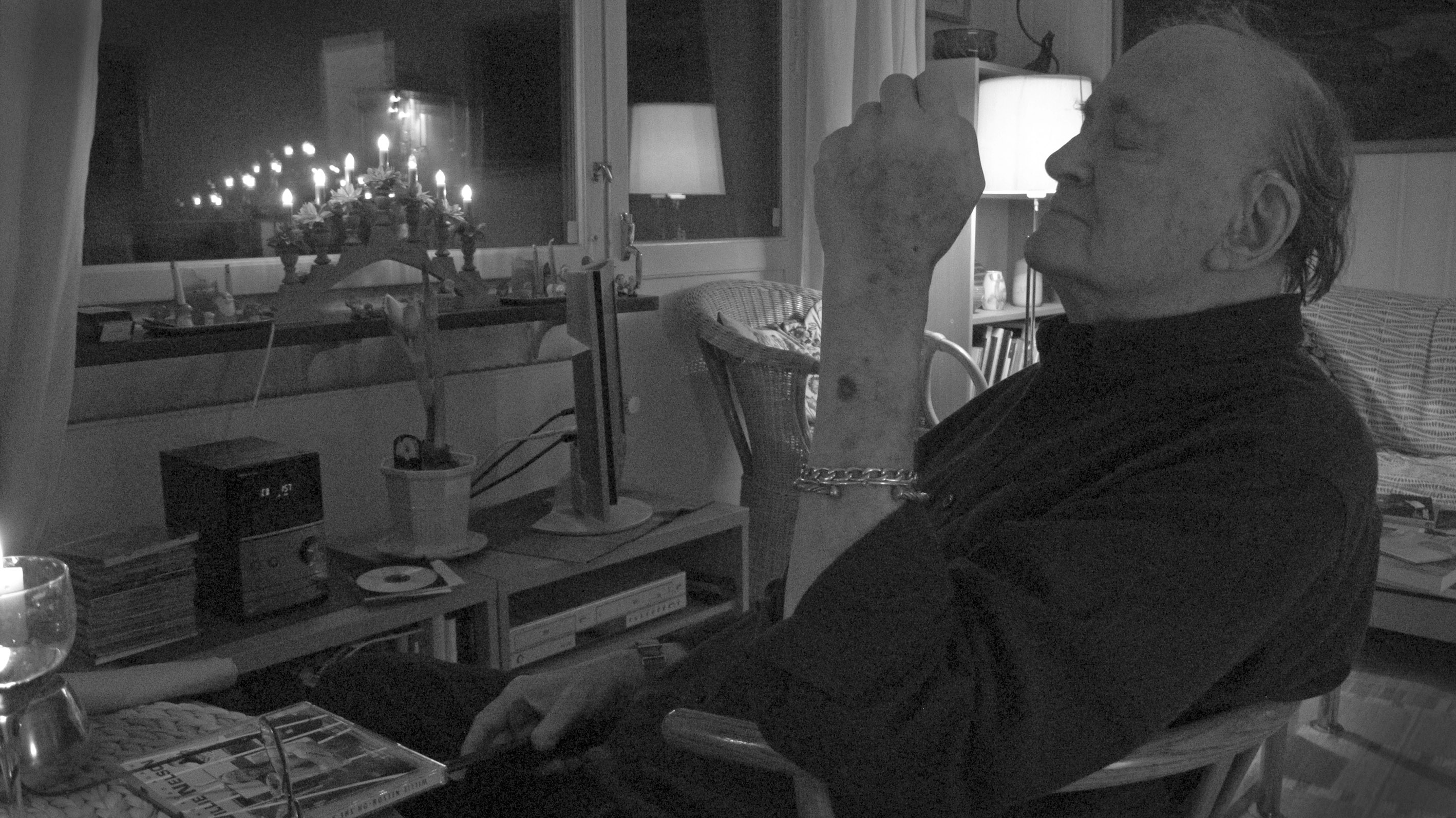
Sam, Årsta, Jan 8th, 2015, listening to Willie Nelson singing Steve Fromholz’s “I’d Have to be Crazy”.

Five Things Extra: Martin Stone

Photograph by Keith Morris

Photograph by Keith Morris

My favourite guitarist in the world is Mark Pringle, obvs, but – for the time he was active in the London scene in the late sixties and early seventies – Martin Stone ran him a close second. Many nights were spent nursing a pint of that horrible seventies’ version of an alcopop, lager & lime, at the Greyhound in Fulham and watching his band, Chilli Willi & The Red Hot Peppers. Not quite as mellow as Bees Make Honey, not quite as rocky as Head, Hands and Feet, not quite as threatening as Kilburn & The High Road, the Peppers were my favourite band of that period – they swung (Pete Thomas was the drummer), they had vim and attack (especially where Martin was concerned), they played great songs and they were funny (frontman Phil Lithman left to rejoin San Francisco avant wackos, The Residents). When he played something particularly wonderful Martin would peer from under his woolly hat and crack a mischievous smile. Now, Martin (who quit the music business and became an antiquarian book seller/scout) is ill and the NHS won’t fund his treatment as he lives in Paris. It’s time to partly pay him back for those nights when the Kings of the Robot Rhythms reigned over Balham’s Bongos – go to the Just Giving site here.

And here’s an excerpt from a vivid piece by Martin that I loved, written in tribute to a book collecting mentor (and I remember that flat in Cannon Street Road, too – Martin shared it with the aforementioned M. Pringle):

“I first met Peter at the Olympia Bookfair in the late 1970s; he had a table of James Joyce in absolutely marvelous condition, many of them inscribed. I stood there hypnotised. I was new to the game, working the coal face of the book trade, a bottom-feeding outsider. I had never seen books like these; a first edition of Joyce’s Dubliners, brand-new in dust-jacket, that had never been tipped out of a sack at five in the morning in Brick Lane market.

Peter peered down at me with avuncular concern. “Stay well away from Joyce,” he said. “He’s a nightmare to buy and sell.”

He said he’d like to see my books and I gave him my address and phone number. He ignored the phone, and sometime after midnight there was a rapping at my window.

“Fuck off,” I yelled. My home was in Whitechapel; bad people sometimes tried to get in under cover of darkness.

“Now, now, Martin, it’s Peter Howard and I’m here to buy your books.”

A fellow member of the 24-hour club. I hid the cocaine and let him in.

He pointed at the far wall of my storeroom. “What are all those?”

“Minor Edwardian and Victorian fiction.”

“There’s no such thing as minor.”

“Er, no, of course not… I mean, I rather like them all really.”

“How much for the wall?”

I was checkmated; it was the first time I’d encountered the omnivore approach to book buying.

“Well, some of them are a bit more but mostly they’re about two pounds each.”

“Why can’t they be more, Martin?”

No book dealer had ever asked me that question, either.”

Some Kind of 2014: What I Learned…

Bruce Springsteen has really good taste in music books
New York Times Book Review: What are the best books about music you’ve read?
Bruce Springsteen: “At the top of my list remains Greil Marcus’s Mystery Train, followed closely by Peter Guralnick’s Last Train to Memphis. I’d include Dylan’s Chronicles and a recent book by Daniel Lanois, Soul Mining, that gives insights into the making of music I found unique from any other book out there. Sonata for Jukebox, by Geoffrey O’Brien, has some lovely chapters in it, particularly its opening discussions of Burt Bacharach’s career.

So I read “Soul Mining”. And Bruce is right…
Notwithstanding my ambivalent view of Dan the Man (and the book has plenty of odd-slash-annoying tributaries that slow it down) the chapters on recording sessions are totally fascinating, and he is such an enthusiastic and expressionistic describer of the creative process that I was willing to forgive a lot. Anyone who can reference both Sly’s “In Time” and Link Wray’s “Fire and Brimstone” in a discussion on what a drummer needs to know is alright by me. One is a drum machine made to play like three drummers, the other seems to be people hitting suitcases and mason jars. Both great.

A couple of excerpts: The Neville Brothers Yellow Moon: “I loved having Eno around with his nonstop stream of sonics. The Nevilles were very curious about him. At an impressed moment, Art Neville leaned over to me, pointed to Eno, and whispered in my ear: “Where did you find this cat?” Art was so impressed that he paid him the greatest compliment, “That’s some cold-blooded shit”. Art knew what he was talking about. Check out his hit from the fifties called “Mardi-Gras Mambo” – definite soul, with a kick-ass sax solo, tone big as a house.”

The one-point source: “I was recently impressed by a Blind Willie Johnson recording… it gave me the sensation of a one-point source. It felt like I was standing in front of him, rather than listening to him. There was a darkness in the guitar, a warble in the voice, but the two ingredients had unity. I believe the human ear finds comfort in these more snapshotlike technically non-complex recordings, like the human eye finds comfort in a movie scene shot with one camera.A recent visit to a friend’s restaurant reinforced this… He couldn’t afford a big sound system, and so only had a small blaster on his open kitchen counter. A lack of funds might have led to a stroke of genius. The cook got to be the DJ – the cook, who is obviously in tune with the action of the room…” Later he talks about plugging both his and Dylan’s guitars into one amp, a small Vox, and how musical the resulting blend was. “The one-point source is a musical friend. If rock ’n’ roll was meant to be spontaneous, perhaps options are the enemy.”

By law, all adverts now come with pop soundtracks
The best ones made you listen again to great music: Chanel’s bonkers Coco ad had Kiera Knightley dispensing tester bottles at a Sixties Black & White party before disappearing and then reappearing in a speedboat under a bridge, all to the Zombies’ timeless “She’s Not There”; Suzuki put James Brown’s “I Want You So Bad” to work, following their previous use of Screamin’ Jay Hawkins “I Put a Spell on You”. And in a newly-recorded and distressed version, “You’re the One that I Want” in an even more mad Chanel ad – Surfer mom, directed by Baz Luhrmann, with Gisele Bündchen, music by Lo Fang. Ludicrous.

Owe Thörnqvist is still going strong

Sept 24 Owe
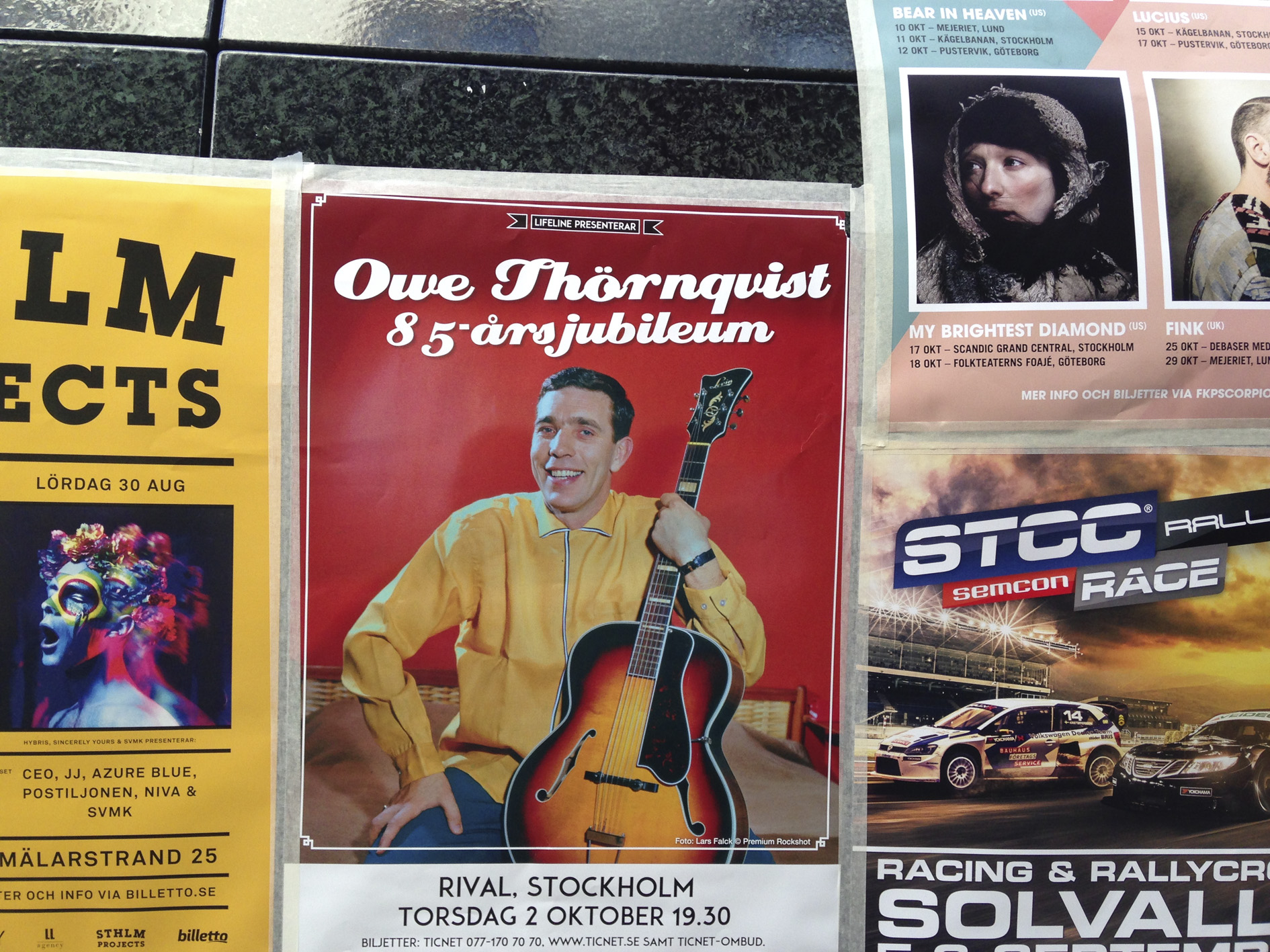
I love this poster for his 85th celebrations, pasted up around Stockholm. I researched Owe, and found that he is an 86-year-old Swedish troubadour. Go, Wikipedia, Go! “In 1955, Thörnqvist released his first record. His musical style spans over both rock, rumba and calypso; his texts are characterised by word play and humour. Thörnqvist was one of the first people to do stand-up comedy in Stockholm in the 1950s. In 1963, Thörnqvist provided guest vocals and performed the song “Wilma” on the Flintstones episode The Swedish Visitors. In 2004, Thörnqvist received The King’s Medal in the 8th size for his many contributions to Swedish culture as a songwriter, singer and composer.”  He looks so happy. I wonder what the King’s Medal in its 8th size is, and what you need to do to get, say, the 5th size?

Lana Del Ray is the most interesting vocalist working in mainstream popular music
I may have been an early adopter here. I loved “Video Games” long before it became the most played and played-out song of 2013, issuing from any radio or shop that you walked past. I think that Ultraviolence may be my favourite pop album of 2014. There’s so much going on here… she’s a tremulous fifties-grained vamp in “Shades Of Cool”, her voice swirled into the sandpapered-cinema strings-reverb of Dan Auerbach’s genius production. She’s funny, too, playing up to a critics’ view of her in “Brooklyn Baby” (or maybe it’s just a diss to Brooklyn) “Well, my boyfriend’s in a band/He plays guitar while I sing Lou Reed/I’ve got feathers in my hair/I get down to Beat poetry”. Whatever, it doesn’t matter. What matters is the extraordinary widescreen use of her voice, multi-tracked over scrubby Nancy Sinatra guitars and ghostly strings. And she swears better than most people – check out the way she sings this refrain… “You never liked the way I said it/If you don’t get it, then forget it/So I don’t have to fucking explain it…” The woozy change time verse/chorus on “West Coast”, flipping the dial from surf rock to Fleetwood-Mac-at-a-narcotised-crawl is just wondrous. Hey, don’t worry, I know I won’t get many takers for this view…

And what I learned this year (in pictures):

Ukeleles always sound good outdoors (here, the Ukelele Orchestra of Great Britain seen at the Walthamstow Festival)

EOY Ukes

My mum’s recall of First World War songs was excellent (At the Royal Academy of Music Exhibition)

EOY Bette

Dylan Thomas’s poetry sounds best when read by a Welsh Shepherd in Fitzroy Square (in a Shepherd’s hut, with sheep, natch)

Fitzroy Shepherds

It’s really nice to discuss the work of Bob Dylan in the South of France (here, the view from Michael Gray’s house, looking not unlike a recent Bob painting).

IMG_4712

If you’re invited to a Private View, don’t arrive at the end of the evening
At Jonny Hannah’s I arrived for the last number of Sandy Dillon and Ray Majors’ set, which sounded impressively bayou in tone. Catching up with them afterwards we talked of the strange machinations of the music business, and Sandy’s incredible homemade electric keyboard/thumb Piano, dubbed The Thing.

Sandy

Timing is key to junk shop finds
I managed to wander past this one – with its potentially rare guitars – when they were closed, and we were about to leave town. So these two in Truro, one a Stella, sadly got away…

Mimi’s Phone_20141114_004

Five Things Extra! Blake Mills at Bush Hall

BM

First thing I wanna say: Alabama Shakes are in good hands. The producer of their second album, due soon, is on stage at Bush Hall tonight and is, second song in, playing Joe Tex’s “I’ll Never Do You Wrong” up a storm, his unfettered guitar slashing out a solo that is terrifyingly “backwoodsy”. He isn’t going to lose the Shakes spontaneity, that’s for sure. His Coodercaster-style guitar has a pickup that sounds like a swarm of bees, apposite considering Joe’s wonderful lyrics for that song (“And if I ever make you cry/Baby, I hope a fly alight on my pie/I hope a bee sting me over my eye”), but his syncopated style puts me most in mind of Lowell George, another great songwriter/guitarist with an unusually broad musical worldview. Seated for the whole gig, Mills would often take delight in a particular phrase and caress it again and again, smiling to himself all the while, especially when leading the band to the brink of a canyon of noise, to only let it all fall away, opening up a cavernous gap filled only by the sound of reverb throbbing its way into the distance…

At various points you could say Manuel Galban or Les Paul, or, I don’t know, Dick Dale, Chet Atkins, Eddie Lang and Lonnie Johnson. I’m not trying to pigeonhole, just trying to get a little of the flavour of someone who – combining great taste with an experimentalist’s bravado – takes the audience (which tonight includes Don Was and Marcus Mumford) on a sonic tour of all the places a guitar can go. Some songs sound beamed in from the mazy dreamscape of an American midnight, where you hear the gaps between the radio stations and the signal comes and goes. Others (the “Who Do You Love” riff, bludgeoned – thrillingly – for about six minutes) show that taking the volume control down to one doesn’t negate his love of turning it up to 11. Oh, and I’ve never seen a performer hit his guitar as much as Mills, either thumping the upper bout or wrenching the body back from the neck for a little improvised tremolo.

With a fine rhythm section of Stuart Johnson, on a kit that includes an enormous Marching Bass Drum and – I think – no hi-hat, and Sebastian Steinberg on deep, deep bass, with Tyler Chester on vintage keys (Chamberlin, Mellotron and Wurlitzer) the music could flip between a swampy ZZ Top boogie and a wistful Randy Newman vibe with ease. The switches in tone  were jagged and dramatic, but they always made sense. Fiona Apple joined in for a suitably gothic/gospel version of Conway Twitty and Jack Nance’s “It’s Only Make Believe” and a couple of the songs that she sings on Mills’ new album, Heigh Ho. After an audience meltdown brought them back for an encore, we were treated to an extraordinary cover of Lonnie Johnson’s “Tomorrow Night” that was part-Elvis, part-Twin Peaks (it owed a lot to Chester’s fifties sci-fi soundtrack organ). In a burnished croon, head flung back and eyes closed, Blake Mills sang it to the rafters, and then soloed with a hushed, dampened series of semi-atonal Les Paul phrases. I realised that for most of the gig I had been leaning forward, not to watch his fingers, but because the music somehow demanded it.

The are some good videos online, but nothing really replaces sitting twenty yards from his amplifiers. Fretboard Journal has a fascinating hour-long interview here.

Five Things Extra! Iceland

Iceland, Early May
The size of England, the population of Bromley. And 90% live in one city, Reykjavik. So we set off to the wilds and discover many an isolated church (all with harmoniums), beer made from icebergs and the cafe where the cover of John Grants’ Pale Green Ghosts was shot.

1 Airport Liquor Store/Strange cafe menu
Bjork, of course, means Birch.

I-Birch

2 Harmonium in a house at the Icelandic Folk Museum
Right next to the extraordinary Skogafoss waterfall. Tourism is great in Iceland. At most sites of natural beauty they put some wooden posts in the ground to denote a car park. That’s it. No toilets, wastebins (take it with you, folks!), concessions, ticket booths. Then you’re free to wander into the waterfall. Health and Safety, you say? Nei. btw, the harmonium worked perfectly, sounded great.

i-Harmonium

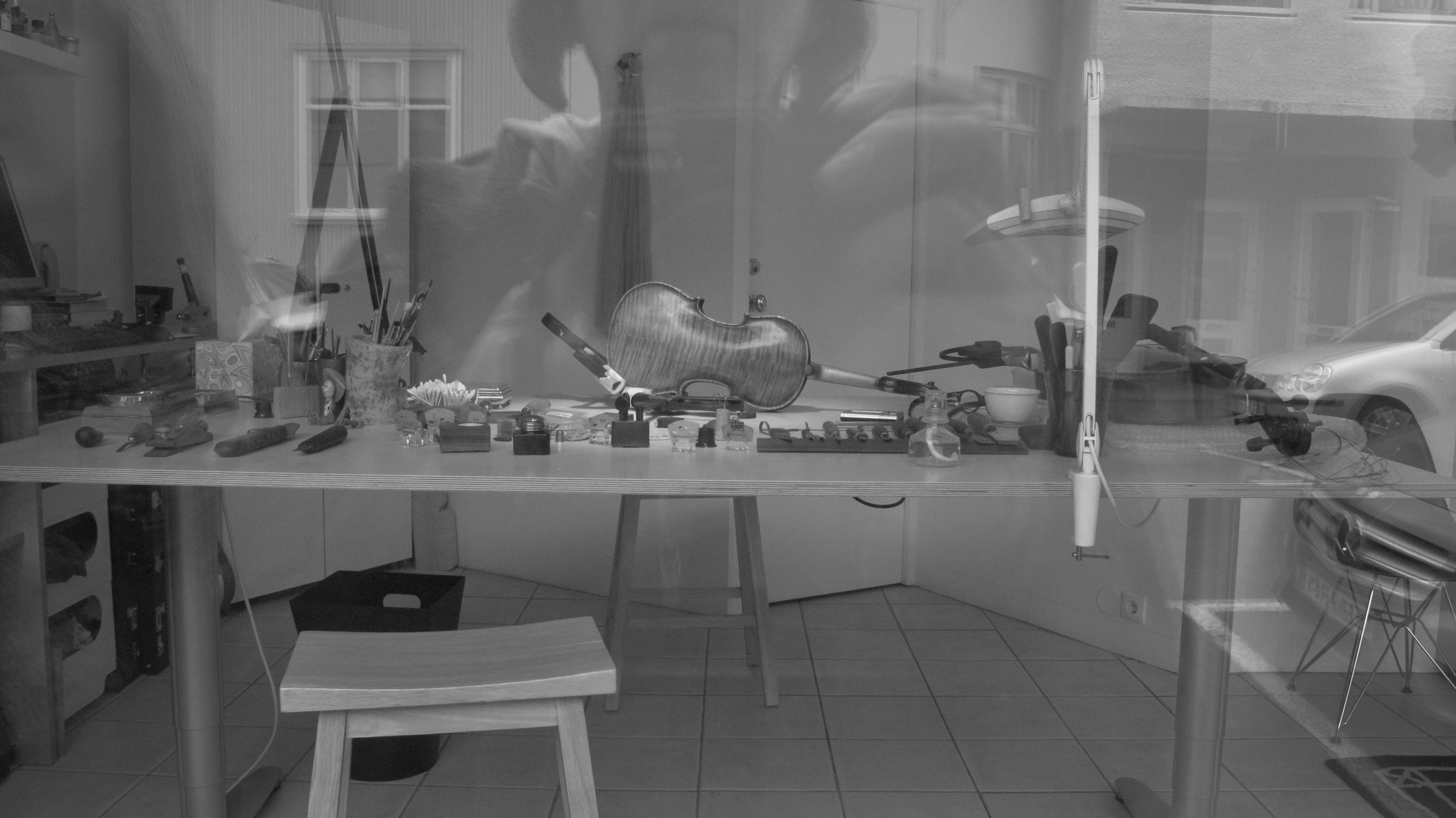
3 Violin Workshop, Reykjavik
A wall of violins (with a Pinocchio puppet, too) hang just out of shot in this rather lovely glass-fronted work space.

i-violin

4 Dyngja guesthouse, Höfn
Höfn is on the eastern edge of Europe’s largest glacier, Vatnajökull, but that doesn’t mean they don’t have full access to Sergio Mendes records, as we discovered when the hotel owner’s son gave us the keys and pointed out this stereogram and his dad’s 70’s record collection, and left us to our own devices. Fuelled by langoustines and glacial beer we disturbed the sleep of the other occupants of the guesthouse with a hit parade consisting of Boston (“More Than A Feeling”), Arlo Guthrie, Stan Getz, America (“Horse With No Name” from History, worst album cover illustration ever), and, of course, Brasil ’66, getting us in the mood for this summer.

i-Sergio

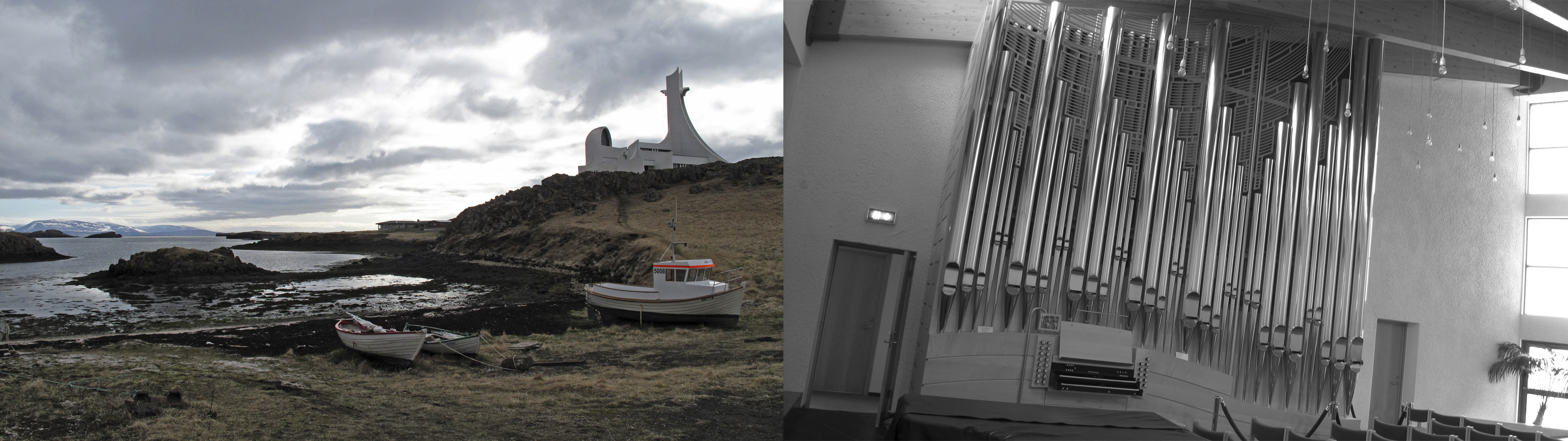
5 Stunning modern nautical church, Stykkishólmur, Snæfellsnes Peninsula.
Featuring an unbelievable new organ. Sadly not heard.

i-Church-Organ

And finally…
back in Reykjavik, to the Mokka-Kaffi, serving espresso since 1958, and lately location to John Grant’s album cover. They’re so cool that they don’t even have a copy of the album anywhere, and our internet was patchy so we couldn’t even google a copy of it. I was rather annoyingly insisting we recreate it, so we had to wait until a table was free and rely on my flawed memory. Marcel did an excellent job getting the right feel with Hipstamatic, though.

I-Mokka copy